
Invest 30 seconds...
...for what may lead to a life altering association!
Help Line
- +91.8800.2828.00 (IND)
- 1030-1830 Hrs IST, Mon-Sat
- support@expertsglobal.com
33% off ends soon:GMAT/GRE prep + applications bundle. Profile building, longer mentoring, better results. Inquire

Venn diagrams help you organize overlapping sets by placing each group into a clear visual structure. When sets share members, a Venn diagram helps you track what belongs only to one set, what belongs to both, and how the totals connect. This simple visual approach supports layered GRE Quant questions where careful counting and clean organization lead to accurate results.
The following video, part of our GRE prep online course, explains Venn diagrams for overlapping sets in a clear, structured, and beginner friendly manner. It shows how to build the diagram step by step, how to place values in the right regions, and how to keep totals consistent. The video then applies the method on GRE-style problems so you experience the application first-hand. Use this learning steadily across your GRE prep, practice exercises, GRE sectional mocks, and GRE mocks.
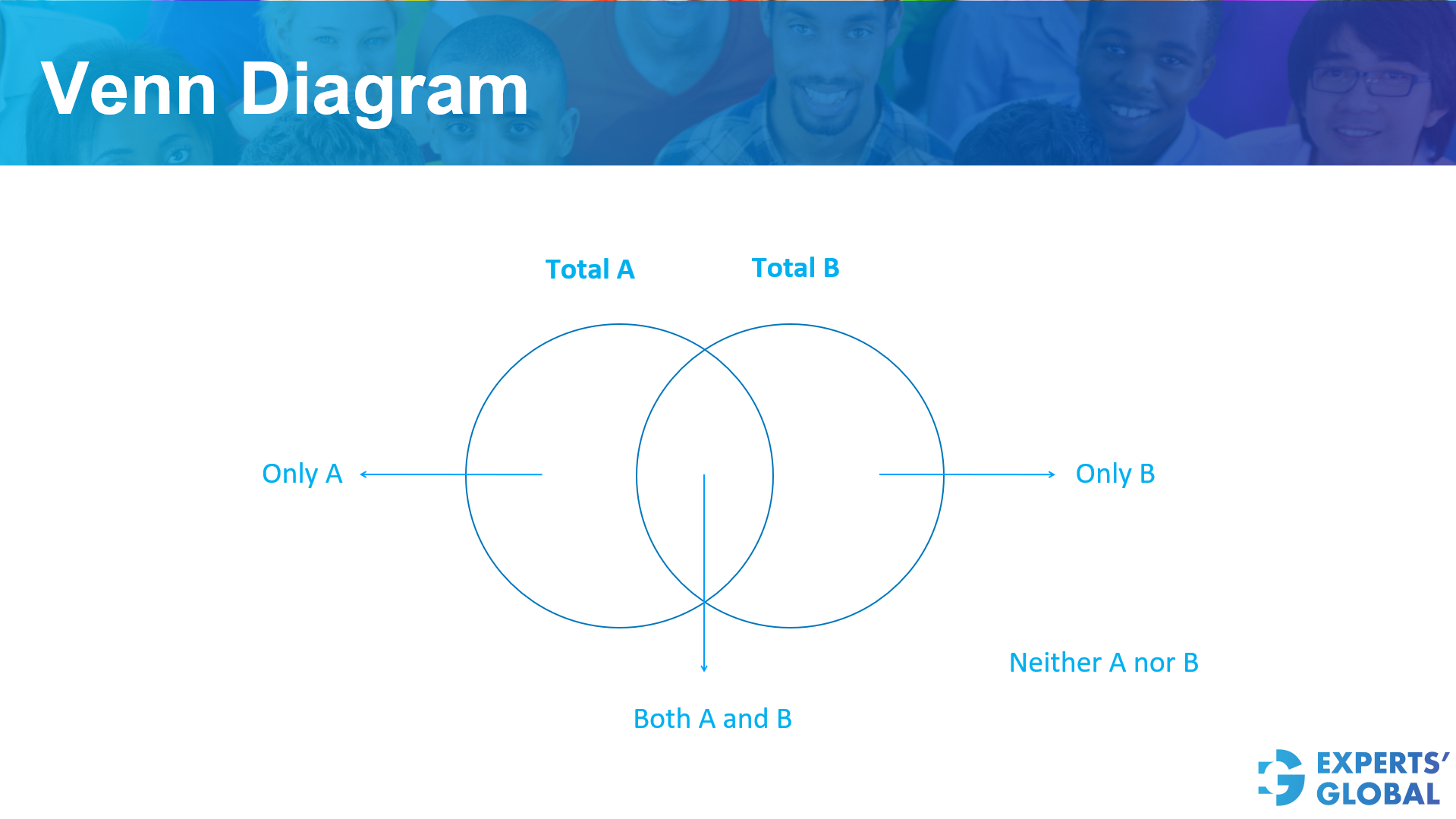
A Venn diagram is a visual tool used to represent the relationships between two sets, labeled here as A and B. It breaks down data into distinct categories based on membership in these sets:
The entire group belonging to set A, including those that also belong to B.
The entire group belonging to set B, including those that also belong to A.
The portion of set A that does not overlap with set B.
The portion of set B that does not overlap with set A.
The intersection where members belong to both sets simultaneously.
The area outside of both circles, representing members that do not belong to either set.
In a typical mathematical context, the relationship between these parts is defined by the following logic: Total = (Only A) + (Only B) + (Both A and B) + (Neither A nor B).
Correct Answers
Both: 60
Exactly one of the two: 50
Only Soccer: 10
Only Cricket: 40
At least one of the two: 110
For a detailed explanation, please refer to the video presented earlier on this page.
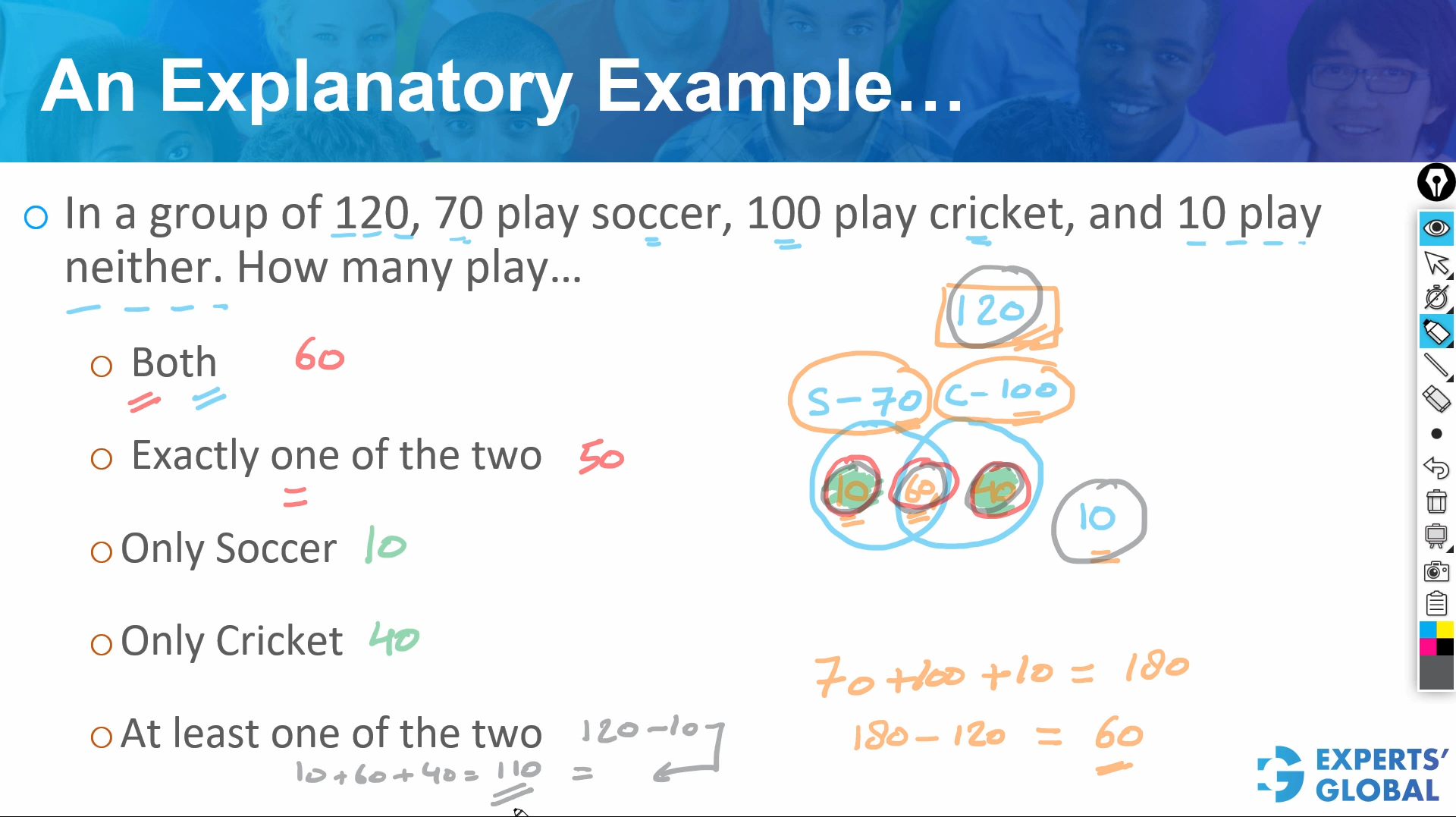
For visual illustration, here is a snapshot from the video…
Following is a concise, step-wise written explanation…
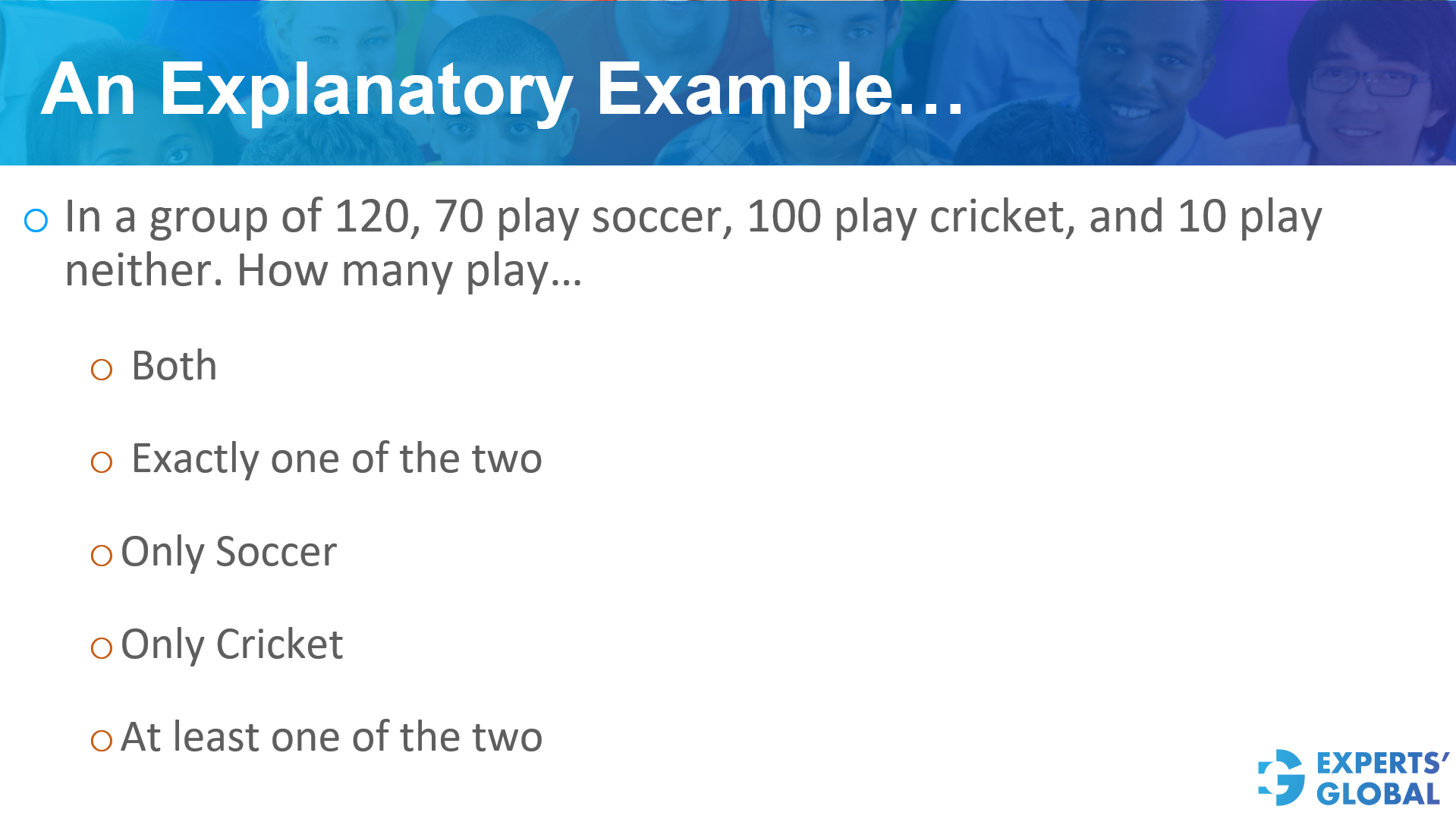
In a group of 120, 70 play soccer, 100 play cricket, and 10 play neither. How many play…
The total group is 120. If 10 people play neither sport, then the number of people who play at least one sport is 120 – 10 = 110.
If we add the soccer players (70) and cricket players (100), we get 170. Since there are only 110 players in total, the extra people must be counted in both groups. 170 – 110 = 60. Both = 60
Correct Answers
Both: 60
Exactly one of the two: 50
Only Soccer: 10
Only Cricket: 40
At least one of the two: 110
Answers
Neither: 5
Exactly one of the two: 60
Only Soccer: 15
Only Cricket: 45
At least one of the two: 115
For a detailed explanation, please refer to the video presented earlier on this page.
For visual illustration, here is a snapshot from the video…
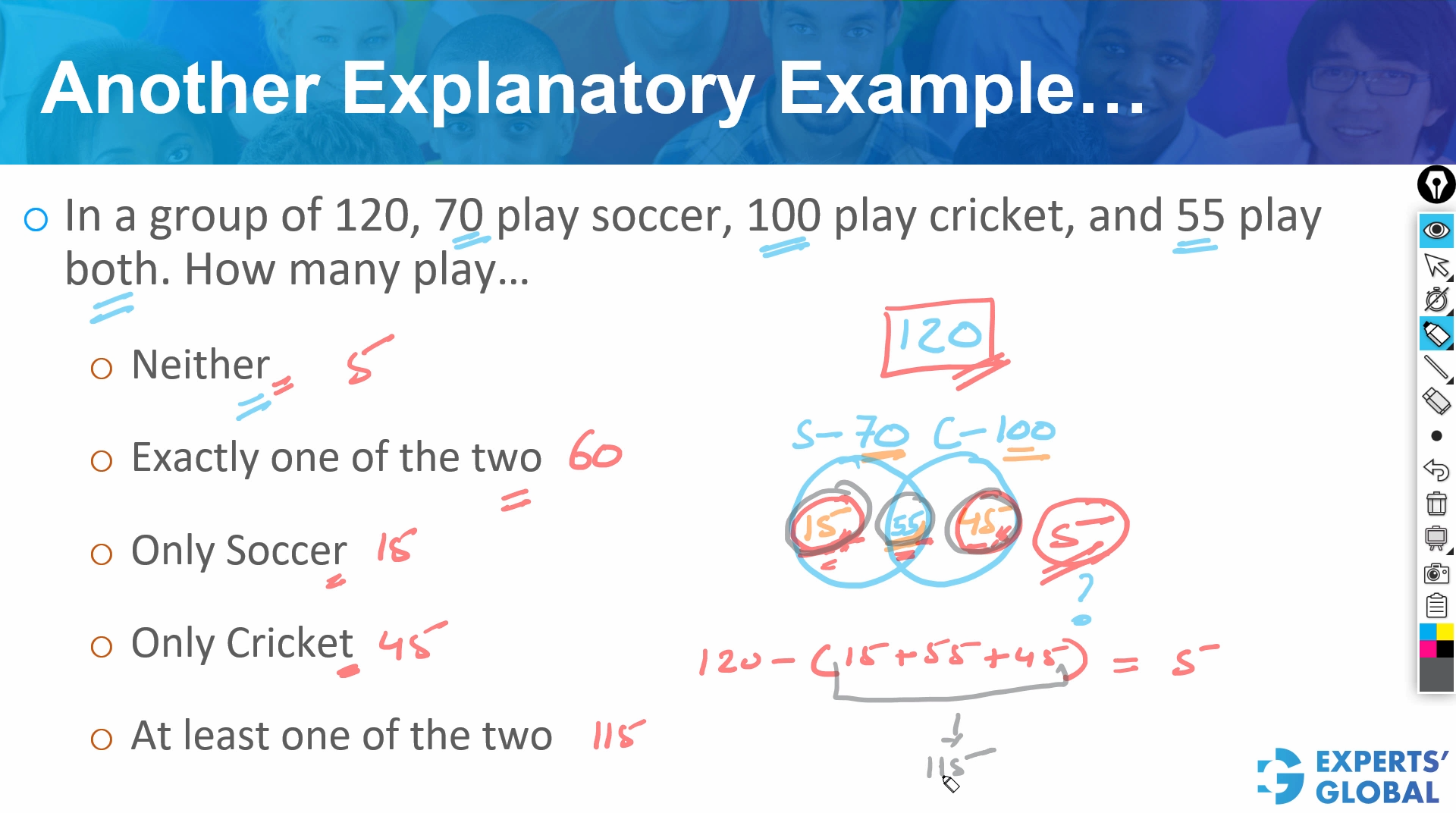
Following is a concise, step-wise written explanation…
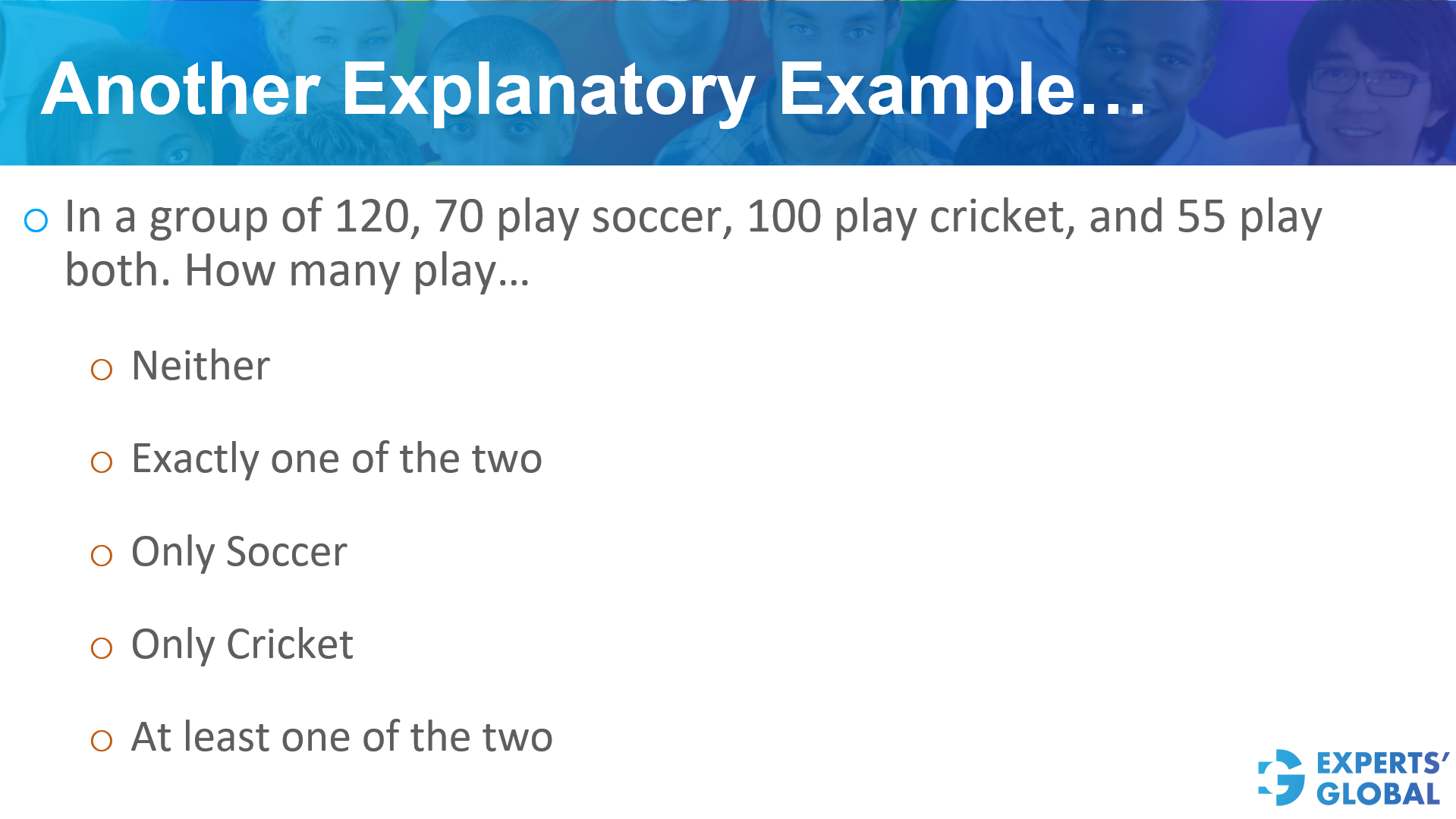
In a group of 120, 70 play soccer, 100 play cricket, and 55 play both. How many play:
Total people = 120
Soccer (Total) = 70
Cricket (Total) = 100
Both = 55
Only Soccer = Total Soccer minus Both = 70 – 55 = 15
Only Cricket = Total Cricket minus Both = 100 – 55 = 45
Exactly one of the two = Only Soccer plus Only Cricket = 15 + 45 = 60
At least one of the two = Only Soccer plus Only Cricket plus Both = 15 + 45 + 55 = 115
Neither = Total people minus At least one = 120 – 115 = 5
Answers
Neither: 5
Exactly one of the two: 60
Only Soccer: 15
Only Cricket: 45
At least one of the two: 115
Correct Answer: C.
The two quantities are equal.
For a detailed explanation, please refer to the video presented earlier on this page.
Following is a concise, step-wise written explanation…
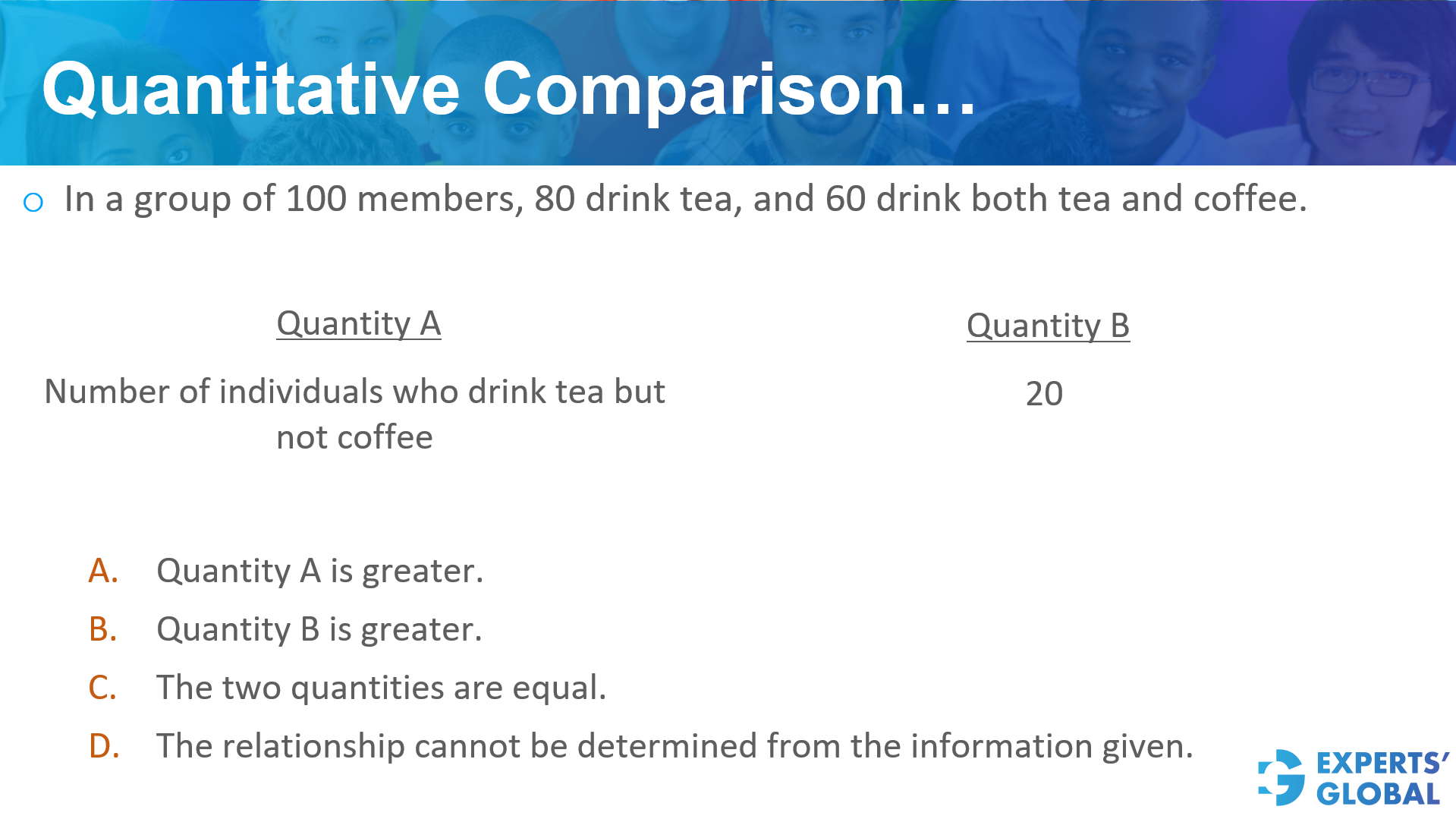
In a group of 100 members, 80 drink tea, and 60 drink both tea and coffee.
Quantity A
Number of individuals who drink tea but not coffee
Quantity B
20
Correct Answer: C
The two quantities are equal.
Correct Answer: C
The two quantities are equal.
For a detailed explanation, please refer to the video presented earlier on this page.
Following is a concise, step-wise written explanation…
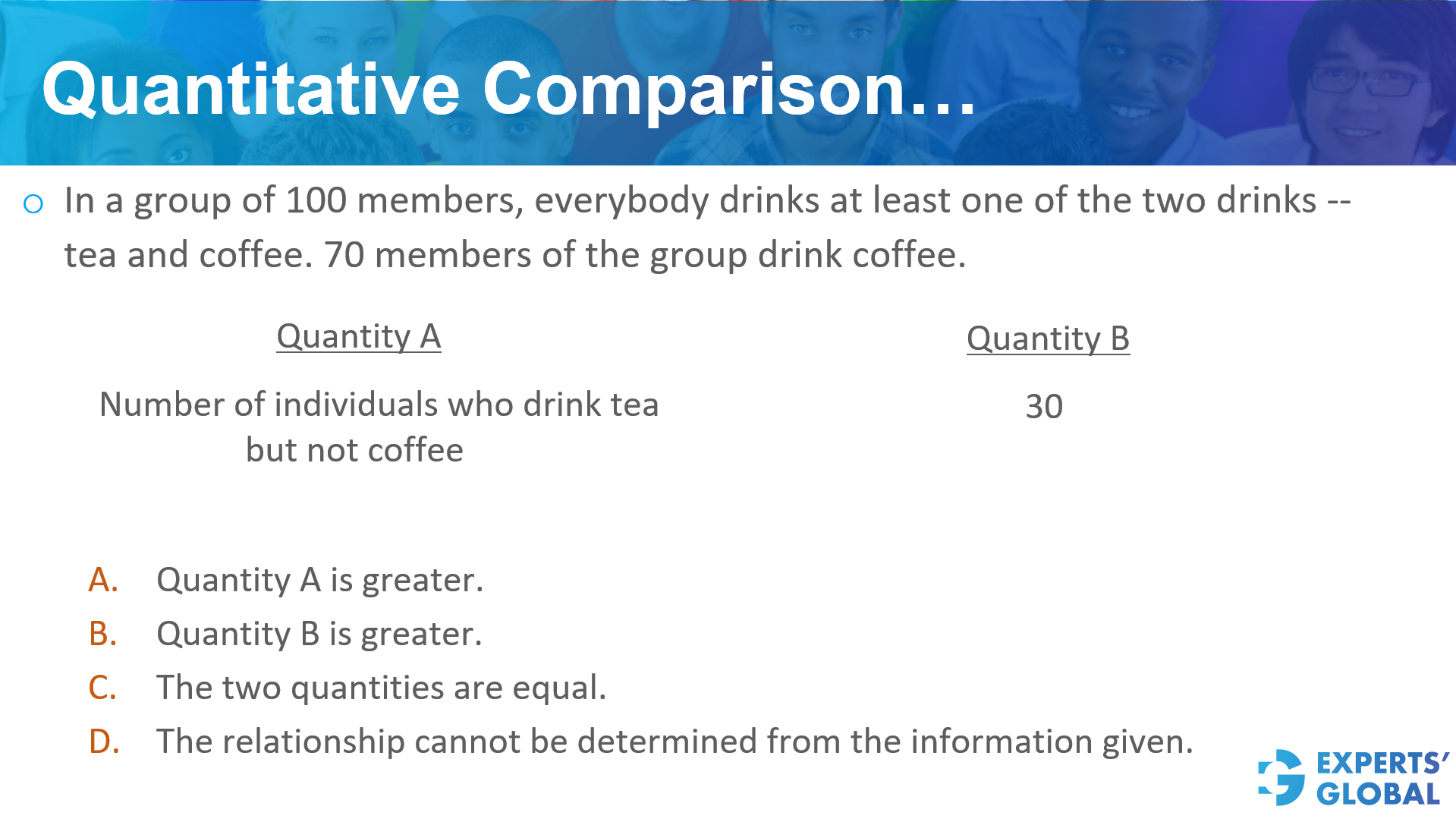
In a group of 100 members, everybody drinks at least one of the two drinks — tea and coffee. 70 members of the group drink coffee.
Quantity A
Number of individuals who drink tea but not coffee
Quantity B
30
Correct Answer: C
The two quantities are equal.
Correct Answer: 20
For a detailed explanation, please refer to the video presented earlier on this page.
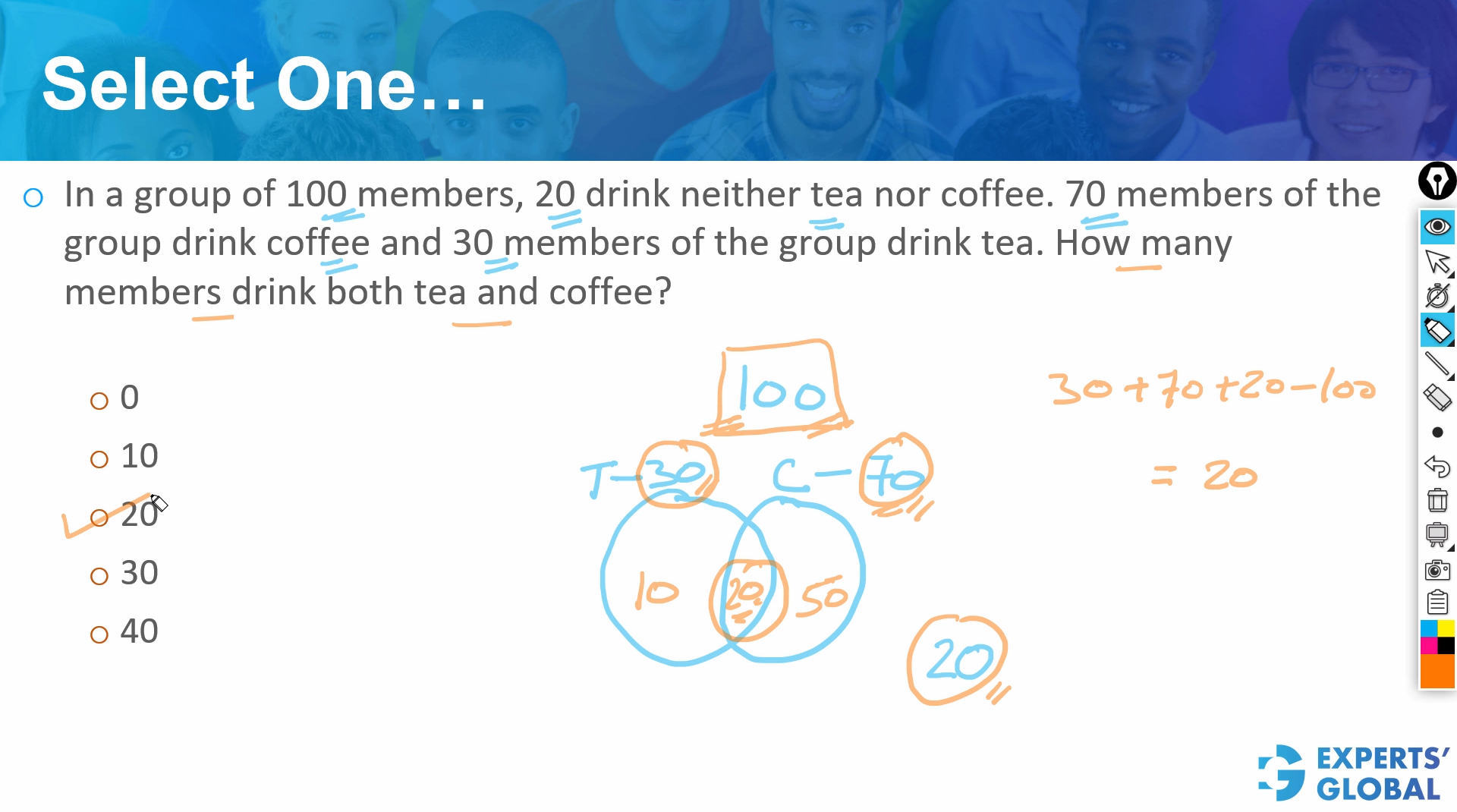
For visual illustration, here is a snapshot from the video…
Following is a concise, step-wise written explanation…
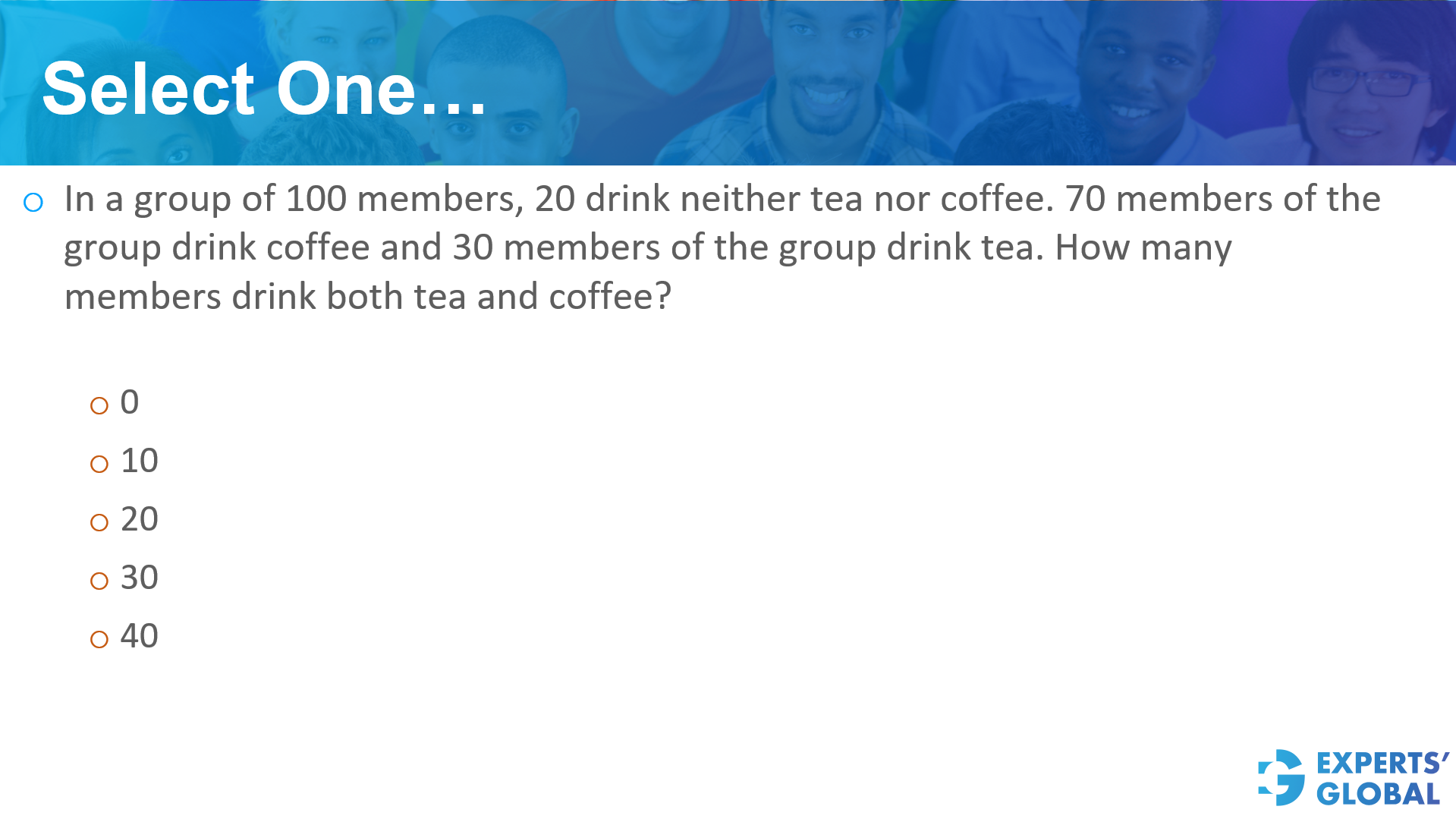
In a group of 100 members, 20 drink neither tea nor coffee. 70 members of the group drink coffee and 30 members of the group drink tea. How many members drink both tea and coffee?
Subtract the people who drink neither from the total group. Total members = 100 Neither = 20 People who drink tea, coffee, or both = 100 – 20 = 80
Coffee drinkers = 70 Tea drinkers = 30 Sum = 70 + 30 = 100
The sum (100) is higher than the actual number of drinkers (80) because the people who drink both were counted twice. Both = Sum of individuals – Total drinkers Both = 100 – 80 = 20
Correct Answer: 20
Correct Answer: 80
For a detailed explanation, please refer to the video presented earlier on this page.
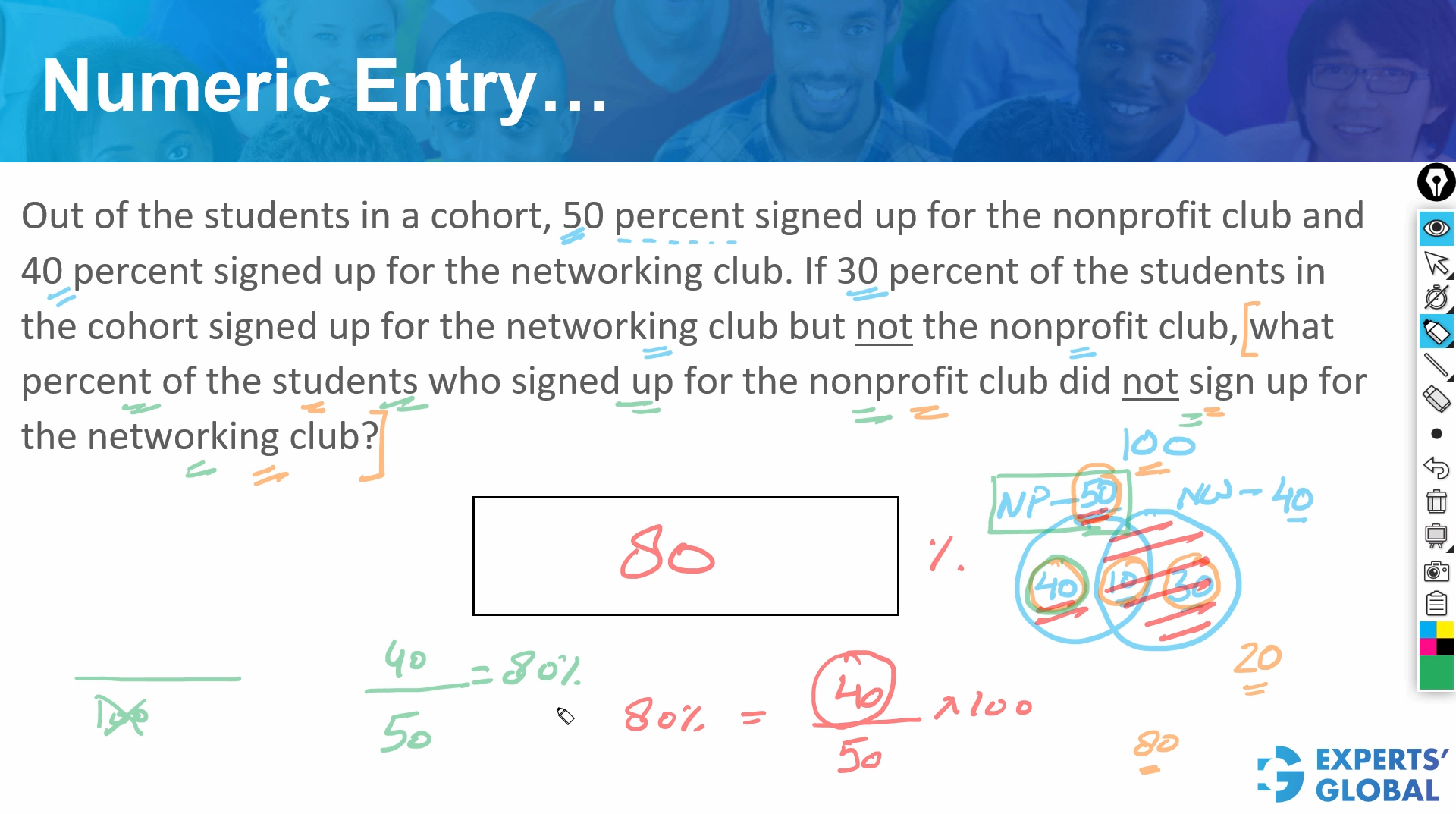
For visual illustration, here is a snapshot from the video…
Following is a concise, step-wise written explanation…
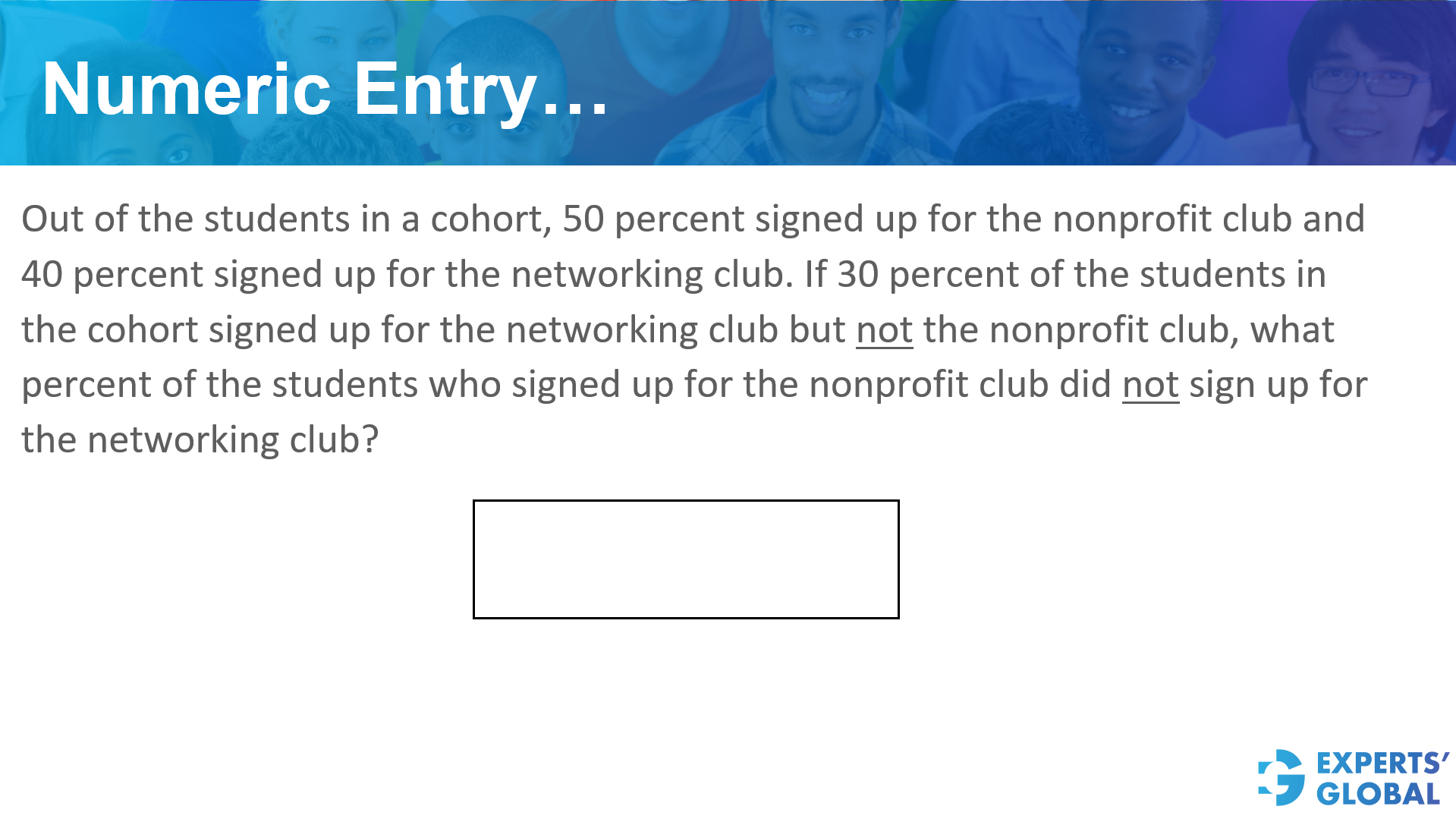
Out of the students in a cohort, 50 percent signed up for the nonprofit club and 40 percent signed up for the networking club. If 30 percent of the students in the cohort signed up for the networking club but not the nonprofit club, what percent of the students who signed up for the nonprofit club did not sign up for the networking club?
Assume the total number of students in the cohort is 100.
The problem states that 30 percent of the cohort (30 students) are in Networking but NOT in Nonprofit.
The question asks for the percent of the Nonprofit club members who did not join the Networking club.
Correct Answer: 80
All-inclusive GRE prep course online
Free full-length GRE diagnostic mock
15 full length GRE practice tests
