
Invest 30 seconds...
...for what may lead to a life altering association!
Help Line
- +91.8800.2828.00 (IND)
- 1030-1830 Hrs IST, Mon-Sat
- support@expertsglobal.com
33% off ends soon:GMAT/GRE prep + applications bundle. Profile building, longer mentoring, better results. Inquire

Text Completion questions usually make up about a quarter of the GRE Verbal section. This question type gives you a valuable chance to strengthen accuracy while also building speed, especially because Reading Comprehension and Text Completion two blank and three blank questions naturally require more time. When you learn to handle Text Completion efficiently, you create breathing room in your timing plan, which helps the entire Verbal section feel smoother and more balanced. With the right method and steady practice, many Text Completion questions can be solved faster, allowing you to carry that saved time into questions that need deeper reading and careful thought. For this reason, learning to save time on Text Completion should be an important part of a comprehensive GRE preparation course.
In this article, we walk through practical techniques for saving time on GRE Text Completion questions. The video that follows explains these techniques clearly and shows how to apply them using GRE style examples. Watch the video with care, then read the article that follows to absorb each idea at a comfortable pace. After that, apply these learnings during your regular practice and full-length GRE mocks, so the approach becomes natural and supports you smoothly on test day.
When you approach Text Completion questions, focus on meaning rather than getting caught up in complex-looking proper nouns. Sentences may include historical references, names of empires, groups, or numerical details, but the key is that they still contain a single blank within a complete thought. Although proper nouns might seem intimidating, they rarely control the logic of the sentence. Instead, pay attention to the structure of the sentence and the words around the blank to understand how the idea develops. Look for clear structural clues in the relationships between ideas, rather than the names themselves. By focusing on context and logical flow, you’ll be able to identify the correct word, even when the sentence contains dense or unfamiliar proper nouns.
For a detailed explanation for examples on the slide, please refer to the video featured earlier on this page. Following is step-by-step written explanation.
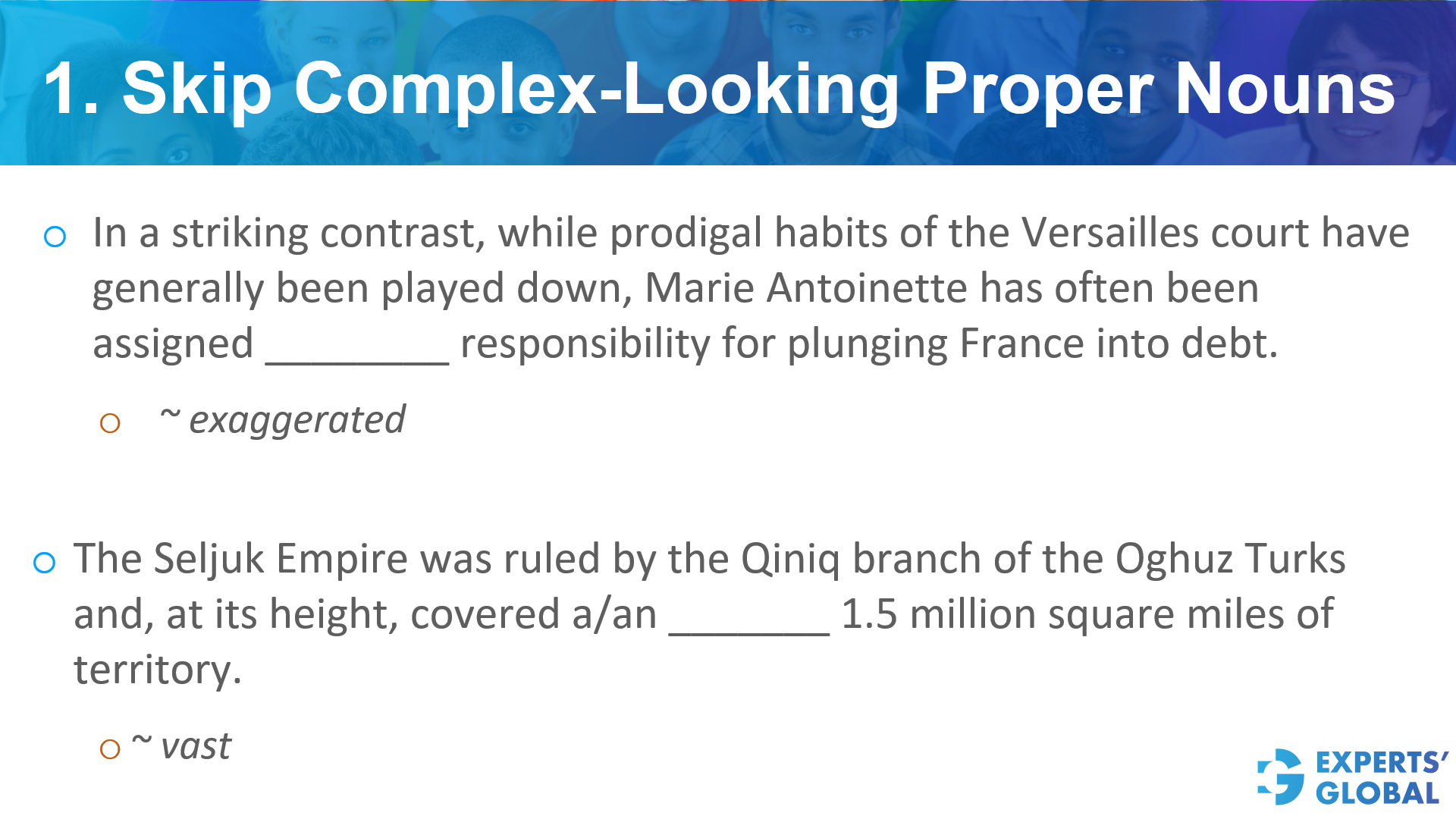
In a striking contrast, while prodigal habits of the Versailles court have generally been played down, Marie Antoinette has often been assigned __________ responsibility for plunging France into debt.
The Answer: A word like exaggerated fits perfectly here.
The Seljuk Empire was ruled by the Qiniq branch of the Oghuz Turks and, at its height, covered a/an __________ 1.5 million square miles of territory.
The Answer: A word like vast is the perfect fit.
Sometimes sentences are filled with extra details that start with words like “on,” “from,” “to,” or “of.” These are called prepositional phrases. You can “run through” (or skim) them to find the main point faster.
For a detailed explanation for examples on the slide, please refer to the video featured earlier on this page. Following is step-by-step written explanation.
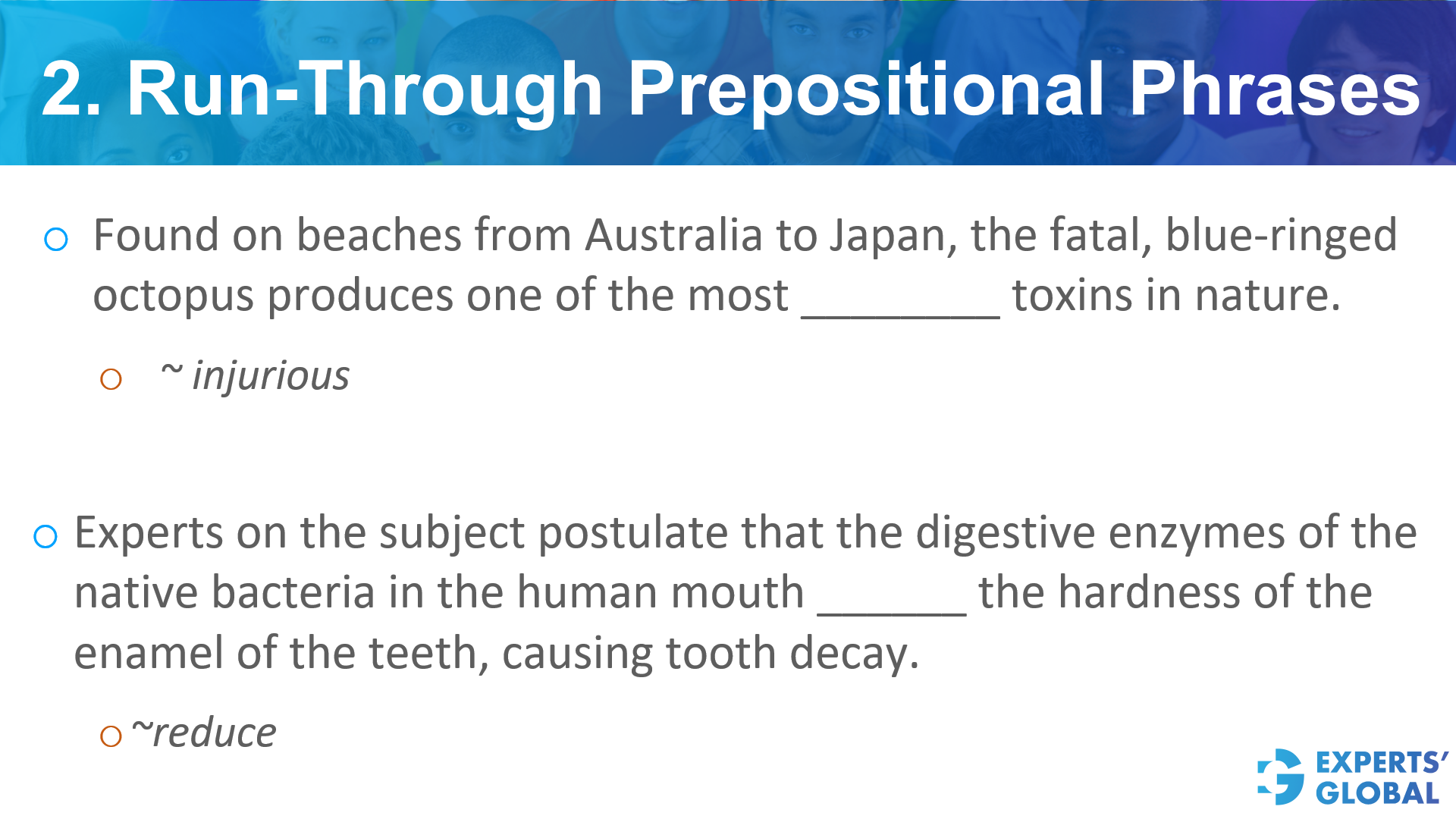
Found on beaches from Australia to Japan, the fatal, blue-ringed octopus produces one of the most __________ toxins in nature.
The Answer: ~ injurious
Experts on the subject postulate that the digestive enzymes of the native bacteria in the human mouth __________ the hardness of the enamel of the teeth, causing tooth decay.
The Answer: ~ reduce
Information placed between two commas is often just extra description. You can skim this text to quickly connect the main parts of the sentence.
For a detailed explanation for examples on the slide, please refer to the video featured earlier on this page. Following is step-by-step written explanation.
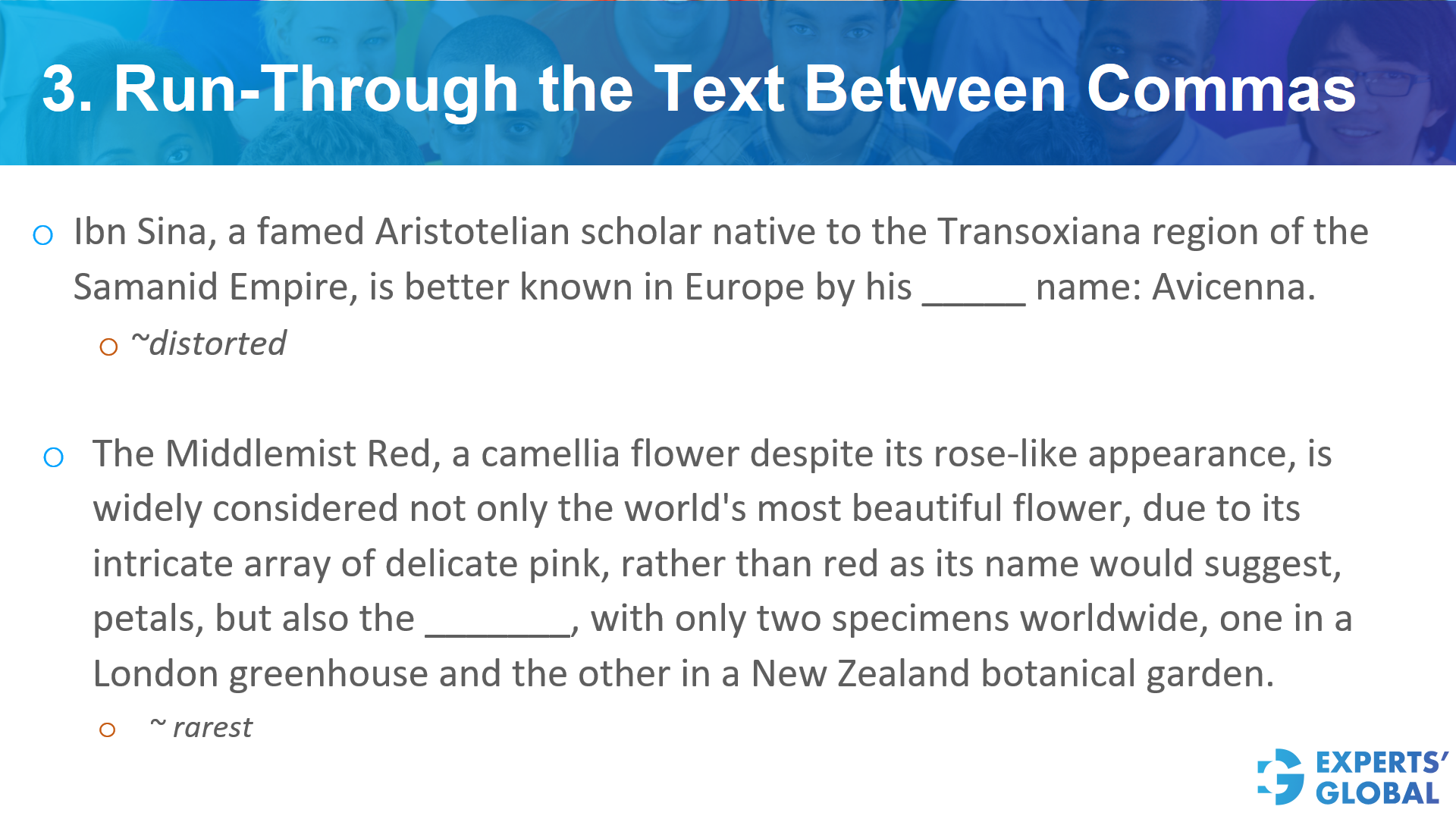
Ibn Sina, a famed Aristotelian scholar native to the Transoxiana region of the Samanid Empire, is better known in Europe by his __________ name: Avicenna.
The Answer: ~ distorted
The Middlemist Red, a camellia flower despite its rose-like appearance, is widely considered not only the world’s most beautiful flower, due to its intricate array of delicate pink, rather than red as its name would suggest, petals, but also the __________, with only two specimens worldwide, one in a London greenhouse and the other in a New Zealand botanical garden.
The Answer: ~ rarest
Specific names, dates, numeric data can be skimmed so you don’t get bogged down by technical details and your focus stays on the core meaning.
For a detailed explanation for examples on the slide, please refer to the video featured earlier on this page. Following is step-by-step written explanation.
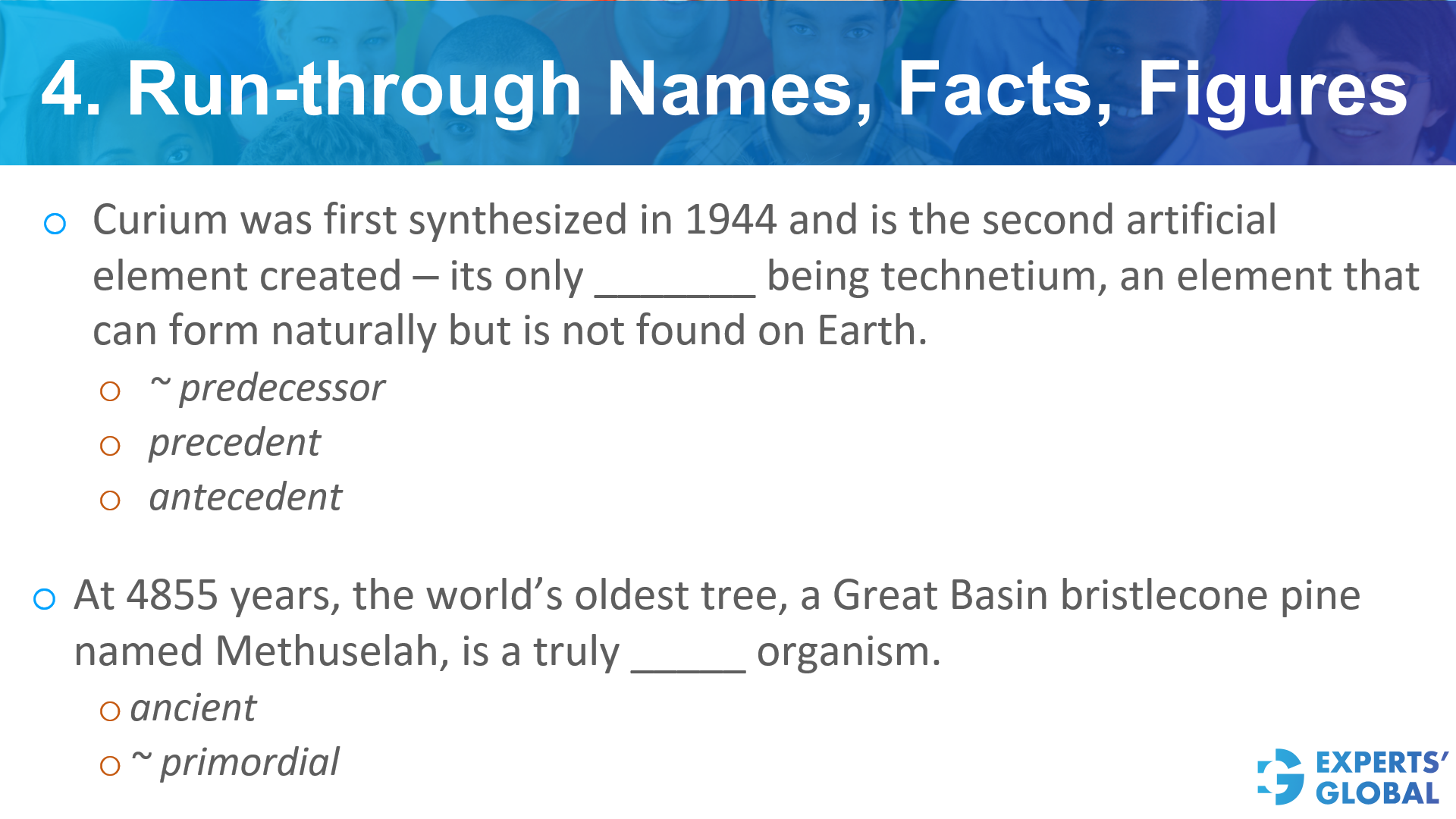
Curium was first synthesized in 1944 and is the second artificial element created — its only __________ being technetium, an element that can form naturally but is not found on Earth.
The Answer: ~ predecessor (Other options like precedent or antecedent are eliminated).
At 4855 years, the world’s oldest tree, a Great Basin bristlecone pine named Methuselah, is a truly __________ organism.
The Answer: ~ primordial (While ancient is good, primordial is a stronger match for the context).
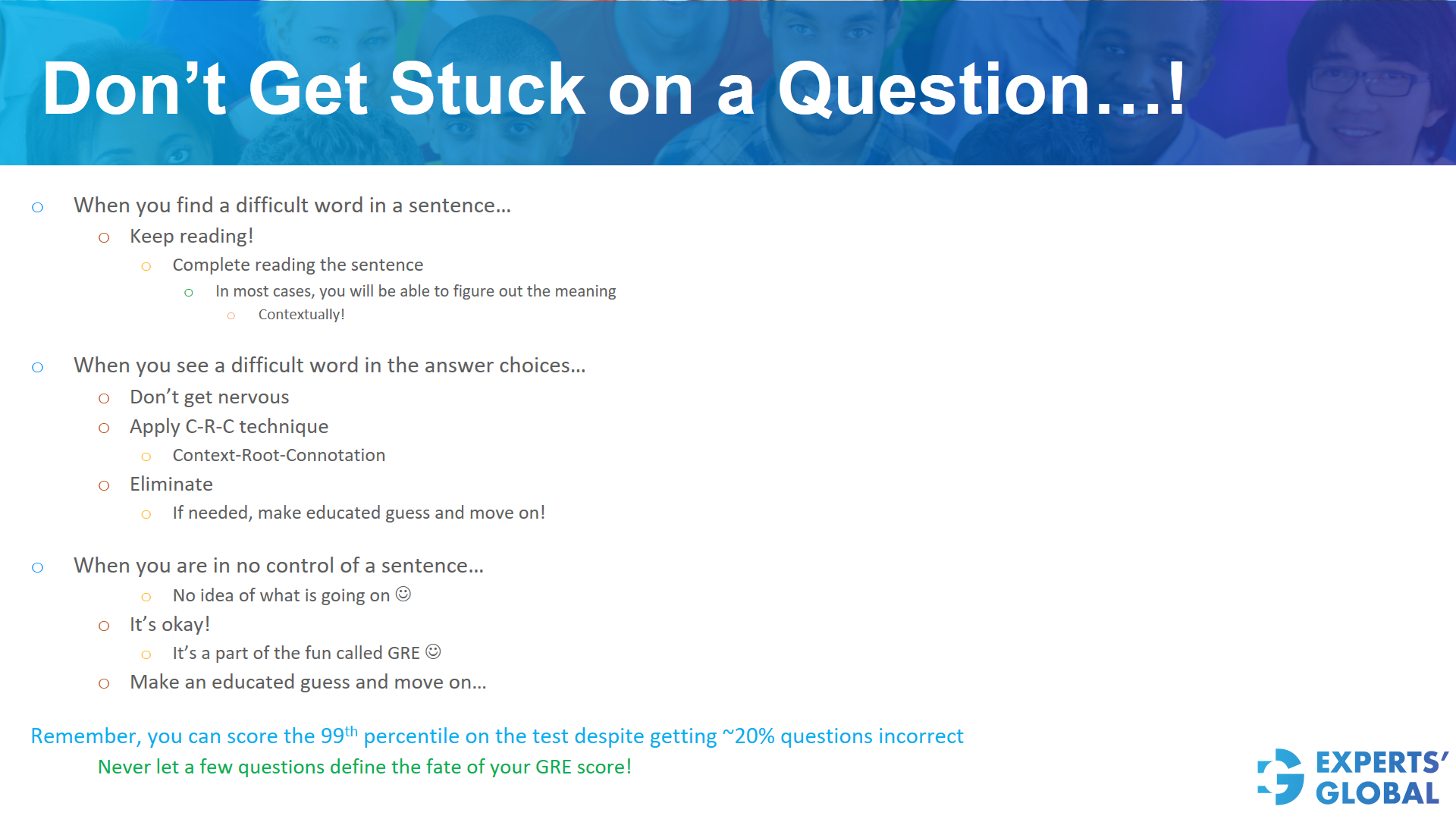
In Text Completion questions, keep moving steadily forward, even when you come across a difficult word, by reading the sentence from beginning to end. Context usually helps clarify meaning as the sentence unfolds. If a challenging word appears in the answer choices, stay focused and use the CRC approach — context, root, and connotation — to guide your understanding. Eliminate choices that don’t fit the sentence and make an educated guess when needed, so you can keep progressing. When a sentence feels tough to handle, recognize it as a normal part of the GRE, make your best guess, and move on. Remember, achieving a ninety-ninth percentile score is still possible even with around twenty percent of questions answered incorrectly, as your overall performance is what counts toward your final score.
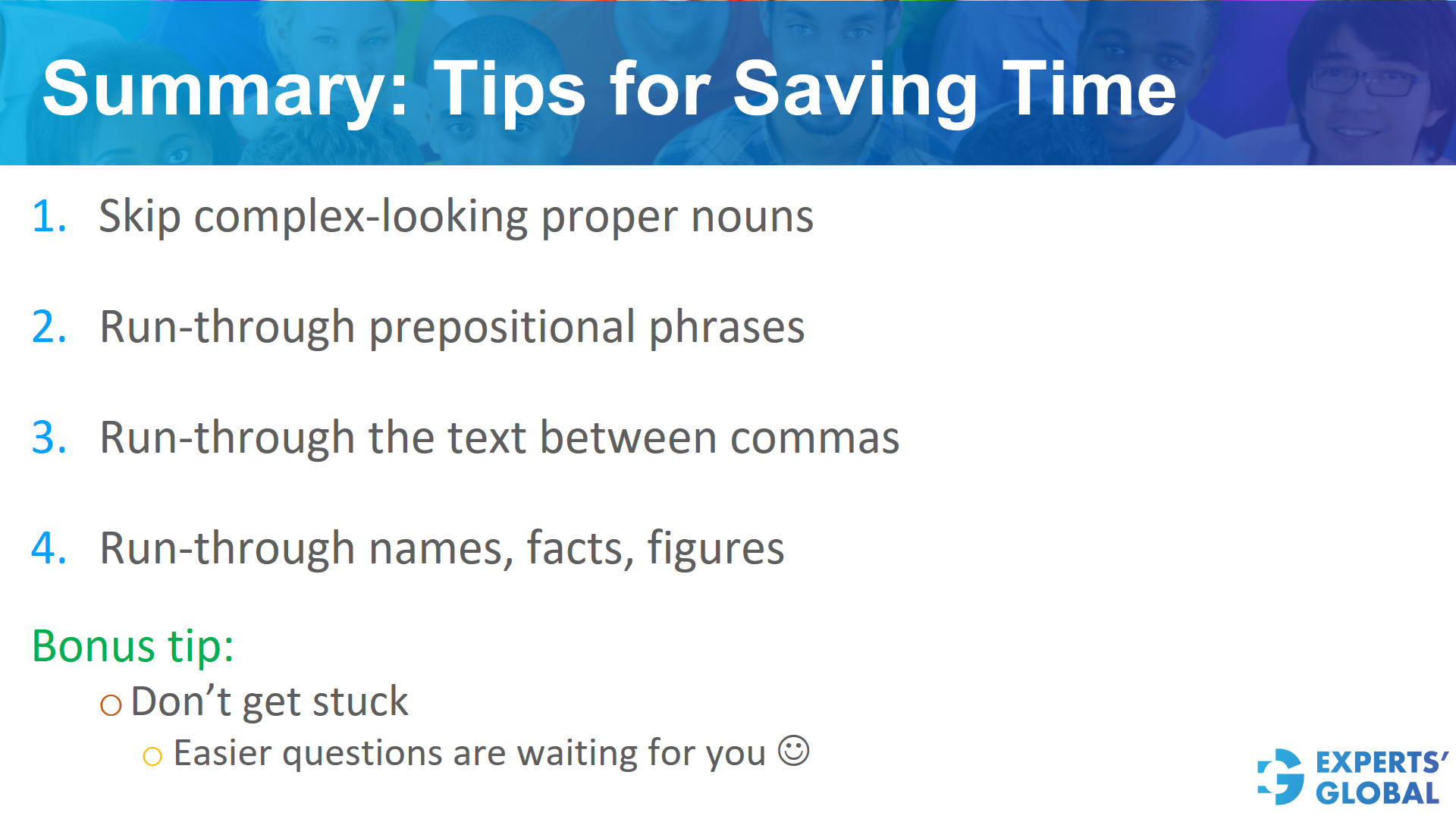
In Text Completion questions, you can read faster by skipping over complex-looking proper nouns and focusing on the overall meaning of the sentence. Move smoothly through prepositional phrases to stay connected to the core idea, and read past text placed between commas to keep the sentence flowing. Glide over names, facts, and figures so you can focus on the blank and the surrounding logic. Keep moving forward, avoid getting stuck on any one question, and remind yourself that easier questions appear later in the test.
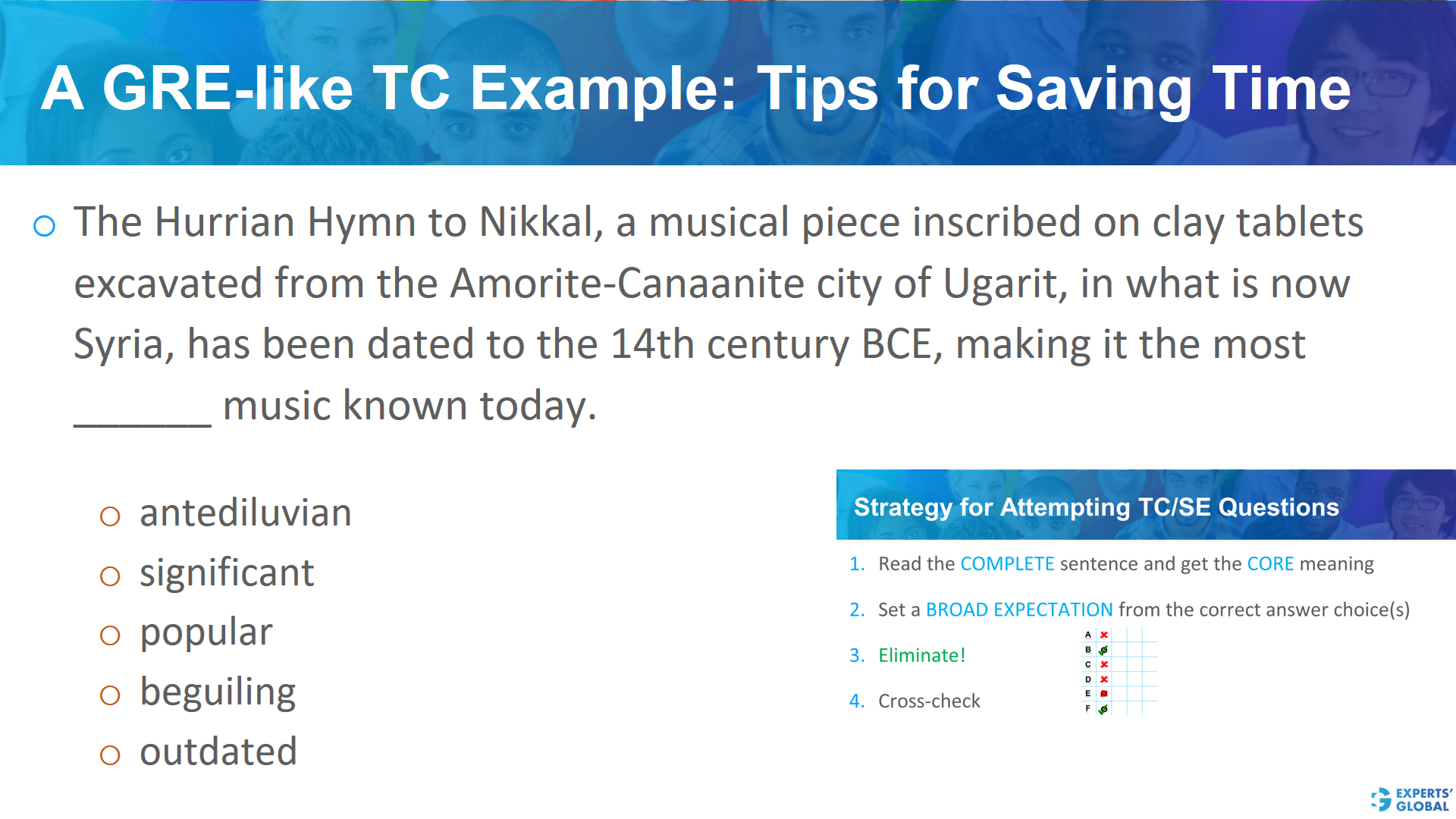
Correct answers: antediluvian
For a detailed explanation of this question, please refer the last ~2 minutes of the video featured earlier on this page. Following is a step-by-step written solution:
The Hurrian Hymn to Nikkal, a musical piece inscribed on clay tablets excavated from the Amorite-Canaanite city of Ugarit, in what is now Syria, has been dated to the 14th century BCE, making it the most ______ music known today.
A. antediluvian
B. significant
C. popular
D. beguiling
E. outdated
1. Core Meaning
The sentence states that a piece of music discovered on clay tablets dates back to the 14th century BCE. This historical timeline identifies the music as being from a very distant past compared to modern times.
2. Broad Expectation
I expect a word meaning extremely old, ancient, or antique to describe music that originated in the 14th century BCE.
3. Eliminate
• antediluvian: Extremely old or belonging to the remote past. Matches the logic of the time clue perfectly.
• significant: Important or worthy of attention. While the discovery is important, this does not specifically describe its age.
• popular: Liked or admired by many people. Irrelevant to the historical date provided.
• beguiling: Charming or enchanting. This describes the quality of the music rather than its age.
• outdated: Old-fashioned or no longer in use. This has a negative connotation that does not fit a significant archaeological find.
4. Cross-check
Antediluvian correctly reflects the “14th century BCE” clue by emphasizing that the music is among the most ancient ever found.
Correct answer: antediluvian
Complete GRE prep course online with free trial
Free GRE diagnostic test (full length)
