
Invest 30 seconds...
...for what may lead to a life altering association!
Help Line
- +91.8800.2828.00 (IND)
- 1030-1830 Hrs IST, Mon-Sat
- support@expertsglobal.com
33% off ends soon:GMAT/GRE prep + applications bundle. Profile building, longer mentoring, better results. Inquire

The following video and the theory that follows give you a quick recap of the Mind Map Approach, explain how to use it for GRE purpose of a sentence questions, and apply it to GRE-style questions with representative answer choices so you gain first-hand experience. Take your time, pause the video to apply the approach yourself, study each explanation carefully, and by the end, develop a clear habit of using the Mind Map Approach for purpose of a sentence questions across your GRE practice quizzes, GRE sectional mocks, and GRE full mocks.
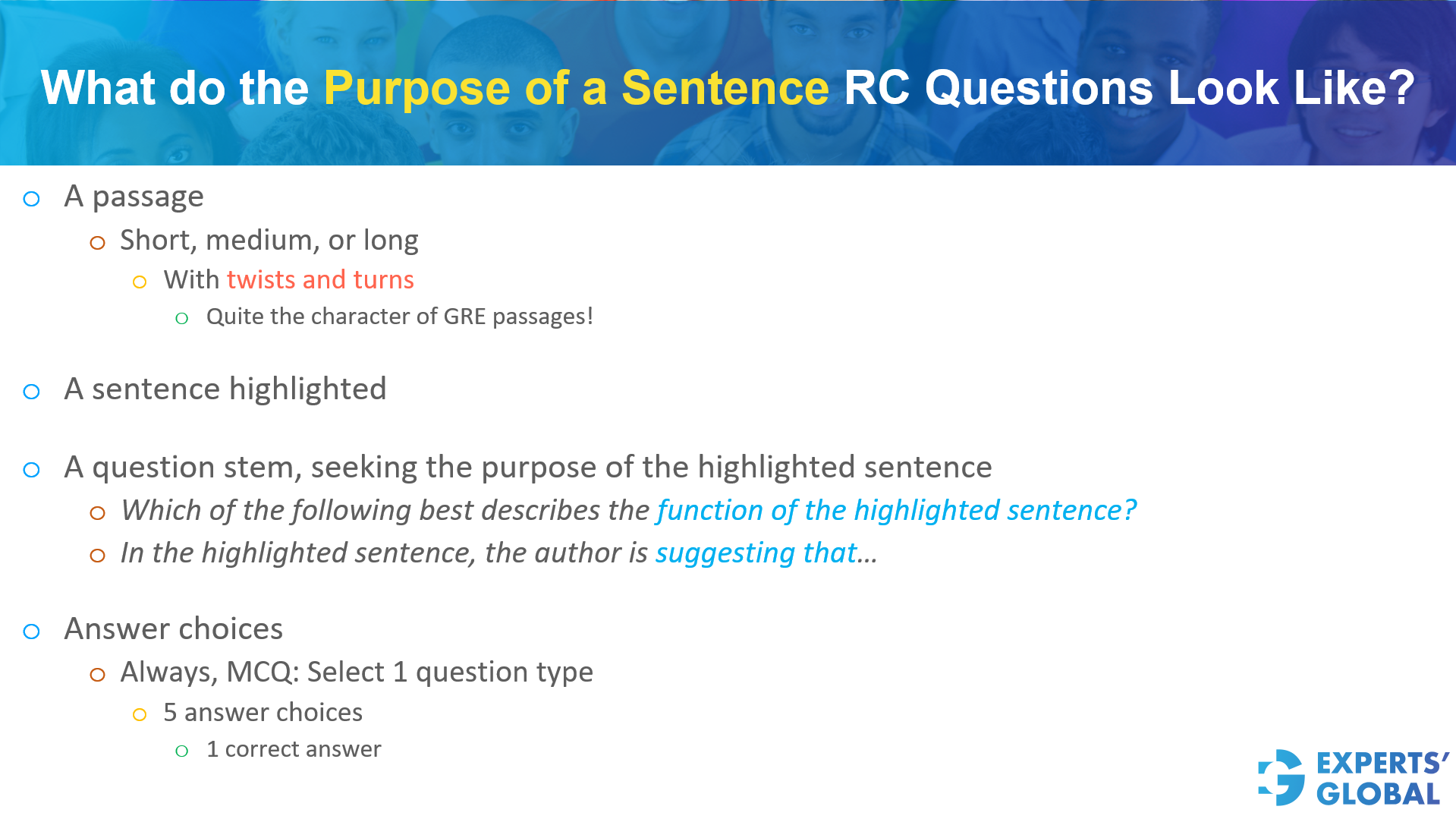
A reading comprehension passage may vary in length, from short to medium to long, and includes twists and turns that reflect the character of GRE passages. One specific sentence in the passage is highlighted, and the question stem focuses on identifying the purpose of that highlighted sentence. The question may ask which option best describes the function of the highlighted sentence or what the author is suggesting through that sentence. The answer choices are multiple choice, with five options, and only one answer choice is correct.
In a previous lesson, we learned the Mind Map Approach for solving any GRE Reading Comprehension question, and this lesson builds directly on that learning. A part of the Experts’ Global GRE prep online course, the Mind Map Approach has helped tens of thousands of students worldwide since 2008. With proper understanding and steady practice, it helps you approach GRE Reading Comprehension in a methodical way that supports both accuracy and pace.
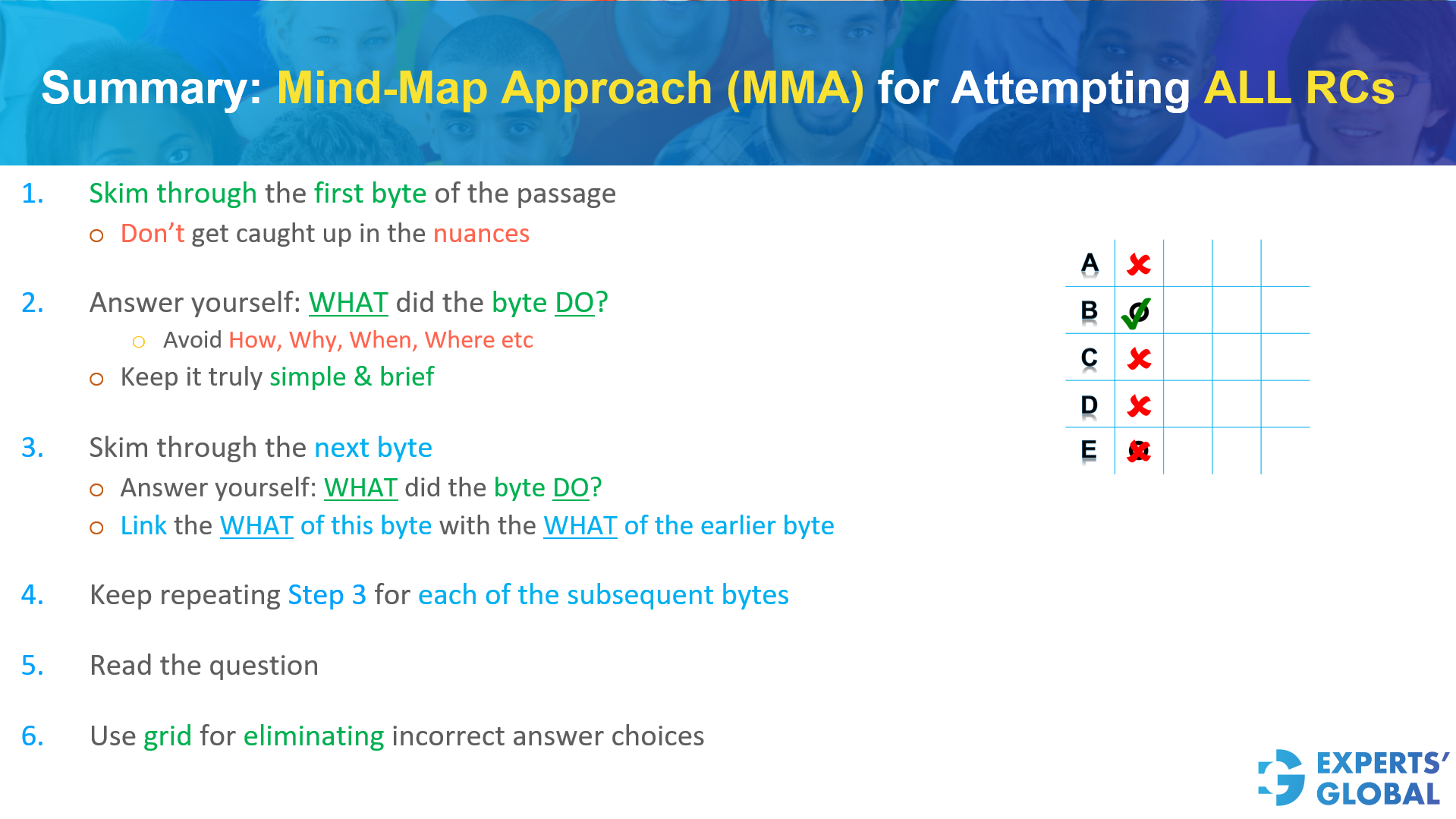
Before you move forward, take a short and focused refresh of the Mind Map Approach –
Begin by glancing through the first small unit of the passage, which means one meaningful chunk that you can grasp in a single look, without diving into fine detail. Pause and ask yourself what role this unit plays, then capture that role in a brief note. Shift to the next unit, repeat the same reflection, and record another crisp takeaway. As you progress, connect each takeaway with the earlier ones so your understanding grows in a structured and connected way. Continue this rhythm for every new unit until a clear mental map of the passage takes shape. Once this map is ready, turn to the question and filter out incorrect answer choices with a systematic grid based process.
The Mind Map Approach supports all RC question types. In this lesson, the focus is on applying the Mind Map Approach to “purpose of a sentence” questions. In such questions, a specific sentence in the passage is highlighted, and your task is to select the answer choice that best captures the role that sentence plays in the passage. The mind map you build shows how information flows across the passage, which helps you see the context around the highlighted sentence clearly. As a result, you understand why that sentence appears where it does and what function it serves in moving the passage forward. To solve these questions, you return to the relevant part of the passage, analyze the context a bit deeper, set a broad expectation for the correct answer choice, and then eliminate incorrect answer choices to reach the correct one.
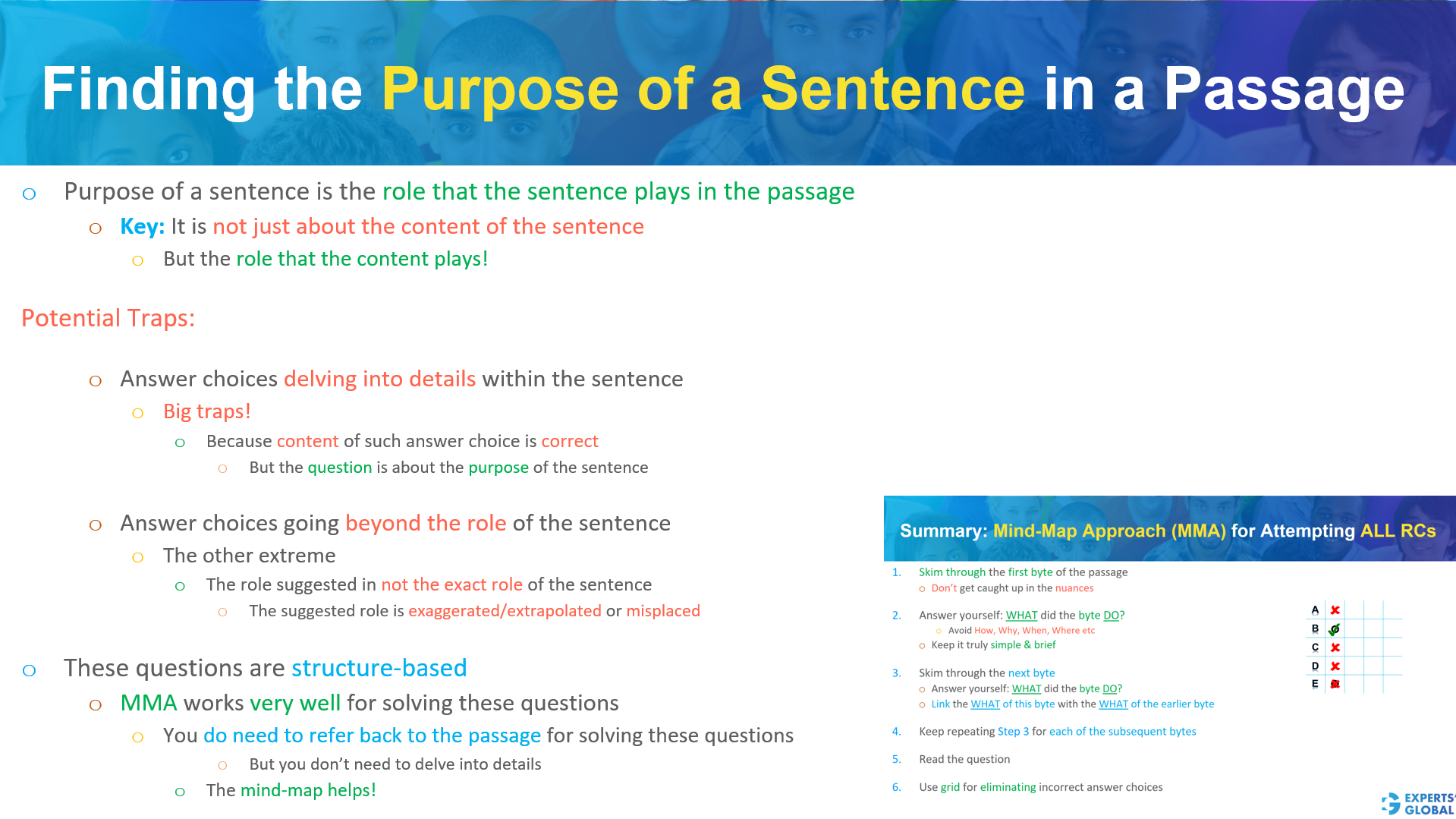
Below is a snapshot of the GRE style Purpose-of-Sentence based Reading Comprehension question discussed in the video, along with the Mind Map approach used to solve it and the Mind Map created for the passage.
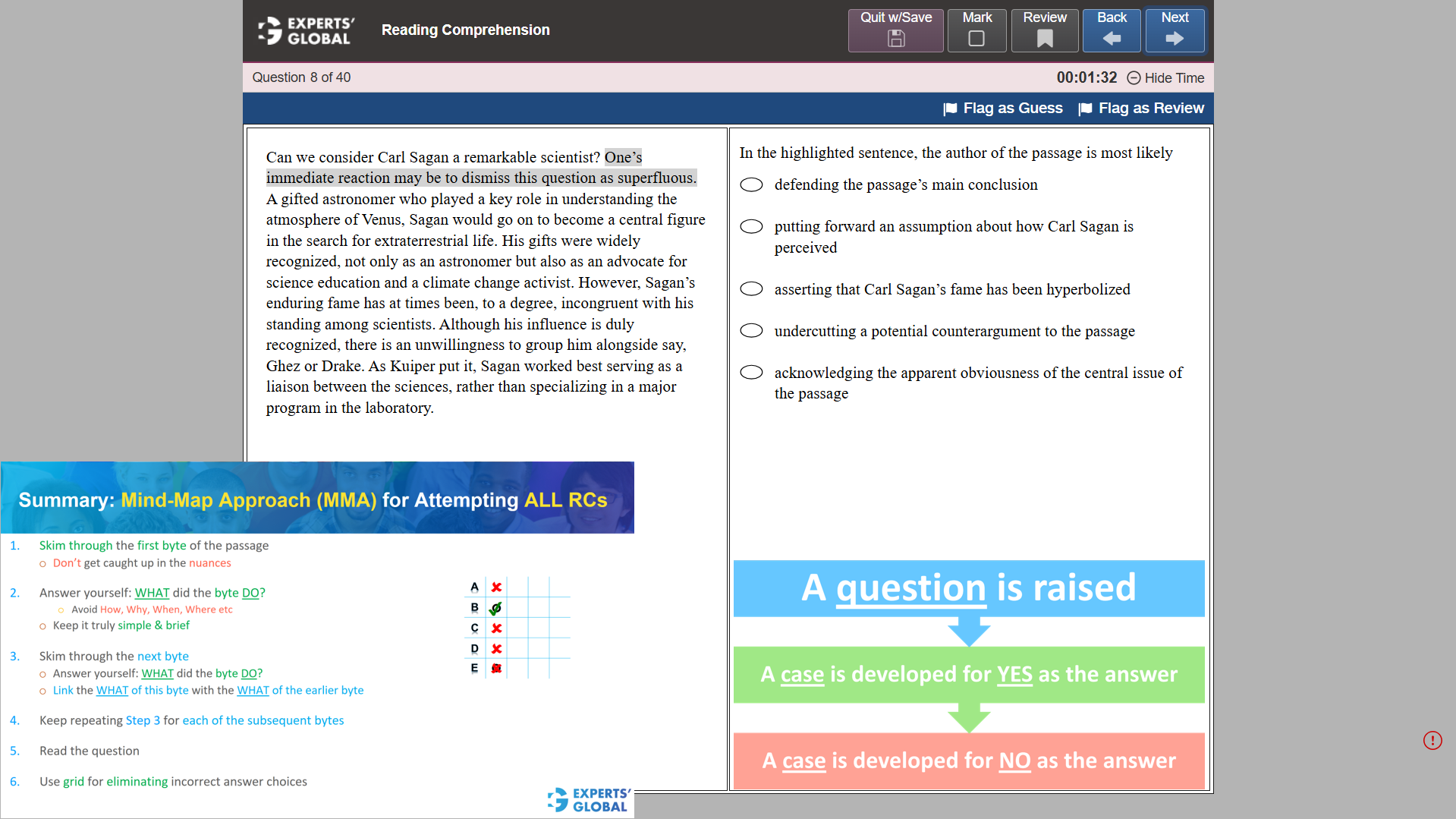
Correct Answer: E
For a detailed explanation of this question, please refer to the video presented earlier on this page.
Following is a step-wise written explanation, using our Mind Map Approach…
Correct Answer: E
Comprehensive online GRE prep course
15 GRE practice tests full length
Free GRE diagnostic test full length
