
Invest 30 seconds...
...for what may lead to a life altering association!
Help Line
- +91.8800.2828.00 (IND)
- 1030-1830 Hrs IST, Mon-Sat
- support@expertsglobal.com
33% off ends soon:GMAT/GRE prep + applications bundle. Profile building, longer mentoring, better results. Inquire

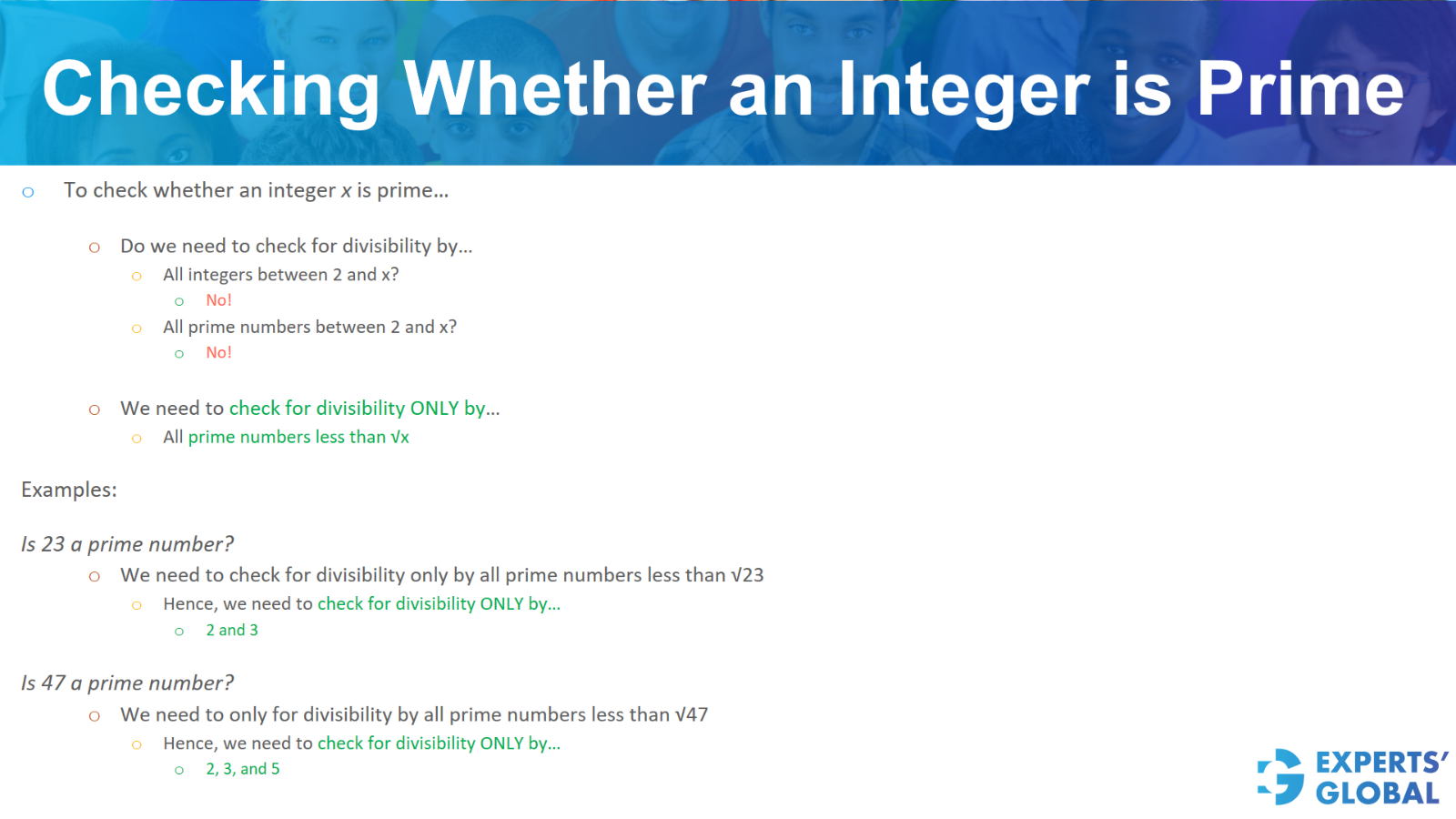
To test whether a number x is prime, check divisibility by all prime numbers from 2 up to √x. If any divide x, then x is non prime; if none divide x, then x is prime.
While on this topic, you may also want to quickly revise the important divisibility rules…
Basic concepts such as primality tests have direct and indirect application across many GRE questions and require proper coverage in a comprehensive GRE prep course. To decide whether an integer x is prime, you do not scan through every number from 2 up to x. You also do not test all prime numbers up to x. You focus only on the prime numbers that lie below the square root of x. This single idea trims away wasted effort and brings sharp efficiency to your process. When none of those smaller primes divide x evenly, x stands as a prime number. Such basic principles can come in handy in a variety of question
Take a fresh example. Suppose you want to test whether 29 is prime. The square root of 29 lies between 5 and 6. The only prime numbers below this range are 2, 3, and 5. You test divisibility by these three values. Since none of them divide 29 evenly, 29 qualifies as a prime number. Now test 41. The square root of 41 lies between 6 and 7, so you check only 2, 3, and 5 again. None divide 41 evenly, so 41 is also prime. This focused method keeps your work light, fast, and precise while giving you full control over accuracy.
Assess your present GRE ability through a free full-length GRE simulation
To check if an integer x is a prime number, follow these steps:
You do not need to check for divisibility by every integer or even every prime number between 2 and x. Instead, you only need to check for divisibility by all prime numbers that are less than the square root of x.
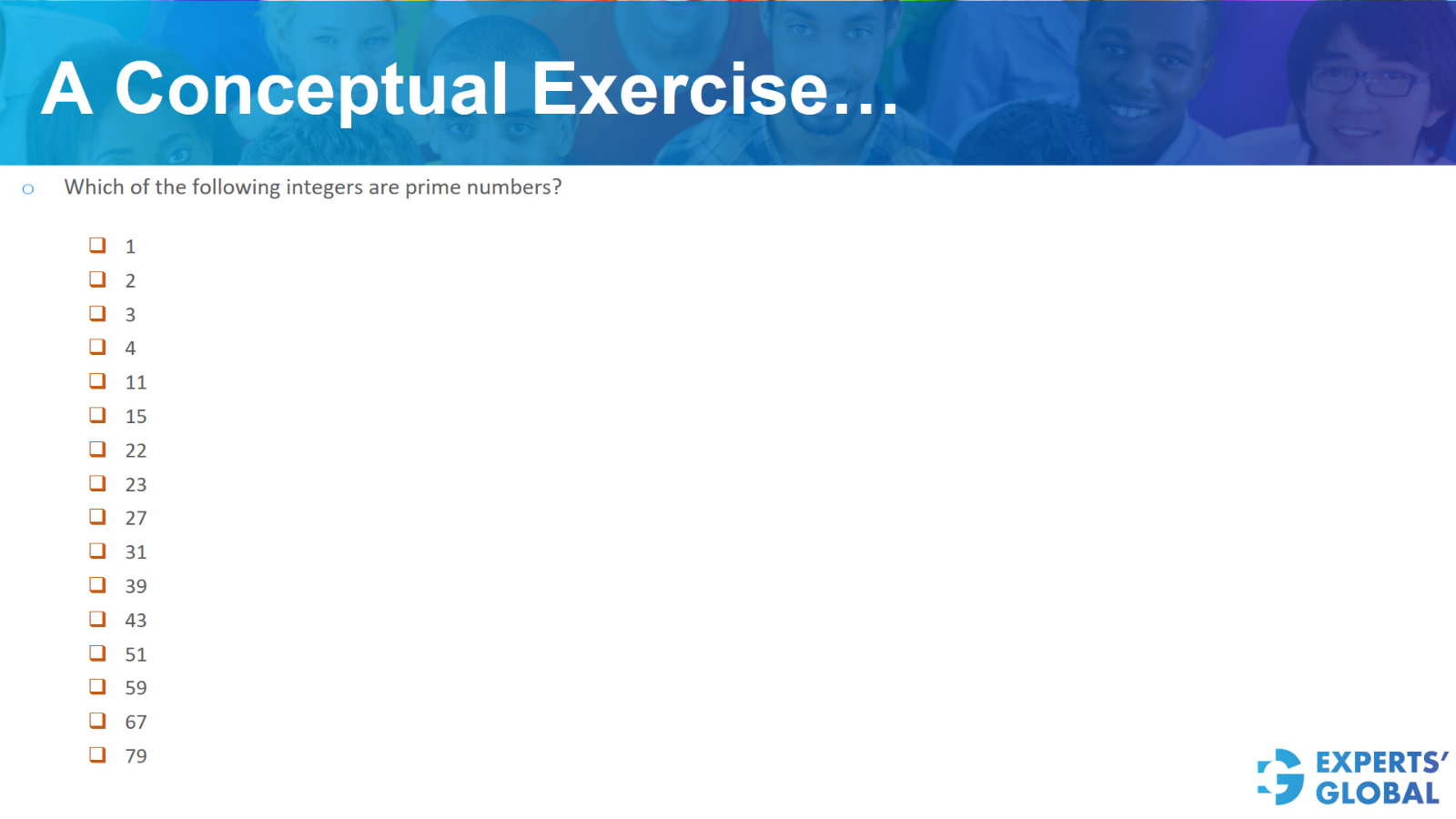
Final list of prime numbers from the slide: 2, 3, 11, 23, 31, 43, 59, 67, 79
Which of the following integers are prime numbers?
1
Not prime
1 has only one positive factor. Prime numbers must have exactly two positive factors.
2
Prime
2 has no positive divisors other than 1 and 2.
3
Prime
3 has no positive divisors other than 1 and 3.
4
Not prime
√4 = 2
4 is divisible by 2, so 4 is not prime.
11
Prime
√11 lies between 3 and 4.
Check divisibility by 2 and 3.
11 is not divisible by 2 or 3, so 11 is prime.
15
Not prime
√15 lies between 3 and 4.
15 is divisible by 3, so 15 is not prime.
22
Not prime
22 is divisible by 2, so 22 is not prime.
23
Prime
√23 lies between 4 and 5.
Check divisibility by 2 and 3.
23 is not divisible by 2 or 3, so 23 is prime.
27
Not prime
√27 lies between 5 and 6.
27 is divisible by 3, so 27 is not prime.
31
Prime
√31 lies between 5 and 6.
Check divisibility by 2, 3, and 5.
31 is not divisible by any of them, so 31 is prime.
39
Not prime
39 is divisible by 3, so 39 is not prime.
43
Prime
√43 lies between 6 and 7.
Check divisibility by 2, 3, and 5.
43 is not divisible by any of them, so 43 is prime.
51
Not prime
51 is divisible by 3, so 51 is not prime.
59
Prime
√59 lies between 7 and 8.
Check divisibility by 2, 3, 5, and 7.
59 is not divisible by any of them, so 59 is prime.
67
Prime
√67 lies between 8 and 9.
Check divisibility by 2, 3, 5, and 7.
67 is not divisible by any of them, so 67 is prime.
79
Prime
√79 lies between 8 and 9.
Check divisibility by 2, 3, 5, and 7.
79 is not divisible by any of them, so 79 is prime.
Final list of prime numbers from the slide: 2, 3, 11, 23, 31, 43, 59, 67, 79
Structured 5-week GRE crash course
GRE preparation course with 7-day trial
Set of 15 full length GRE practice tests
