
Invest 30 seconds...
...for what may lead to a life altering association!
Help Line
- +91.8800.2828.00 (IND)
- 1030-1830 Hrs IST, Mon-Sat
- support@expertsglobal.com
33% off ends soon:GMAT/GRE prep + applications bundle. Profile building, longer mentoring, better results. Inquire

Data Interpretation is not a new topic and not a new question type as such. These are general Quant questions where the background information appears through graphs, charts, and tables, while the underlying concepts remain the same as those used across the quantitative section. You generally get one Data Interpretation set with three questions based on the same data set. Strong preparation in Data Interpretation helps you lift accuracy and save valuable time, since these questions can otherwise become time consuming. For this reason, thorough Data Interpretation preparation deserves a clear place in your GRE preparation course, GRE sectional mocks, as well as your GRE test series.
Preparation for DI begins with building a solid base in quantitative concepts, especially percentages, percentage change, ratio proportion, and statistics, as many Data Interpretation questions draw directly from these topics. Consistent practice builds a natural ability to synthesize data and find the exact answers a Data Interpretation set seeks, while careful analysis of mistakes and slow attempts, followed by reattempting such questions after a meaningful gap, plays a central role in progress – this practice converts every error into learning opportunity and fuels visible progress!
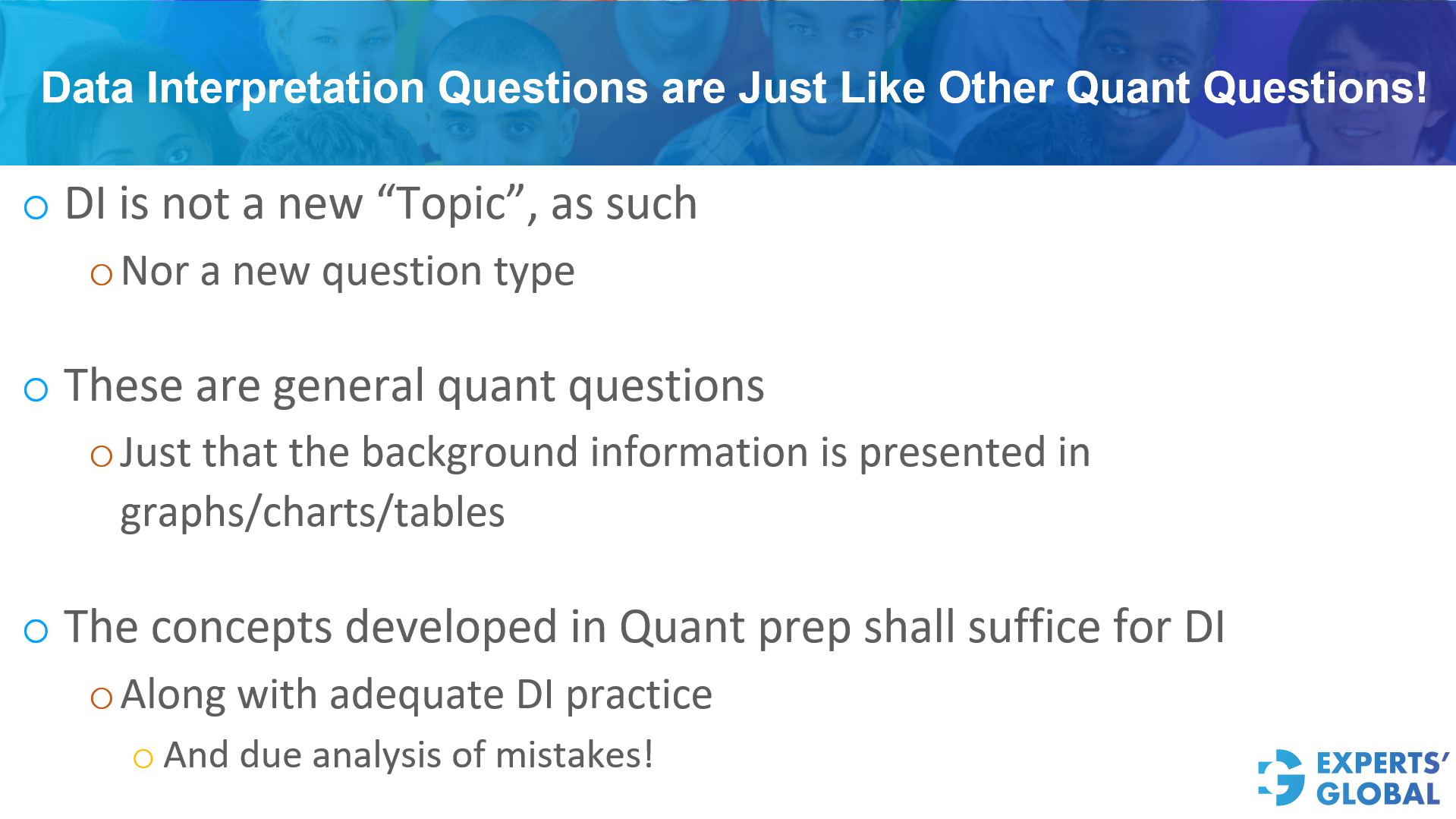
Data interpretation questions on the GRE test the same quantitative skills that you build in regular Quant preparation. They do not introduce a new topic or a separate question type. The only difference lies in how information appears, since the background data comes through tables, charts, and graphs instead of plain text. If you build strong Quant foundations, practice data interpretation regularly, and review mistakes with care, you develop the full skill set needed to handle these questions well.
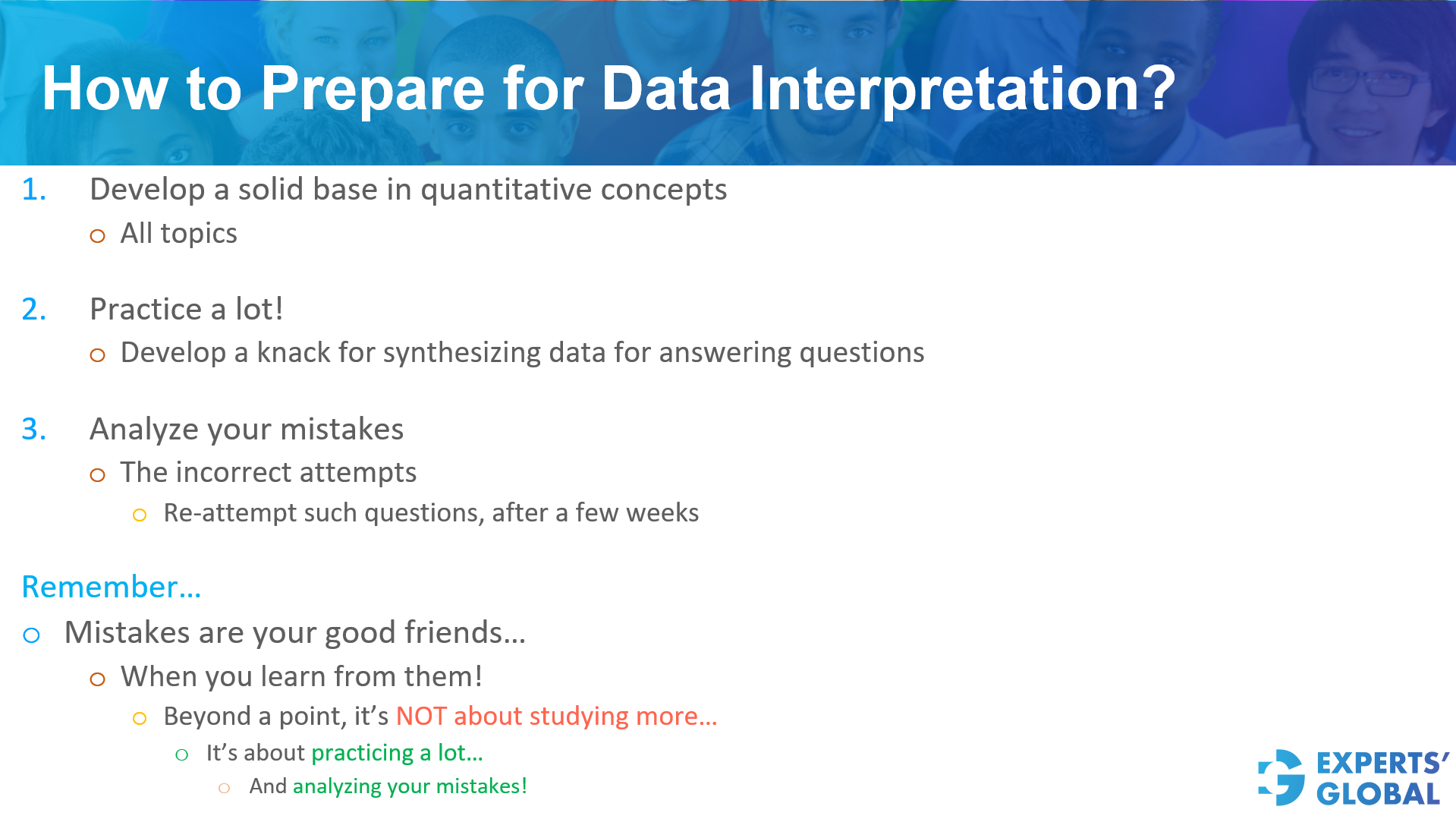
Preparing for Data Interpretation involves a three-step academic strategy focused on conceptual mastery and iterative learning:
It is essential to develop a solid base in quantitative concepts across all topics. This foundational knowledge serves as the prerequisite for accurately interpreting data sets.
Extensive practice is required to develop a specific proficiency for synthesizing data to answer questions. High-volume practice helps build the intuition necessary to extract relevant information from complex data displays.
Effective preparation requires a deep analysis of mistakes. This process includes:
Beyond a certain stage of preparation, improvement is no longer about additional theoretical study. Instead, progress is driven by the combination of continuous practice and the rigorous analysis of errors. Mistakes are valuable learning tools when they are used to refine technique and understanding.
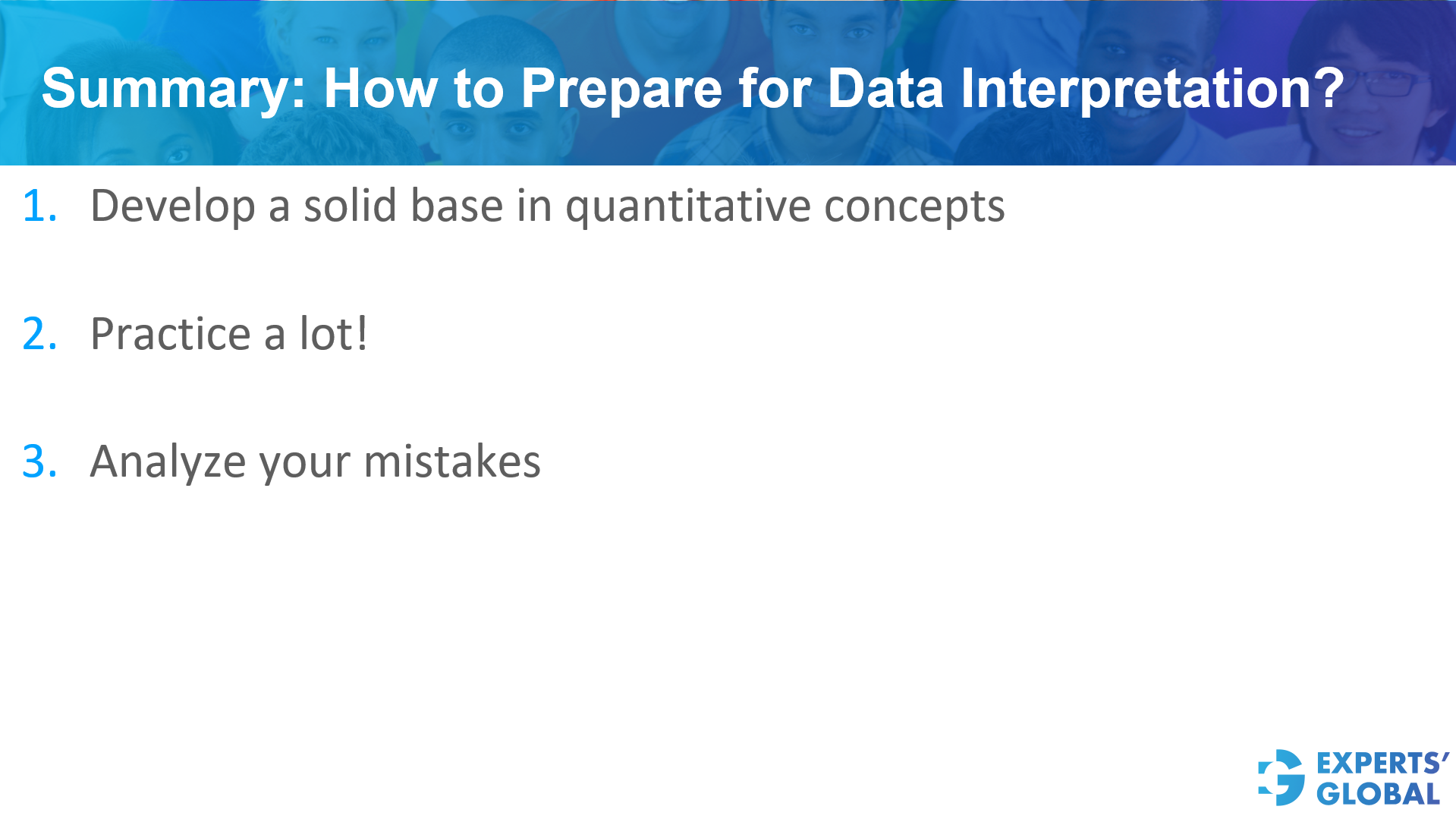
To prepare for Data Interpretation, focus on the following three key areas:
Ensure you have a strong understanding of fundamental mathematical principles and numerical reasoning.
Engage in consistent and extensive practice to build speed and familiarity with various data formats.
Carefully review errors made during practice to identify weaknesses and refine your problem-solving approach.
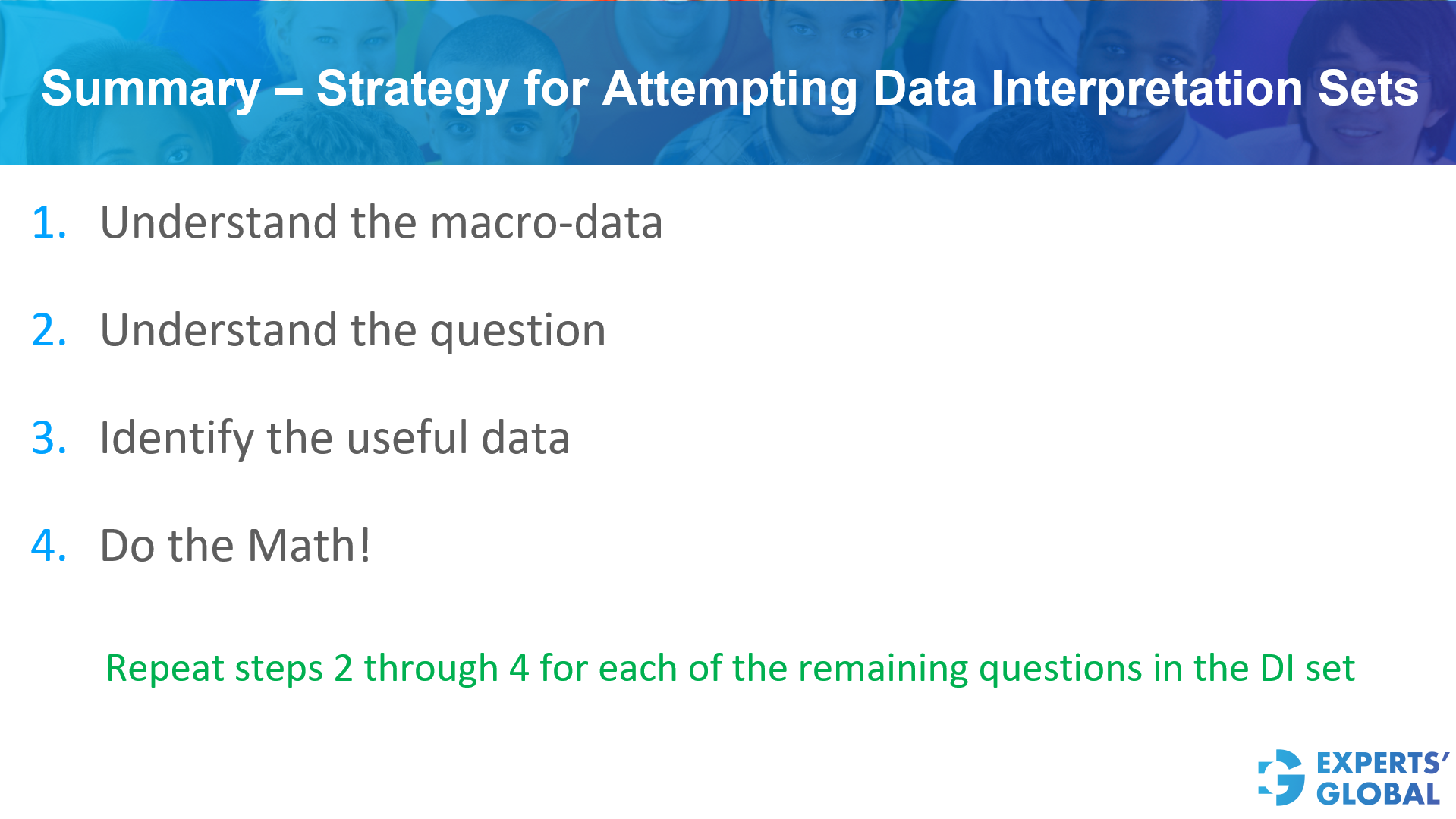
To effectively attempt Data Interpretation (DI) sets, follow this systematic four-step strategy:
Begin by grasping the overall context, scale, and units of the provided information before diving into specific details.
Clearly define what is being asked to avoid solving for the wrong variable or misinterpreting the goal.
Filter through the set to extract only the specific figures and facts necessary to answer that particular question.
Perform the required calculations to reach the final solution.
For every subsequent question within the same DI set, repeat steps two through four.
Complete GRE prep course online with free trial
