
Invest 30 seconds...
...for what may lead to a life altering association!
Help Line
- +91.8800.2828.00 (IND)
- 1030-1830 Hrs IST, Mon-Sat
- support@expertsglobal.com
33% off ends soon:GMAT/GRE prep + applications bundle. Profile building, longer mentoring, better results. Inquire

Prime and non-prime numbers form a key theme in GRE Quant questions, and a clear understanding of how these numbers behave creates a strong base for solving many Quant problems. Straightforward definitions lead to layered outcomes, and steady familiarity with prime structure helps you spot patterns, evaluate factor behavior, and reason accurately across a wide range of GRE Quant questions.
The following video, part of the GRE preparation course by Experts’ Global, explains prime and non-prime numbers in a clear, structured, and intuitive manner. It walks you through how primes and non-primes behave within expressions, products, and conditions, and highlights patterns that frequently shape answer choices on GRE Quant questions. Take your time to absorb this topic and apply the learnings steadily across your GRE practice drills, GRE sectional mock tests, and GRE full mock tests.
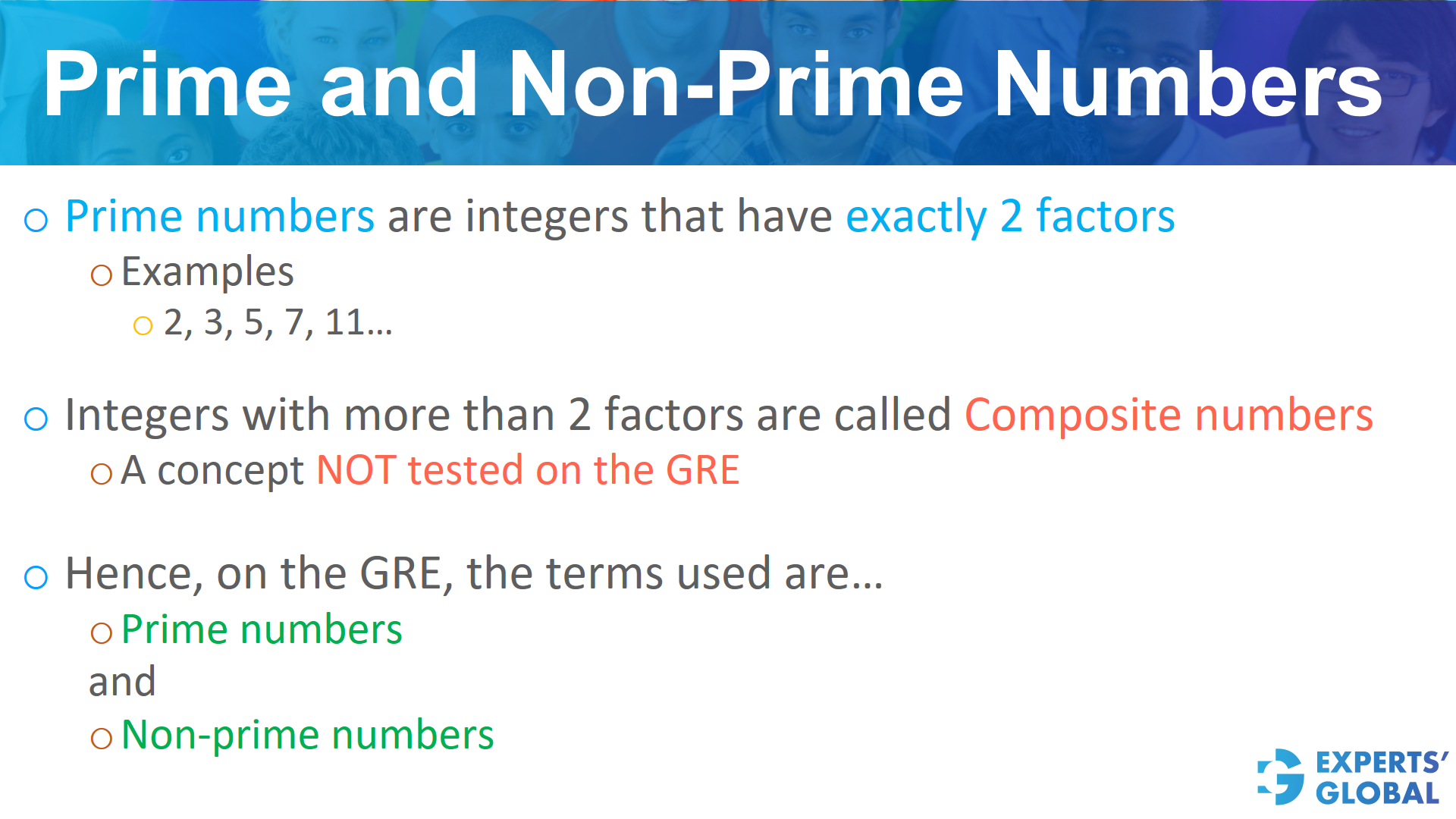
Prime numbers are integers that have exactly 2 factors. Examples of prime numbers include 2, 3, 5, 7, 11, and so on.
Integers with more than 2 factors are referred to as composite numbers. It is important to note that the specific term “composite” is not tested on the GRE.
Because the term “composite” is not used, the GRE categorizes integers using the following two terms:
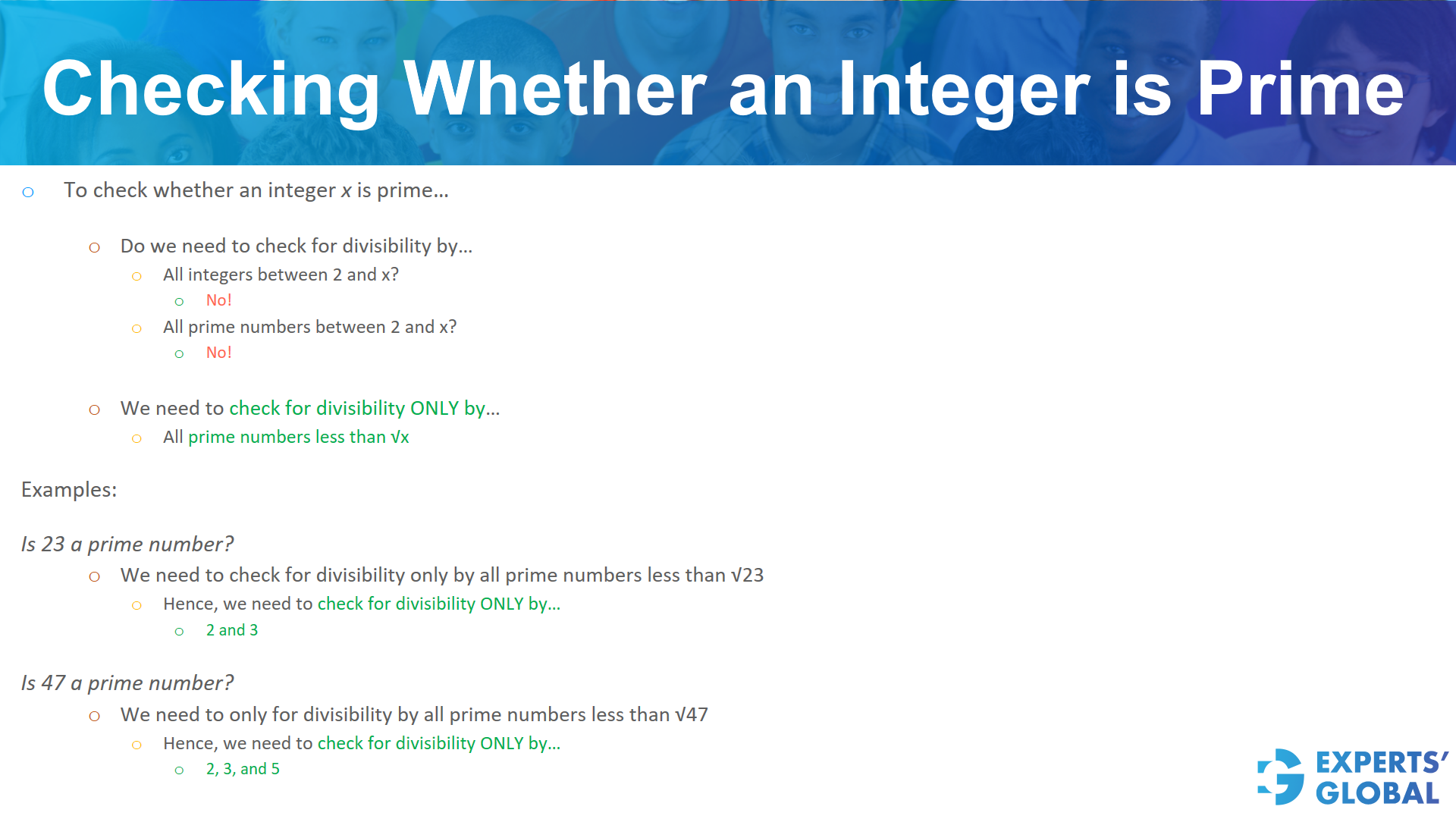
To check whether an integer x is prime, you do not need to check for divisibility by all integers between 2 and x, nor do you need to check all prime numbers between 2 and x.
You only need to check for divisibility by all prime numbers less than the square root of x.
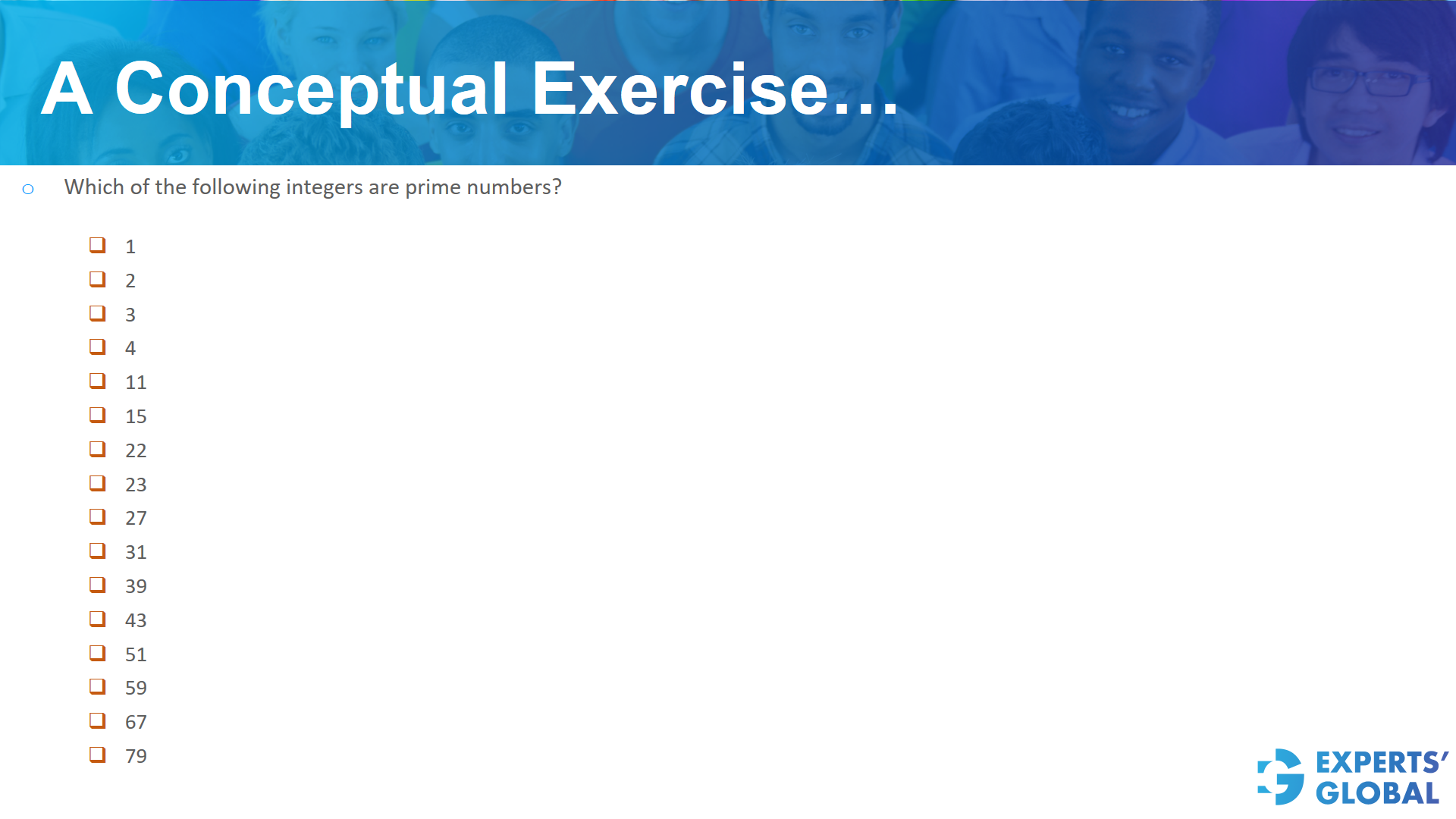
Answer: 2, 3, 11, 23, 31, 43, 59, 67, 79 are prime
For a detailed explanation, please refer to the video presented earlier on this page.
Which of the following integers are prime numbers?
To determine if an integer “x” is prime, you only need to check for divisibility by all prime numbers less than the square root of x. If none of these primes divide x evenly, then x is prime.
Here is the evaluation of the list based on this methodology:
Prime Numbers from the list: 2, 3, 11, 23, 31, 43, 59, 67, 79
Free GRE full length diagnostic mock
End to end online GRE preparation course with free trial
