
Invest 30 seconds...
...for what may lead to a life altering association!
Help Line
- +91.8800.2828.00 (IND)
- 1030-1830 Hrs IST, Mon-Sat
- support@expertsglobal.com
33% off ends soon:GMAT/GRE prep + applications bundle. Profile building, longer mentoring, better results. Inquire

GRE Critical Reasoning assumption questions give you an argument with stated facts, a conclusion, and a visible gap between them, which we refer to as the missing link. The correct assumption is the idea that bridges this gap and supports the conclusion, and it must be true for the argument to stand. This overview shows you how to identify such assumptions by checking both support and necessity. The assumption strengthens the reasoning, and if that statement is removed or denied, the argument breaks down. A part of our GRE prep course, the comprehensive video below explains this approach clearly, applies it to GRE-style examples, and prepares you to use it effectively in your GRE drills, GRE sectionals, and GRE full mocks.
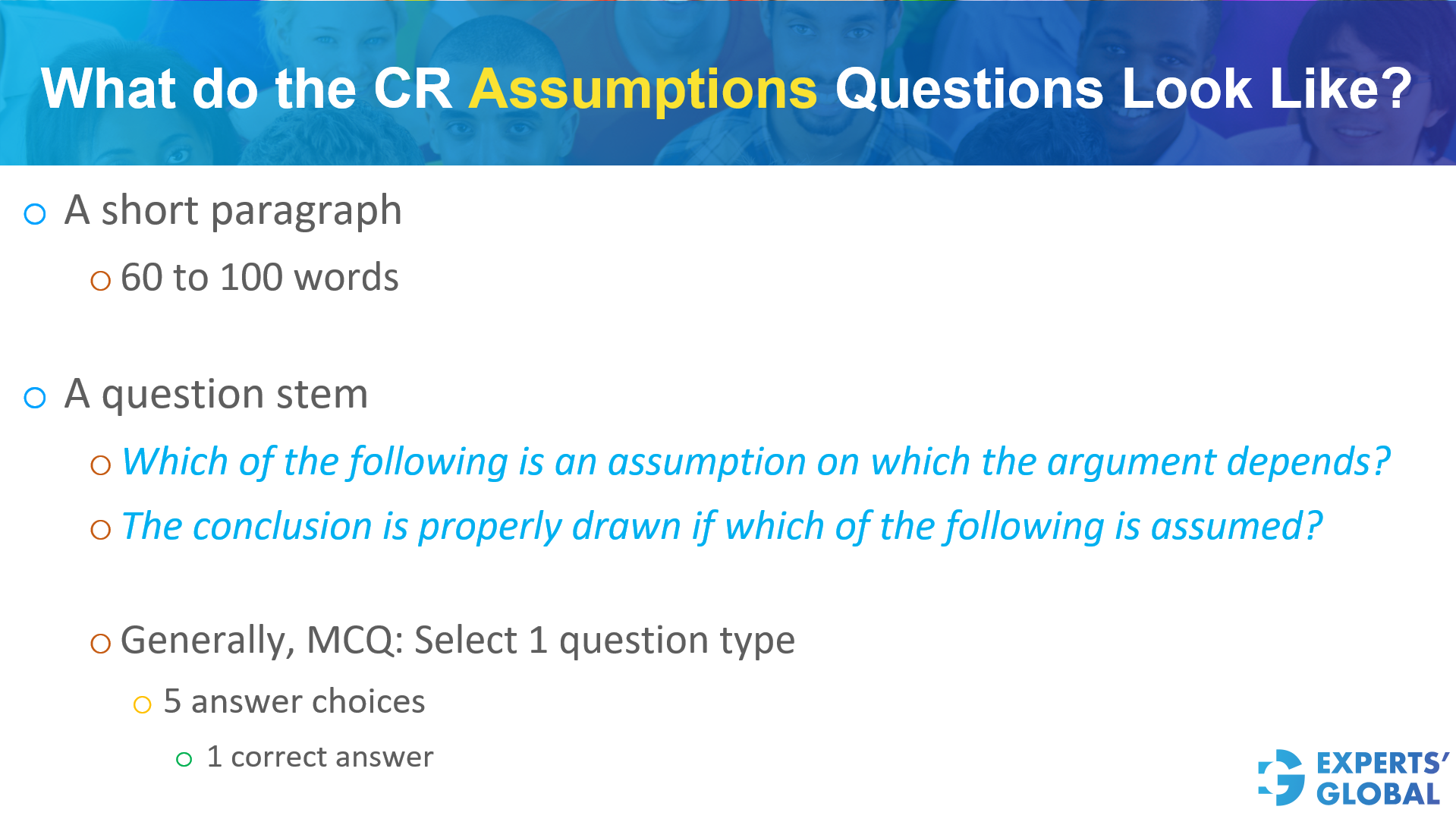
Critical Reasoning assumption questions present a brief paragraph, usually between 60 and 100 words, followed by a question focused on identifying the assumption behind the argument. The question typically asks which assumption the argument depends on or which assumption allows the conclusion to be drawn correctly. These questions are usually in a multiple-choice format with five answer choices, and only one of them is correct.
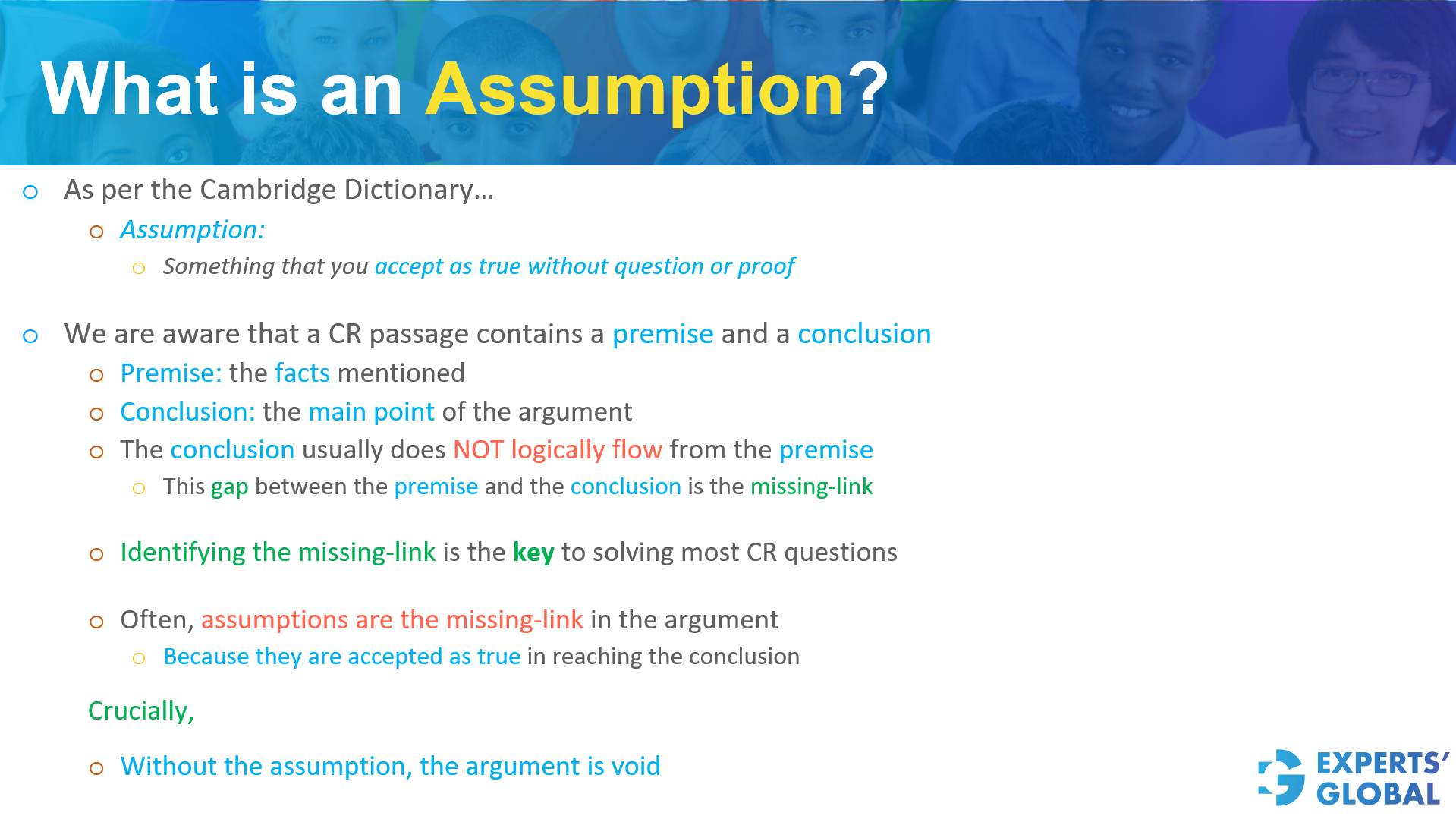
An assumption is something accepted as true without question or proof. In Critical Reasoning, a passage contains a premise and a conclusion. The premise presents the facts in the argument, while the conclusion represents the main point. Often, the conclusion does not logically follow from the premise, and the gap between them is the missing link. Identifying this missing link is crucial for solving most Critical Reasoning questions. Assumptions often serve as this missing link, as they are accepted as true in reaching the conclusion. Without the assumption, the argument becomes invalid.
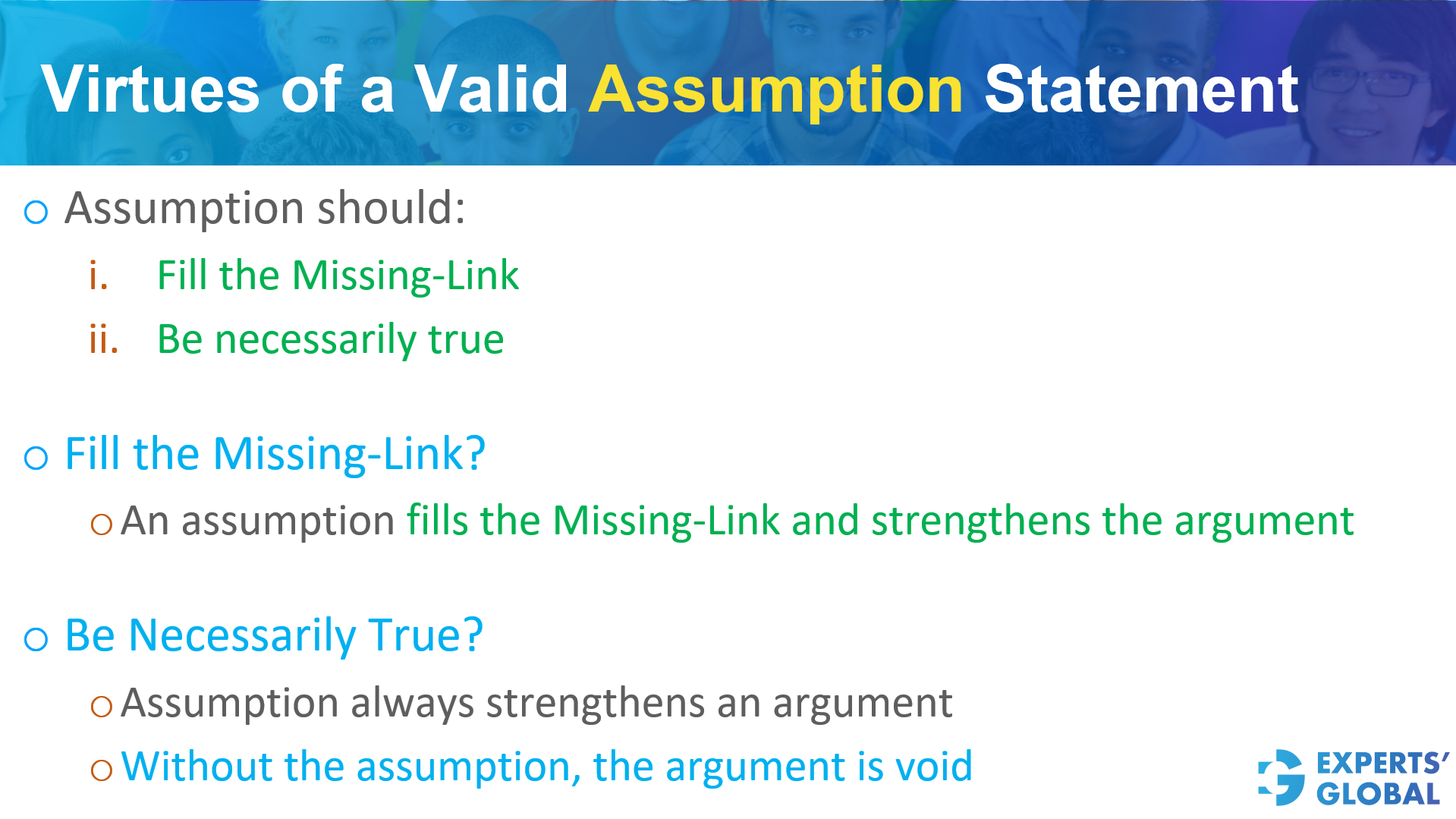
A valid assumption fills the missing link in the argument and must be necessarily true for the argument to hold. By filling this gap, an assumption strengthens the argument. Without the assumption, the argument becomes invalid.
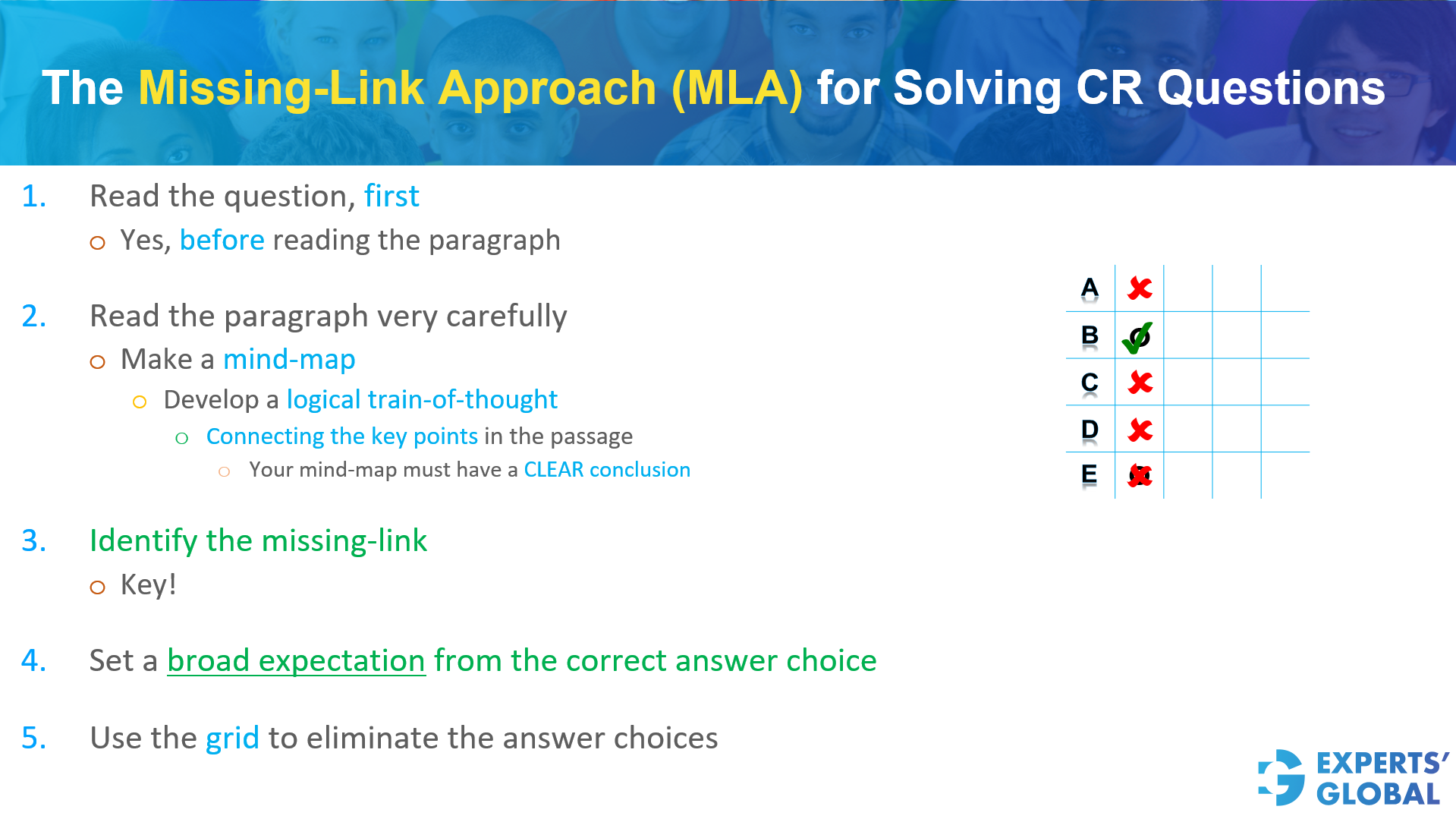
Read the question first to understand the task. Then, read the paragraph carefully. As you read, create a clear mind map by connecting key points in the passage. Ensure the mind map leads to a logical conclusion. Identify the missing link between the premise and the conclusion, and treat this as the key step in solving the question. Set a broad expectation for the correct answer choice and use the grid method to eliminate answer choices systematically.
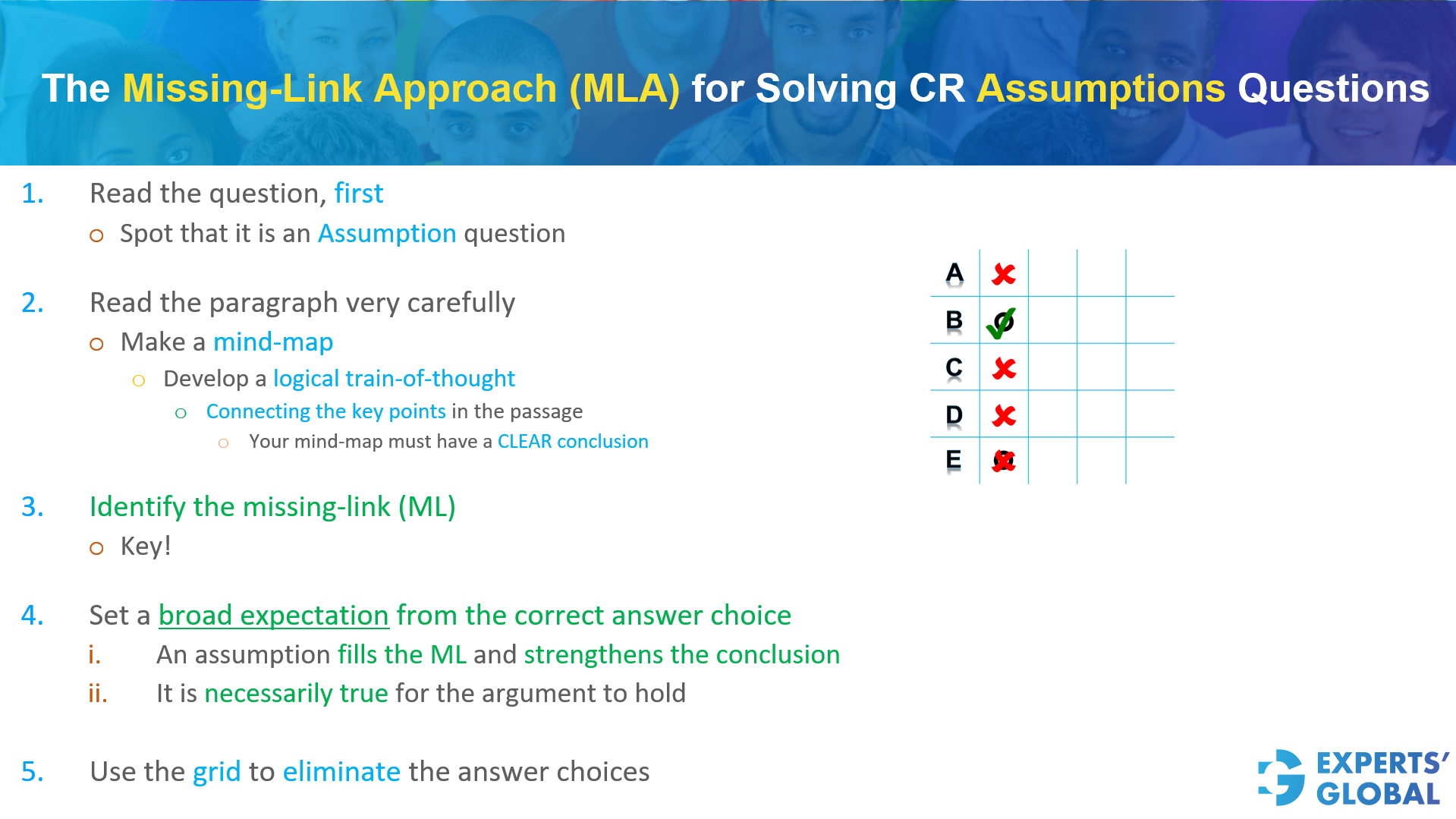
Read the question first to clearly recognize that it is an assumption question. Then, read the paragraph carefully to build a strong understanding. Create a focused mind map as you read and connect the key points to develop a logical train of thought. Ensure the mind map leads to a clear conclusion. Identify the missing link between the premise and the conclusion and treat this as the key step in solving assumption questions. Set a broad expectation for the correct answer choice by expecting it to fill the missing link and strengthen the conclusion. The correct assumption must be necessarily true for the argument to hold. Finally, use the grid method to eliminate answer choices efficiently and accurately.
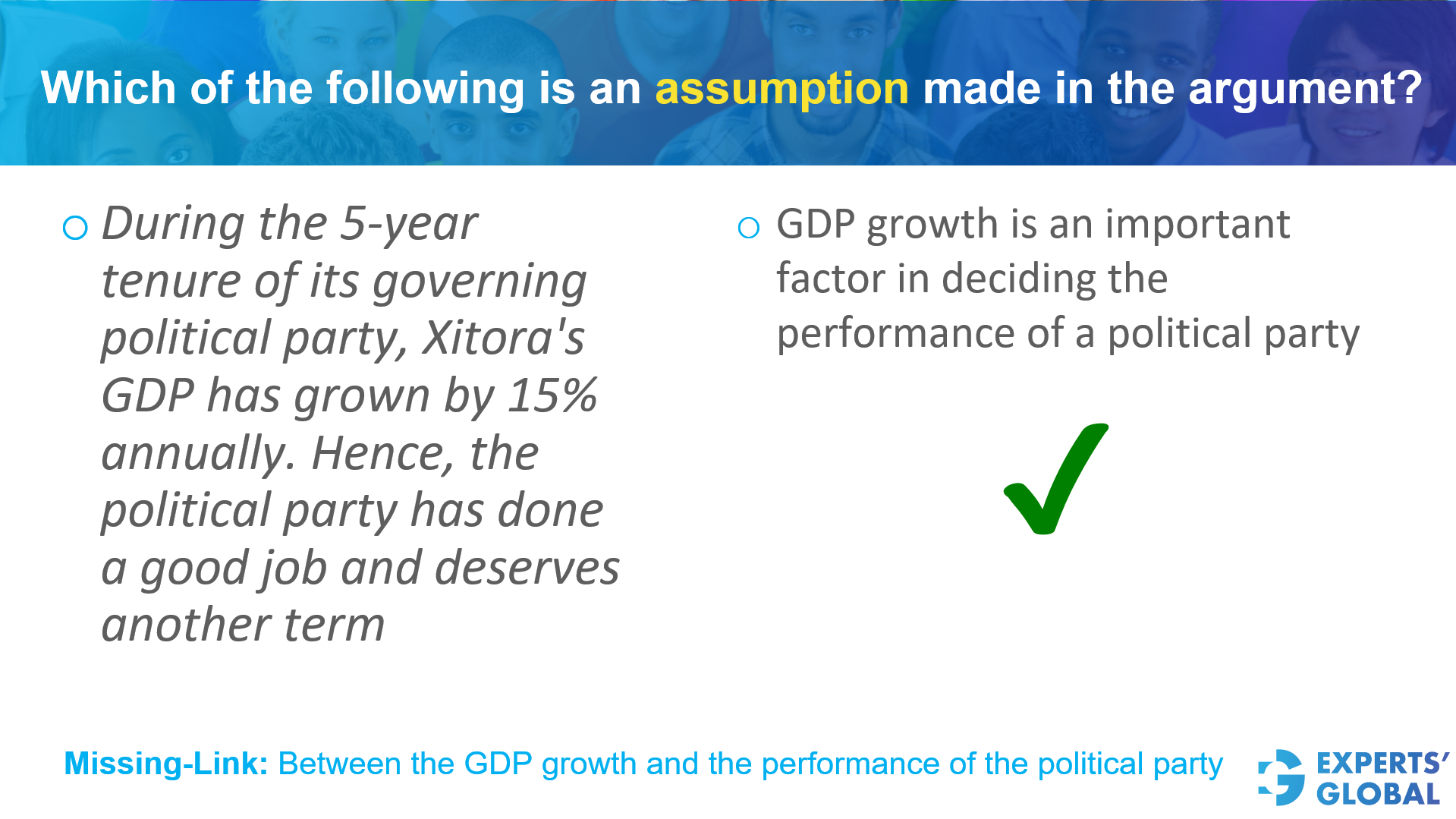
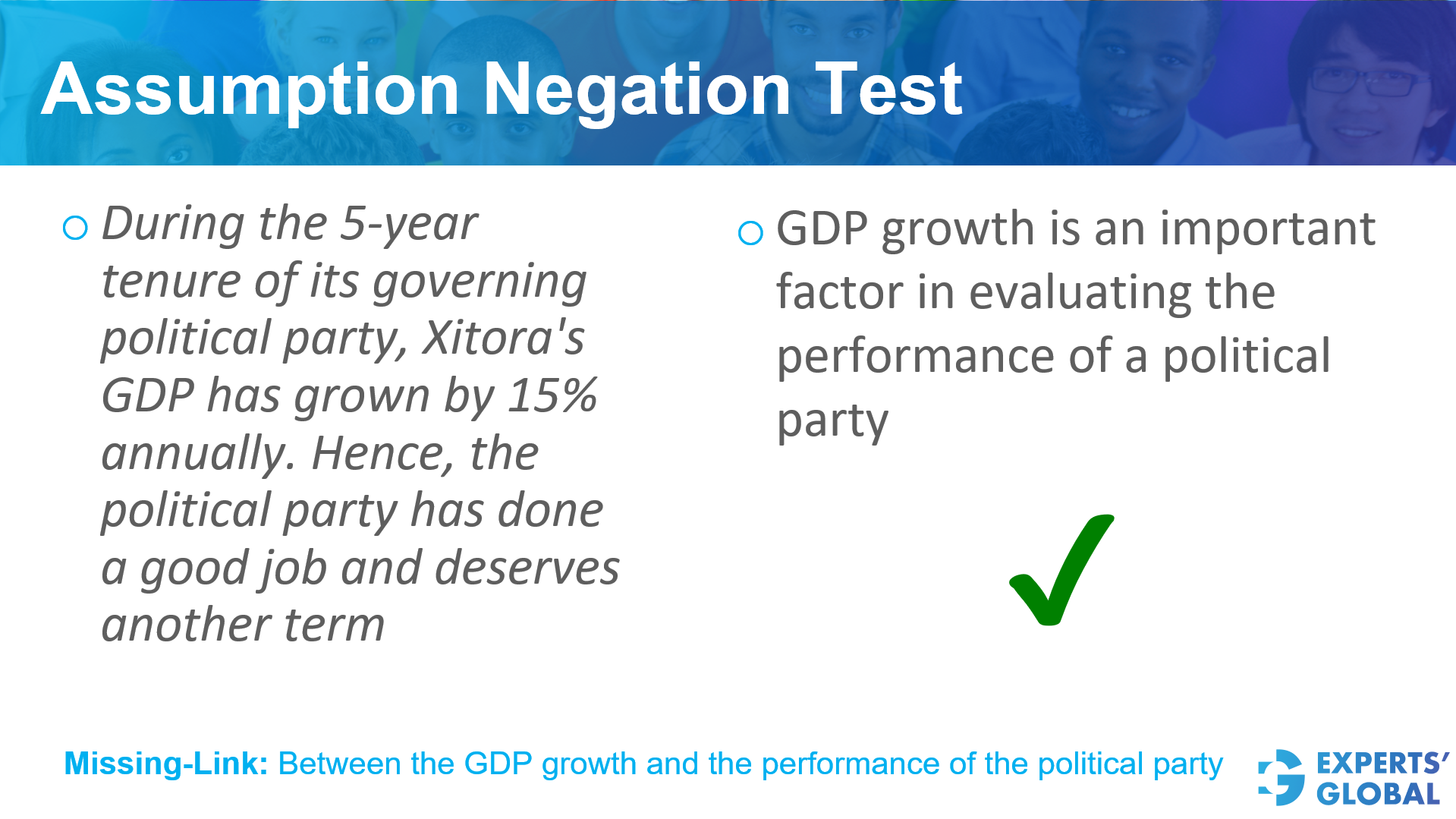
A short argument presents a five-year period of governance with GDP growth of 15 percent annually and concludes that the political party has done a good job and deserves another term. This reasoning relies on a link between GDP growth and judging political performance. The missing link is the assumption that GDP growth matters when evaluating a political party’s performance. This assumption connects economic growth directly with the conclusion about deserving another term and makes the argument logically sound.
An assumption statement adds support to a given argument and must be necessarily true for the argument to hold ground. A strengthening statement only adds support to a given argument and makes it stronger, but it does not have to be necessarily true for the argument to hold ground. The extra condition of being necessarily true makes assumption statements more demanding than strengthening statements. In this sense, strengthening questions form an easier version of assumption questions, while assumption questions represent a more demanding version of strengthening questions because of this added layer of logical requirement.
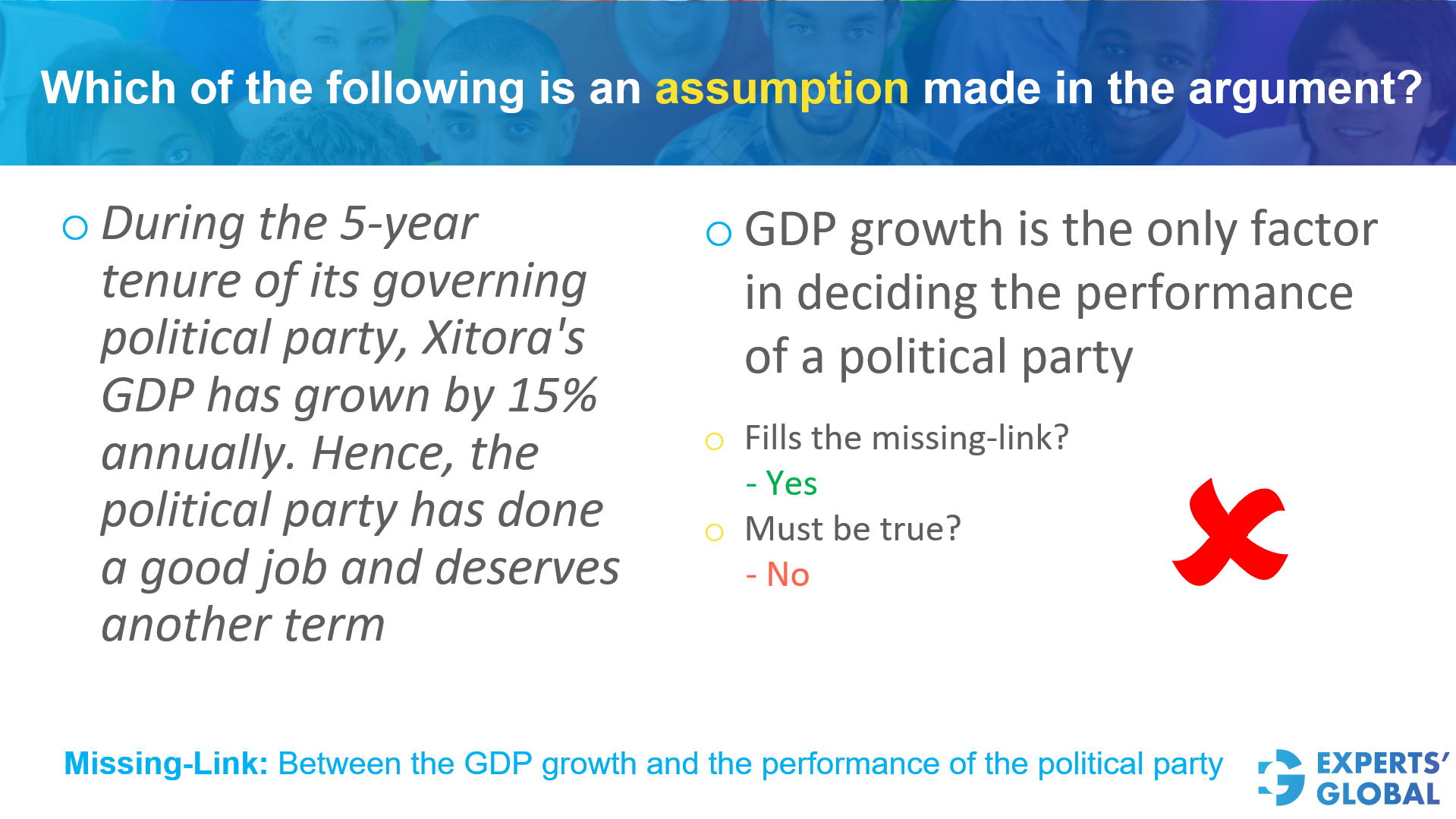
As the example above shows, the given answer choice supports the argument by filling the missing link, but it does not state a condition that must be true for the argument to hold ground. Hence, it works as a strengthening statement, not as a valid assumption.
If you feel unsure whether an answer choice that lends support to an argument is a valid assumption, you can use the assumption negation test. In this method, you take the given answer choice, negate it, and place the negated version into the argument. If the argument breaks down, then the original answer choice qualifies as a valid assumption. If the argument still holds, then the answer choice does not qualify as a valid assumption.
This works because an assumption states a condition that must be true for the argument to hold ground, and when that condition is reversed, the argument loses its foundation. You should treat the assumption negation test as a backup strategy, since applying it consumes extra time and can slow down your overall pace.
Let’s understand this through an example…
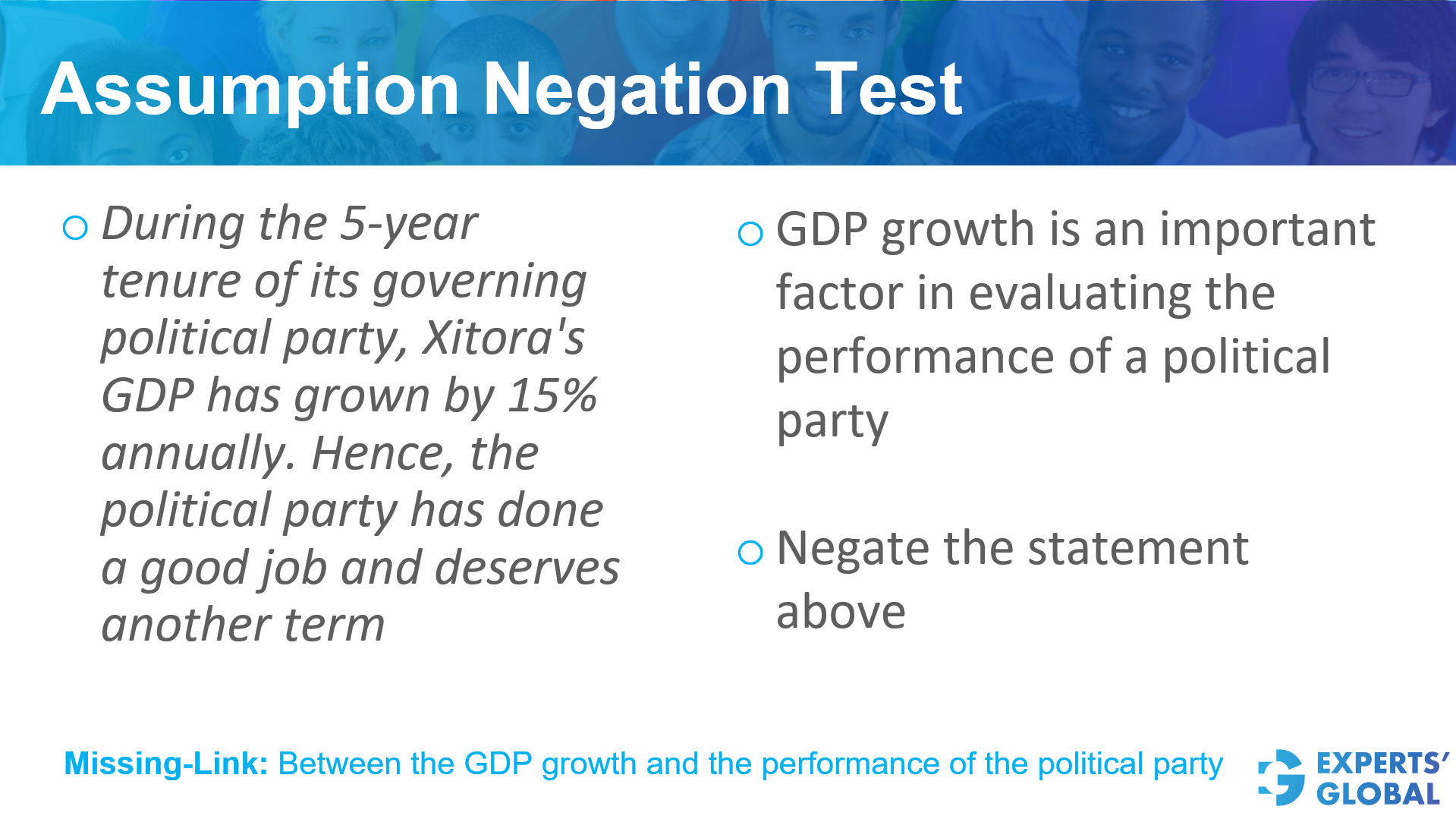
We see that the given answer choice fills the missing link and strengthens the argument. To check whether this answer choice is not merely a strengthening statement but a genuine assumption, we apply the assumption negation test by negating the message conveyed in the answer choice.
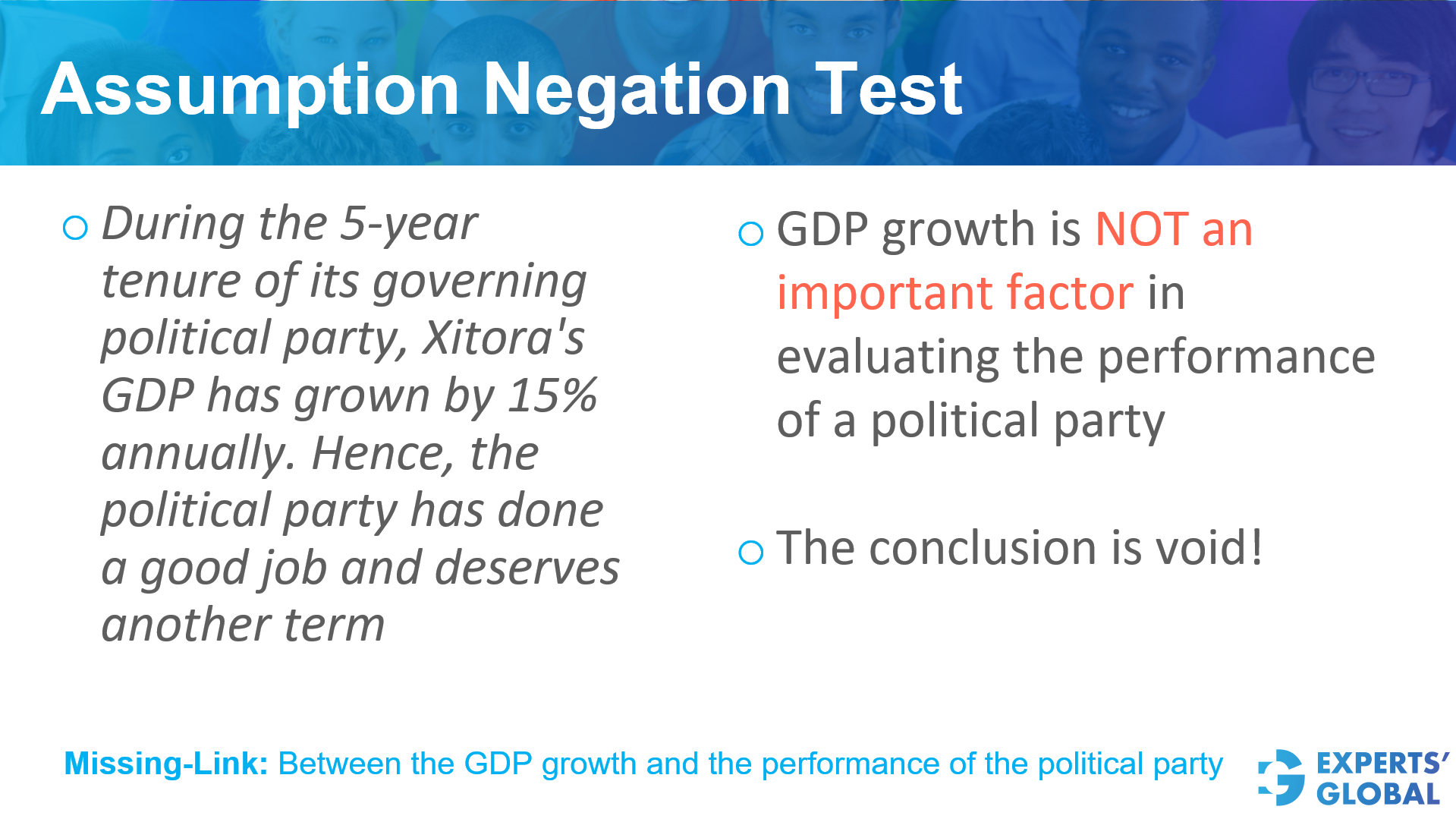
When we negated the statement, the argument collapsed. Hence, this answer choice is not just a strengthening statement but also a valid assumption!
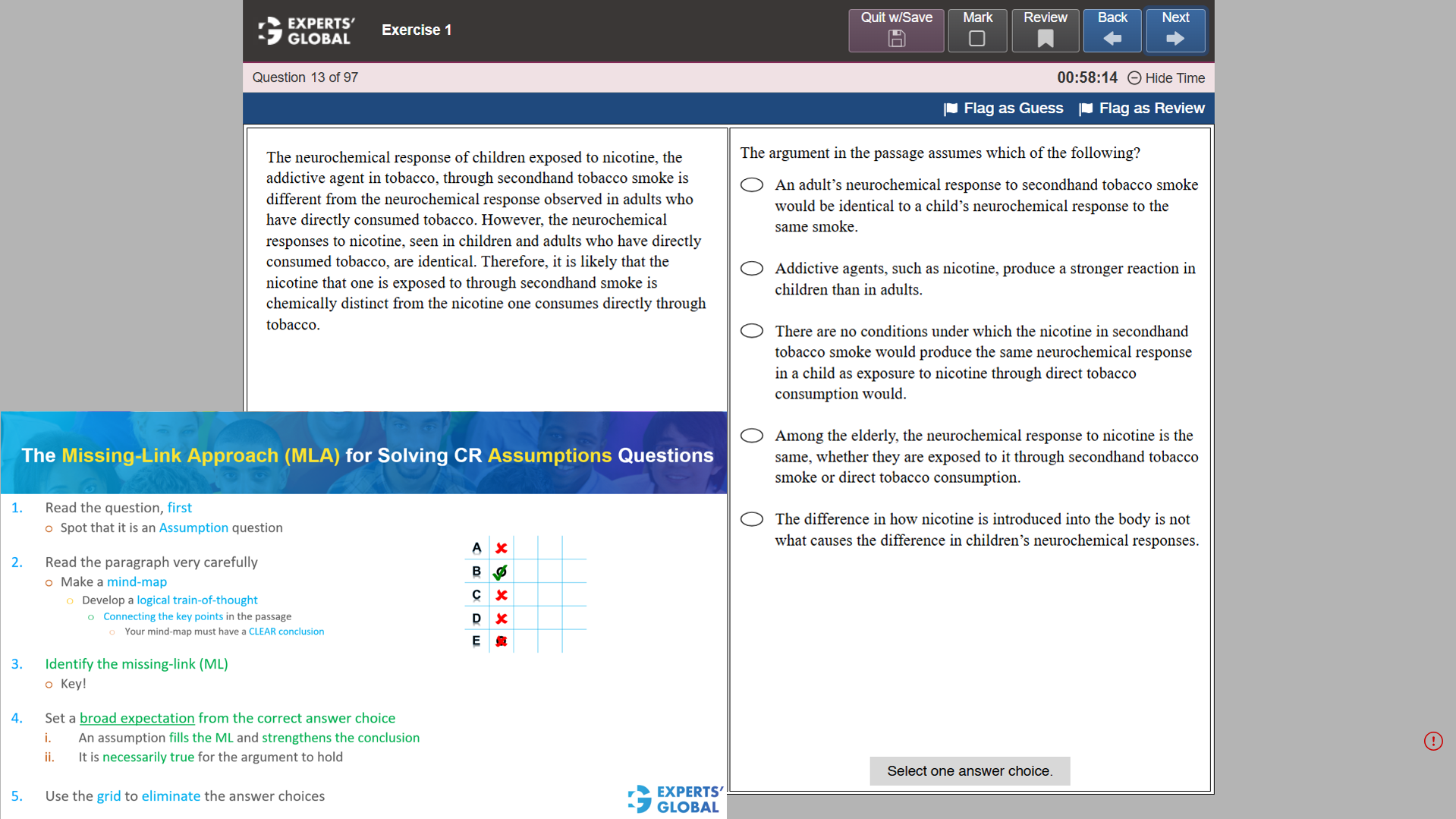
Correct Answer: E
For a detailed explanation of this question, please refer to the video presented earlier on this page.
Following is a concise, step-wise written explanation, using our Missing-Link Approach (MLA)…
The question asks for an assumption on which the argument depends.
The link between the method of exposure and the neurochemical response.
The correct answer will rule out the delivery method as the reason for the different reaction.
Correct Answer: E
Complete GRE prep course online with free trial
