
Invest 30 seconds...
...for what may lead to a life altering association!
Help Line
- +91.8800.2828.00 (IND)
- 1030-1830 Hrs IST, Mon-Sat
- support@expertsglobal.com
33% off ends soon:GMAT/GRE prep + applications bundle. Profile building, longer mentoring, better results. Inquire

In the previous lesson, we solved a set of 10 rich and diverse Data Interpretation questions. In this short lesson, you now solve one additional challenging GRE style DI question. This question sits at the highest level of difficulty that you may encounter on the GRE. After the learning built across the earlier lessons, this exercise acts as a final checkpoint. If you solve this question with comfort, you are progressing very well in your DI preparation. If the question stretches your thinking, that is natural. Take the learning forward and apply it across your GRE prep and practice across GRE exercises and full-length GRE practice tests.
Correct Answer: 72
For a detailed explanation, please refer to the video presented earlier on this page.
Following is a concise, step-wise written explanation…
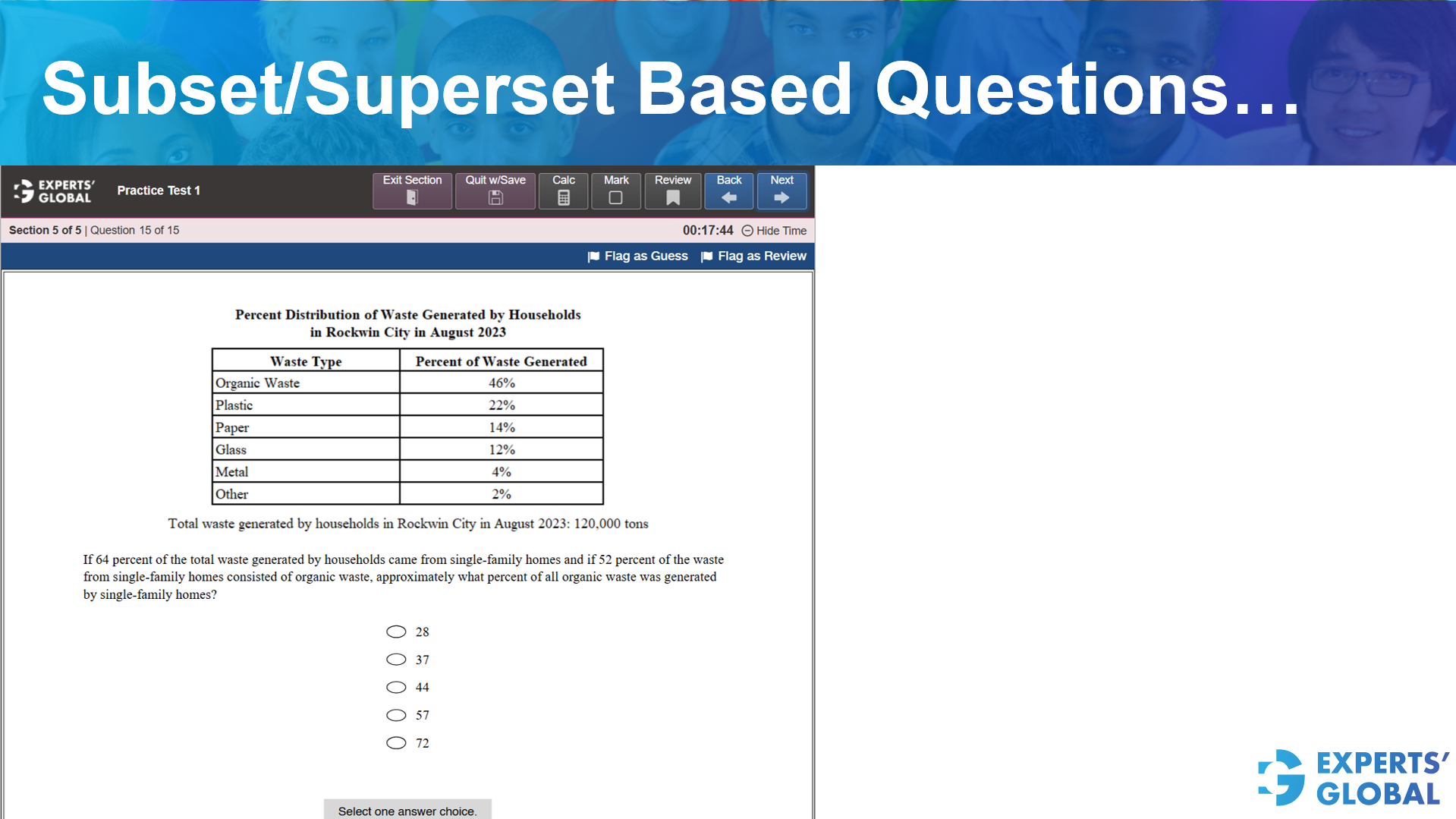
If 64 percent of the total waste generated by households came from single-family homes and if 52 percent of the waste from single-family homes consisted of organic waste, approximately what percent of all organic waste was generated by single-family homes?
A. 28
B. 37
C. 44
D. 57
E. 72
From the table, the total organic waste is 46 percent of the total waste.
Single-family homes produce 64 percent of the total waste.
Out of that waste, 52 percent is organic.
Organic waste from single-family homes = 0.52 * 0.64 of the total waste.
To find what percent this is of ALL organic waste, divide the single-family organic waste by the total organic waste: (0.52 * 0.64) / 0.46
0.3328 / 0.46 = 0.7234
Converting to percentage: 0.7234 * 100 = 72.34 percent.
The closest approximate value is 72.
Correct Answer: 72
All-inclusive GRE prep course online
15 full length GRE practice tests
60 sectional GRE practice tests
Free full-length GRE diagnostic mock
GRE prep bundled with admission consulting
