
Invest 30 seconds...
...for what may lead to a life altering association!
Help Line
- +91.8800.2828.00 (IND)
- 1030-1830 Hrs IST, Mon-Sat
- support@expertsglobal.com
33% off ends soon:GMAT/GRE prep + applications bundle. Profile building, longer mentoring, better results. Inquire

Analytical Writing is the first section you encounter on the GRE exam. When you begin fresh, this moment can also be your first experience with an official standardized test and the focused, formal environment of a test center, where you are asked to write an essay on a subjective issue while the clock runs. In this setting, having a broad essay template of your own proves highly valuable. A template that you have practiced during your GRE mock tests allows you to write the opening and closing paragraphs smoothly, while giving you space to settle into the exam and quietly observe and analyze the issue as you type those sections.
Having a clear overall approach and a preplanned flow for your essay, including strong first and last paragraphs and a clear structure for the middle paragraphs, helps you spend your exam time on analyzing the issue and shaping your ideas rather than figuring out how to organize your writing. The following video and the theory that follow, part of our GRE prep course, explain the importance of having your own broad template ready in advance. They clarify what such a template should look like, highlight the value of keeping it flexible, and guide you in developing a template that truly belongs to you. Use this concise yet rich resource to build a flexible and ethical template that supports a smooth start, steady focus, and a strong essay response on test day.
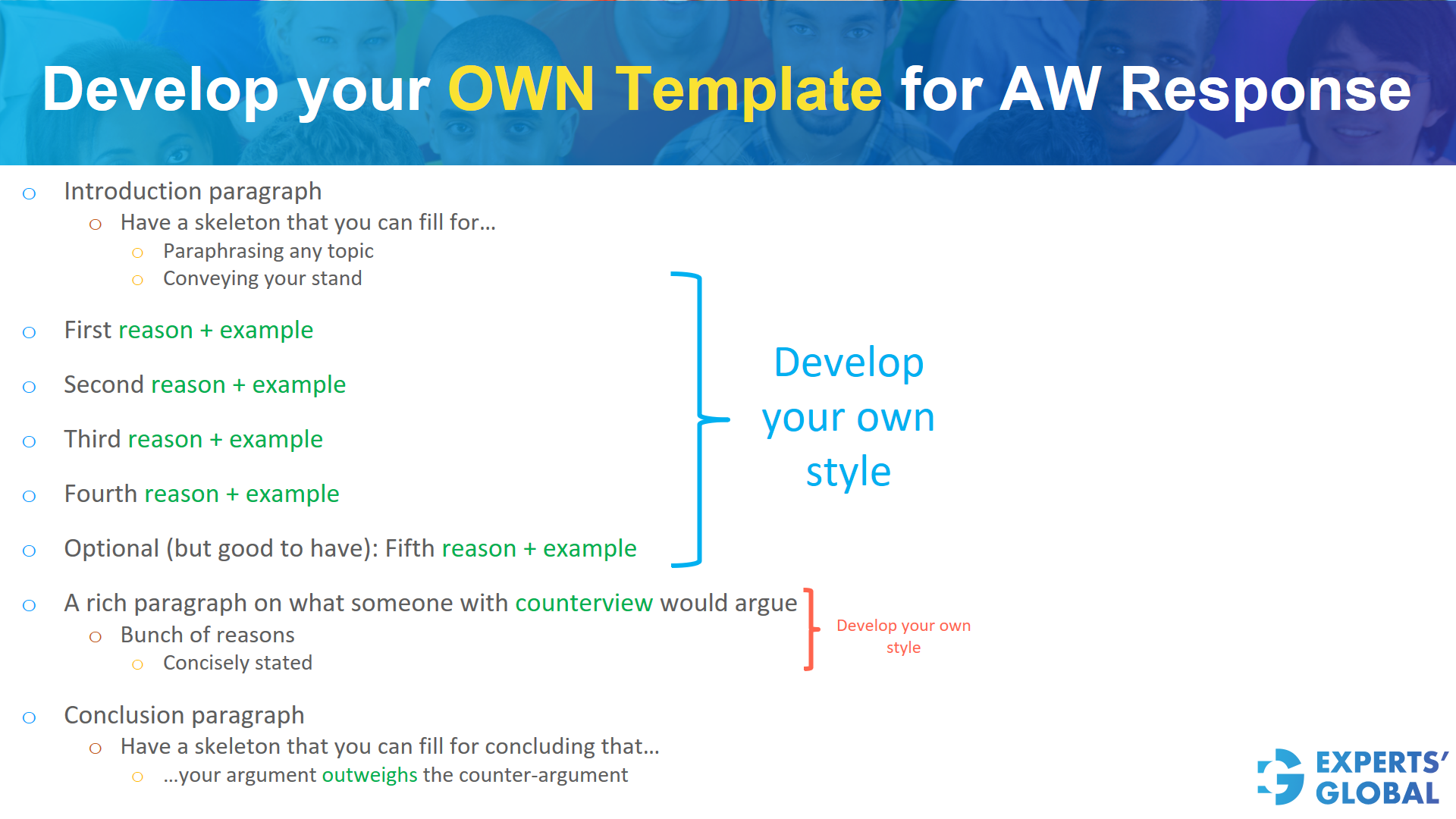
For a strong GRE Analytical Writing response, develop your own clear template that you can apply to every topic. Begin with an introduction paragraph that has a fixed skeleton you can easily fill. This skeleton should help you paraphrase the topic and clearly convey your stand. Having this structure in place allows you to start writing with direction and purpose every time.
Next, build the core of the essay through a sequence of reason and example paragraphs. Write the first reason with its example, followed by the second reason with its example, then the third, and then the fourth. If time allows, include an optional fifth reason with its example, which is good to have but not mandatory. Across these paragraphs, develop your own style so the flow feels natural while each reason remains clear and well supported.
After presenting your reasons, include a rich paragraph that explains what someone with a counterview would argue. This paragraph should present a bunch of reasons and state them concisely, again in your own style. Finally, close with a conclusion paragraph that also follows a fixed skeleton. This conclusion should clearly show that your argument outweighs the counter argument, bringing the response together in a complete and convincing way.
Complete GRE prep course online with free trial
Free GRE diagnostic test (full length)
Intensive 5-week GRE crash course
GRE preparation and admission consulting bundle
