
Invest 30 seconds...
...for what may lead to a life altering association!
Help Line
- +91.8800.2828.00 (IND)
- 1030-1830 Hrs IST, Mon-Sat
- support@expertsglobal.com
33% off ends soon:GMAT/GRE prep + applications bundle. Profile building, longer mentoring, better results. Inquire

Recurring decimals arise when fractions expand into decimals with digits that repeat in a fixed pattern. To solve GRE Quant questions based on recurring decimals, you focus on identifying the repeating pattern and answering the specific question being asked. The following video, part of our GRE course, explains recurring decimals in a simple and intuitive manner. It walks you through how repeating decimals form and shows how to represent them cleanly, then applies the approach on GRE-style questions so you experience the application first-hand. Take your time to absorb this topic and apply the learnings steadily across your GRE exercises, GRE sectional practice, and full-length GRE practice.
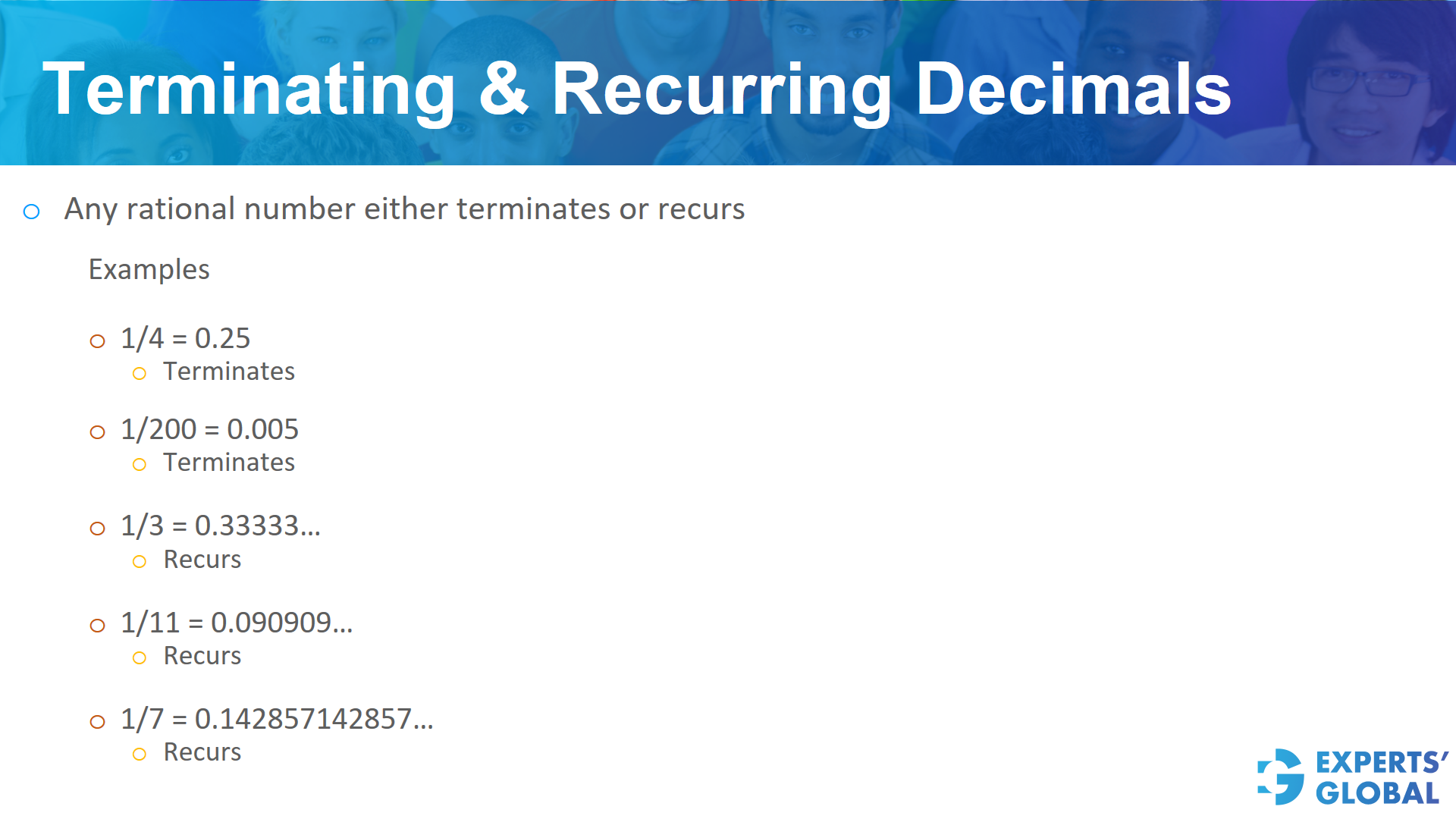
Any rational number can be expressed as a decimal that either terminates or recurs.
A terminating decimal is a decimal that has a finite number of digits. Examples include:
A recurring (or repeating) decimal is a decimal that has a digit or a sequence of digits that repeats infinitely. Examples include:
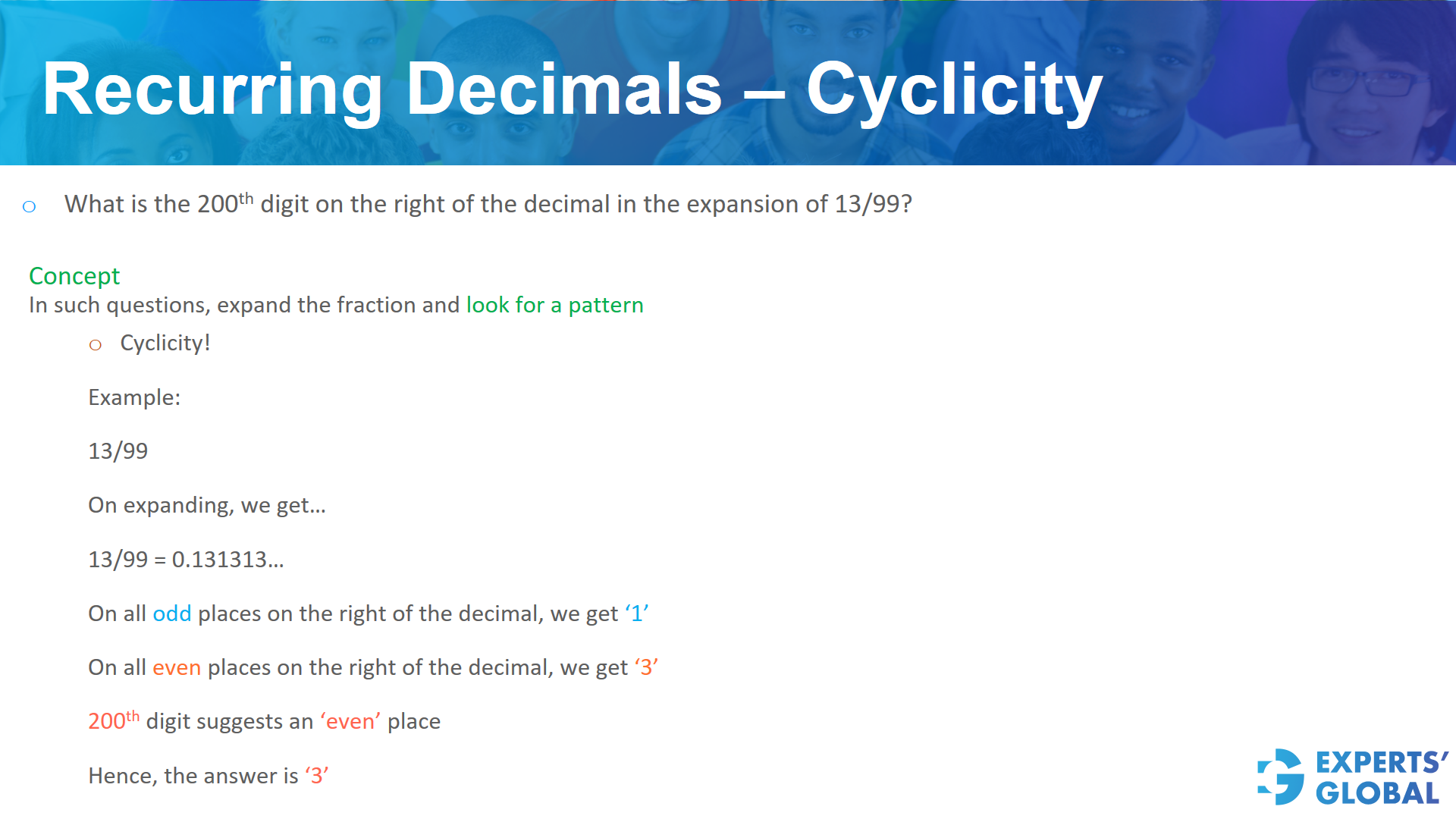
To find a specific digit in the expansion of a recurring decimal, you must identify the pattern of cyclicity within that expansion.
When expanding the fraction 13/99, the decimal result is 0.131313… This shows a repeating cycle of two digits: 1 and 3.
By observing the positions of the digits to the right of the decimal point, a clear pattern emerges based on whether the position is odd or even:
To determine the 200th digit in this expansion:
Correct Answer 4
For a detailed explanation, please refer to the video presented earlier on this page.
Following is a concise, step-wise written explanation…
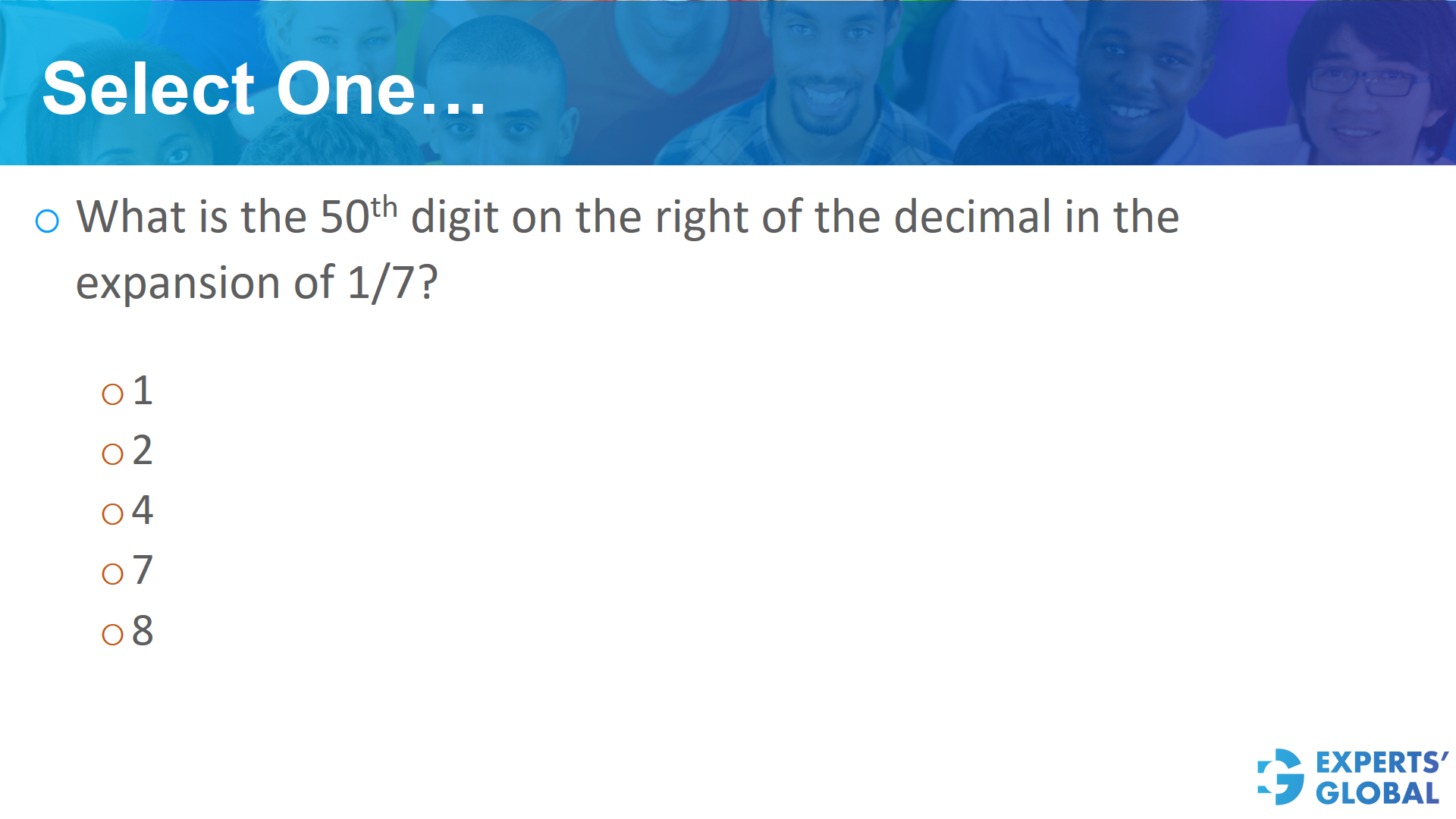
What is the 50th digit on the right of the decimal in the expansion of 1/7?
Divide 1 by 7 to see the pattern. 1 / 7 = 0.142857142857…
The digits 1, 4, 2, 8, 5, and 7 repeat. This is a cycle of 6 digits.
Divide the target position (50) by the number of digits in the cycle (6). 50 / 6 = 8 with a remainder of 2.
The remainder of 2 means the 50th digit is the same as the 2nd digit in the cycle. The 1st digit is 1. The 2nd digit is 4.
Correct Answer 4
Correct Answers: A, B, C, E, F, H, I
For a detailed explanation, please refer to the video presented earlier on this page.
Following is a concise, step-wise written explanation…
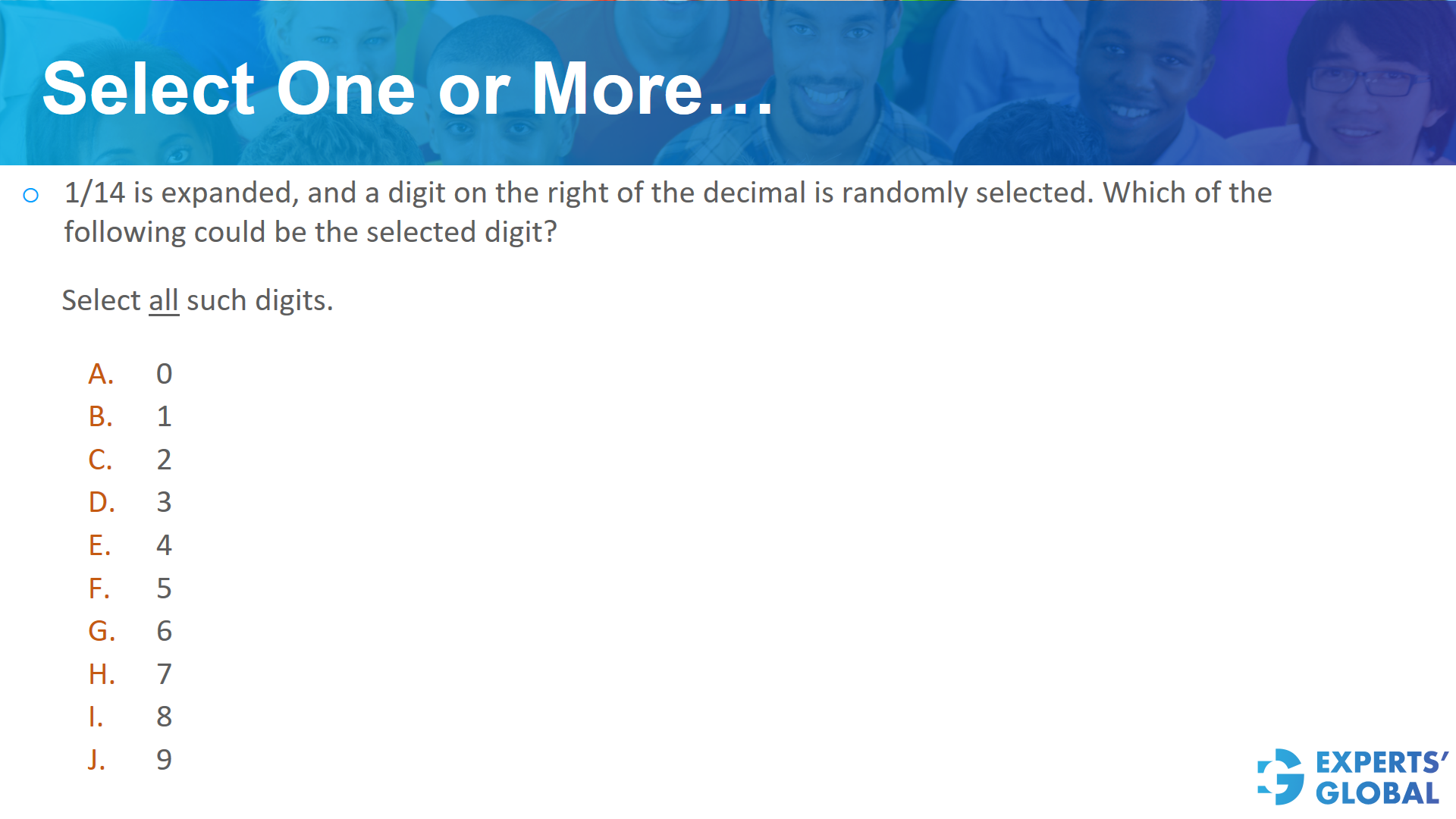
1/14 is expanded, and a digit on the right of the decimal is randomly selected. Which of the following could be the selected digit?
Select all such digits.
To find the decimal expansion, divide 1 by 14.
1 divided by 14 = 0.0714285714285…
The digit 0 appears only once at the start. After that, the sequence 714285 repeats forever.
Looking at the expansion, the digits that appear to the right of the decimal point are: 0, 7, 1, 4, 2, 8, and 5.
The digits 3, 6, and 9 do not appear in the decimal expansion of 1/14.
Correct Answers: A, B, C, E, F, H, I
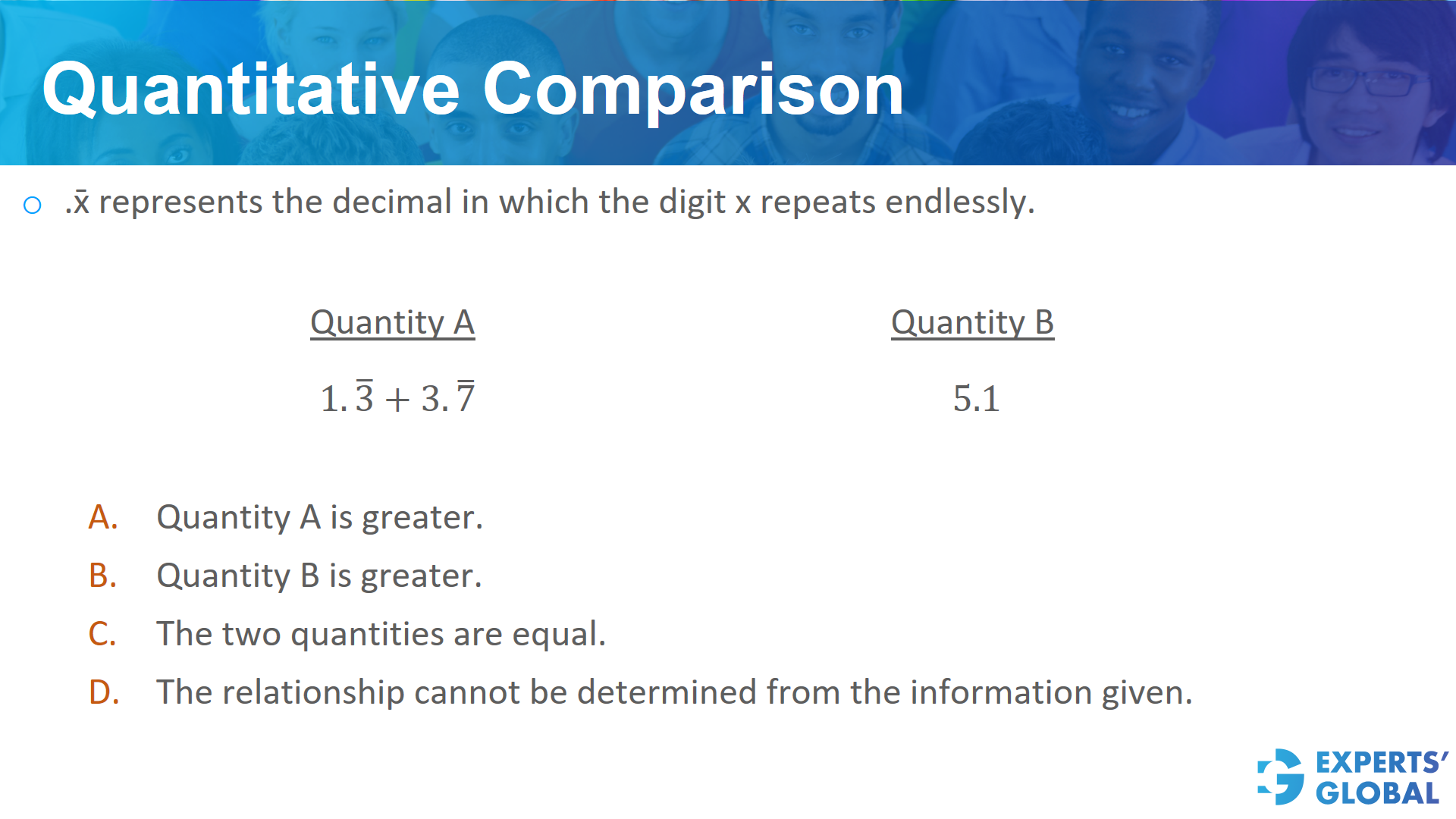
Correct Answer: A
Quantity A is greater.
For a detailed explanation, please refer to the video presented earlier on this page.
Following is a concise, step-wise written explanation…
represents the decimal in which the digit repeats endlessly.
Quantity A
1.333… + 3.777…
Quantity B
5.1
The bar over a number means it repeats forever. 1.3 bar = 1.3333… 3.7 bar = 3.7777…
Add the whole numbers: 1 + 3 = 4 Add the repeating decimals: 0.3333… + 0.7777… = 1.1111… Total for Quantity A: 4 + 1.1111… = 5.1111…
Quantity A: 5.1111… Quantity B: 5.1000
Since 5.11 is larger than 5.10, Quantity A is greater.
Correct Answer: A
Quantity A is greater.
GRE preparation course designed for full coverage
15 full length GRE practice exams
60 sectional GRE practice exams
