
Invest 30 seconds...
...for what may lead to a life altering association!
Help Line
- +91.8800.2828.00 (IND)
- 1030-1830 Hrs IST, Mon-Sat
- support@expertsglobal.com
33% off ends soon:GMAT/GRE prep + applications bundle. Profile building, longer mentoring, better results. Inquire

Main point or conclusion questions in GRE Critical Reasoning ask you to identify the central takeaway of an argument or the conclusion the author wants you to reach. These questions focus on the purpose of the argument and the reason it was written. The correct answer is not just any statement that follows from the paragraph. It must reflect the core message that ties all parts of the argument together. A sincere GRE prep course must ensure due coverage of this question type.
The correct answer choice must meet two clear criteria. First, it must be deducible from the information presented in the paragraph without relying on assumptions, extrapolations, or exaggerations. Second, it must represent the main point of the argument, meaning the primary idea the argument is built around. To arrive at this, you first build a clear mind map that connects the key points of the argument and leads you to its conclusion. Based on this mind map, you set a broad expectation for the correct answer choice and then go by elimination, removing options that do not meet both criteria. A common trap is an answer choice that can be inferred from the passage but does not capture the main point. This distinction is what separates main point or conclusion questions from inference questions.
The following comprehensive video lesson explains this question type in a clear and structured way and demonstrates the approach on GRE-style examples. Use this resource carefully and apply the same method consistently as you continue your GRE preparation and practice on GRE full mocks and GRE sectional mocks.
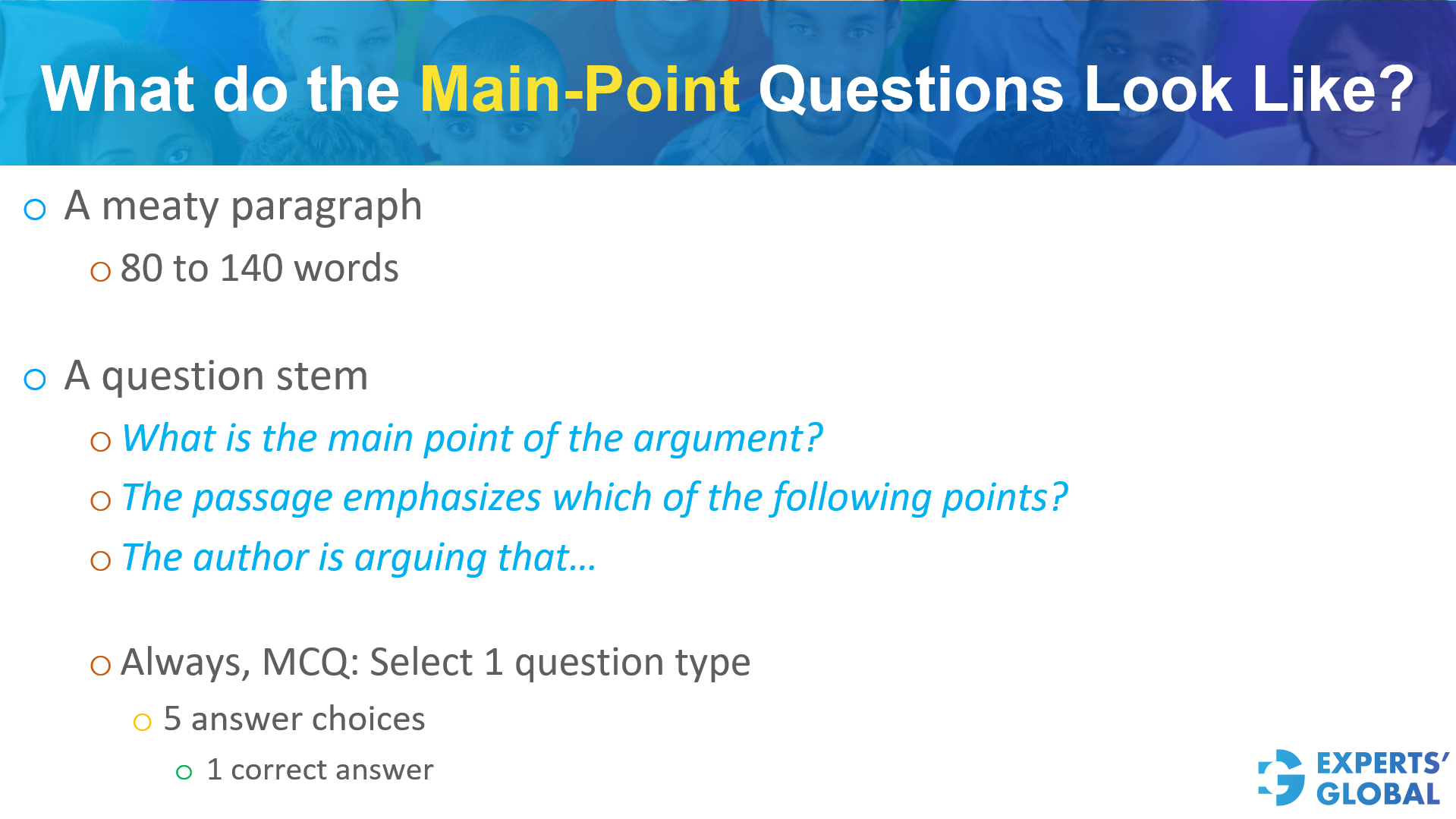
Main Point questions feature a single, well-developed paragraph that presents a complete argument. This text typically ranges between 80 and 140 words to ensure a full expression of ideas. A specific question stem directs focus toward the central idea of the argument by asking for the main point or the point the passage emphasizes most. Some stems frame the task by noting that the author argues for a specific idea and require you to identify it.
These questions use a multiple choice format with a Select 1 structure. You evaluate five total answer choices to find the one option that correctly captures the main point. This structure requires precise reading and focused thinking to distinguish the central claim from supporting evidence or background information.
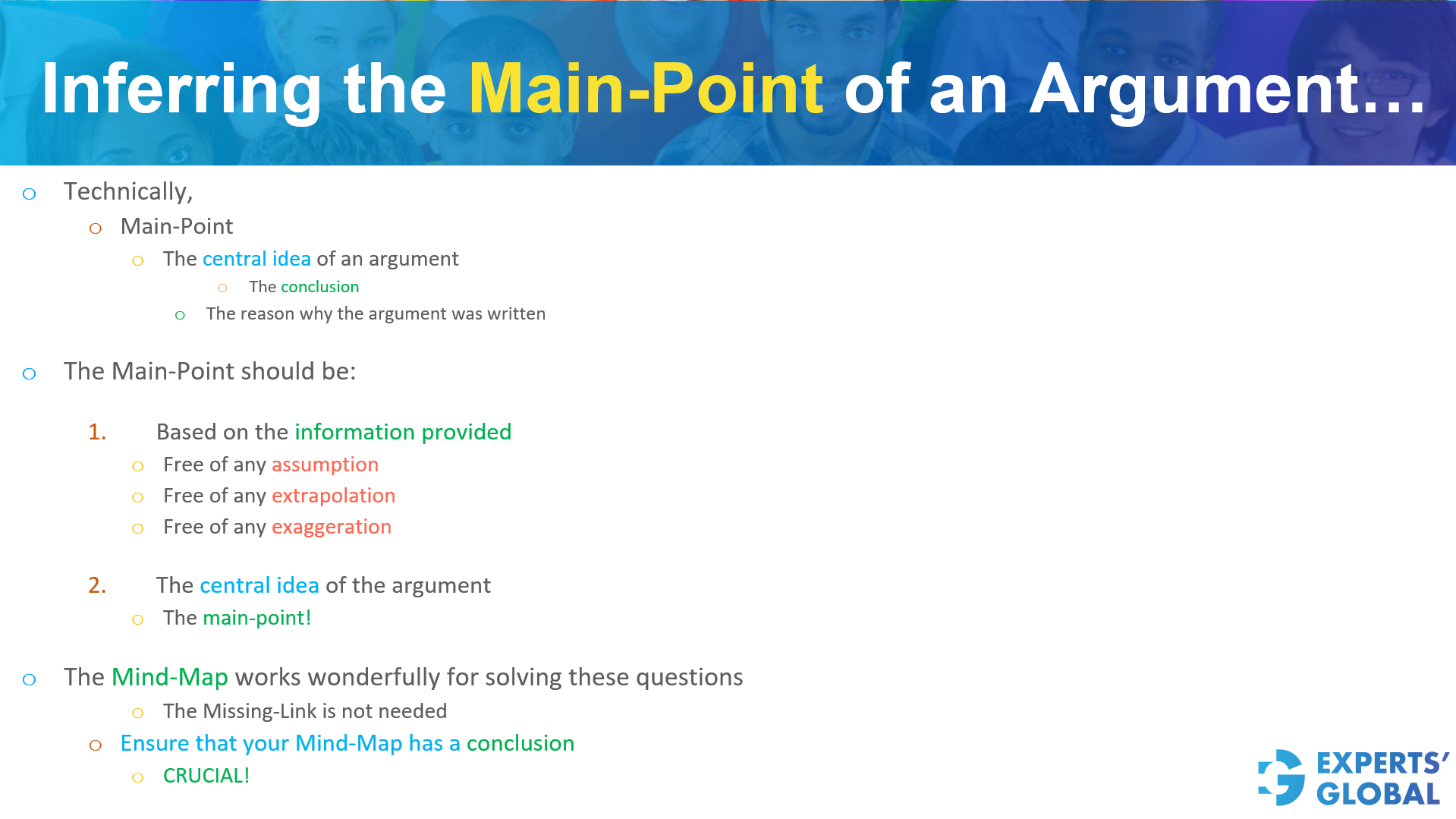
The main point represents the central idea of an argument and serves as the ultimate conclusion. It identifies the fundamental reason for the existence of the text. A correct main point relies entirely on the information provided in the passage and excludes any outside assumption, extrapolation, or exaggeration. This ensures the final selection reflects the central idea in a precise and grounded manner.
Using a mind map organizes ideas and creates a clear path toward the core purpose of the argument. You do not require a missing link to identify the main point because the focus remains exclusively on what the author directly states. A comprehensive mind map leads to a clear conclusion, which provides the necessary clarity to identify the main point with accuracy.
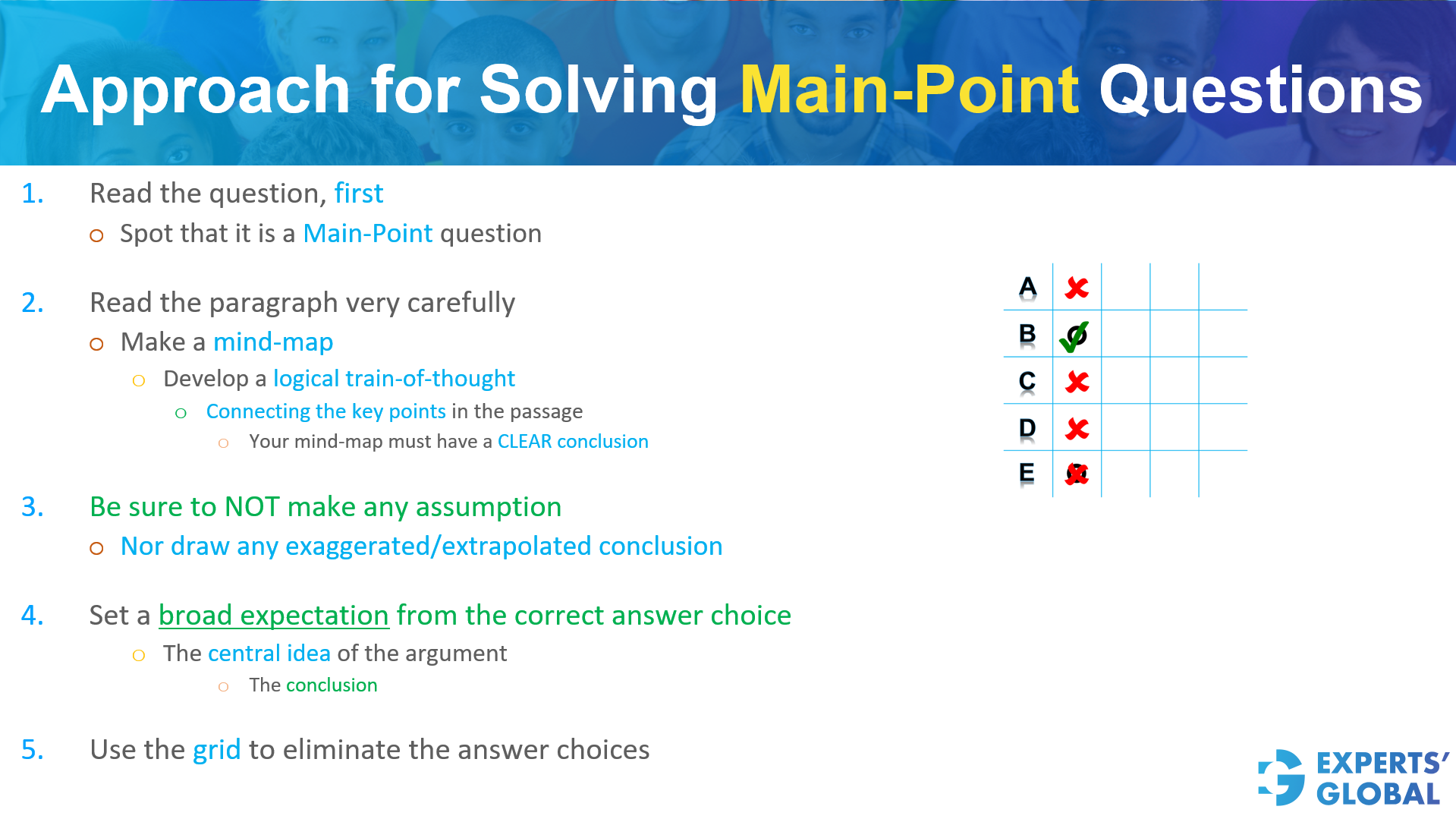
Begin by reading the question to identify it as a main point question, then read the paragraph carefully to build full clarity regarding the argument. Create a clear mind map while reading to track the flow of ideas and develop a logical train of thought by connecting the key points in the passage. Ensure that the mind map leads to a clear and well-defined conclusion.
Maintain complete accuracy by staying free of any assumption. Keep the conclusion free of any exaggeration or extrapolation. Set a broad expectation for the correct answer by focusing on the central idea of the argument and identify the conclusion as the core of the main point. Use the grid approach to evaluate and eliminate answer choices systematically.
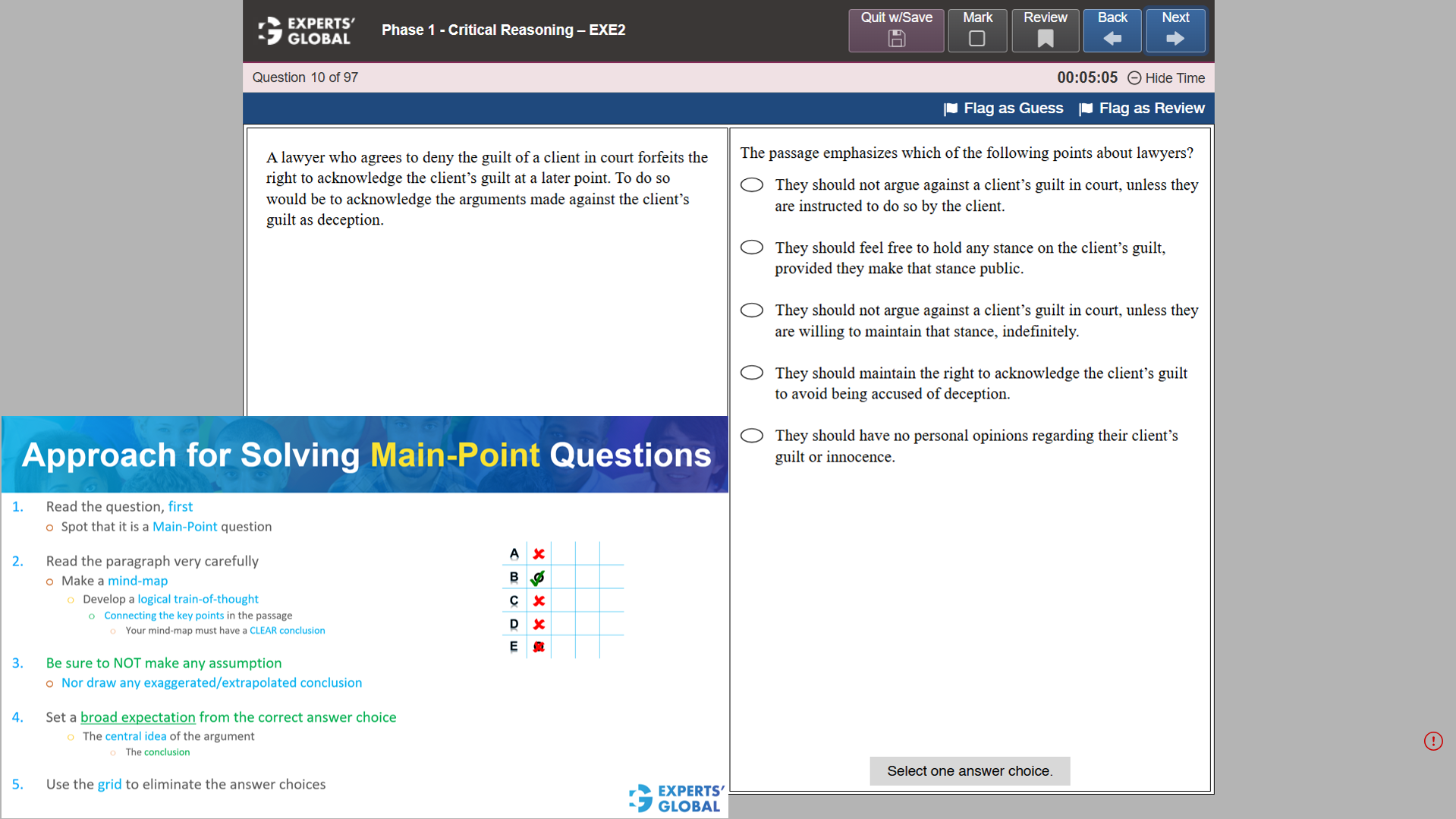
Correct Answer: C
For a detailed explanation of this question, please refer to the video presented earlier on this page.
Following is a concise, step-wise written explanation, using our Missing-Link Approach (MLA)…
The question asks what point the passage emphasizes about lawyers. This confirms it is a Main-Point question.
We will break the passage into three logical bytes to build a mind-map:
We must only use the information provided. We cannot assume what a lawyer personally believes or what the client’s instructions are. We only know that once a stance is taken in court, it must be maintained.
The correct answer should reflect that choosing to argue for innocence in court creates a long-term commitment to that position to avoid being seen as deceptive.
Correct Answer: C
Free full length GRE diagnostic test
