
Invest 30 seconds...
...for what may lead to a life altering association!
Help Line
- +91.8800.2828.00 (IND)
- 1030-1830 Hrs IST, Mon-Sat
- support@expertsglobal.com
33% off ends soon:GMAT/GRE prep + applications bundle. Profile building, longer mentoring, better results. Inquire

Sentence equivalence questions typically account for about 7 of the 27 questions in the GRE Verbal section. This question type offers a meaningful opportunity to strengthen accuracy and, even more importantly, build speed, since some of the other question types such as Reading Comprehension and Text Completion 2 Blank and 3 Blank questions naturally take more time to solve. When you learn to handle sentence equivalence efficiently, you create extra space in your timing plan, which makes the entire Verbal section feel more manageable and balanced. With the right strategy and steady practice, sentence equivalence questions can usually be solved in about 45 to 60 seconds on average, allowing you to carry that saved time into questions that need deeper reading and reflection. Therefore, saving time on SE should be an important part of GRE preparation course.
In this article, we walk through practical techniques for saving time on GRE sentence equivalence questions. The video that follows explains these techniques clearly and shows how you can apply them using GRE-like examples. Watch the video with attention, then study the article that follows to absorb each idea at a comfortable pace. After that, apply these learnings in your GRE preparation, both during regular practice exercises and in full-length GRE mock tests, so the approach settles in naturally and supports you on test day.
Identify your GRE strengths and gaps using a free full-length GRE diagnostic test
When you are reading a difficult passage, you will often come across “Proper Nouns”—these are specific names of people, places, or scientific things. Sometimes these names are long and hard to pronounce. The secret to reading faster and better is this: Do not get stuck on them. You can simply skim over the complex name and focus on what the sentence is actually saying.
Instead of trying to pronounce a 20-letter name, just treat it like a simple placeholder (like “Person X” or “This Animal”). Here are two examples of how to do this:
For a detailed explanation for examples on the slide, please refer to the video featured earlier on this page. Following is step-by-step written explanation.
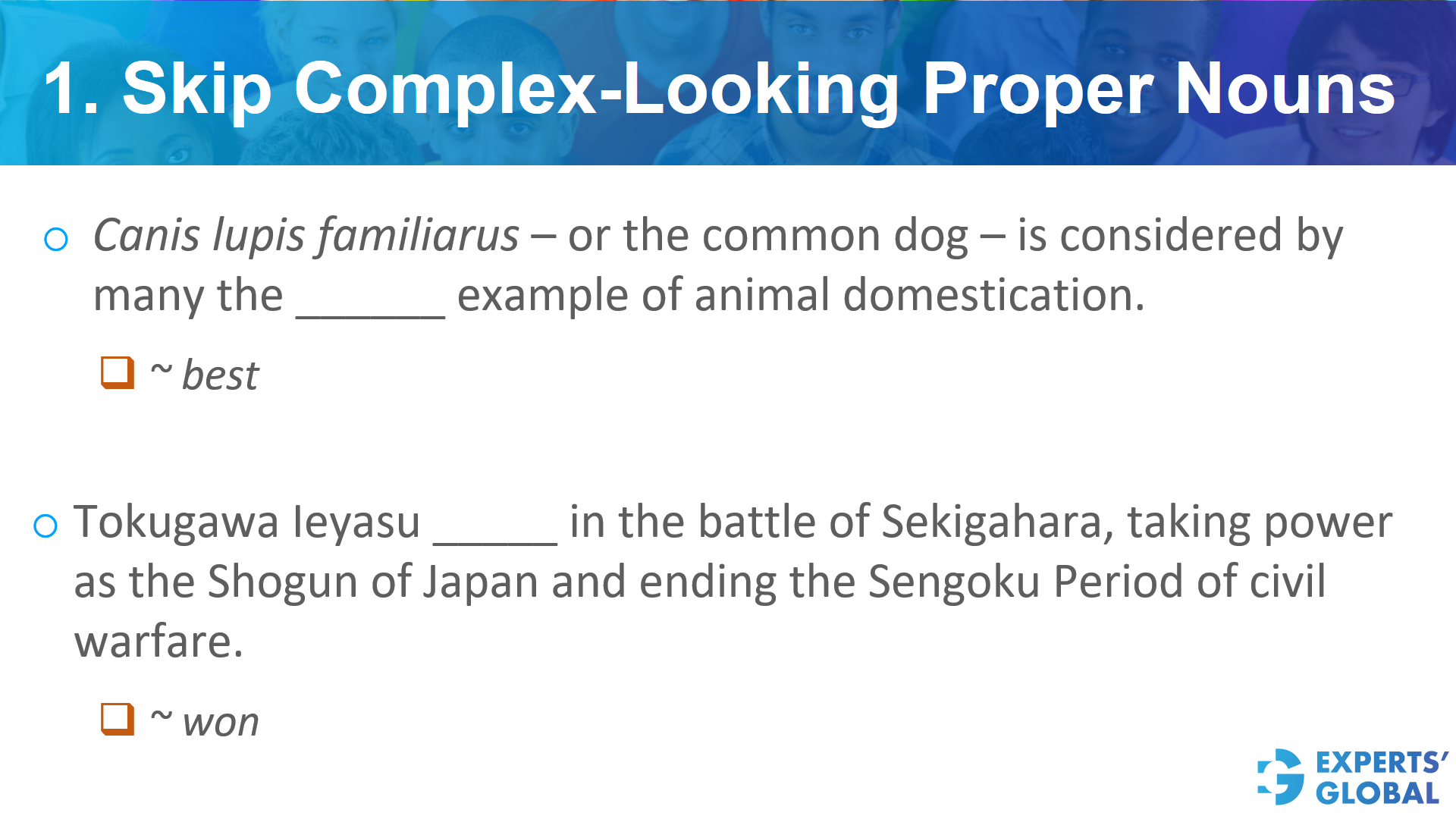
Canis lupis familiarus — or the common dog — is considered by many the ______ example of animal domestication.
Broad expectation from the correct answer choice: ~ best
Tokugawa Ieyasu ______ in the battle of Sekigahara, taking power as the Shogun of Japan and ending the Sengoku Period of civil warfare.
Broad expectation from the correct answer choice: ~ won
Don’t let big names scare you! If you see a word that starts with a capital letter and looks hard to read, just recognize it as a “Proper Noun” and keep moving to find the main action of the sentence.
When reading long sentences, it is easy to get lost in all the extra details. One of the best ways to simplify a sentence is to identify and “run through” the prepositional phrases. These are groups of words that begin with a preposition (like of, in, for, to) and end with a noun. By identifying these phrases, you can find the core subject and the main action more easily.
For a detailed explanation for examples on the slide, please refer to the video featured earlier on this page. Following is step-by-step written explanation.
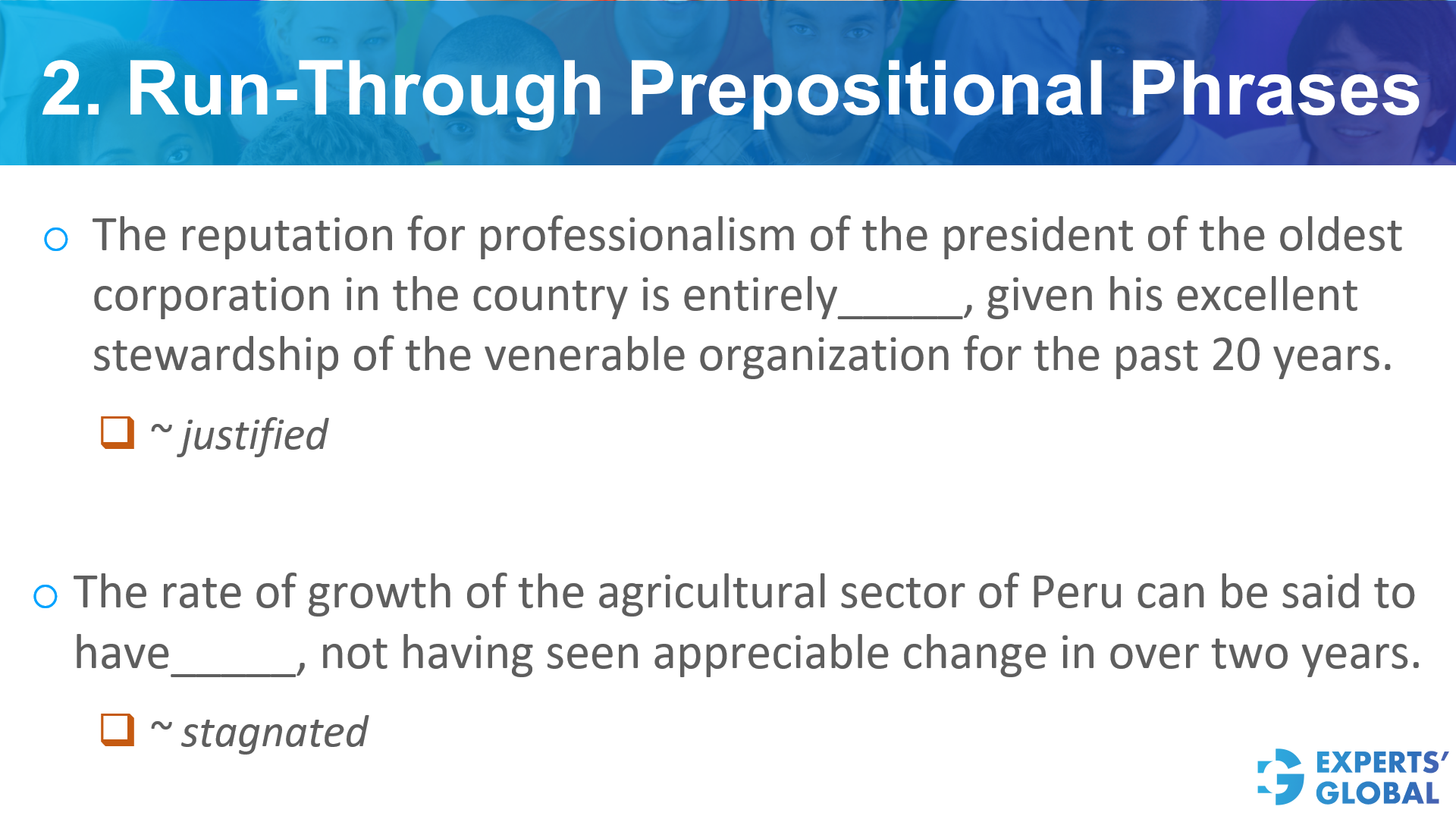
The reputation for professionalism of the president of the oldest corporation in the country is entirely ______, given his excellent stewardship of the venerable organization for the past 20 years.
Step-by-Step Solution:
Broad expectation from the correct answer choice: ~ justified
The rate of growth of the agricultural sector of Peru can be said to have ______, not having seen appreciable change in over two years.
Step-by-Step Solution:
Broad expectation from the correct answer choice: ~ stagnated
When you are reading long or complex sentences, it is easy to get lost in the details. One of the most effective ways to understand the core meaning of a sentence is to Run-Through the Text Between Commas. In most sentences, the information placed between two commas is “extra” information (an appositive or a parenthetical phrase) that describes the noun before it. While this information is helpful, you don’t need it to understand the basic structure of the sentence. By mentally skipping or “running through” that middle section, you can connect the subject directly to the verb, making the sentence much easier to solve or understand.
For a detailed explanation for examples on the slide, please refer to the video featured earlier on this page. Following is step-by-step written explanation.
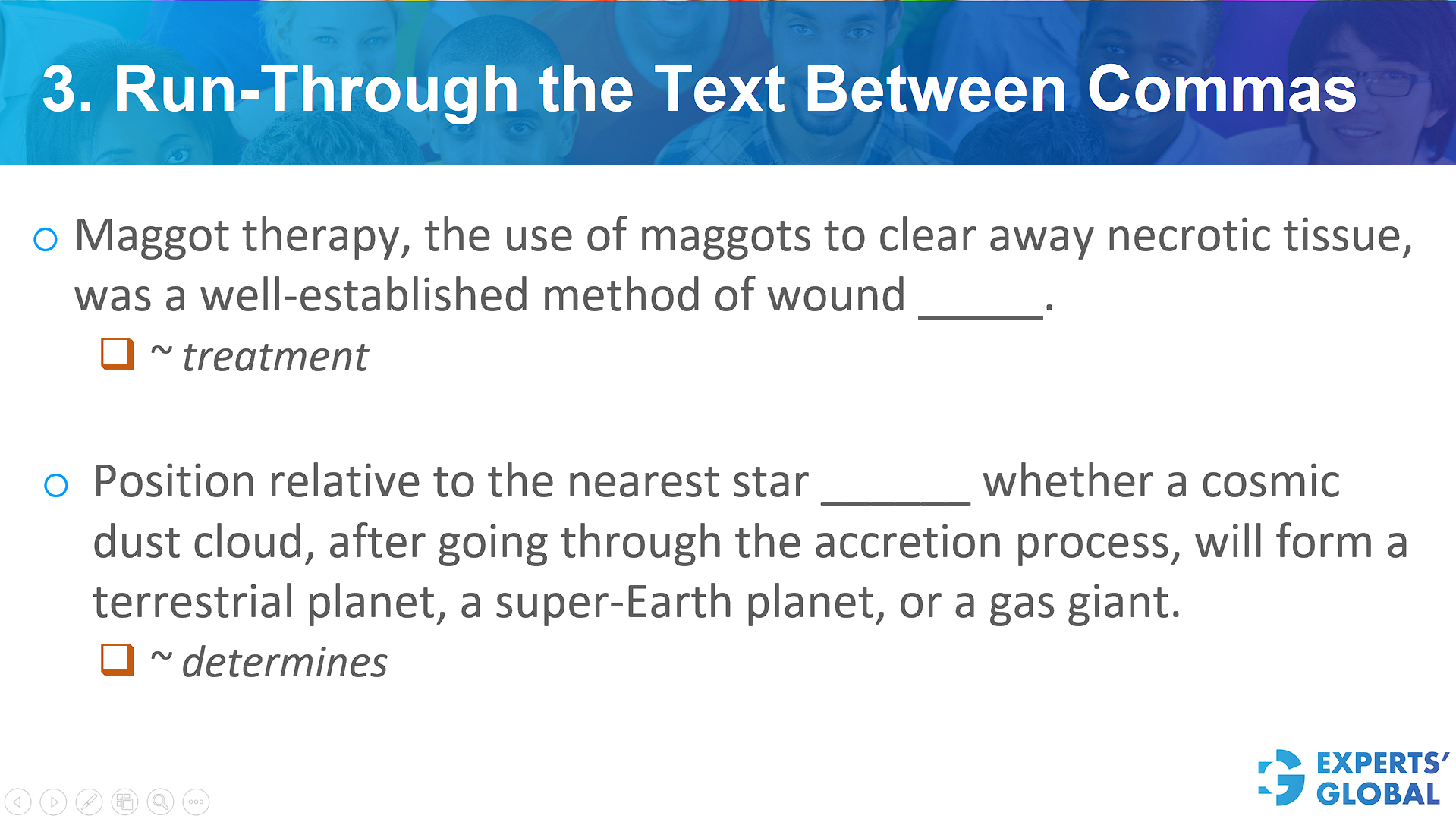
Maggot therapy, the use of maggots to clear away necrotic tissue, was a well-established method of wound ______.
Step-by-Step Approach:
Broad expectation from the correct answer choice: ~ treatment
Position relative to the nearest star ______ whether a cosmic dust cloud, after going through the accretion process, will form a terrestrial planet, a super-Earth planet, or a gas giant.
Step-by-Step Approach:
Broad expectation from the correct answer choice: ~ determines
You can save time on GRE sentence equivalence questions by skimming complex names, factual details, and numbers, focusing instead on the role they play in the sentence and on understanding the core message (rather than the surface complexity).
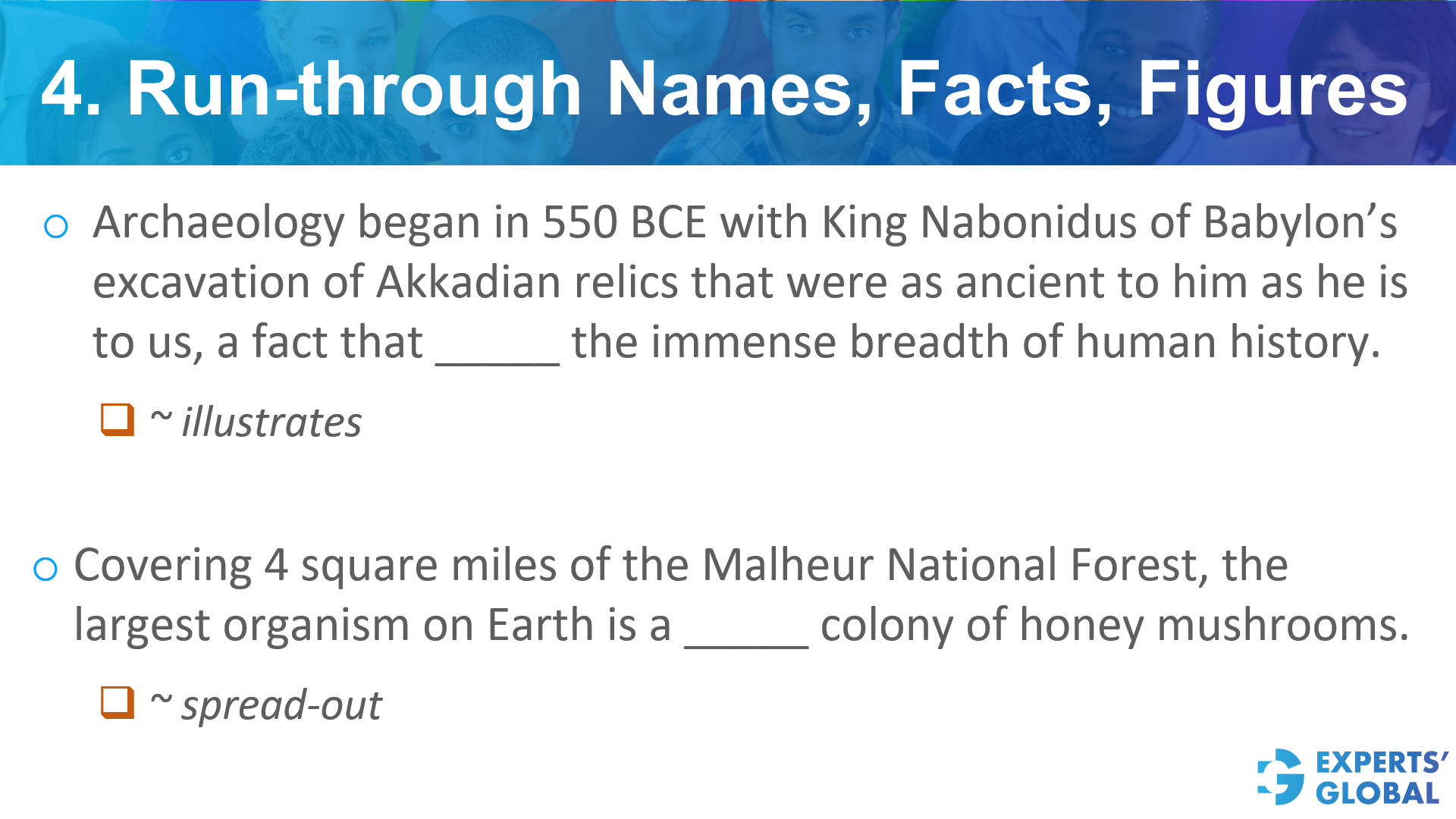
Archaeology began in 550 BCE with King Nabonidus of Babylon’s excavation of Akkadian relics that were as ancient to him as he is to us, a fact that _______ the immense breadth of human history.
Step-by-Step Solution:
Broad expectation from the correct answer choice: ~ illustrates
Completed Sentence:
Archaeology began in 550 BCE with King Nabonidus of Babylon’s excavation of Akkadian relics that were as ancient to him as he is to us, a fact that illustrates the immense breadth of human history.
Covering 4 square miles of the Malheur National Forest, the largest organism on Earth is a _______ colony of honey mushrooms.
Broad expectation from the correct answer choice: ~ spread-out
Completed Sentence:
Covering 4 square miles of the Malheur National Forest, the largest organism on Earth is a sprawling colony of honey mushrooms.
It is completely normal to encounter words you don’t know while taking the GRE. This happens to everyone! Even if you run into a difficult sentence or word, it is not the end of the road. You can still get the question correct. Here is a simple guide on how to handle difficult words and stay in control of your test.
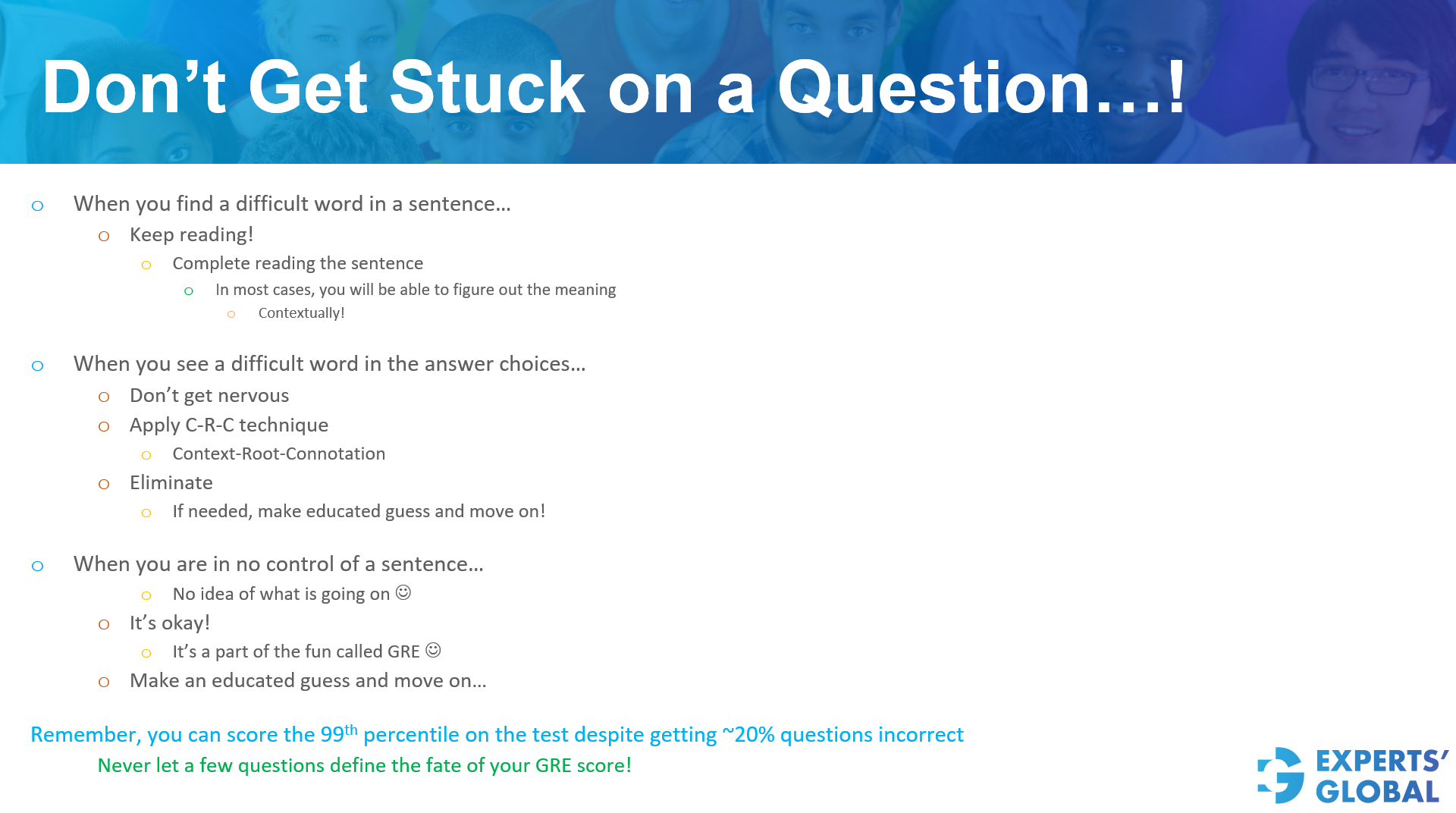
Keep reading..
If you are looking at the options and see a word that looks intimidating, follow these steps:
Sometimes, you might have no idea what is going on in a sentence at all.
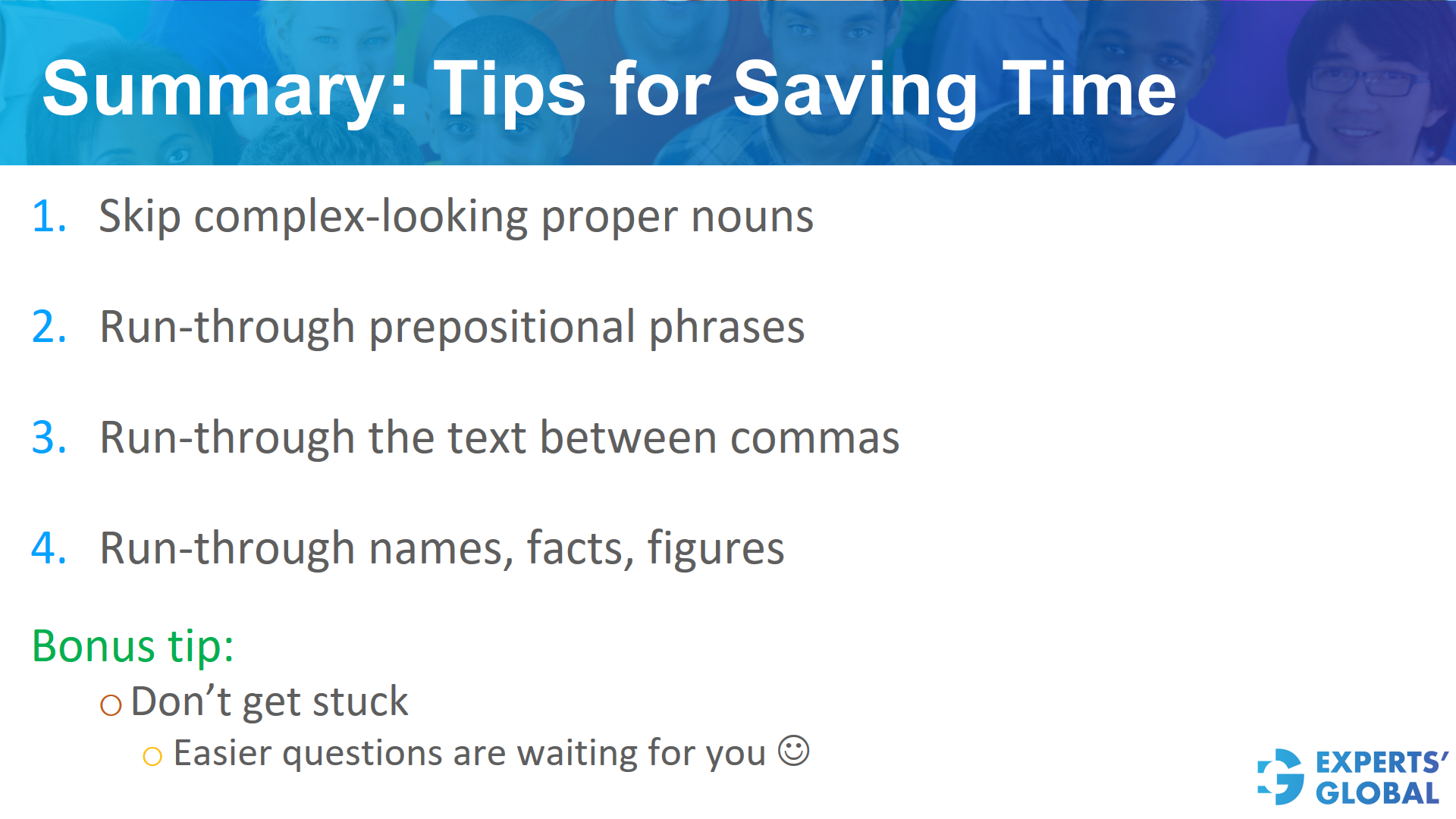
When you are taking a timed exam like the GRE, managing your time is just as important as knowing the material. Here is a recap of the four simple strategies to help you move through the text faster and more efficiently.
Proper nouns are the names of specific people, places, or organizations (usually starting with a capital letter). If you see a long or complicated name that is hard to pronounce, do not waste time trying to sound it out. Simply recognize it as a “name” and move on.
Prepositional phrases (groups of words starting with words like “in,” “on,” “at,” or “by”) often add extra detail but are not the main point of the sentence. You can “run-through” or skim these quickly to get to the core message faster.
Information placed between two commas is often descriptive or secondary. To save time, skim through this extra information to maintain the flow of the main sentence.
Specific details like dates, long lists of facts, or numerical figures can slow you down. Run-through these quickly during your first read. If a question specifically asks for a number or a fact later, you can always go back and find it.
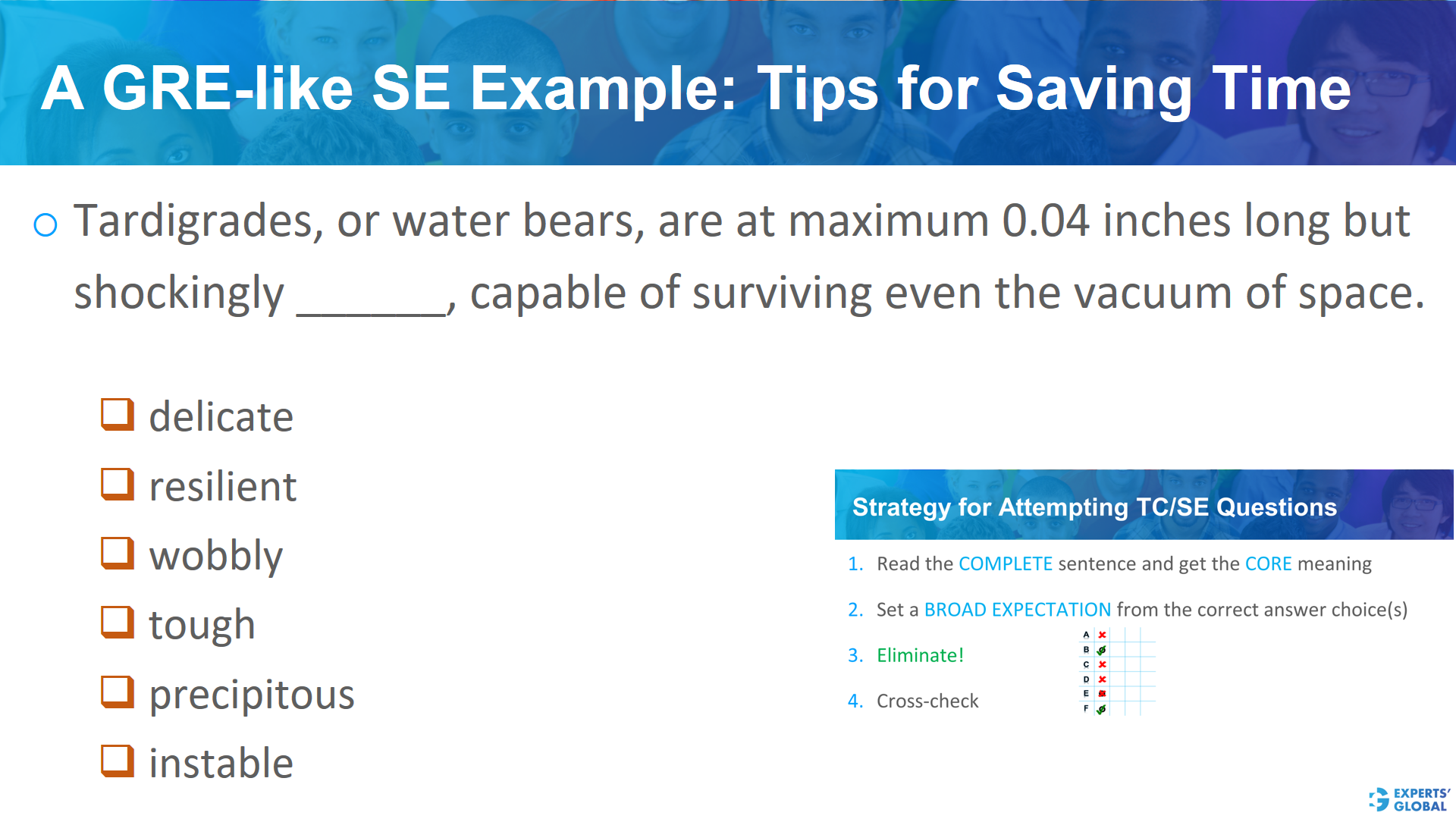
Correct Answers: B and D
For a detailed explanation of this question, please refer the last ~2 minutes of the video featured earlier on this page. Following is a step-by-step written solution:
Tardigrades, or water bears, are at maximum 0.04 inches long but shockingly __________, capable of surviving even the vacuum of space.
Based on the clue “surviving the vacuum of space,” what kind of word are we looking for? We need a word that means strong, sturdy, or able to survive harsh conditions.
Now, let’s look at our choices and remove the ones that don’t fit our “broad expectation”:
In Sentence Equivalence, the two words you choose must create sentences with the same meaning.
Correct Answers: B and D
As you work on saving time in Sentence Equivalence, you start building a deeper skill that quietly shapes your entire GRE journey: you learn to respect meaning more than noise. You skim long names, extra phrases, facts, and figures not because they do not matter, but because you train yourself to locate the core message first and return to details only when they serve a purpose. That habit carries into graduate and MBA admissions consulting process in a beautiful way. Applications reward the same clarity: you present your story with focus, you keep your message coherent, and you do not let crowded details dilute what you truly want the reader to understand. Life works the same way. Days fill up with information, opinions, and pressure to respond quickly, yet progress comes from choosing what deserves your attention and letting the rest pass without stealing your energy. Keep practicing these time-saving techniques with warmth and consistency. Over time, you gain speed, strengthen accuracy, and develop a calm inner structure that supports every high-stakes choice you make.
GRE preparation course with 7-day trial
Set of 15 Full length GRE practice tests
Set of 60 sectional GRE practice tests
Free full length diagnostic test for GRE
