
Invest 30 seconds...
...for what may lead to a life altering association!
Help Line
- +91.8800.2828.00 (IND)
- 1030-1830 Hrs IST, Mon-Sat
- support@expertsglobal.com
33% off ends soon:GMAT/GRE prep + applications bundle. Profile building, longer mentoring, better results. Inquire

Running into unfamiliar vocabulary is a natural and expected part of GRE preparation. In Text Completion questions, you often see one or more words that you have never encountered before, and that is completely normal. Even with steady vocabulary building, no test taker knows every word that appears on the exam. These moments do not interrupt your progress and they do not define the outcome of a question. They simply mark a routine step in the reasoning process, one that thoughtful preparation always anticipates.
Text Completion questions reward your ability to work with meaning, structure, and direction, even when specific words feel new. When you approach such questions with a clear plan, unknown words lose their power to distract. A sincere GRE prep course must include a practical way to manoeuvre the challenge move forward.
The video below and the explanation that follows present a clear and structured approach known at Experts’ Global as the Context Root Connotation, or CRC, strategy. This method shows you how to rely on the sentence framework, word roots, and emotional tone to evaluate answer choices effectively in GRE Text Completion questions. The resources on this page walk you through the approach and demonstrate its application on GRE style examples. Use this guidance with intention as you practice, so that handling unfamiliar words becomes a steady and dependable habit throughout your GRE preparation.
Seeing words that feel new or unclear is a routine part of the GRE experience, especially in Text Completion questions. Accepting this early gives you a strong mental edge. These moments appear naturally, and progress depends on how prepared your thinking is when they arise. When unfamiliar words distract you, attention shifts away from sentence logic. When you stay focused on structure and meaning, control stays with you. Text Completion questions do not expect complete vocabulary coverage. They reward your ability to reason through context, direction, and intent. What matters is having a clear response when a word feels unfamiliar. The video below explains a practical way to handle such situations, helping you remain attentive, analytical, and forward moving throughout the question. With the right approach, even sentences filled with unknown words become clear opportunities to apply logic and continue solving with purpose.
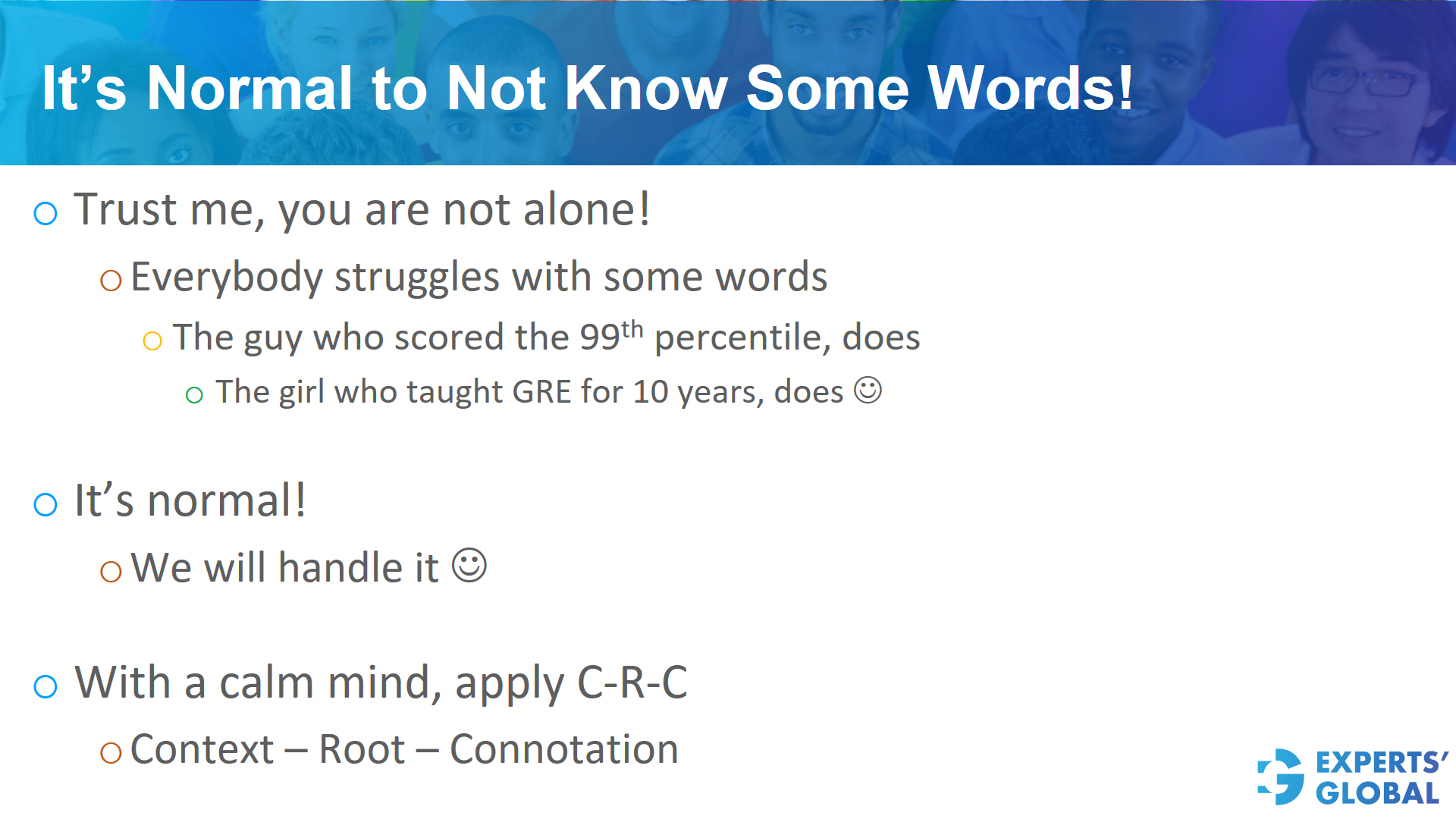
Not knowing some words is normal and happens to everyone, and this situation does not block you from answering correctly. You can still reach the correct answer by using a structured approach. The CRC technique helps you interpret unfamiliar words by combining context, root, and connotation.
For a detailed explanation for example on the slide, please refer to the video featured earlier on this page. Following is step-by-step written explanation.
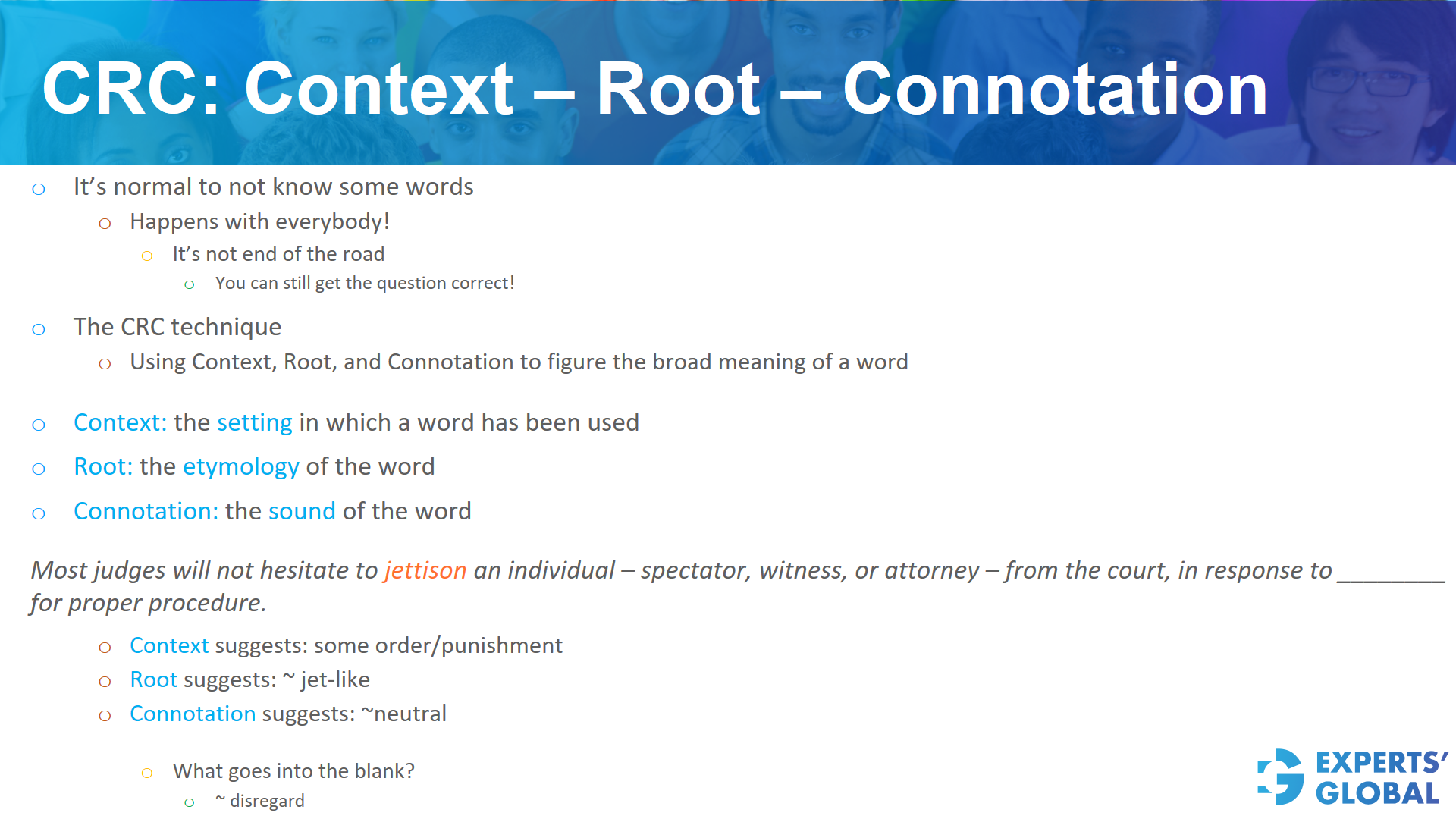
Most judges will not hesitate to jettison an individual — spectator, witness, or attorney — from the court, in response to ________ for proper procedure.
Now, let’s look at the blank at the end of the sentence: “…in response to ________ for proper procedure.”
What goes into the blank?
If a judge is removing someone from court as a punishment, it is likely because that person showed a ~ disregard for the rules.
Broad expectation from the correct answer choice for filling the blank: ~ disregard
When reading, you may often come across a word you do not know. However, you can often figure out a lot about that word simply by looking at the context — the words and sentences surrounding it.
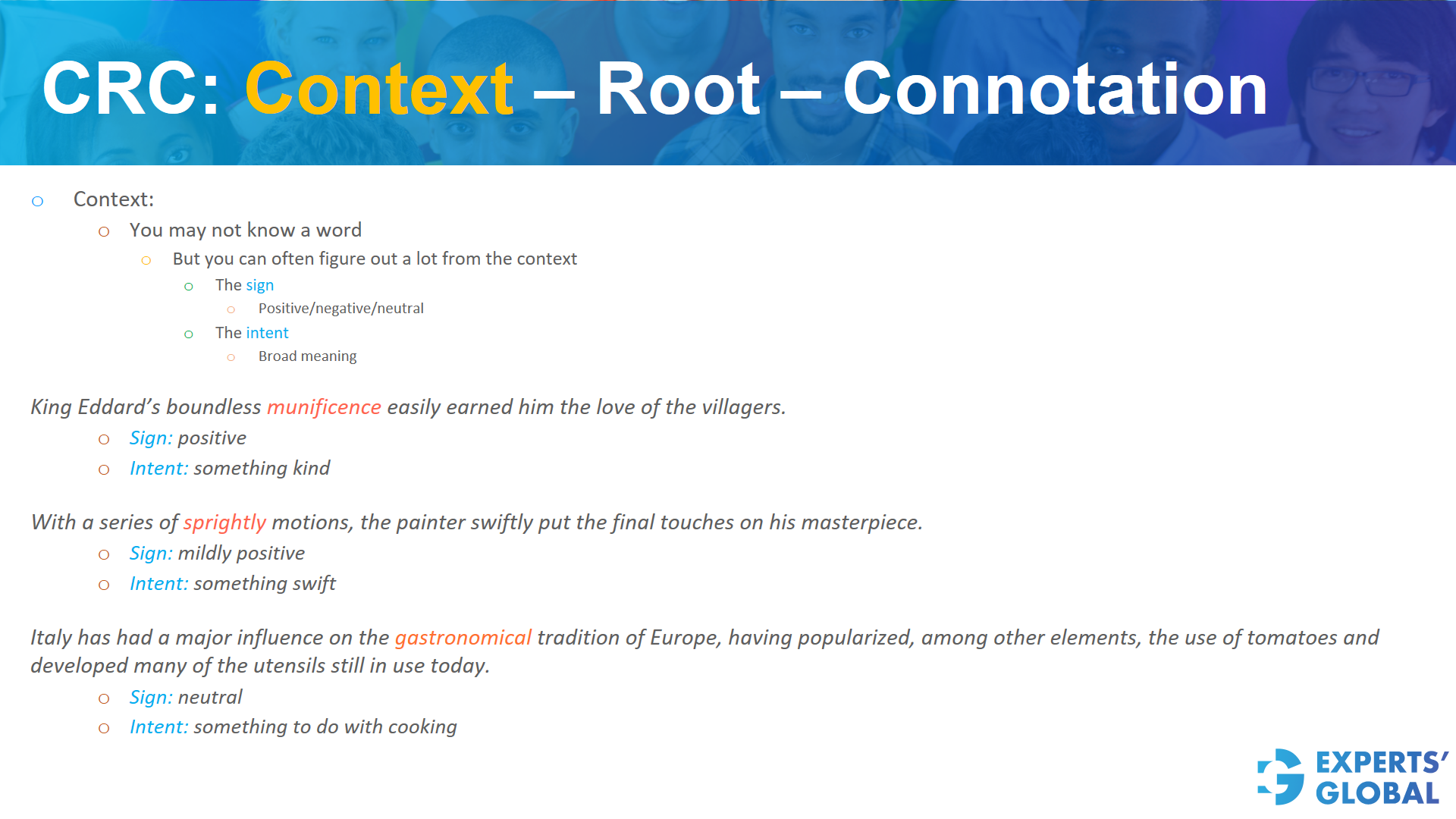
To use context effectively, look for two main clues:
For a detailed explanation for examples on the slide, please refer to the video featured earlier on this page. Following is step-by-step written explanation.
King Eddard’s boundless munificence easily earned him the love of the villagers.
With a series of sprightly motions, the painter swiftly put the final touches on his masterpiece.
Italy has had a major influence on the gastronomical tradition of Europe, having popularized, among other elements, the use of tomatoes and developed many of the utensils still in use today.
By paying attention to the Sign and Intent, you can often understand the general meaning of unknown words without needing a dictionary!
Root forms a key element within the CRC framework and supports you when a word feels unfamiliar. You infer meaning by breaking the word into smaller parts. Etymology refers to the study of word roots, sources, and development. Roots connect to two guiding signals. The sign shows whether a word carries a positive, negative, or neutral sense.
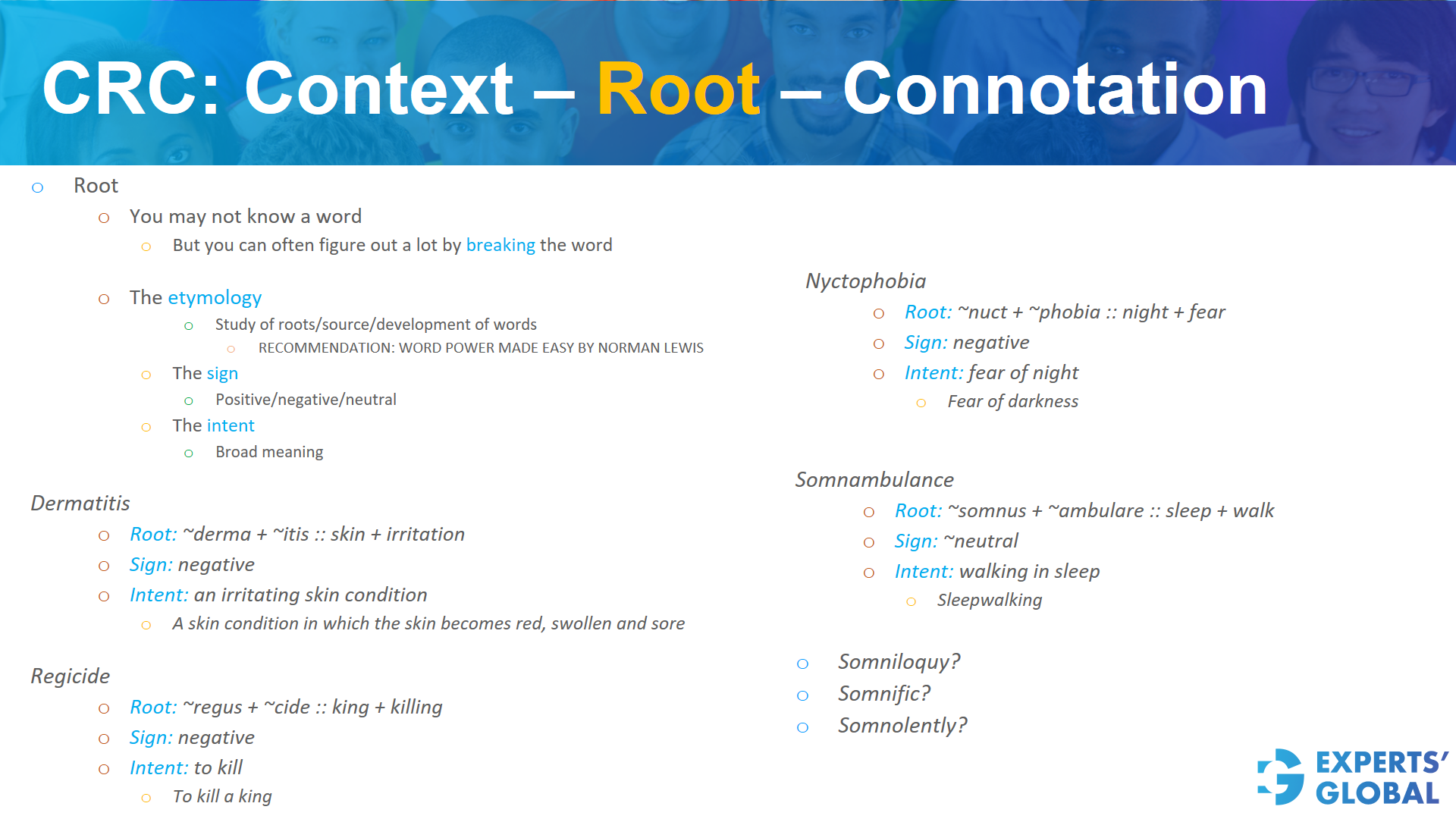
Another way to figure out an unknown word is by breaking the word down into its roots. This is called etymology, which is the study of the roots, source, and development of words. (A great recommendation for learning this is the bookWord Power Made Easy by Norman Lewis).
Just like with context, you can look for:
For a detailed explanation for examples on the slide, please refer to the video featured earlier on this page. Following is step-by-step written explanation.
Dermatitis
Regicide
Nyctophobia
Somnambulance
Using the root ~somnus (sleep) from the example above, can you guess the broad meaning of these words?
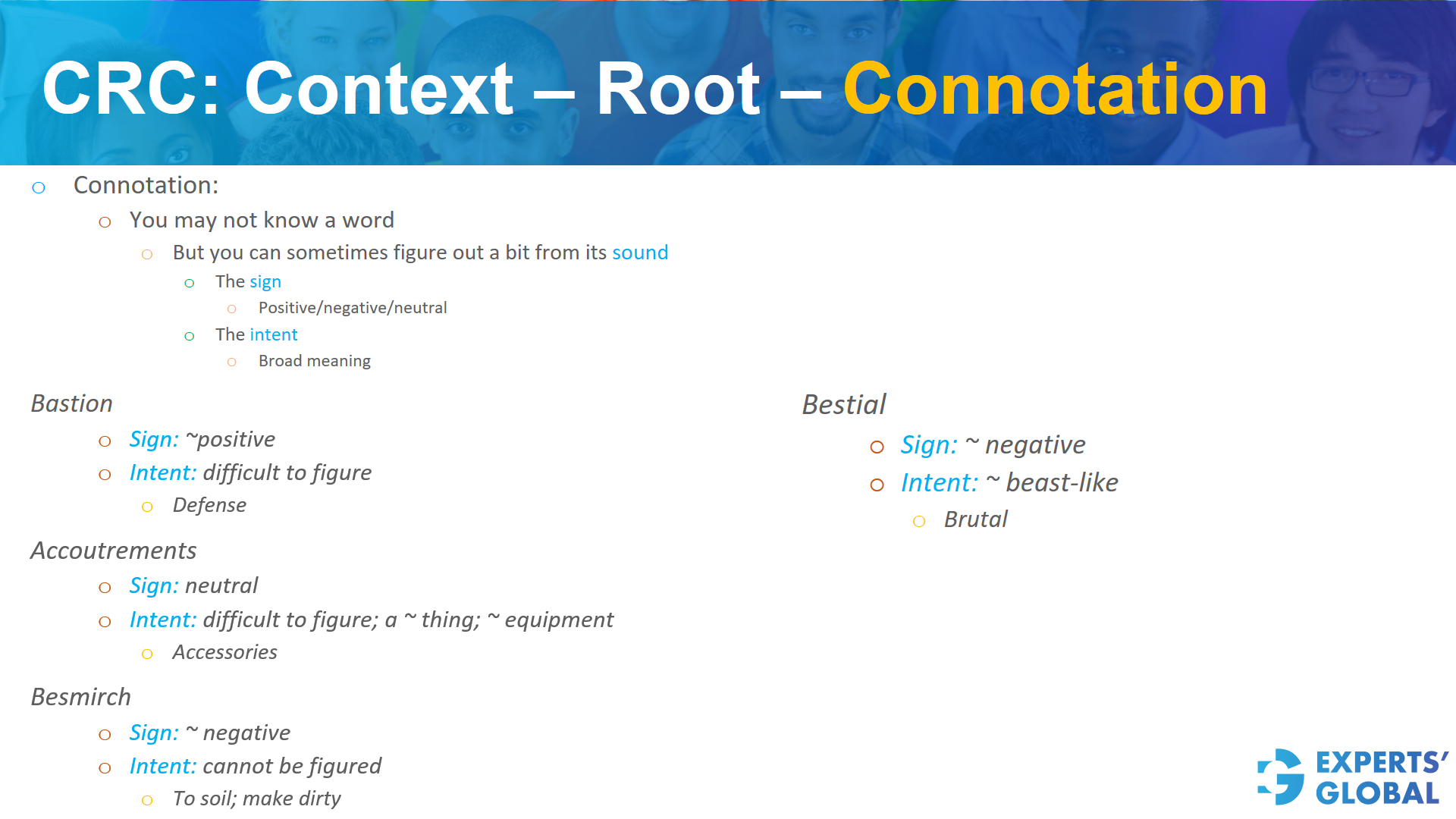
Connotation operates as a key element within the CRC framework and supports you when a word feels unclear. You infer meaning by paying attention to how a word sounds. Connotation works through two guiding elements. The sign of a word tells you whether it feels positive, negative, or neutral. The intent of a word points to the broad meaning suggested by its sound.
For a detailed explanation for examples on the slide, please refer to the video featured earlier on this page. Following is step-by-step written explanation.
Bastion
Accoutrements
Besmirch
Bestial
![A GRE-like TC example: applying CRC [context – root – connotation]](https://www.expertsglobal.com/wp-content/uploads/2026/02/3060.-A-GRe-llike-TC-Example-applying-CRC-context-root-connotation.png)
Correct answers: a picturesque
For a detailed explanation of this question in the context of the CRC technique, please refer the last ~2 minutes of the video featured earlier on this page. Following is a step-by-step written solution:
Following the construction of a major railway hub and river port, what was once ______ setting became dominated by garish smokestacks, irritating clouds of soot, and the relentless sounds of engines .
1. Core Meaning
The sentence describes a transformation of a location. After a railway hub and port were built, a place that used to be one way became filled with “garish smokestacks,” “soot,” and “loud engines”. This indicates a shift from a beautiful or natural state to an ugly, industrial one.
2. Broad Expectation
I expect a word meaning visually attractive, scenic, or peaceful to describe the original state of the setting before it was ruined by industrial pollution and noise.
3. Eliminate
4. Cross-check
Picturesque correctly reflects that the setting was once beautiful and scenic before the industrial construction made it ugly and loud.
Correct answer: a picturesque
All-inclusive GRE prep course online
15 full length GRE practice tests
60 sectional GRE practice tests
