
Invest 30 seconds...
...for what may lead to a life altering association!
Help Line
- +91.8800.2828.00 (IND)
- 1030-1830 Hrs IST, Mon-Sat
- support@expertsglobal.com
33% off ends soon:GMAT/GRE prep + applications bundle. Profile building, longer mentoring, better results. Inquire

Encountering difficult or unknown words is a natural part of GRE preparation and the test-taking experience. In sentence equivalence and text completion questions, you often face multiple challenging words, and it is unrealistic to expect that you will know the meaning of every word, no matter how strong your vocabulary becomes. Such moments are inevitable and they do not signal failure or the end of a question. Instead, they represent a normal part of problem solving, and having a clear method for handling them should be built into any well-designed GRE prep course.
The detailed video below and the article that follow introduce a structured way to navigate these situations, known at Experts’ Global as the Context-Root-Connotation (CRC) strategy. The resources on this page explain the approach and show how to apply it to GRE-like questions and answer choices. Use this material thoughtfully to build a reliable response to unknown words and apply the strategy consistently in your GRE practice exercises and full-length GRE mock tests.
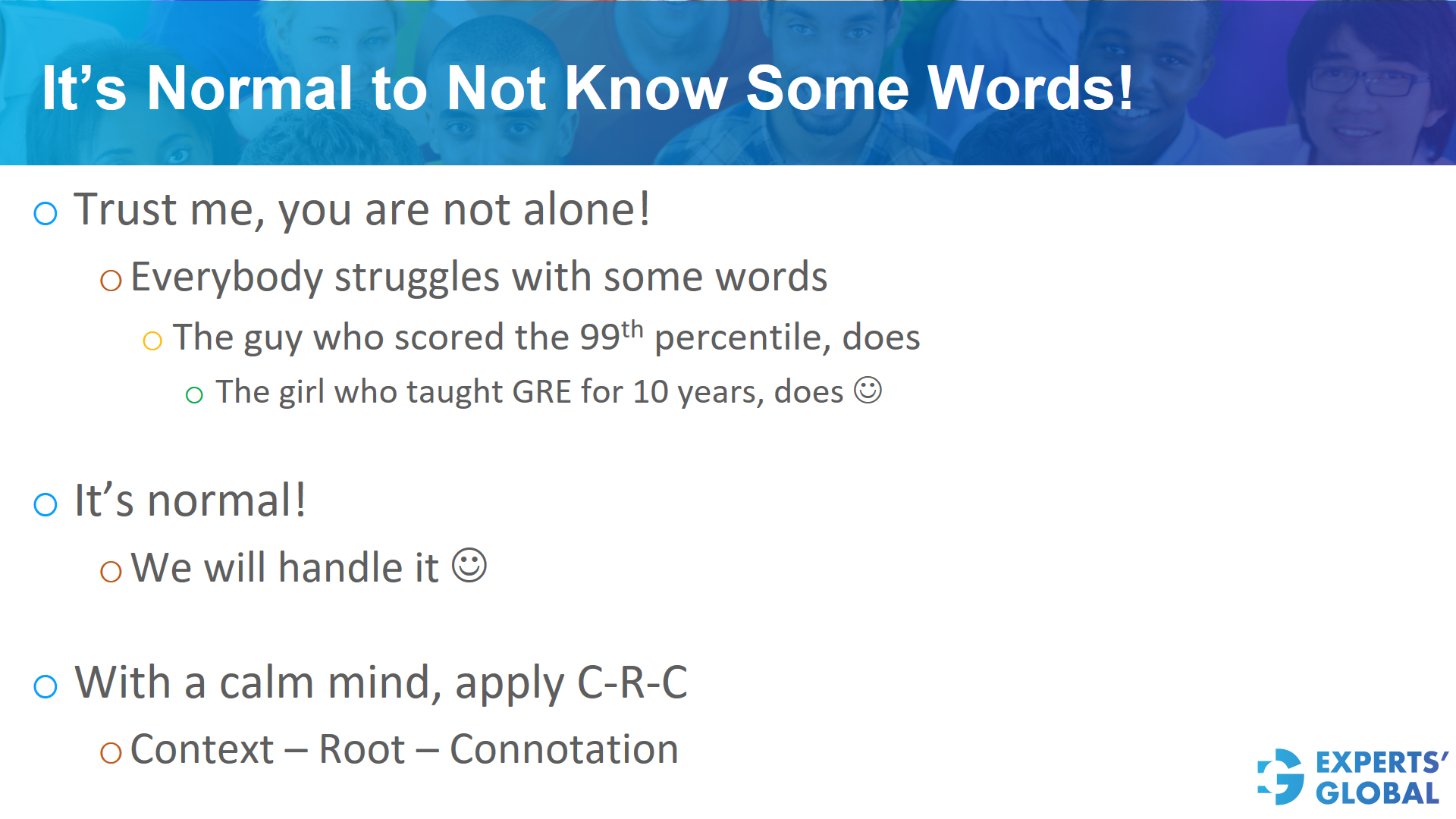
It is completely normal to run into words you do not know on the GRE, and accepting this early puts you in a strong position. These moments are inevitable, and the real win lies in being mentally ready for them. Getting intimidated by unfamiliar words only pulls you away from the logic of the question, while staying steady and approaching the situation thoughtfully keeps you in control. You do not need to know every word to get the question right. You need a smart way to respond when a word feels unfamiliar. The video that follows walks you through the right approach, helping you stay composed, think tactfully, and continue solving confidently. With the right mindset and method, even questions filled with unknown words can turn into scoring opportunities!
The following slide explains how the Context, Root, and Connotation of an unknown word’s usage can help us in estimating its likely meaning.
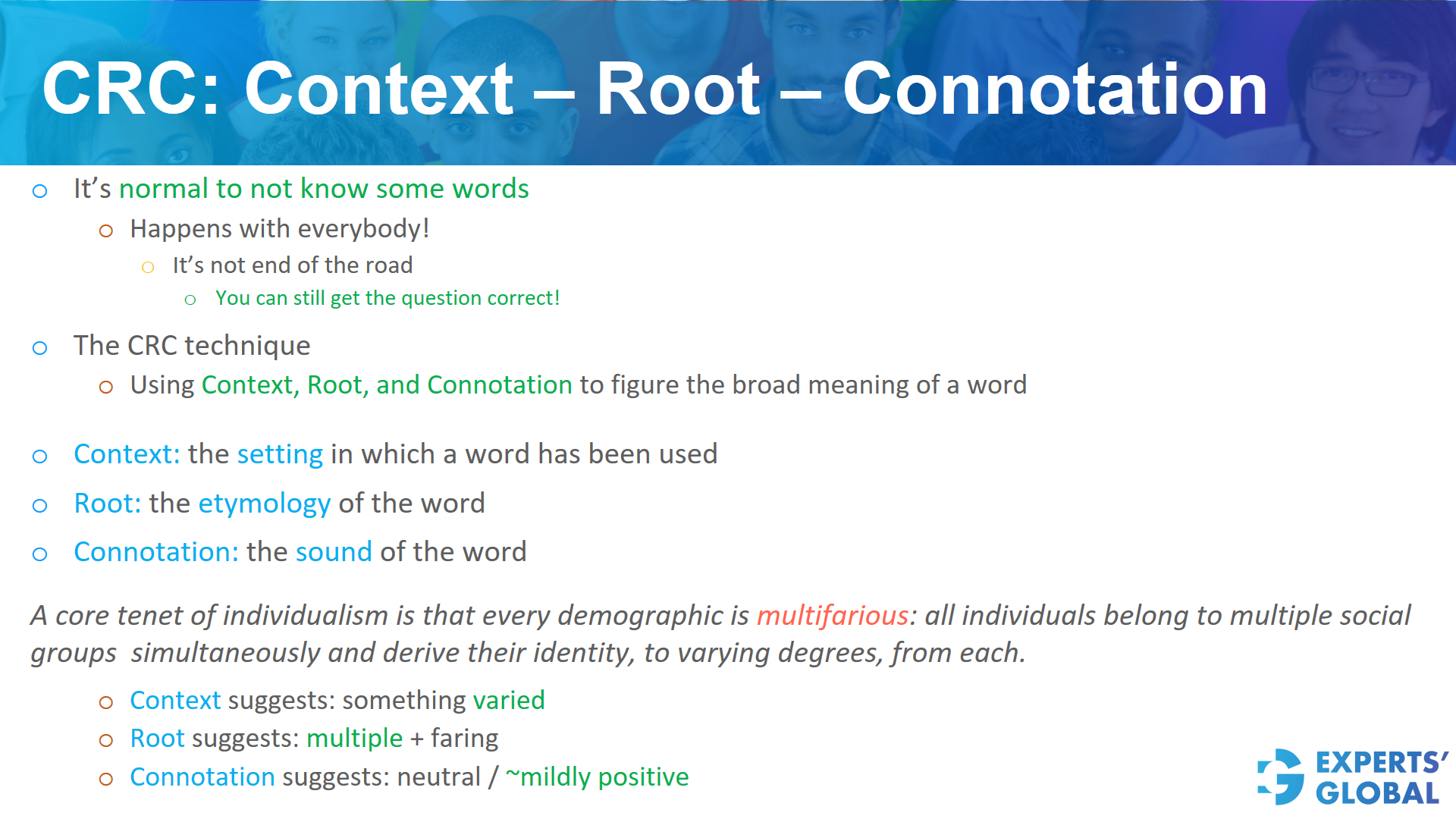
To understand an unfamiliar word, break it down into these three categories:
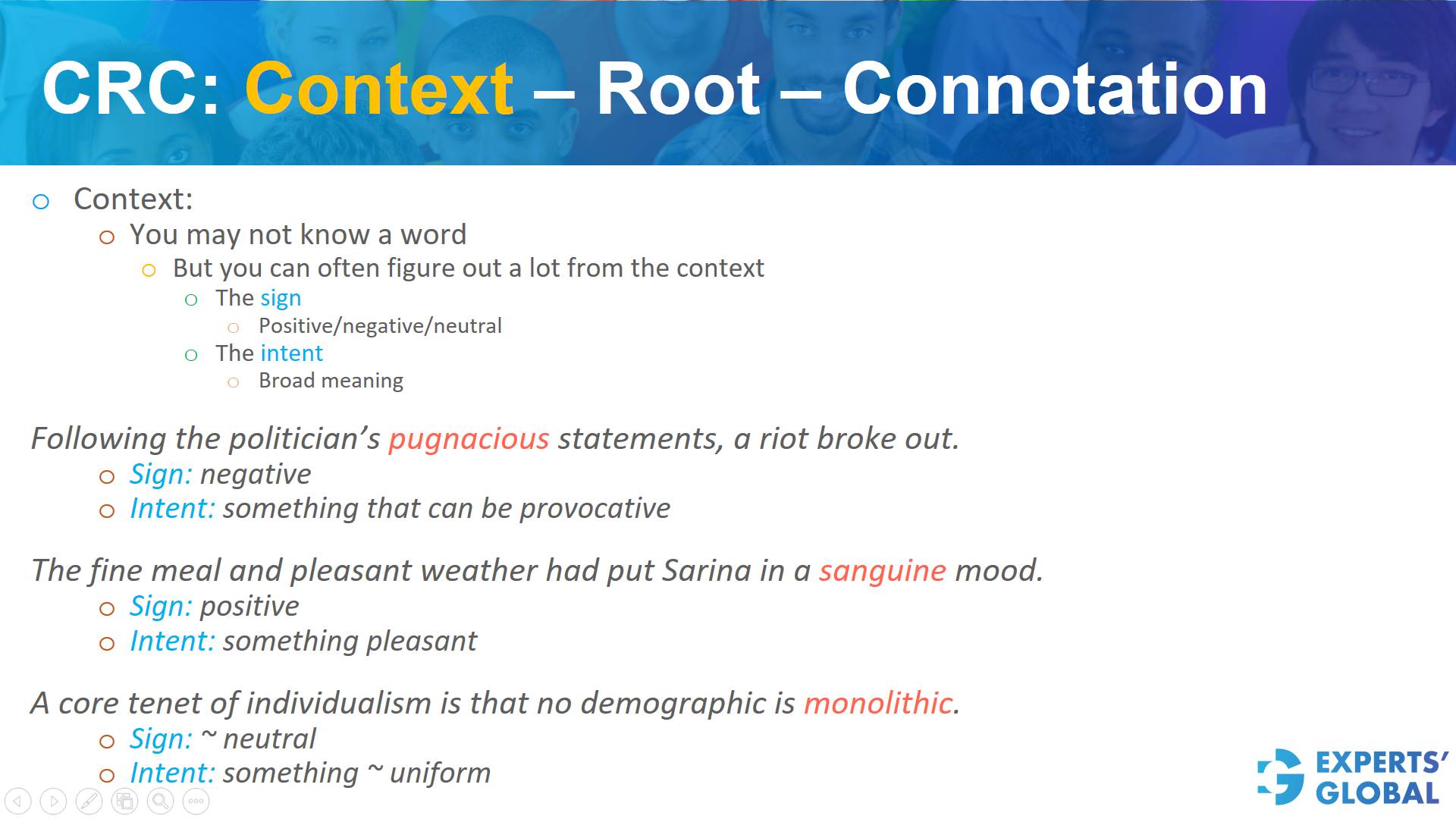
When you are reading, you may encounter a word you do not know. However, you can often figure out a lot about that word by looking at the context – the words and sentences surrounding it. To use context effectively, look for two things:
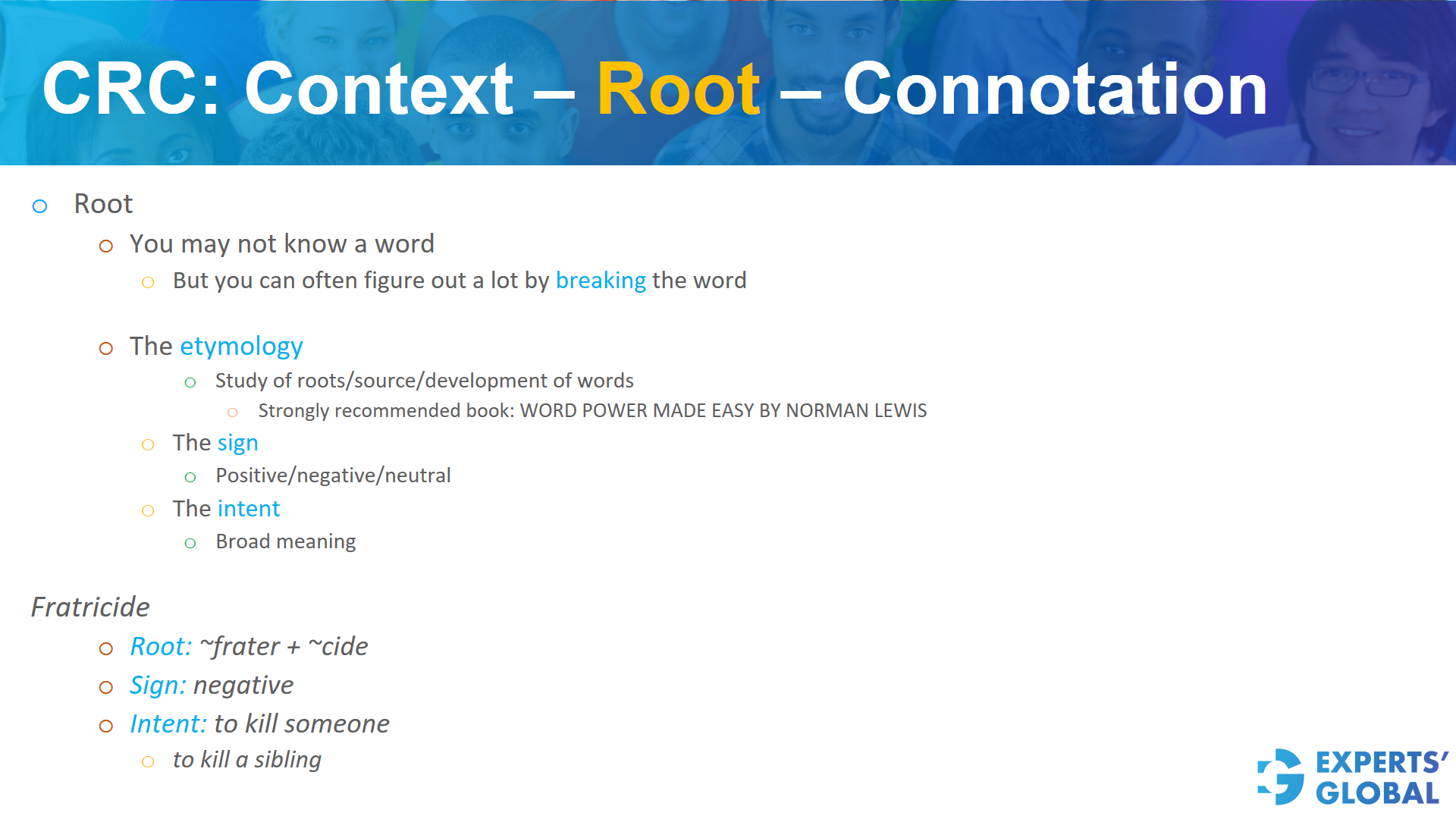
Even if you don’t know a word, you can often figure out a lot by breaking the word down into its roots. This is known as etymology, which is the study of the roots, source, and development of words.
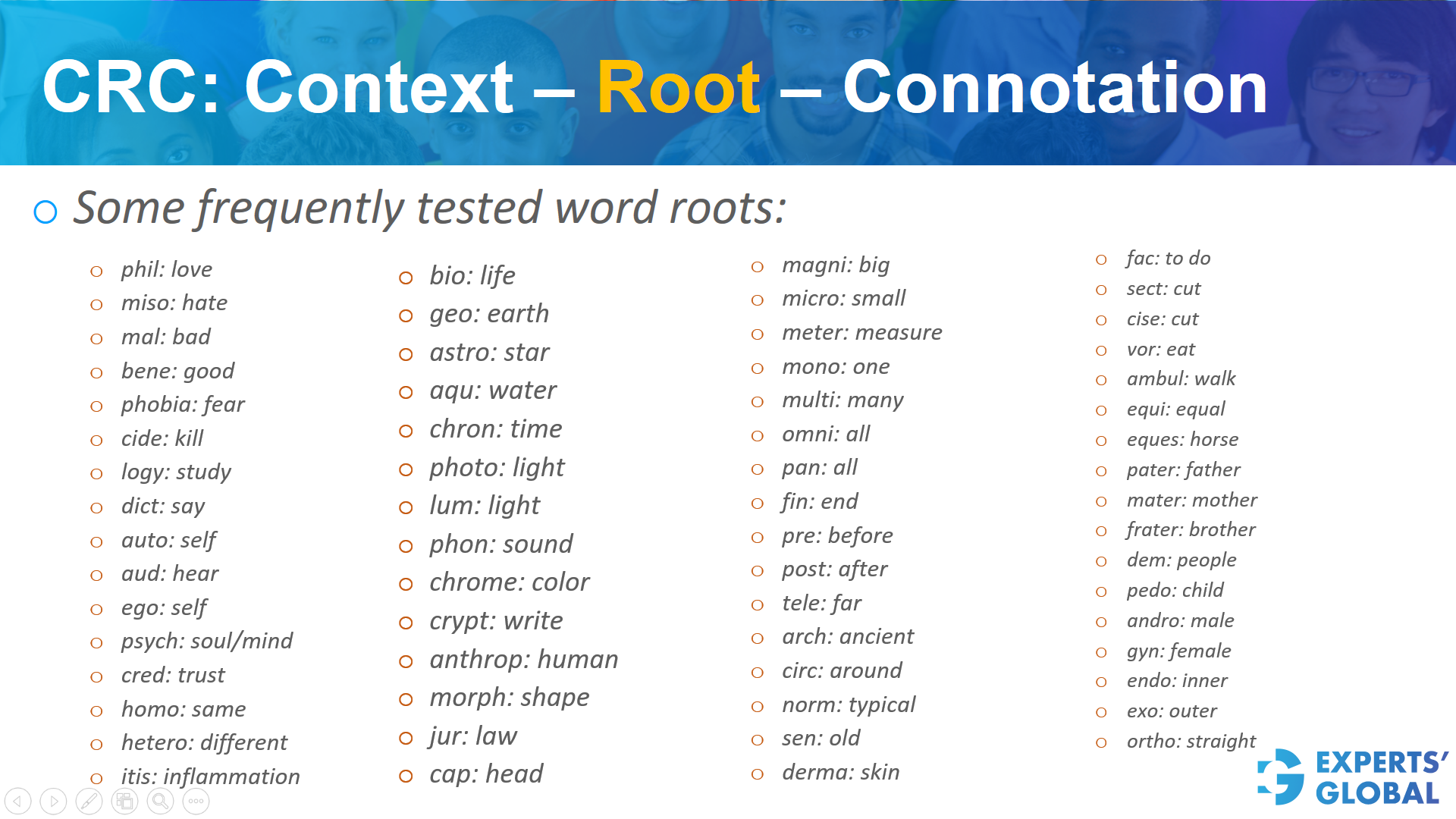
The following is a detailed infographic that brings together some of the most common and frequently tested word roots on the GRE. You may find it useful to download this infographic and keep it handy for regular reference as you continue your preparation.
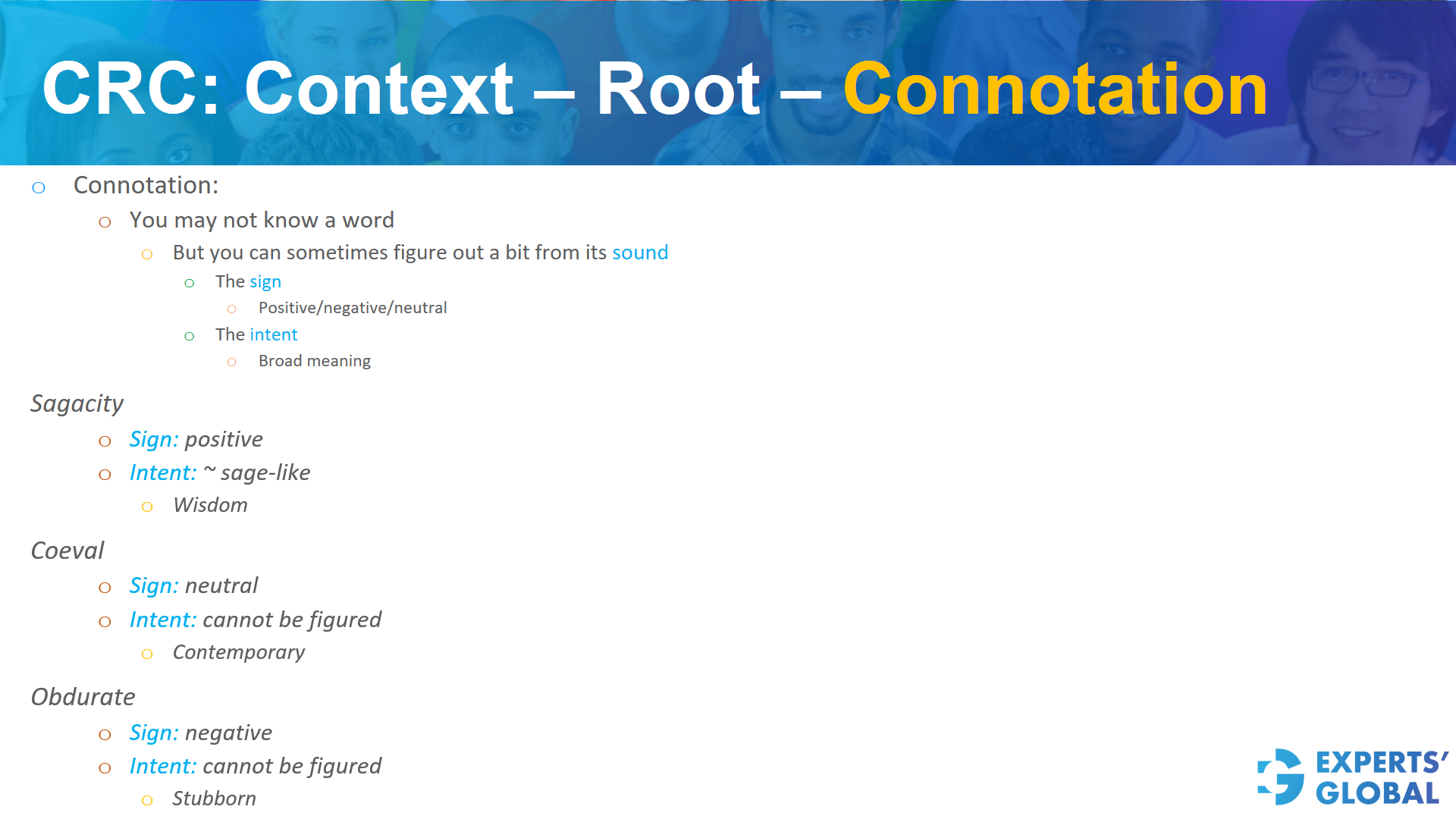
The final part of the technique is Connotation. Sometimes you can figure out a word based on its sound. Again, we look for the Sign and the Intent.
![A GRE SE-like example: Applying CRC [Context-Root-Connotation]](https://www.expertsglobal.com/wp-content/uploads/2026/01/2060-A-GRE-SE-like-example-Applying-CRC-Context-Root-Connotation.png)
Let’s use our new skills to solve a GRE-like example!
Question: In the ancient Olympics, ___________ was also a field of competition, including events such as debate, poetic composition and recitation, and acting.
For a thorough explanation and application of CRC, please watch the first video lesson on this page.
Step-by-Step Approach
1. Read the COMPLETE sentence and get the CORE meaning:
The sentence talks about ancient Olympic competitions that involve speaking, writing poetry, and acting.
2. Set a BROAD EXPECTATION from the correct answer choice(s):
Since the examples given are “debate” and “recitation,” we are looking for a word that means “the art of speaking”.
3. Eliminate
4. Cross-check
Oratory and Rhetoric both relate to the art of public speaking and debate. They fit the context of the sentence perfectly!
Correct Answers: oratory and rhetoric
When you learn to handle unknown words with CRC, you train your mind to stay steady when the surface feels uncertain. That ability matters in GRE prep because the test rewards clear thinking more than perfect familiarity, and it matters even more in graduate and MBA admissions because your applications often place you in similar moments. A prompt can feel unfamiliar, a question can feel tricky, and you still need to respond with structure, meaning, and direction. Life offers the same pattern. You rarely get a complete glossary before you step into a new role, a new city, or a new phase, yet you still make progress by reading the situation, understanding the roots of what matters, and sensing the tone beneath the noise. CRC is more than a technique for vocabulary. It is a way of moving forward without panic, staying open, and making smart decisions even when you do not have full certainty. Carry this approach into your practice drills and mock tests, and let it become a steady habit that supports every high-stakes moment.
Online GRE prep course with 7-day free access
Free diagnostic full length GRE mock test
