
Invest 30 seconds...
...for what may lead to a life altering association!
Help Line
- +91.8800.2828.00 (IND)
- 1030-1830 Hrs IST, Mon-Sat
- support@expertsglobal.com
33% off ends soon:GMAT/GRE prep + applications bundle. Profile building, longer mentoring, better results. Inquire

GRE Text Completion questions often feel demanding when the correct answers do not align with what seems obvious at first glance. In these situations, some options appear attractive immediately, while the correct choice feels subtle or unexpectedly different. This happens with words whose meanings differ from their surface impression, words with wide and flexible usage, words with confusing emotional tone, homonyms, and similar vocabulary patterns that invite quick but inaccurate judgments. Learning to recognize and manage these patterns forms an essential pillar of a thorough GRE preparation course.
The videos on this page explore each of these counter intuitive answer choice patterns in a focused and thoughtful way. Every video introduces a clear and repeatable approach for that specific challenge and then applies it directly to GRE style Text Completion questions using realistic answer choices designed to reflect these traps. The explanation that follows expands on the same ideas with additional clarity. Take time to absorb the reasoning and apply it consistently in your GRE practice drills and full-length GRE practice tests so that your decision making becomes sharper, steadier, and more reliable across all Text Completion questions.
Some words carry meanings that differ sharply from what their sound or familiarity suggests. A word may feel familiar, yet its actual meaning moves in a completely different direction. In GRE Text Completion questions, this gap between appearance and meaning can quietly influence your expectations and pull attention away from the sentence logic. These counter intuitive words create difficulty not because they are rare, but because they invite assumptions that the sentence itself does not support.
The video below focuses on this exact pattern in GRE Text Completion questions. It explains a clear and practical way to identify counter intuitive words, evaluate them using context, and decide their fit within the sentence. The examples use carefully designed answer choices that reflect this challenge directly, allowing you to see how meaning unfolds inside the sentence and how thoughtful reading leads you to the correct choice. With repeated exposure and a clear method, these words become easier to manage and far less distracting during practice and on test day.
Some words carry emotional or tonal shades that are easy to misinterpret when you focus only on their basic meaning. In GRE Text Completion questions, such words check whether you notice not just what a word points to, but the feeling or attitude it brings into the sentence. The key task is to see whether that implied tone fits perfectly with the direction and intent of the sentence as a whole. When this alignment is clear, the choice becomes much easier to evaluate.
The video that follows focuses on this pattern in GRE Text Completion questions. It explains how words with confusing connotation appear in sentences, shows a clear method for judging their suitability, and then applies that method directly to GRE style examples. The answer choices are designed to reflect this challenge accurately, helping you learn how to read tone carefully and select words that truly match the sentence meaning. With practice, this skill strengthens your precision and makes your Text Completion decisions more deliberate and consistent.
Some words carry meanings that stretch across many situations, which allows them to appear suitable in a wide variety of sentences. In GRE Text Completion questions, such words test your ability to judge precision rather than familiarity. The real task is to decide whether a broadly applicable word matches the exact meaning, direction, and intent of the sentence, not just whether it sounds reasonable on its own.
The video below explains how words with wide application show up in GRE Text Completion questions and why they require careful evaluation. It presents a clear and practical approach for testing whether such words truly belong in the sentence and then applies that approach to GRE style examples. The answer choices are crafted to reflect this challenge accurately, helping you learn how to favor exact meaning over general fit as you practice consistently.
Some words share the same spelling or sound but point to different meanings, and this overlap can create real ambiguity in GRE Text Completion questions. In these cases, the challenge is not the word itself but deciding which meaning the sentence actually supports. The task is to read the full sentence carefully and confirm that the chosen word matches the intended meaning that fits the overall message and direction.
The video below explains how homonyms appear in GRE Text Completion questions and why they require extra attention. It introduces a clear and dependable approach for identifying the correct meaning based on context and then applies that approach directly to GRE style examples. The answer choices are designed to reflect this exact challenge, helping you practice selecting meanings that align cleanly with the sentence rather than relying on sound or familiarity.
Let us bring everything from this page together and solve a GRE-style Text Completion question built around counter intuitive answer choices. Read with care, track the sentence direction, and notice where an option feels appealing for the wrong reason. Look for traps that come from surface impressions, misleading tone, or meanings that do not match what the sentence actually supports. Give priority to clean application of the ideas and methods from this page, and let accuracy guide your pacing. All the best!
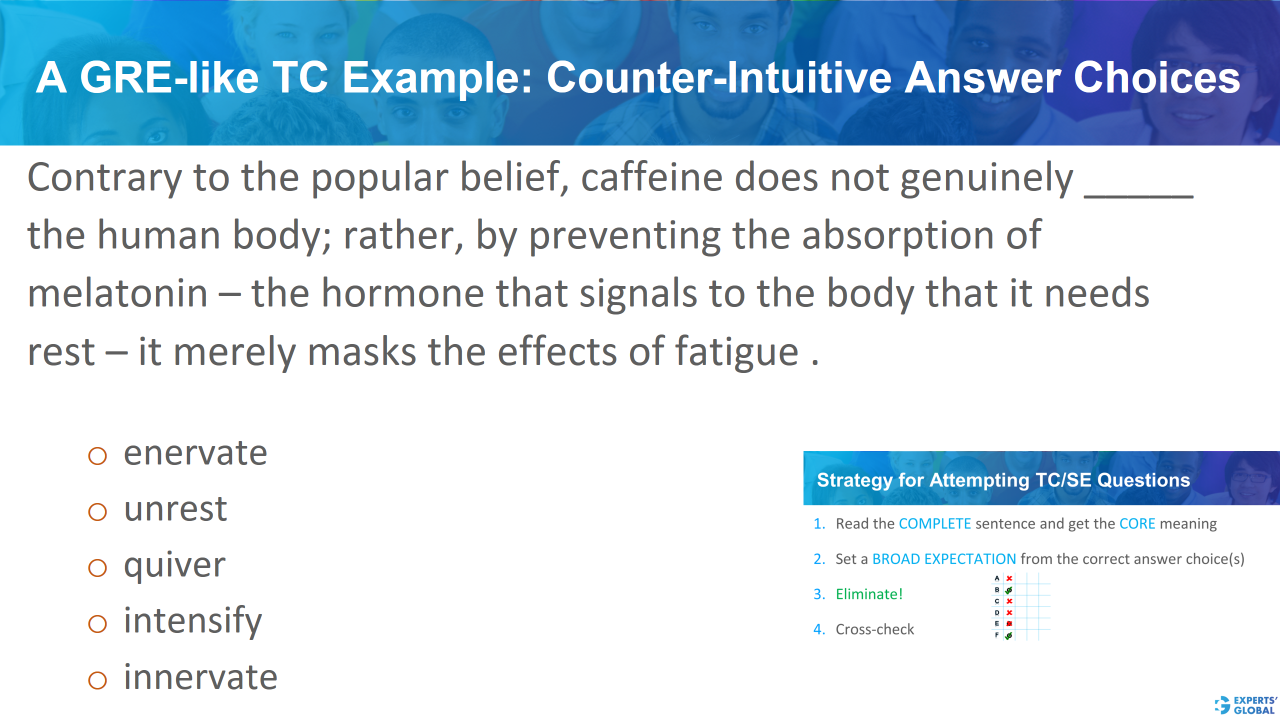
For a detailed explanation of this question, please refer the video featured earlier on this page.
Following is a step-by-step written solution:
Contrary to the popular belief, caffeine does not genuinely ______ the human body; rather, by preventing the absorption of melatonin – the hormone that signals to the body that it needs rest – it merely masks the effects of fatigue.
1. Core Meaning
The sentence states that while most people think caffeine provides energy, it actually just blocks the hormone that makes you feel tired. Therefore, caffeine does not actually provide energy or stimulate the body; it only hides exhaustion.
2. Broad Expectation
I expect a word that means to supply with energy, stimulate, or energize to fill the gap of what caffeine does “not genuinely” do.
3. Eliminate
4. Cross-check
Innervate fits the sentence because it highlights that caffeine does not truly stimulate the body’s nervous system with new energy; it merely interferes with the signals of fatigue.
Correct answer: innervate
GRE online preparation course with free trial
Free full length GRE diagnostic test
