
Invest 30 seconds...
...for what may lead to a life altering association!
Help Line
- +91.8800.2828.00 (IND)
- 1030-1830 Hrs IST, Mon-Sat
- support@expertsglobal.com
33% off ends soon:GMAT/GRE prep + applications bundle. Profile building, longer mentoring, better results. Inquire

GRE Text Completion questions often build meaning through a turn in logic, a reversal of expectation, or a subtle shift in direction, and contrast plays a central role in shaping that meaning. Many Text Completion sentences rely on contrast to guide you from an initial idea to a different final takeaway, sometimes through a single clear pivot and sometimes through multiple linked shifts that unfold step by step. When you learn to notice where the sentence changes direction and carefully compare the meaning on each side of that turn, you start filling the blanks in a way that feels precise and natural. This is why comprehensive GRE preparation treats contrast as a foundational reading skill and helps you recognize how it shapes meaning across different sentence structures.
The video set below presents contrast based Text Completion scenarios as focused lessons, allowing you to work through one pattern at a time with clarity and ease. Each video shows you how to identify contrast signals, understand how the sentence direction evolves, and select words that align perfectly with the final meaning created by the contrast. The same approach then appears in GRE style Text Completion questions with answer choices designed to reflect real test behavior. The theory that follows reinforces this framework so you apply it smoothly in practice sets and GRE test series, building steady and reliable performance across all Text Completion questions that rely on contrast.
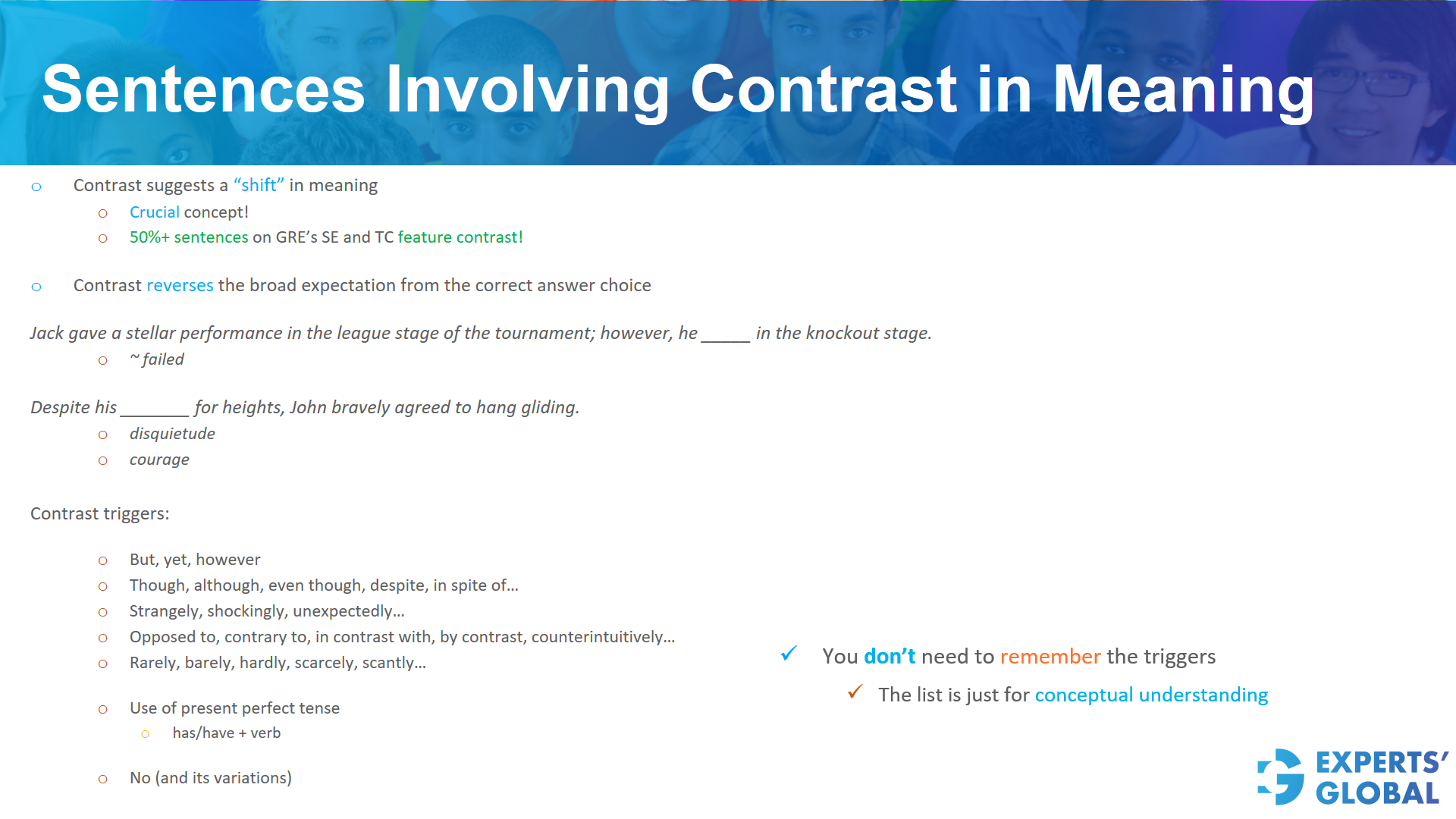
Contrast signals a clear shift in meaning within a sentence, and recognizing this shift plays a crucial role in understanding what the sentence truly intends. Over half of GRE Sentence Equivalence and Text Completion sentences rely on contrast, where the later part of the sentence reverses the broad expectation set earlier.
For a detailed explanation for examples on the slide, please refer to the video featured earlier on this page. Following is step-by-step written explanation.
Jack gave a stellar performance in the league stage of the tournament; however, he ______ in the knockout stage.
The Answer: Jack failed in the knockout stage.
Despite his ______ for heights, John bravely agreed to hang gliding.
The Answer: disquietude.
These are words or structures that “trigger” a shift in meaning. You don’t need to remember the triggers; this list is just for your conceptual understanding.
By recognizing these triggers, you can easily predict when a sentence is going to shift its meaning.
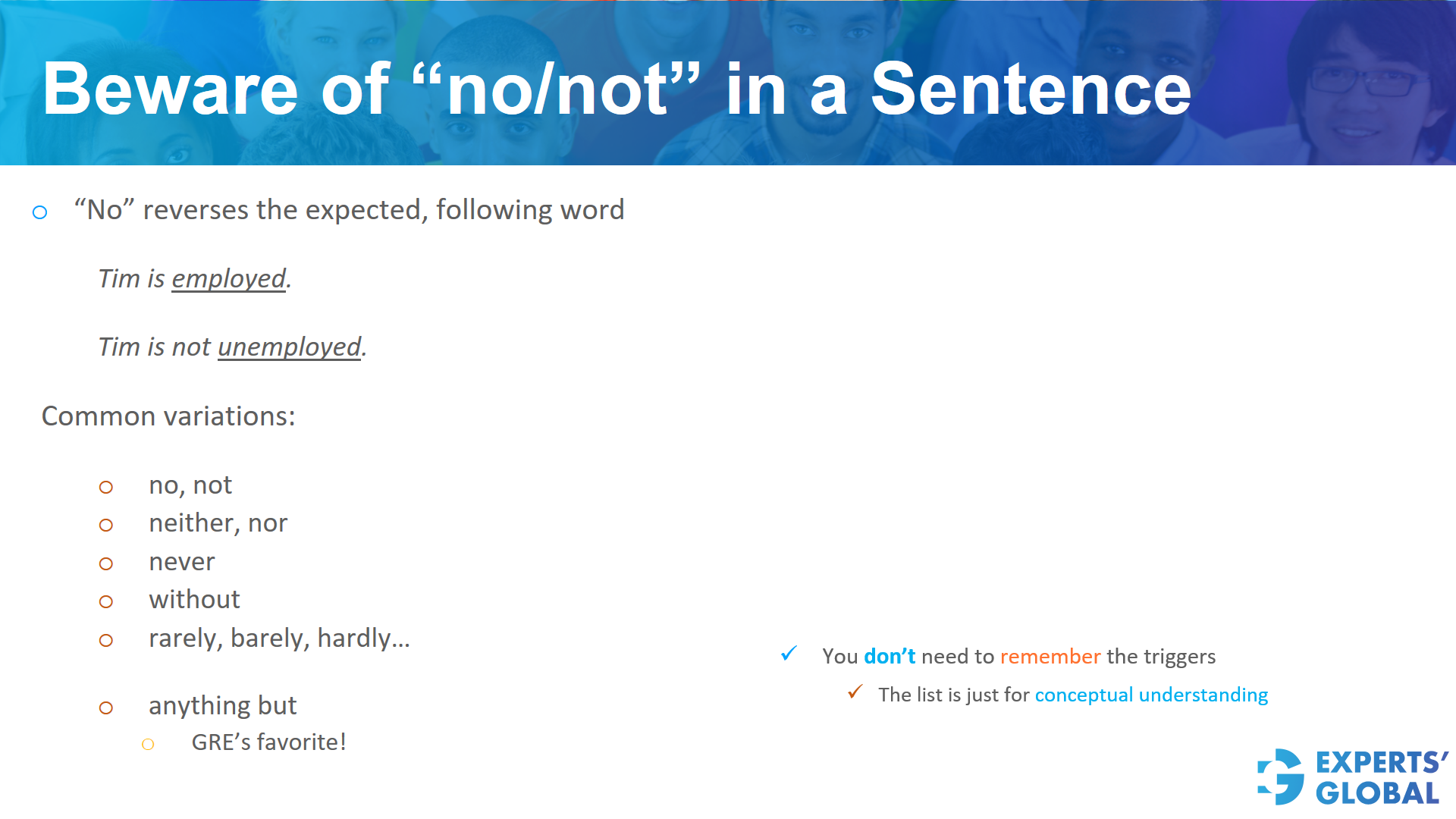
The word no reverses the expected meaning of the word that follows, and the same reversal occurs when you place not before a word. Variations such as neither and nor also flip the direction of meaning. Words like never, without, rarely, barely, and hardly reduce or reverse expectation in a sentence. The phrase “anything but” functions as a strong reversal and appears frequently on the GRE. You do not need to memorize every reversal form. Understanding how reversal works conceptually allows you to recognize these shifts naturally while reading.
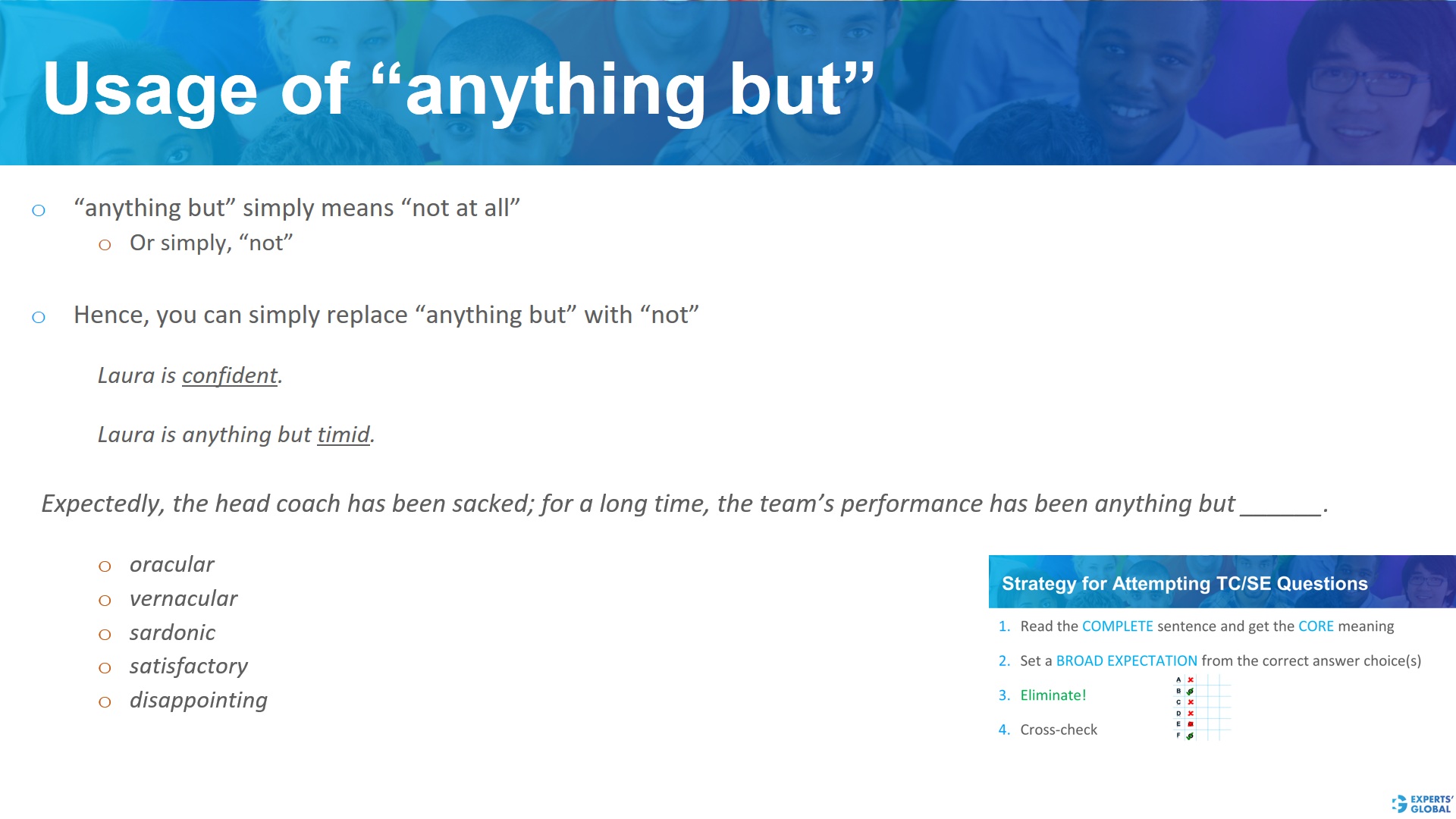
The phrase “anything but” simply means not at all, and you can understand it simply as not. Replacing “anything but” with “not” preserves the original meaning of the sentence.
For a detailed explanation for example on the slide, please refer to the video featured earlier on this page. Following is step-by-step written explanation.
Expectedly, the head coach has been sacked; for a long time, the team’s performance has been anything but ______.
Correct Answer: satisfactory.
It is important to focus on whether there is a SHIFT in meaning. A shift is the key!
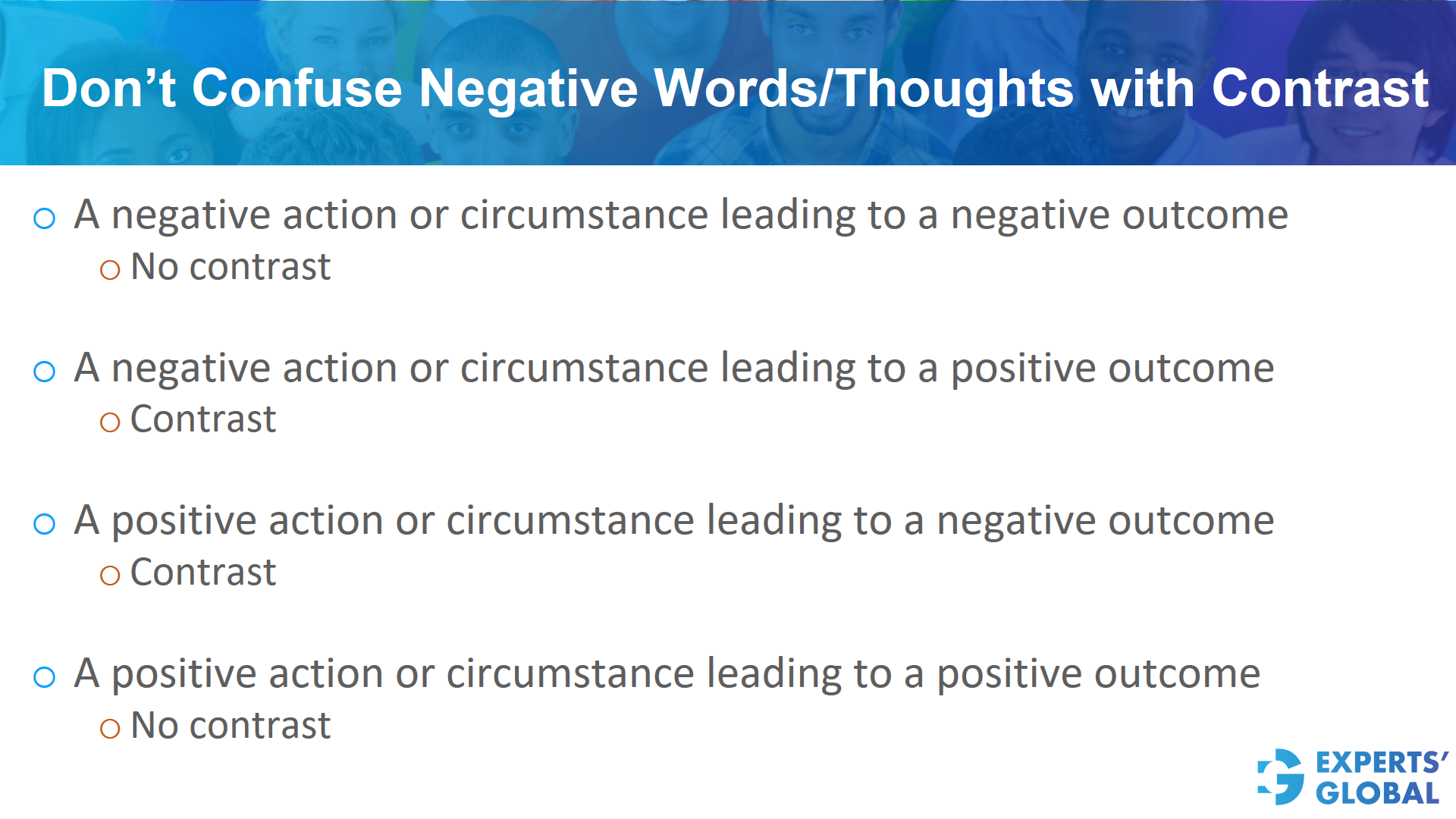
In these examples, there is no contrast because there is no “shift” in meaning; the second part follows the expectation of the first. A negative act led to a negative consequence; hence, no contrast.
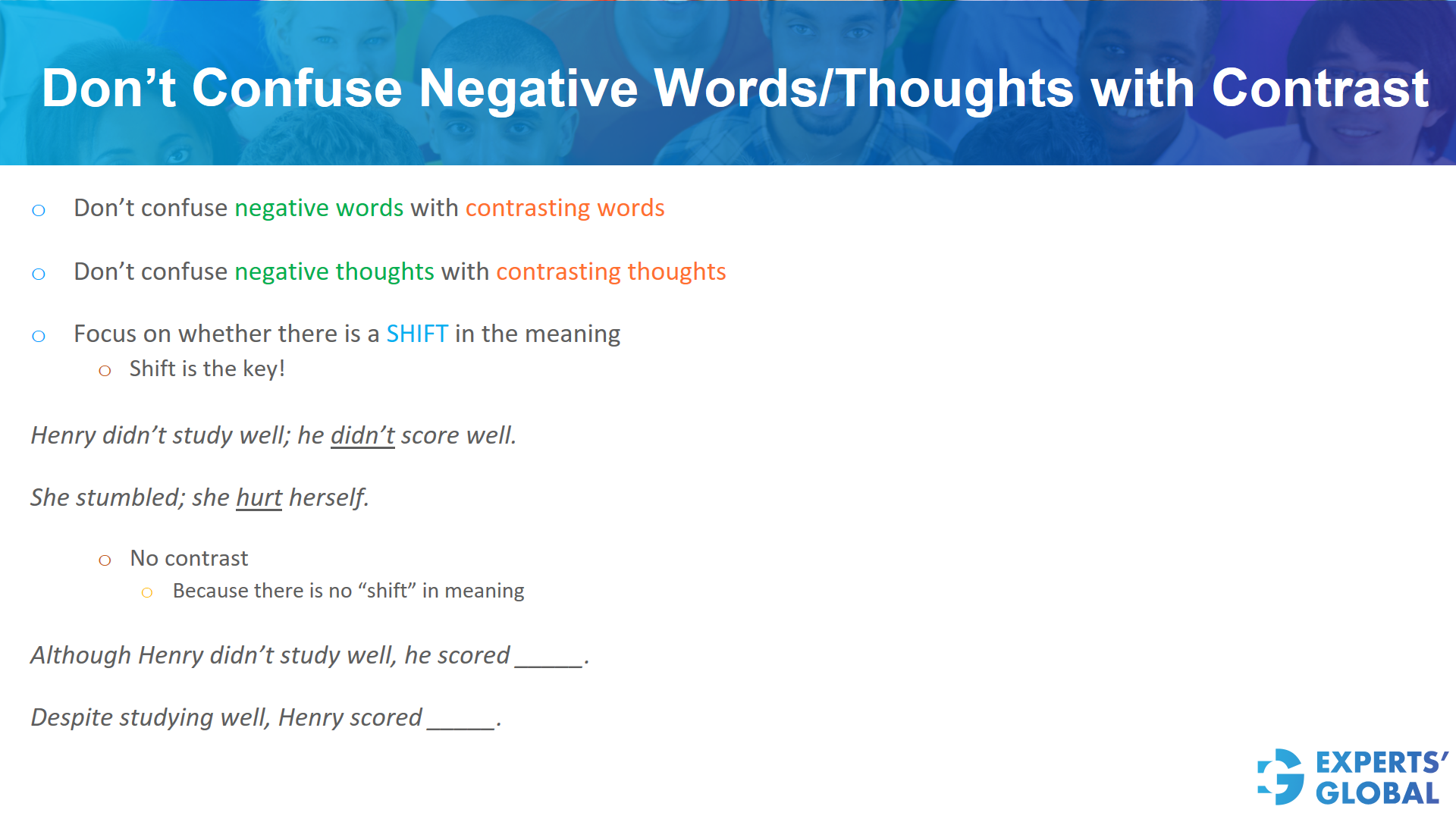
Contrast depends on the relationship between an action or circumstance and its outcome. When a negative action leads to a negative outcome, no contrast exists. When a negative action leads to a positive outcome, contrast appears. A positive action followed by a negative outcome also creates contrast, while a positive action leading to a positive outcome shows no contrast. You identify contrast by spotting a clear shift between what you expect and what actually happens.
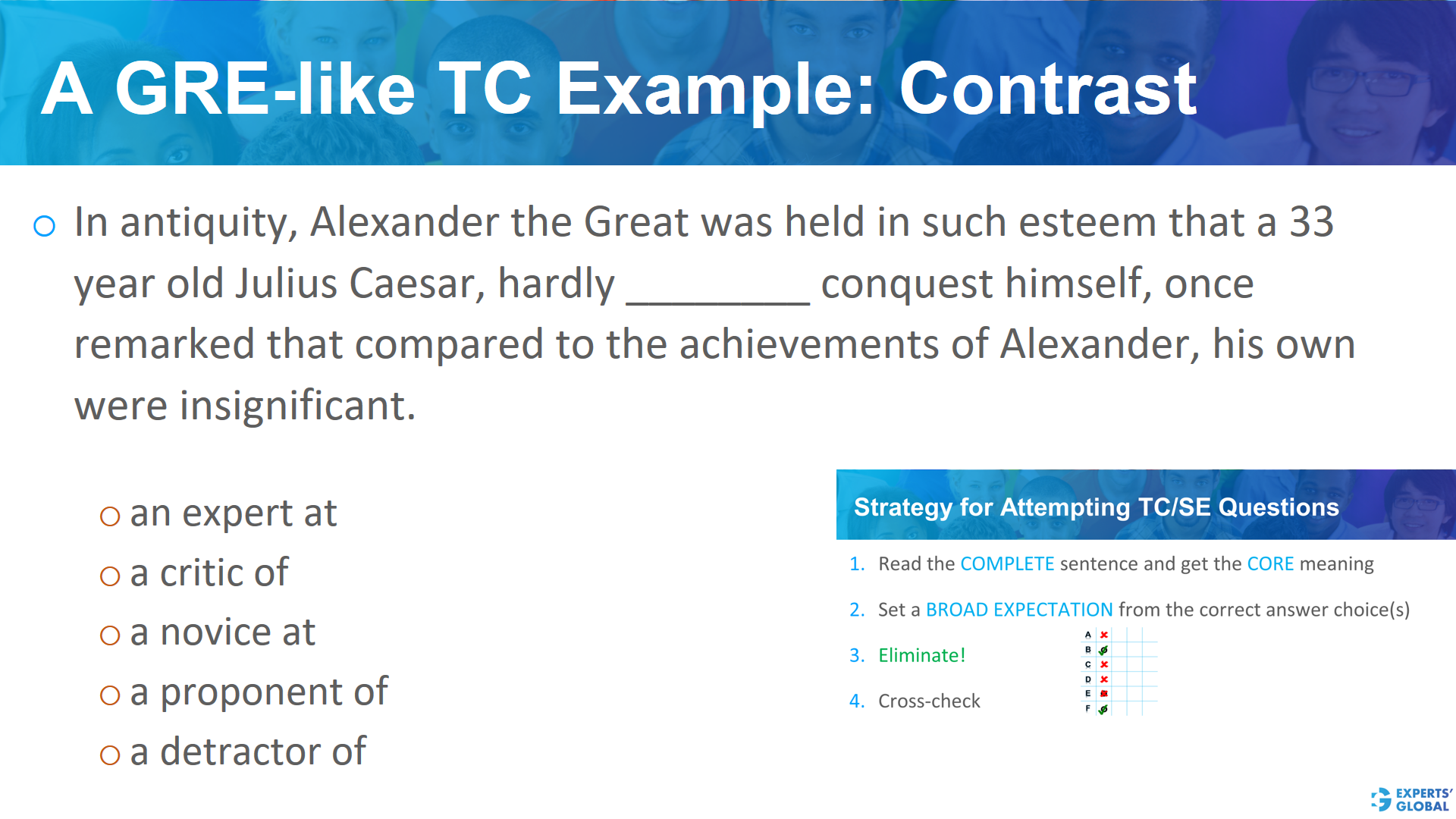
Correct answers: a novice at
For a detailed explanation of this question, please refer the last ~2 minutes of the video featured earlier on this page. Following is a step-by-step written solution:
In antiquity, Alexander the Great was held in such esteem that a 33 year old Julius Caesar, hardly ______ conquest himself, once remarked that compared to the achievements of Alexander, his own were insignificant.
1. Core Meaning
The sentence highlights that Julius Caesar, who was himself a great conqueror, felt his own successes were minor when compared to those of Alexander the Great. The word “hardly” indicates that even though Caesar was very experienced in conquest, he still felt humbled.
2. Broad Expectation
I expect a word that means a beginner or someone inexperienced because “hardly a beginner” would mean he is actually an expert. This creates the necessary contrast with his humble remark.
3. Eliminate
4. Cross-check
Novice fits perfectly because saying Caesar was “hardly a novice” emphasizes that he was a master of conquest, yet he still viewed Alexander’s work as far superior to his own.
Correct answer: a novice at
Comprehensive online GRE prep course
15 GRE practice tests full length
60 GRE practice tests sectional
Free GRE diagnostic test full length
