
Invest 30 seconds...
...for what may lead to a life altering association!
Help Line
- +91.8800.2828.00 (IND)
- 1030-1830 Hrs IST, Mon-Sat
- support@expertsglobal.com
33% off ends soon:GMAT/GRE prep + applications bundle. Profile building, longer mentoring, better results. Inquire

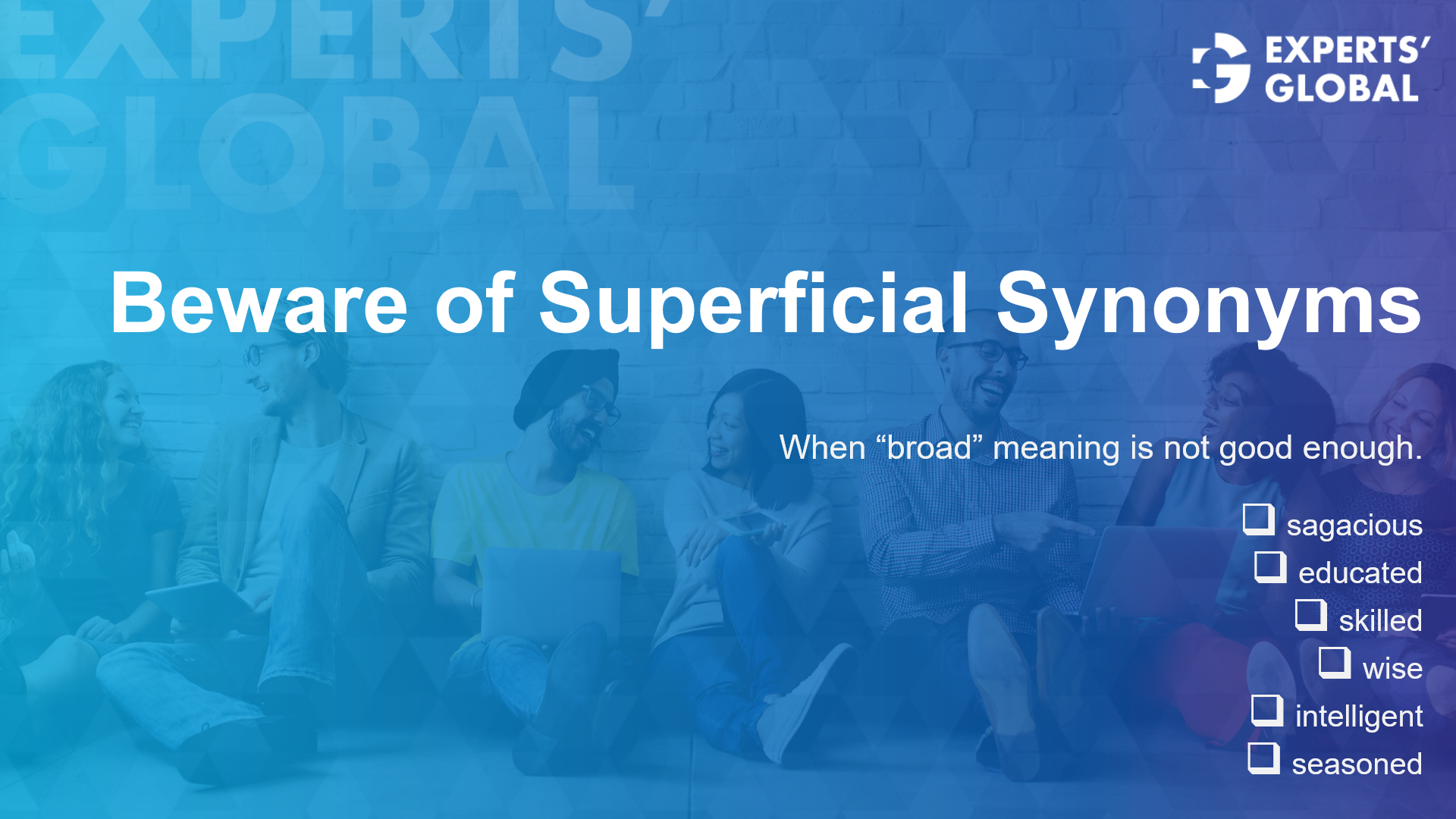
A tricky scenario on GRE Sentence Equivalence questions arises when two answer choices appear synonymous on the surface but do not truly share the same meaning. These superficial synonyms often create false comfort and pull attention away from the correct pair that matches the sentence logic more precisely. Learning to detect and reject weak or surface level similarity plays a meaningful role in improving accuracy on higher difficulty Sentence Equivalence questions. Thus, due coverage of the scenario of superficial or false synonyms reflects the in-depth nature of a high-quality GRE preparation course.
The video below explains a sound and practical approach for handling superficial synonyms, first clarifying why surface similarity is unreliable and then demonstrating how to evaluate deeper meaning on GRE-style examples with realistic answer choices. The article that follows expands on the same approach in greater detail. Carefully understand the concept, the method, and how they apply, and then carry them forward into GRE practice exercises and full-length GRE mock tests to improve both accuracy and speed on Sentence Equivalence questions.
Superficial synonyms are words that seem similar at first glance but differ in meaning or usage. Example: economic relates to the economy, while economical relates to saving money.
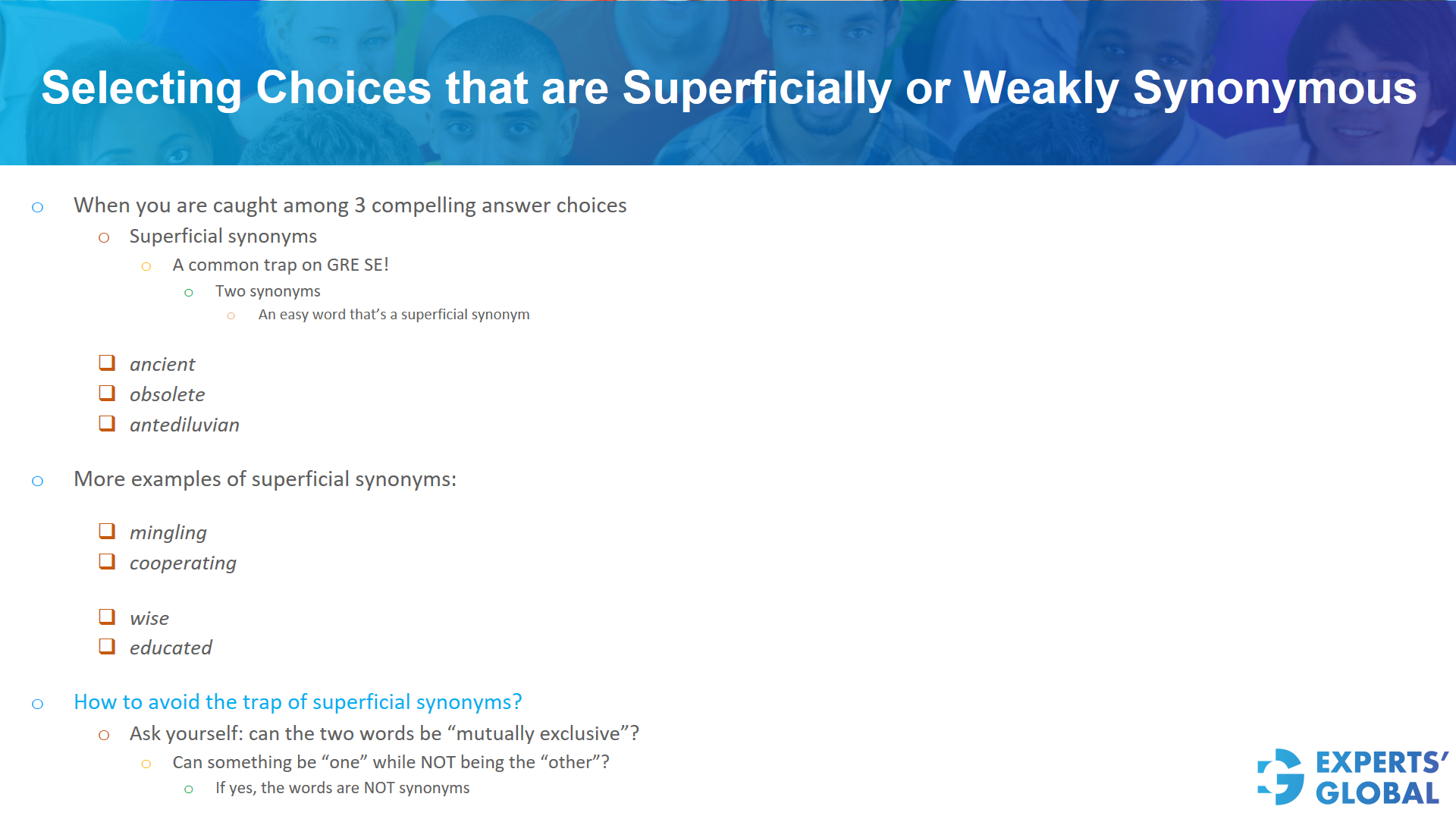
Ancient means very old or from a long time ago.
Antediluvian also means extremely old (literally “before the flood”). These two are strong synonyms.
Obsolete, however, means “no longer produced or used” or “out of date.”
Mingling vs. Cooperating: You can mingle (socialize) at a party without cooperating (working together) on a task.
Wise vs. Educated: A person can be very educated (has many degrees) but lack wisdom (good judgment), or be wise without having a formal education.
To make sure you aren’t falling for a superficial synonym, use this simple step-by-step test:
Ask the “Mutually Exclusive” question.
Ask yourself: “Can something be ‘word A’ while NOT being ‘word B’?”
Can someone be educated but NOT wise? Yes.
Can something be obsolete but NOT ancient? Yes.
If you can be one without being the other, the words are NOT synonyms.
Thus, “educated” and “wise” are not synonyms, nor are “obsolete” and “ancient”.
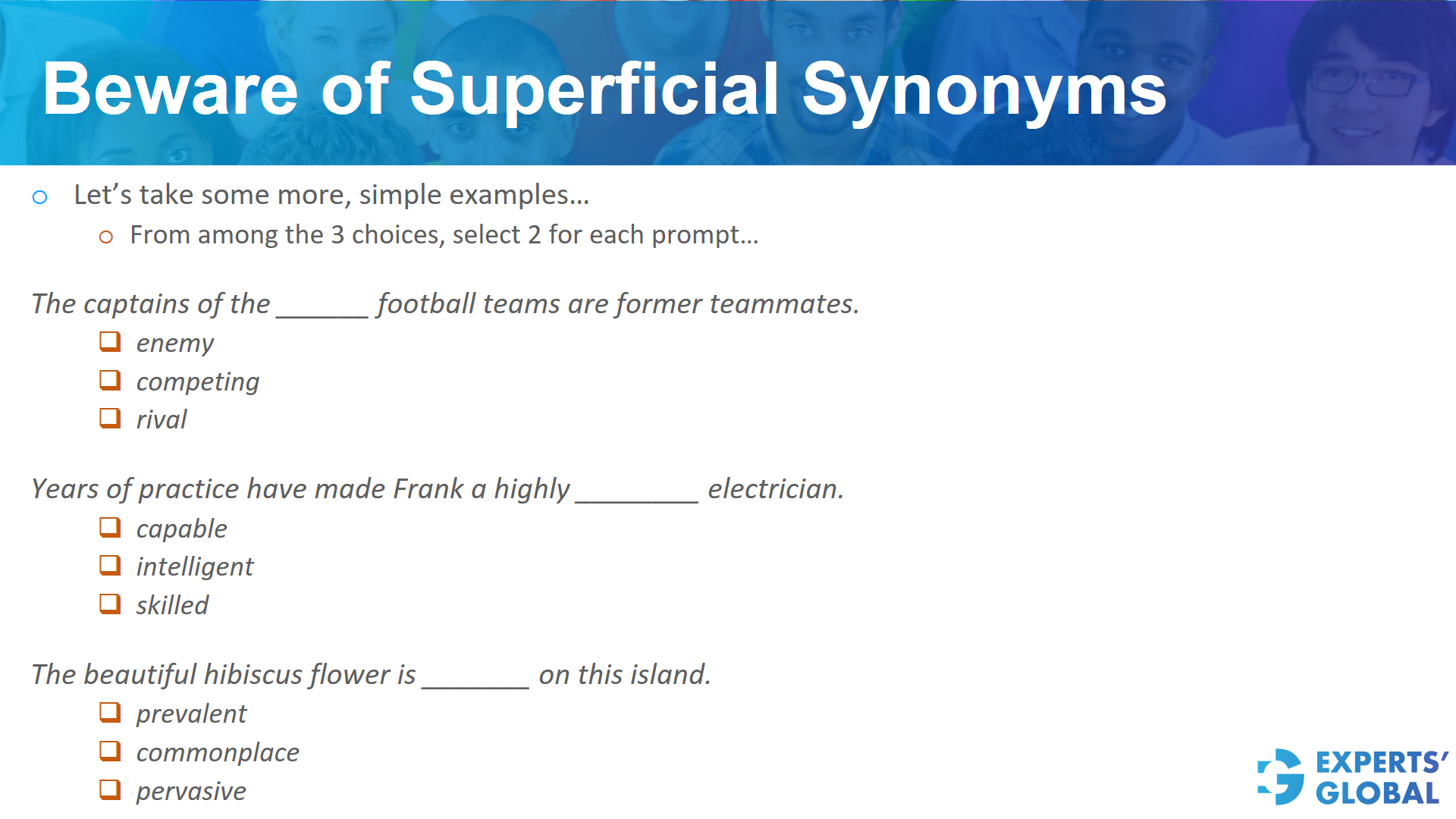
The slide introduces additional simple practice prompts designed to sharpen awareness of superficial synonyms, where each prompt asks you to select two choices from a group of three options. The first sentence centers on football teams whose captains share a past connection, with enemy, competing, and rival presented for evaluation. The second sentence describes professional growth through practice, offering capable, intelligent, and skilled as possible fits. The third sentence highlights the presence of a flower on an island, using prevalent, commonplace, and pervasive as the answer choices. Together, these examples reinforce careful attention to meaning when words appear closely related on the surface.
“Competing” and “rival” fit because both describe teams that play against each other in sport. “Enemy” implies hostility, conflict, or animosity, which is excessive in a football context. Teams can compete or be rivals without being enemies, especially when captains are former teammates.
“Capable” and “skilled” work because years of practice directly improve hands-on ability and technical expertise. “Intelligent” refers to cognitive ability, not professional competence gained through experience. Practice sharpens skill and capability, not raw intelligence, which makes “intelligent” the incorrect choice here.
“Prevalent” and “commonplace” correctly describe something that occurs frequently or is commonly found. “Pervasive” suggests spreading everywhere and influencing many aspects of life, which is too strong for a flower’s presence. A flower can be common without being pervasive across all contexts.
For a detailed explanation of these examples, please refer to the video featured earlier on this page.
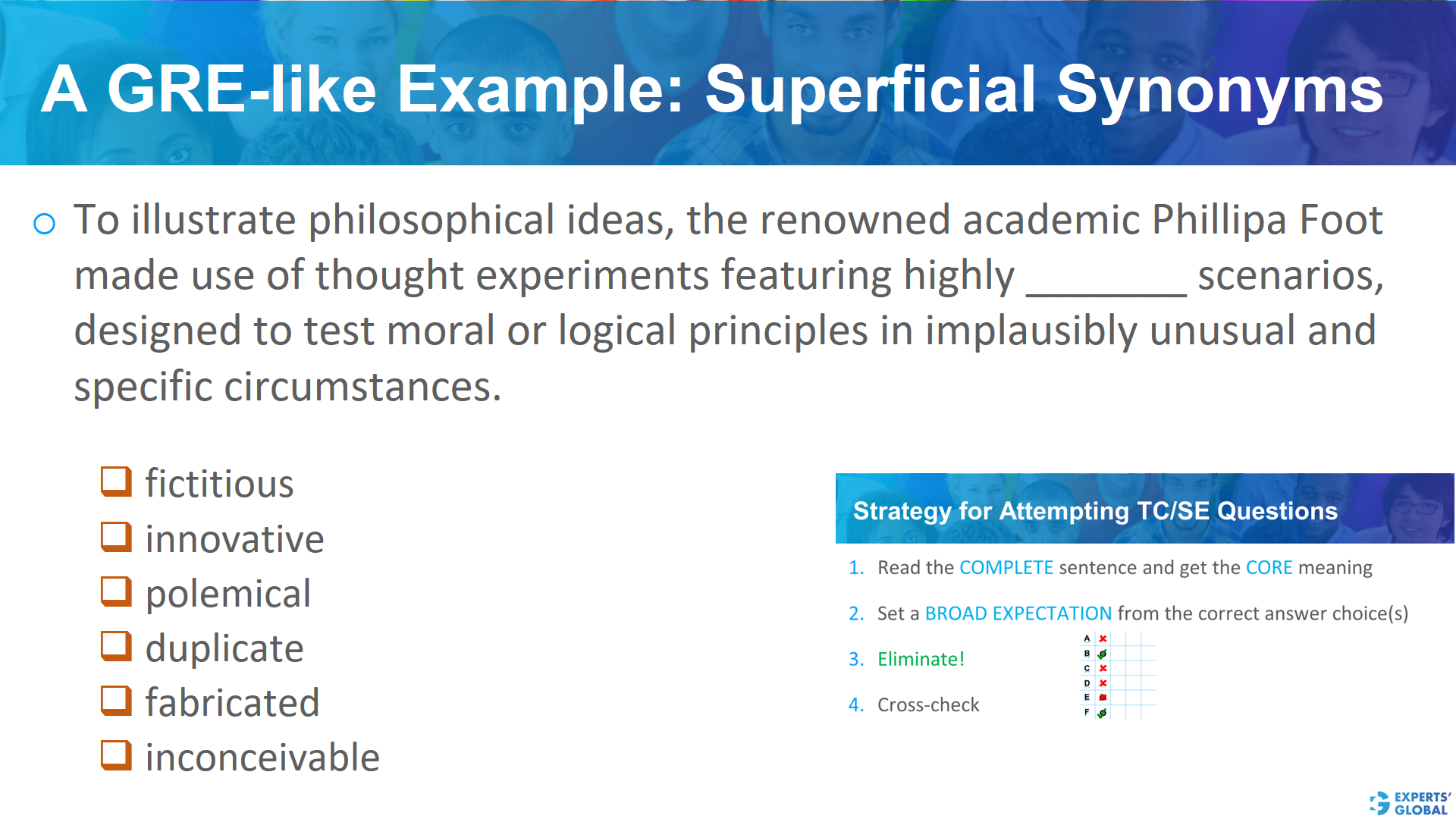
The blank describes the status of the scenarios as invented and used to test principles in unusual, specific circumstances.
Innovative and polemical describe style or argument, not whether scenarios are made up. Duplicate does not fit meaning. Inconceivable can fit “implausibly unusual,” but it shifts the focus to “unthinkable” rather than “invented,” so it becomes a trap here.
Fictitious and fabricated both directly signal “made up” scenarios, matching “thought experiments” and “implausibly unusual.”
Therefore, the correct choices are fictitious, fabricated
For a detailed explanation of this question, please refer to the video featured earlier on this page.
All-inclusive GRE prep course online
15 full length GRE practice tests
