
Invest 30 seconds...
...for what may lead to a life altering association!
Help Line
- +91.8800.2828.00 (IND)
- 1030-1830 Hrs IST, Mon-Sat
- support@expertsglobal.com
33% off ends soon:GMAT/GRE prep + applications bundle. Profile building, longer mentoring, better results. Inquire

A challenging situation on GRE Sentence Equivalence questions occurs when none of the six answer choices appear synonymous at first glance. In such cases, selecting two options that lead to equivalent meanings becomes difficult and often disrupts otherwise solid performance. Clear coverage of this scenario, along with a practical way to handle it, should be an integral part of a well-designed GRE prep course.
The detailed video below addresses this challenge in a clear and structured way. It explains a simple approach for handling questions that test such scenarios and then applies this approach to GRE-style Sentence Equivalence examples with realistic answer choices designed to reflect this difficulty. The explanation that follows the video elaborates on the ideas discussed in the video. Duly understand the concepts and methodology explained so that you apply them effectively in GRE practice questions and GRE mock tests, helping improve accuracy on Sentence Equivalence questions.
On GRE sentence equivalence questions, you often encounter situations where the correct answer choices are not synonyms per se. Context drives meaning, and in the given context, these choices still lead to complete, coherent sentences with equivalent meanings. The example below illustrates this exact scenario.

The slide introduces a situation where the two answer choices appear to match closely in meaning at first glance but are the correct choices. The sentence describes a community facing severe circumstances while remaining united and supportive, and the blank highlights an action that the community did not take during this period. Two (correct) answer choices are presented, decay and crumble, which encourages close evaluation of how each word fits the sentence meaning. This example reinforces attention to precise word usage when surface similarity feels unclear and meaning must guide the decision.
When you look for synonyms, don’t worry about finding words that are “exactly the same.” In the English language, “exact synonyms” are actually quite rare because every word has its own unique character. Instead, your mission is to find:
– Two choices that lead to complete, coherent sentences.
– Sentences that are EQUIVALENT in meaning once the words are plugged in.
Sometimes, words that are NOT “clear synonyms” on their own can still lead to equivalent sentences. This is why context matters!
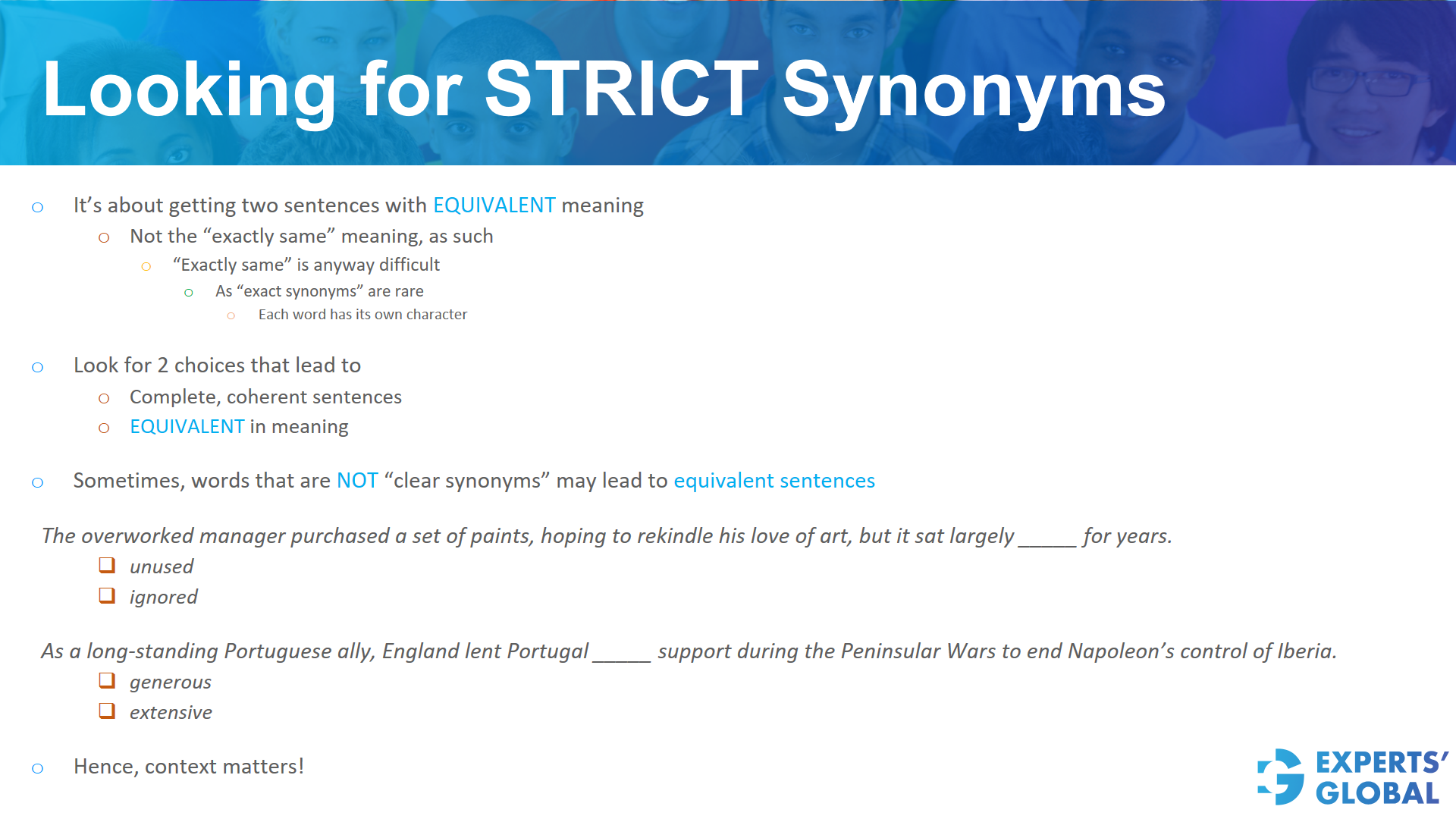
The slide emphasizes finding two choices that create sentences with equivalent meaning and highlights that equivalent meaning does not require an exactly same word meaning. Exact synonyms are rare, and each word carries its own character, so the guidance points toward selecting two choices that form complete and coherent sentences with matching intent. The emphasis stays on equivalence in meaning across the completed sentences, showing that words which do not appear as clear synonyms can still produce equivalent sentences when placed in the right context. One example sentence presents a blank about paints that remained unused or ignored over time, while another example sentence presents a blank about support provided during the Peninsular Wars. The closing idea reinforces that context plays a central role in deciding equivalence and guiding accurate selection.
The two examples on the slide show answer choice pairs that are not obvious synonyms, yet both pairs are correct because each independently produces complete sentences with similar meaning.
For a detailed explanation, refer to the video earlier on this page.
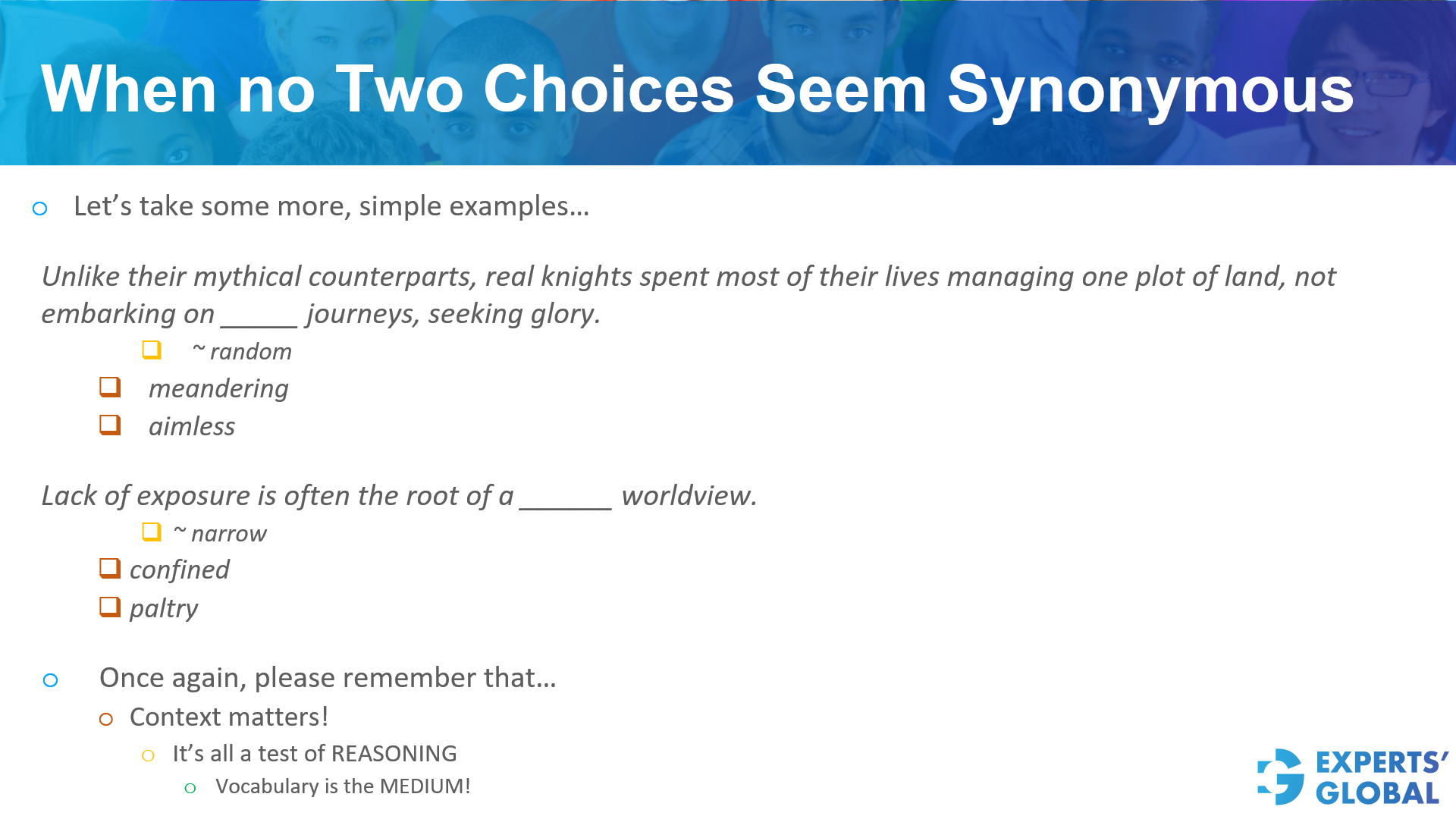
The slide gives mor examples of situations where no two answer choices appear synonymous at first glance and invites learners to explore additional simple examples to build clarity. One example sentence contrasts mythical knights with real knights and includes a blank that describes the nature of journeys, supported by multiple answer choices. Another example sentence connects a lack of exposure to a particular worldview and presents several descriptive options.
Across all three examples, the correct answer pairs shown are not direct synonyms. Yes, they are correct because, in context, each pair leads to sentences with equivalent meanings. This shows that meaning emerges through careful reading of the full sentence and reminds you that context matters in decision making. The examples reinforce that reasoning drives success, with vocabulary serving as the medium through which that reasoning works.
For a detailed explanation of these examples, please refer to the video featured earlier on this page.
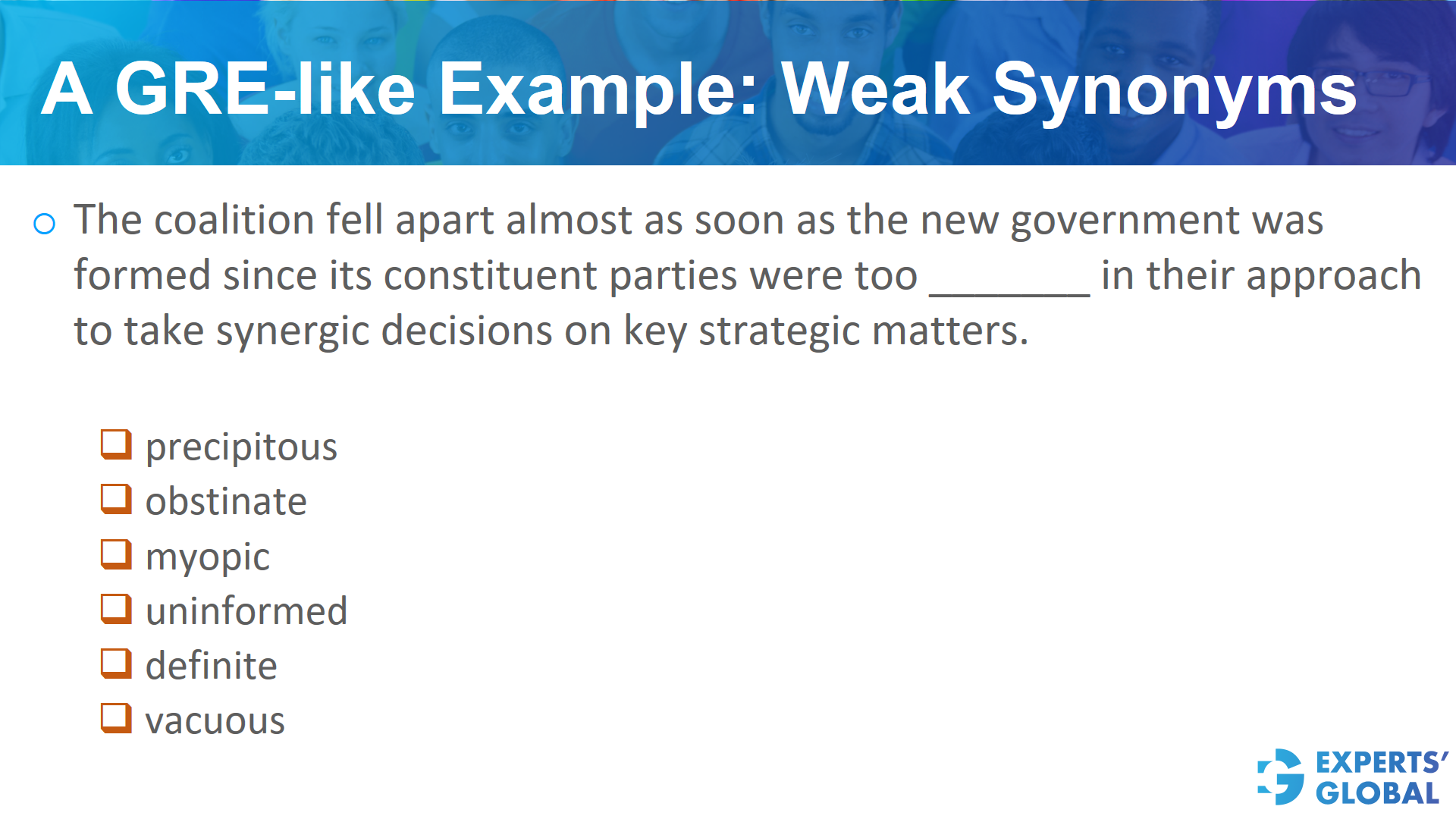
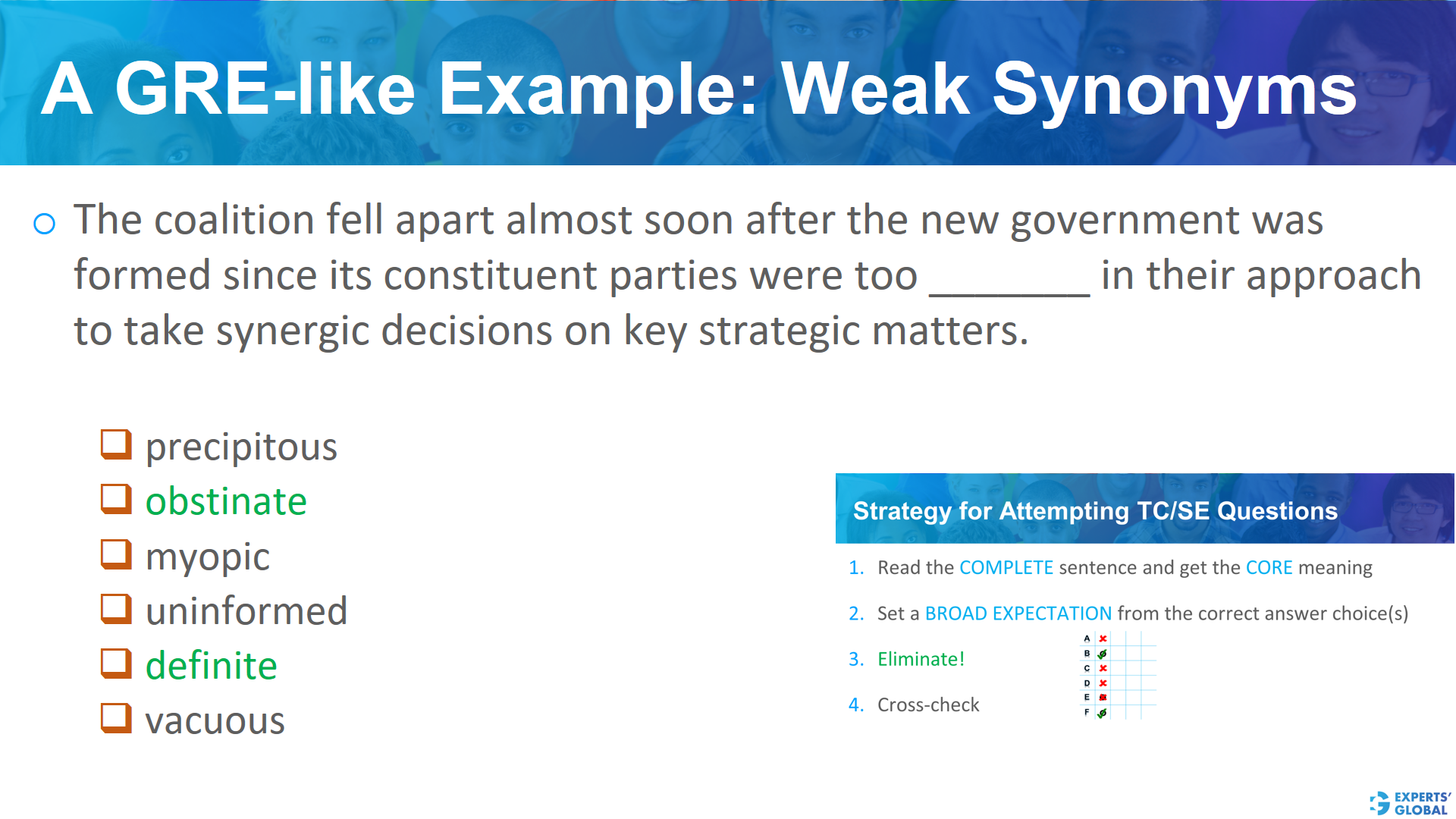
Here, obstinate and definite are not synonyms per se, yet they form a correct pair because, in this context, each leads to a sentence with equivalent meaning. For a detailed explanation of this question, please refer to the video earlier on this page.
Following is a step by step written explanation…
The coalition fell apart almost soon after the new government was formed since its constituent parties were too ________ in their approach to take synergic decisions on key strategic matters.
The sentence tells us a group (a coalition) broke up very quickly. Why? Because the parties involved couldn’t work together (“take synergic decisions”) on important things. The core meaning is that the parties were too “stiff” or “set in their ways” to cooperate.
Based on the context, we are looking for words that describe being stubborn, inflexible, or very fixed in an opinion. If everyone is too fixed in their own way, they can’t make a group decision.
We are left with obstinate and definite.
By using these two words, the core meaning remains the same: the parties were too stubborn/fixed to work together. They are our “weak synonyms” that made correct answer choices!
GRE online preparation course with free trial
Free full length GRE diagnostic test
