
Invest 30 seconds...
...for what may lead to a life altering association!
Help Line
- +91.8800.2828.00 (IND)
- 1030-1830 Hrs IST, Mon-Sat
- support@expertsglobal.com
33% off ends soon:GMAT/GRE prep + applications bundle. Profile building, longer mentoring, better results. Inquire

A particularly tricky scenario on GRE Sentence Equivalence questions shows up when the answer choices include multiple synonym pairs, making it difficult to identify the correct pair that fits the sentence meaning precisely. Such questions often carry higher difficulty and answering them correctly can contribute meaningfully to score improvement, which is why clear coverage of this challenge should be part of a well-structured GRE prep course.
The video below explains a sound and practical approach for handling Sentence Equivalence questions that test multiple synonym pairs, first outlining the approach and then demonstrating its direct application on GRE-style examples with realistic answer choices. The article that follows expands on the same approach in greater detail. Carefully understand the concepts, the method, and how they apply, and then carry them forward into GRE practice exercises and full-length GRE mock tests to improve accuracy and speed on Sentence Equivalence questions.
In the GRE Sentence Equivalence (SE) section, your goal is to choose two words that, when used to complete the sentence, result in two sentences with the same meaning.
While it is tempting to just look for two words that mean the same thing, there is a common trap you must avoid: Multiple Synonym Pairs.
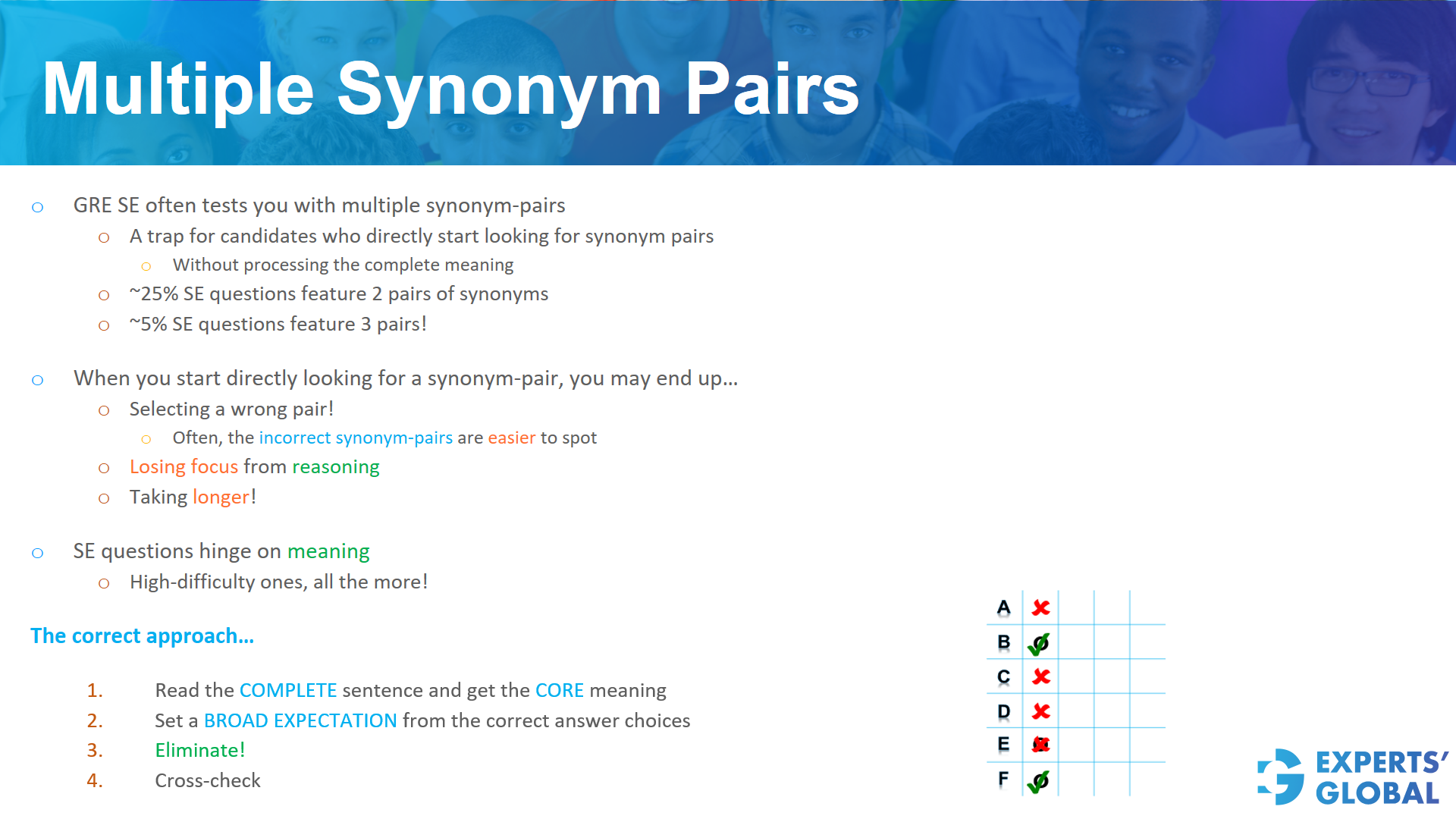
On GRE Sentence Equivalence questions, you often encounter more than one synonym pair within a single question. Many questions include multiple possible pairs, with about twenty five percent containing two pairs and about five percent containing three. A common mistake is to focus on spotting synonym pairs before fully understanding the sentence meaning; this approach can push you toward an appealing but incorrect pair. Meaning always drives correctness, especially in higher difficulty questions where reasoning plays a stronger role. Hence, you should follow the correct, complete approach: to read the full sentence first, form a broad expectation, eliminate unsuitable choices, and finish with a careful cross check to support accuracy.
If you start by looking for synonym pairs instead of analyzing the sentence, you may end up:
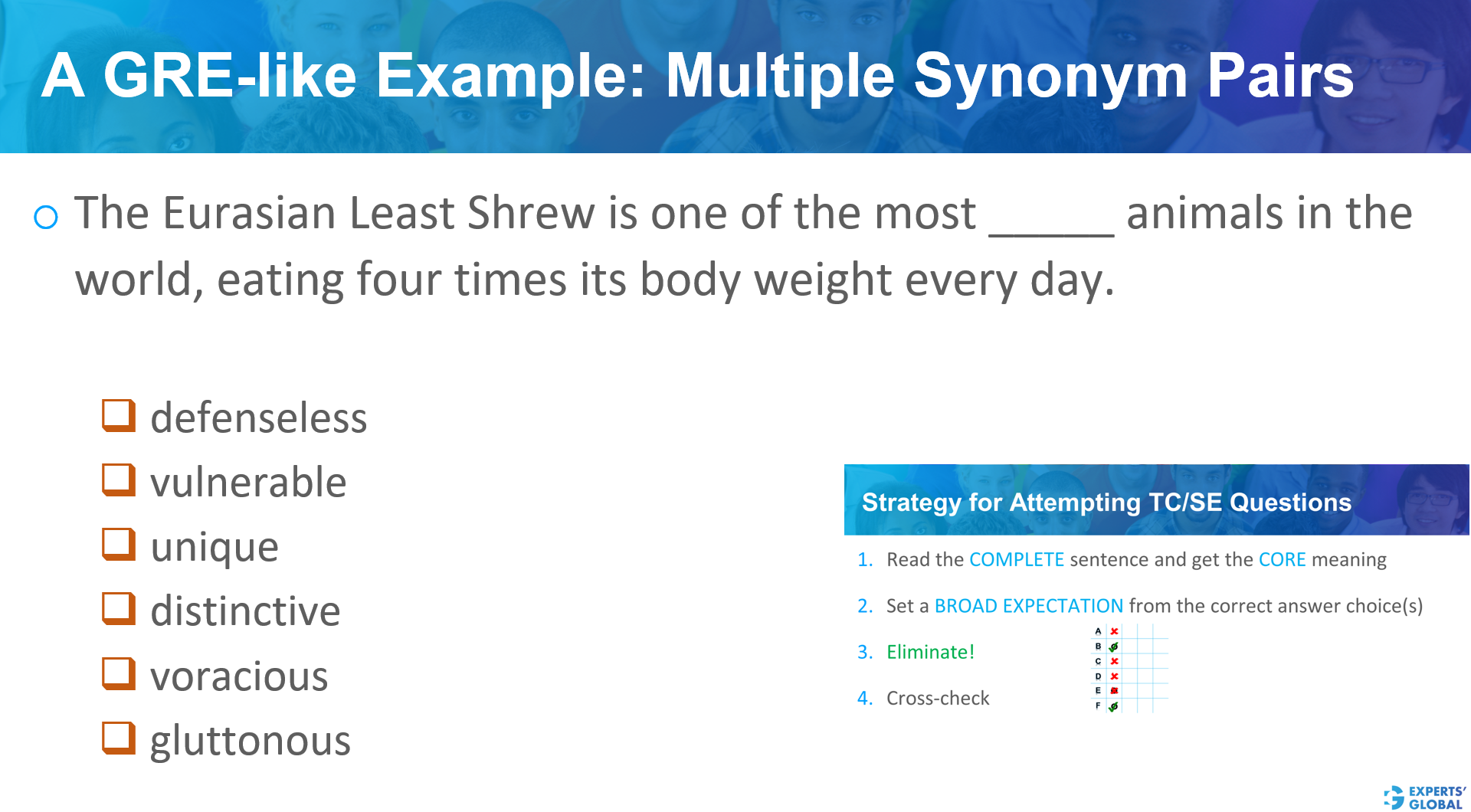
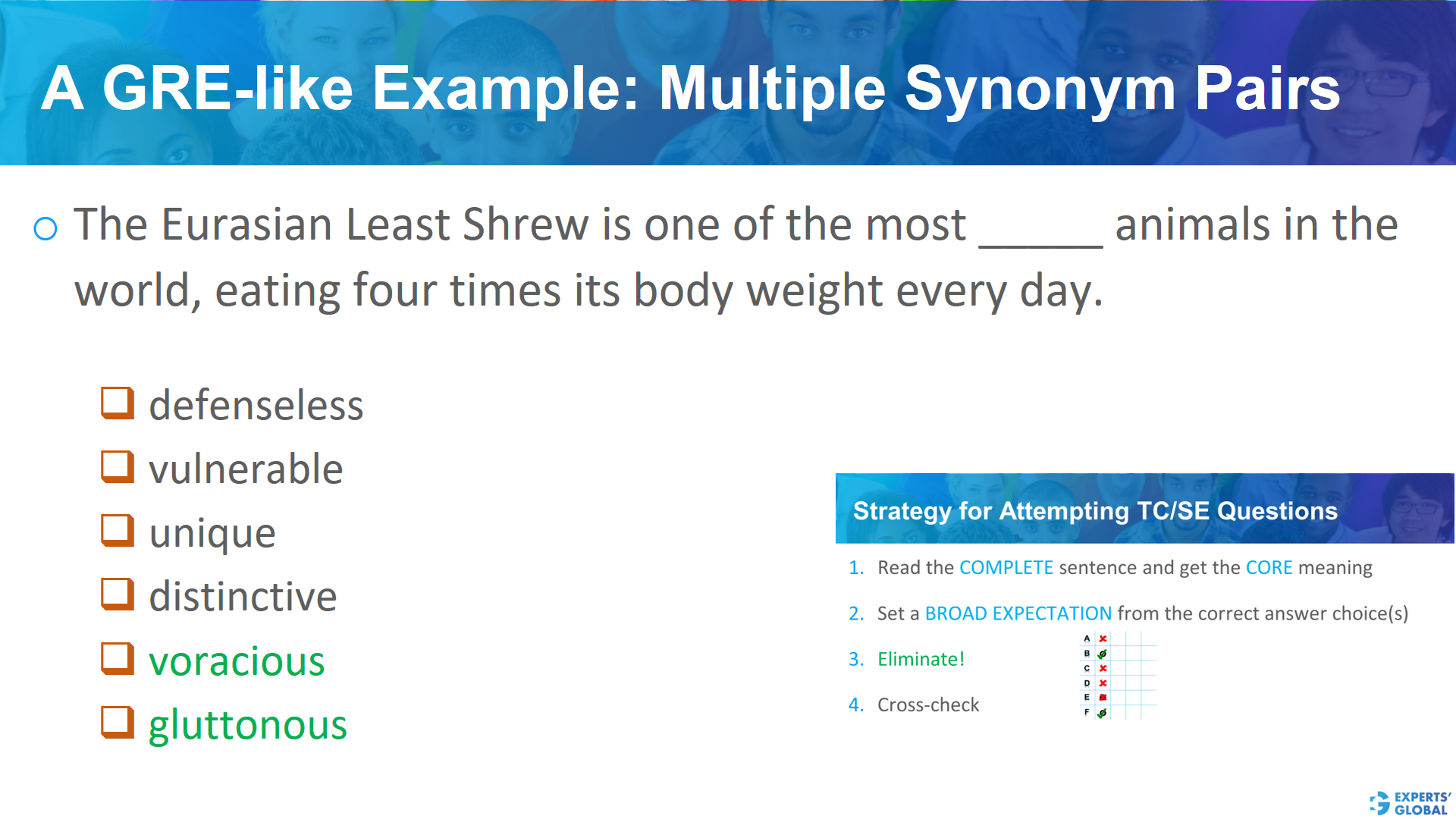
For a detailed video explanation of this question, please refer to the video featured earlier on this page. Following is a step-by-step written explanation:
The Eurasian Least Shrew is one of the most ________ animals in the world, eating four times its body weight every day.
First, we read the entire sentence: “The Eurasian Least Shrew is one of the most ________ animals in the world, eating four times its body weight every day.” The core meaning here is about an animal that eats a huge amount of food relative to its size.
Based on the fact that this animal eats “four times its body weight every day,” our broad expectation for the blank is a word that means “very hungry” or “having a huge appetite”.
Now, let’s look at our choices and eliminate words that don’t match our expectation:
Finally, we check our pair: voracious and gluttonous. Both words fit the sentence perfectly and ensure that the sentence conveys the exact same core meaning.
The correct answer choices, therefore, are voracious and gluttonous.
Comprehensive online GRE prep course
15 GRE practice tests full length
Free GRE diagnostic test full length
