
Invest 30 seconds...
...for what may lead to a life altering association!
Help Line
- +91.8800.2828.00 (IND)
- 1030-1830 Hrs IST, Mon-Sat
- support@expertsglobal.com
33% off ends soon:GMAT/GRE prep + applications bundle. Profile building, longer mentoring, better results. Inquire

GRE sentence equivalence questions often become challenging when the answer choices are counter-intuitive in nature. In such situations, incorrect answer choices may start appearing appealing at first glance, while the correct answer choices may appear less obvious or even misleading. These include words whose meanings differ from how they appear, words with very broad usage, words with misleading or confusing connotations, homonyms, and similar vocabulary patterns. Proper and deliberate coverage of these counter-intuitive answer choice scenarios, along with a structured way to handle them, must form an essential part of a well-designed GRE prep course.
The set of videos below addresses each of these counter-intuitive answer choice scenarios individually and carefully. Each video explains a clear and methodical approach for handling that specific challenge and then applies the same approach to GRE-style sentence equivalence questions using realistic answer choices that test these traps directly. The theory that follows the videos elaborates on the same ideas in greater detail. Absorb the concepts and the approach explained here fully and apply them consistently in GRE drills and full-length GRE practice tests to improve performance on sentence equivalence questions.
Some words carry meanings that differ from what their sound may suggest. Words such as fastidious, enervate, restive, precocious, and spendthrift often mislead, and comparing spendthrift with thrifty sharpens usage awareness. You rely on an elimination based approach as a core habit by removing four choices through careful reasoning. This process builds accuracy by narrowing options logically, while regular practice strengthens vocabulary understanding and reinforces correct meaning over time.
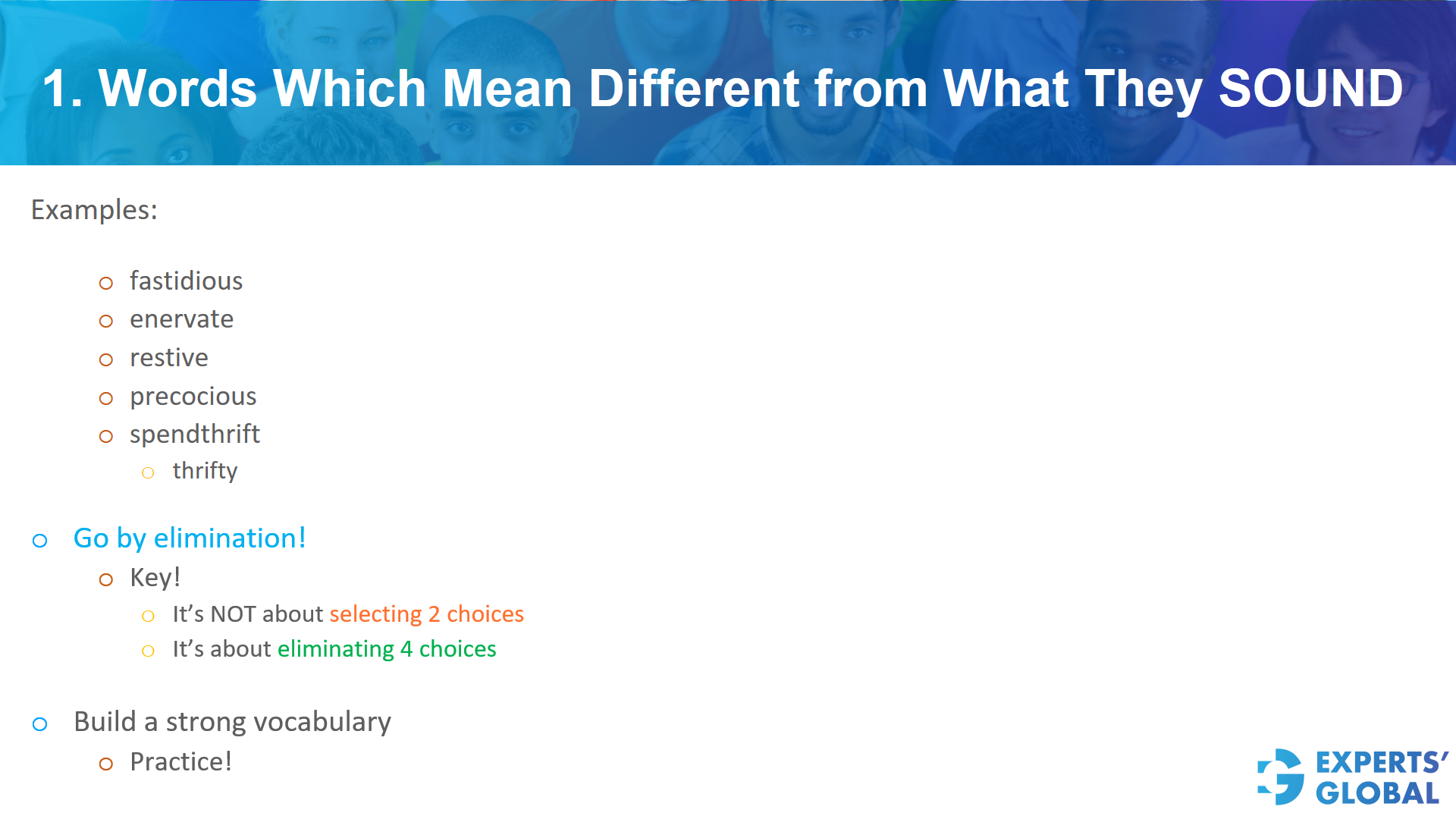
Here are some interesting examples:
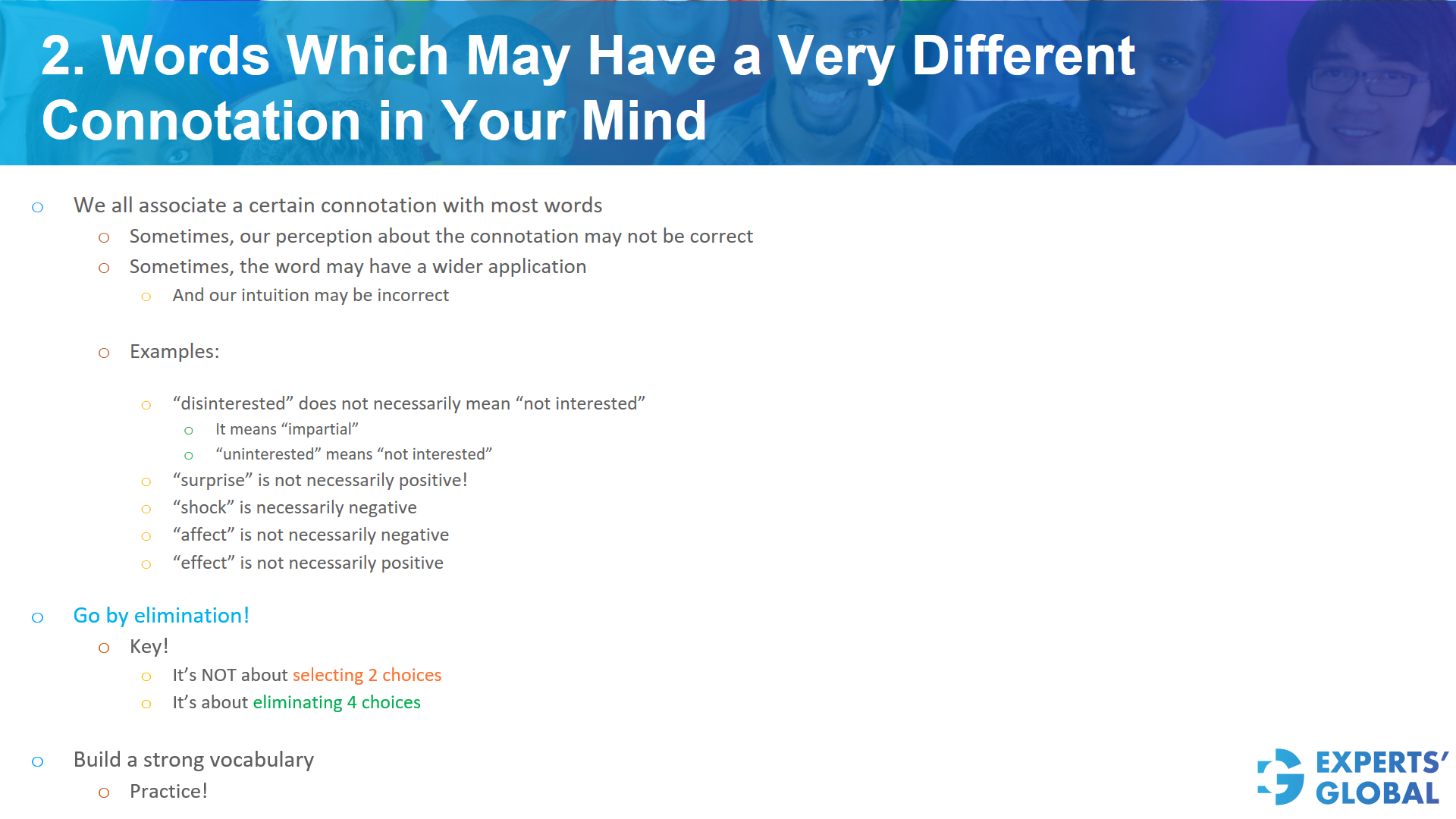
Words carry personal connotations shaped by past exposure and intuition, yet your perception of a word can differ from how it functions in actual usage. A word often applies more broadly or differently than the meaning you first associate with it, so intuition alone does not always guide correct choice.
Some interesting examples:
A word often applies more broadly than your first impression suggests, and a narrow understanding can mislead elimination. You improve accuracy by paying close attention to how a word functions across different contexts.
Some interesting examples…
Profound
Homely
Sentence context determines which application fits correctly. You use elimination as a key strategy by removing four choices. Regular practice strengthens vocabulary understanding and accuracy.
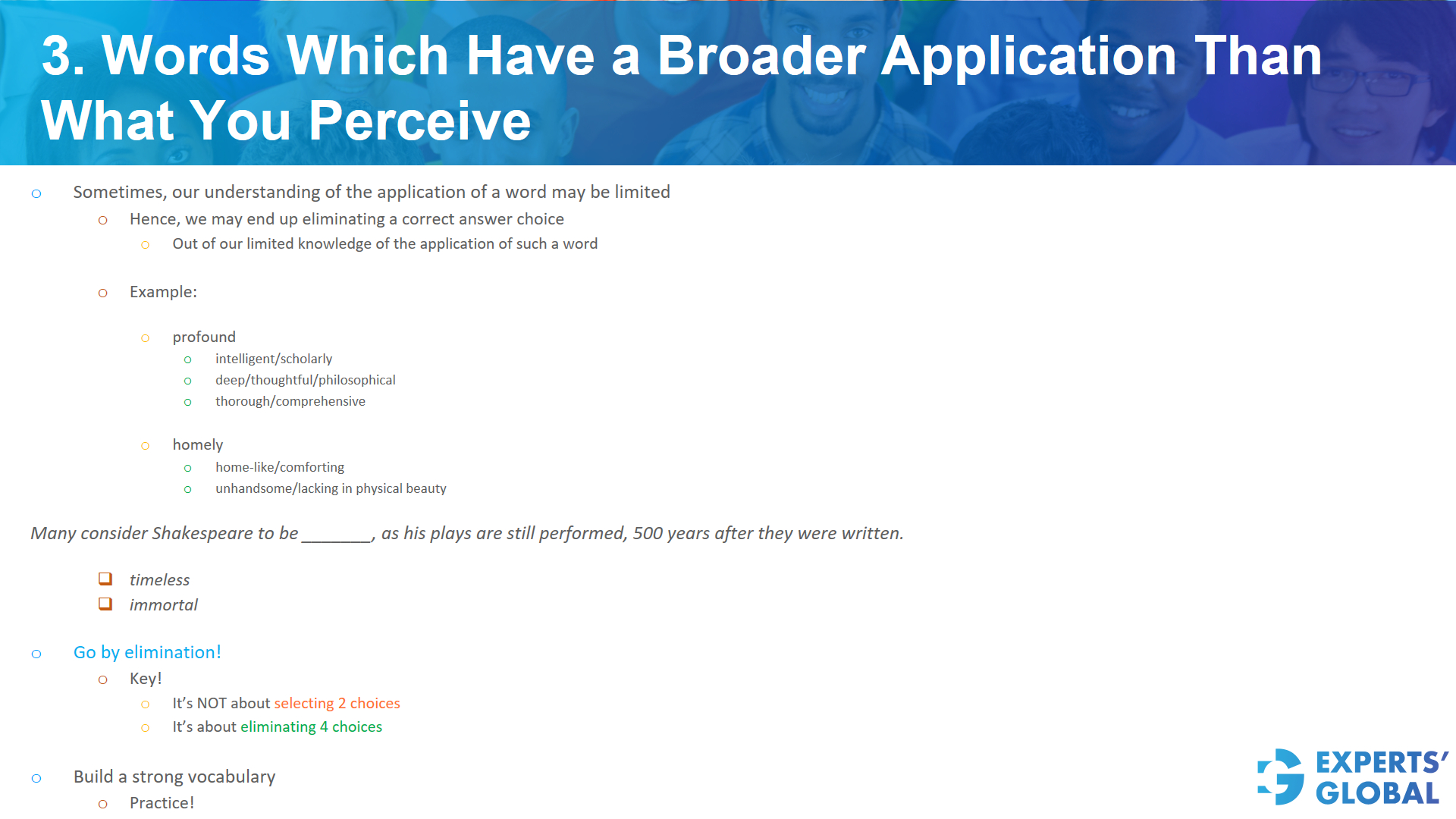
For a detailed explanation for example on the slide, please refer to the video featured earlier on this page. Following is step-by-step written explanation.
Many consider Shakespeare to be __________, as his plays are still performed, 500 years after they were written.
1. Analyze the Sentence: The sentence tells us that Shakespeare’s work is still being used 500 years later. This suggests his influence or work never “dies” or ends.
2. Examine the choices:
3. The Result: Both “timeless” and “immortal” fit because they both complete the sentence accurately based on the broader application of the words.
Homographs share the same spelling but carry different meanings, as in rock and rock, and bear and bear. Homophones share the same pronunciation but carry different meanings, as in two and too, and mat and mate. Both homographs and homophones fall under homonyms, which can feel confusing at first glance even though these traps appear rarely. You rely on sentence context to identify the intended meaning and avoid the trap. You use elimination as a key strategy by removing incorrect choices step by step, and consistent practice strengthens vocabulary over time.
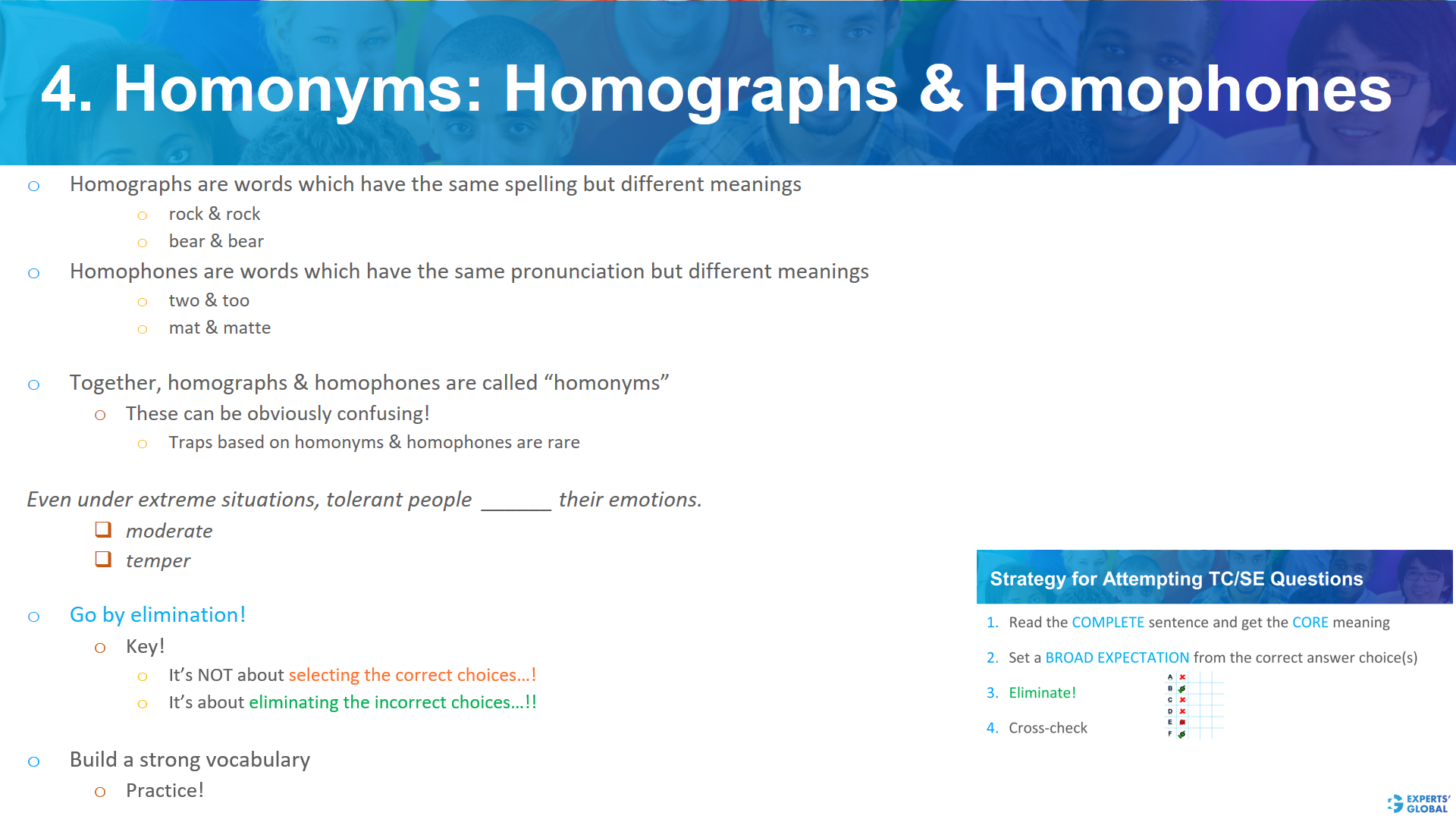
For a detailed explanation for example on the slide, please refer to the video featured earlier on this page. Following is step-by-step written explanation.
Even under extreme situations, tolerant people _________ their emotions.
1. Read the COMPLETE sentence: We are looking for what tolerant people do with their emotions during tough times.
2. Set a BROAD EXPECTATION: We expect the word to mean “control” or “balance”.
3. Examine the chocies:
4. Cross-check: Both “moderate” and “temper” duly complete the core meaning of the sentence.
Whether you are dealing with tricky sounds or confusing connotations, the best way to find the right answer in a test is to use the process of elimination.
By focusing on why four of the options are wrong, you will naturally be left with the correct one.
The best way to improve is through consistent effort:
The more you practice, the more you will come across such words, and the better you will become at spotting and dealing with these traps.
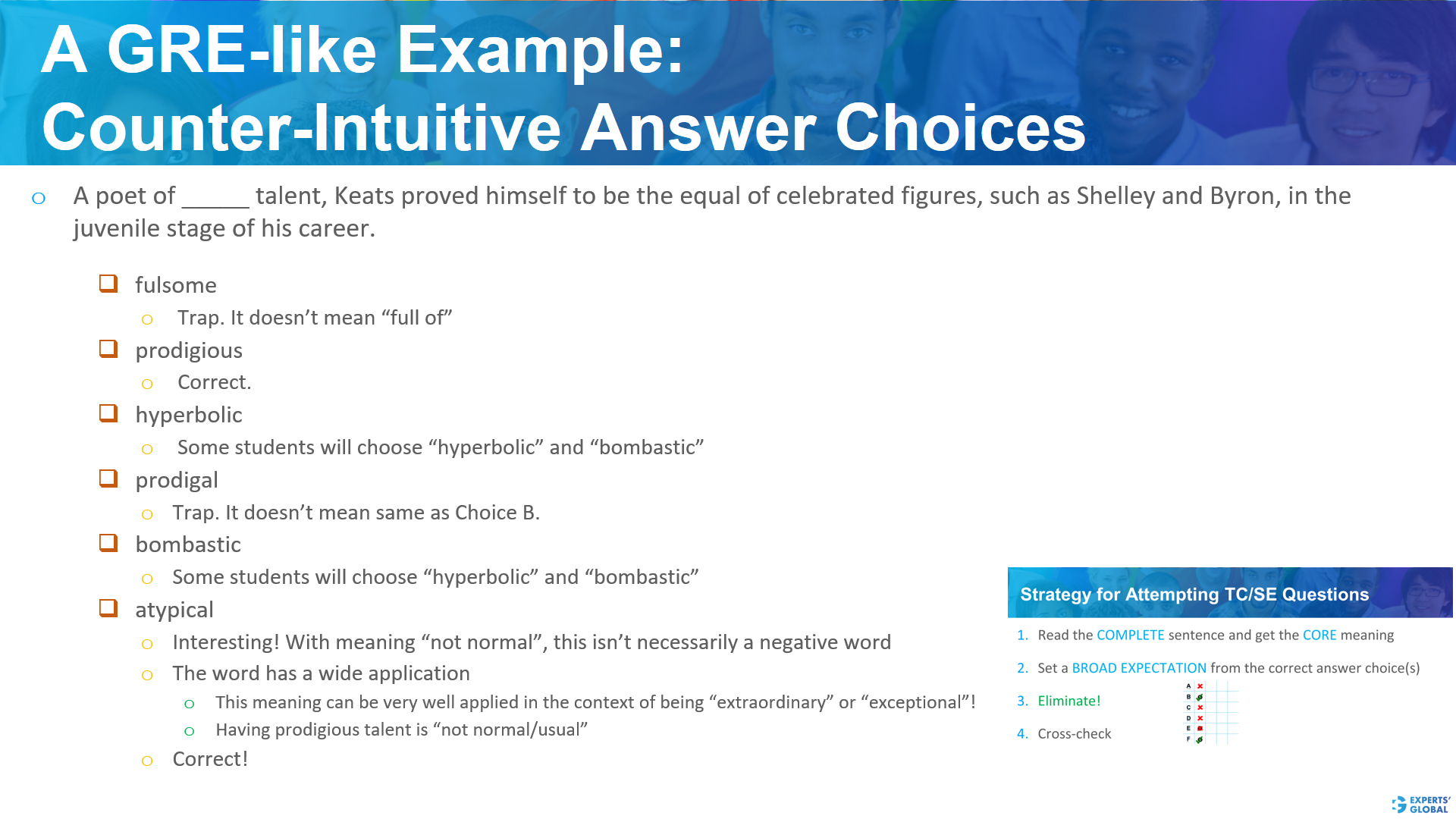
Correct answers: prodigious, atypical
For a detailed explanation of this question, please refer the last ~2 minutes of the video featured earlier on this page. Following is a step-by-step written solution:
A poet of _____ talent, Keats proved himself to be the equal of celebrated figures, such as Shelley and Byron, in the juvenile stage of his career.
1. Core Meaning
The sentence compares the poet Keats to “celebrated figures” like Shelley and Byron during his early years. To be their “equal” while still in a “juvenile stage,” he must have possessed remarkable or extraordinary talent.
2. Broad Expectation
I expect a word meaning extraordinary, immense, or unusual to describe talent that matches famous established poets so early in a career.
3. Eliminate
4. Cross-check
Prodigious and atypical both function here to show that his talent was not normal or usual. While atypical is often seen as negative, it successfully conveys the “extraordinary” nature of his skills in this specific context.
Correct answers: prodigious, atypical
Complete GRE preparation course with 7-day free trial
