
Invest 30 seconds...
...for what may lead to a life altering association!
Help Line
- +91.8800.2828.00 (IND)
- 1030-1830 Hrs IST, Mon-Sat
- support@expertsglobal.com
33% off ends soon:GMAT/GRE prep + applications bundle. Profile building, longer mentoring, better results. Inquire

GRE Sentence Equivalence and Text Completion questions often hide the real meaning inside a turn, a reversal, or a quiet shift in direction, and contrast sits right at the center of that game. Many Sentence Equivalence sentences lean on contrast, sometimes through one clean pivot and often through layered movement that includes multiple contrasts, false contrasts, and double negatives. When you learn to catch these turns and read the meaning before and after the pivot with precision, you start selecting answer pairs that fit the sentence naturally and exactly. That is why a well-built GRE preparation course treats contrast as a core skill and covers its common patterns with real depth.
The video set below breaks contrast-focused Sentence Equivalence scenarios into individual lessons, so you practice one pattern at a time with clarity. Each video walks you through spotting contrast triggers and pivot words, locking the sentence direction, and choosing the correct pair based on the exact meaning created by the contrast, then shows the same method on GRE-style questions with realistic answer choices designed to test these patterns directly. The theory after the videos reinforces the same framework. Take the method with you into timed drills and full-length GRE practice exams, so your contrast handling becomes consistent across your Sentence Equivalence work.
More than 50% of sentences found on the GRE’s Sentence Equivalence (SE) and Text Completion (TC) sections feature contrast. Contrast suggests a “shift” in meaning. Essentially, contrast reverses the broad expectation you would otherwise have from the correct answer choice. Hence, identifying and processing each contrast or shift in meaning is essential to solving SE and TC questions correctly.

The correct answer is “frugal.” If you did not process the contrast in meaning, you may have selected “extravagant.” For a detailed explanation of this example, please refer to the video presented earlier on this page.
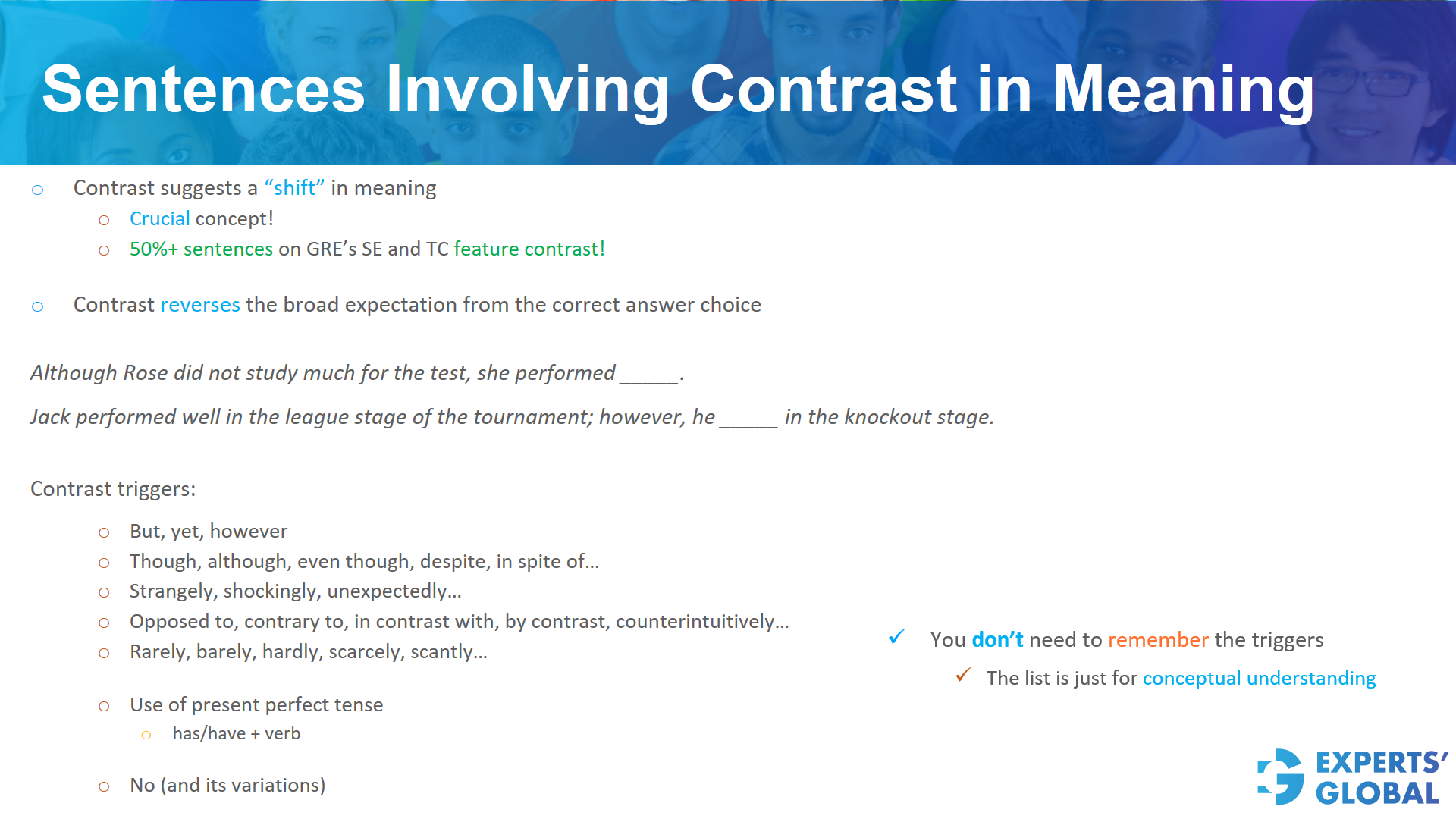
To understand how contrast works, let’s look at two examples and solve them using a simple, step-by-step approach.
Although Rose did not study much for the test, she performed ________.
Jack performed well in the league stage of the tournament; however, he ________ in the knockout stage.
These are words or phrases that signal a shift is happening in the sentence. You don’t need to remember every single one; this list is just for your conceptual understanding:
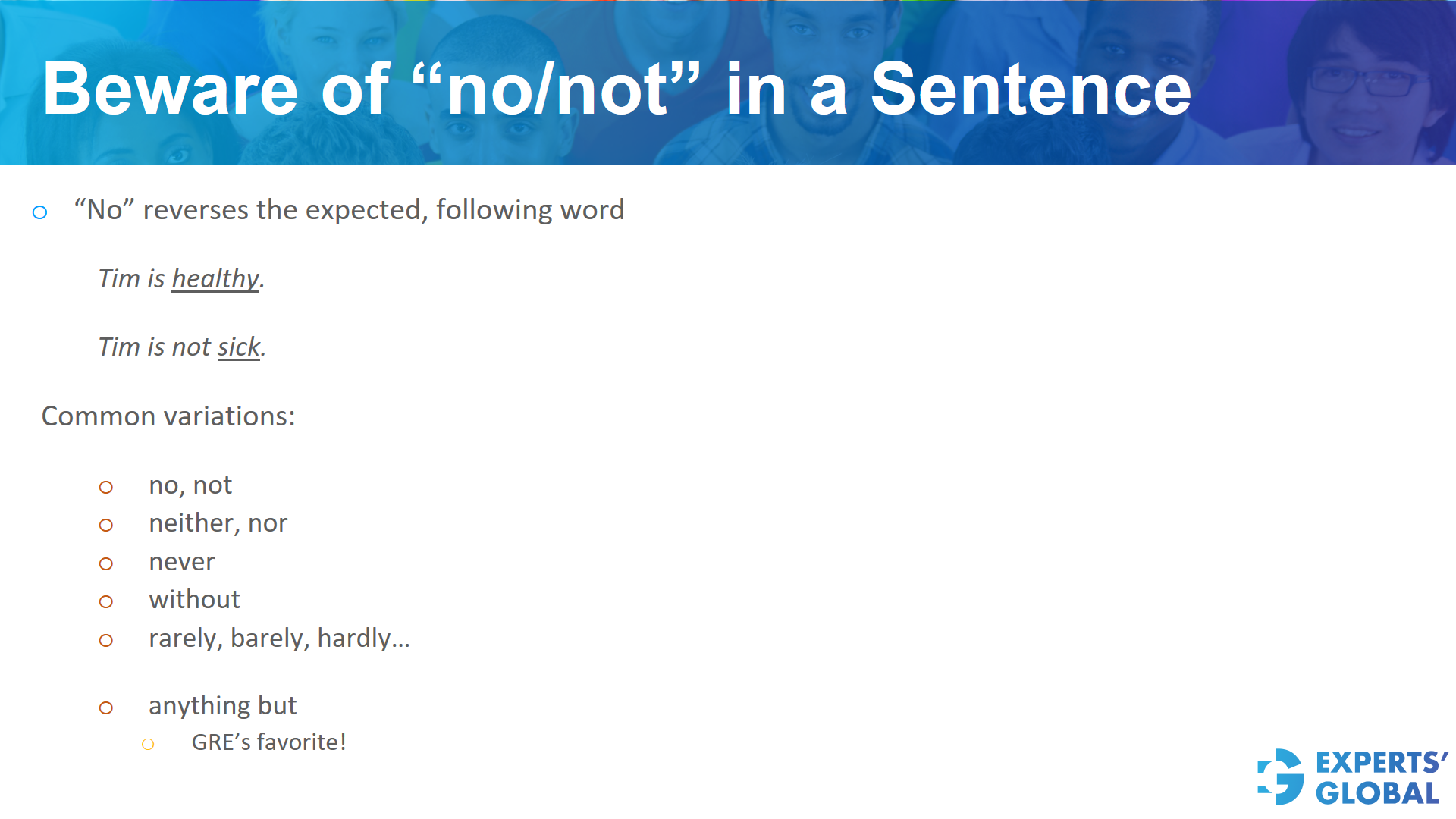
The word no reverses the meaning of the word that follows it, and the same flip occurs when not appears before a description. You treat these words as clear signals that the expected meaning changes direction. Paired forms such as neither and nor work in the same way, and words like never and without also signal a strong reversal in meaning. Words such as rarely, barely, and hardly create a similar shift, and the phrase anything but signals a powerful reversal and appears often in GRE questions. When you spot these signals early, you track sentence logic accurately and stay aligned with the intended meaning.
Pay close attention when you see these words, as they change the direction of the sentence:
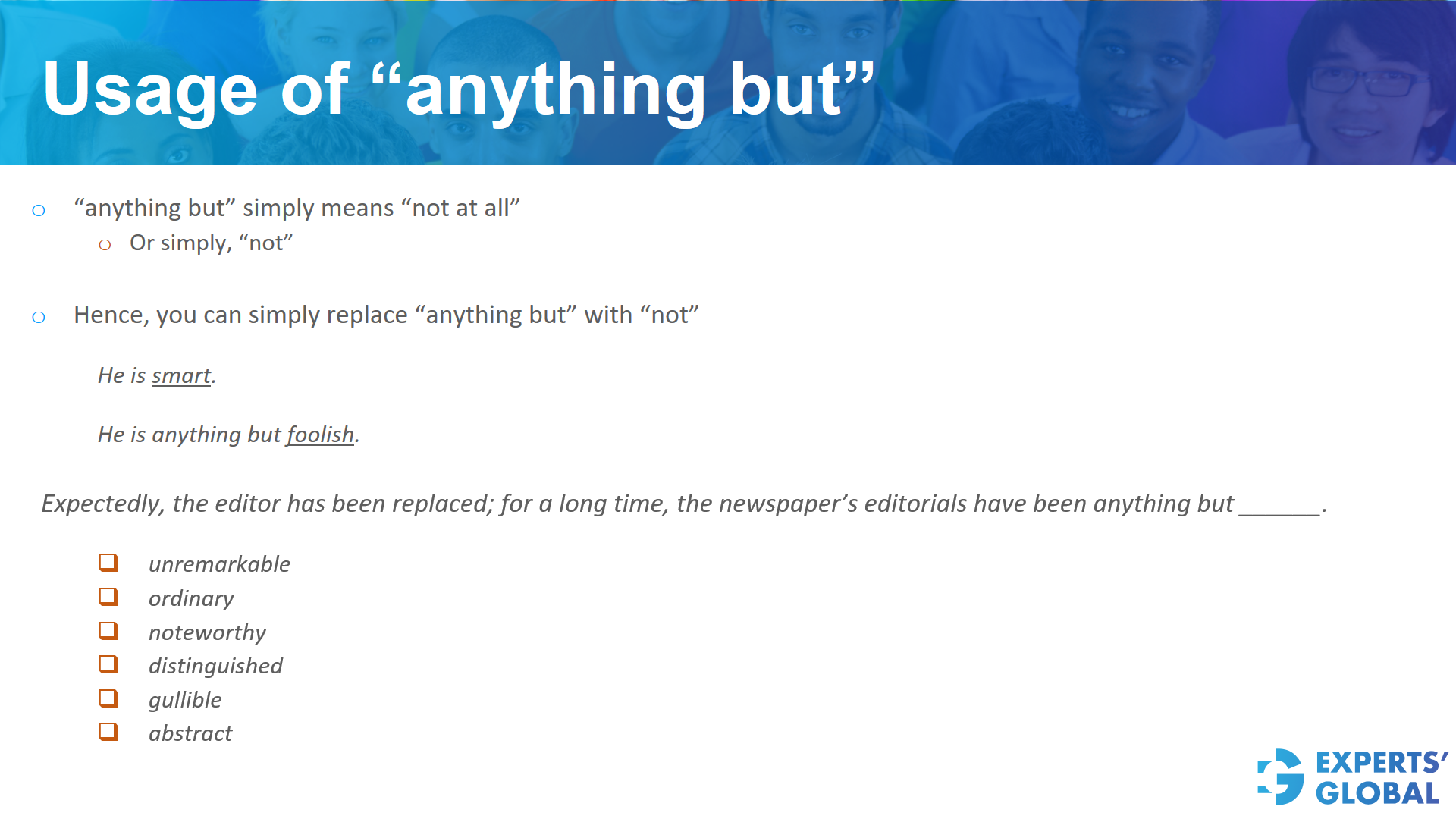
The phrase “anything but” means “not at all” and functions the same way as “not” within a sentence. You can replace “anything but” with “not” and preserve the intended meaning. This phrase flips the meaning of the word that follows and creates a clear reversal in interpretation.
The phrase “anything but” simply means “not at all” or simply, “not”. You can simply replace “anything but” with “not” to make the sentence easier to read.
Expectedly, the editor has been replaced; for a long time, the newspaper’s editorials have been anything but ________.
1. Step 1: Understand the context. The editor was “expectedly” replaced, which suggests the editorials were not good.
2. Step 2: Apply the “anything but” strategy. Replace “anything but” with “not”. The sentence now reads: “…the newspaper’s editorials have been not”
3. Step 3: Logical completion. If the editor was replaced for doing a poor job, the editorials were not good. Therefore, the blank should be a word that means “good” or “impressive,” so that “not good” matches the context.
4. Final Answer: The words noteworthy and distinguished both mean excellent or impressive. When we say they were “anything but noteworthy,” it means they were not noteworthy, explaining why the editor was replaced!
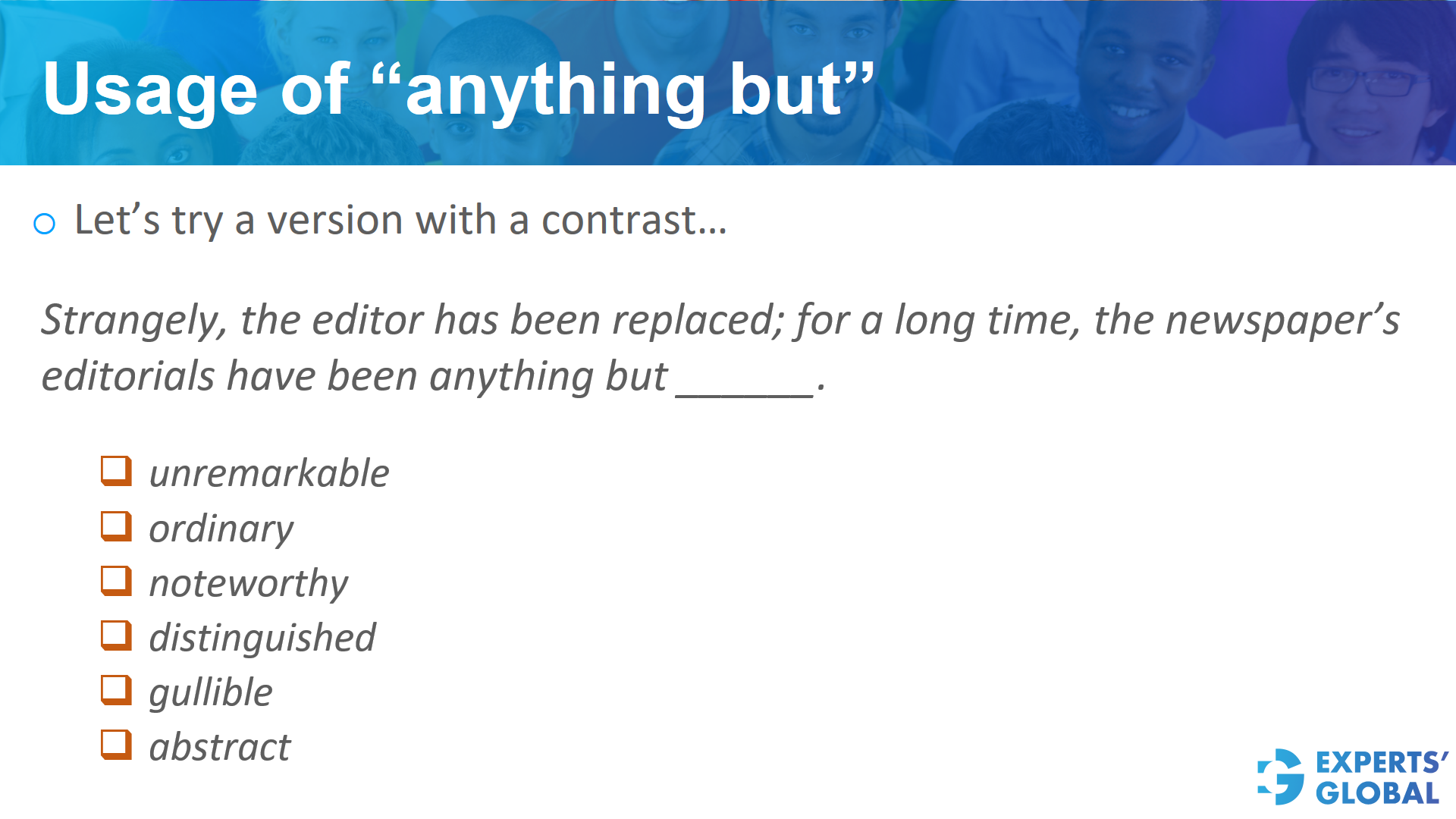
Strangely, the editor has been replaced; for a long time, the newspaper’s editorials have been anything but ________.
1. Identify the Contrast Trigger: The sentence starts with the word “Strangely”. This is a contrast trigger that suggests a “shift” in meaning from what we would normally expect.
2. Understand the Situation: Usually, if an editor is replaced, it is because their work was not good. However, because the word is “Strangely,” we must reverse that broad expectation. This tells us that, surprisingly, the editor was replaced even though the editorials were actually good!
3. Use the “Anything But” Strategy: The second part of the sentence says the editorials were “anything but ________”. We can simply replace “anything but” with “not”.
4. Put it All Together: Our logic tells us the editorials were good. To make the sentence mean they were good while using the word “not,” we need to pick a negative word for the blank. If the editorials were “not ordinary,” then they were good!
5. Select the Best Fit: Looking at our choices, “unremarkable” and “ordinary” are the perfect words. Saying the editorials were “anything but ordinary” means they were not ordinary—they were special!
It is important not to confuse negative words with contrasting words, or negative thoughts with contrasting thoughts.
Always focus on whether there is a SHIFT in the meaning. Shift is the key!
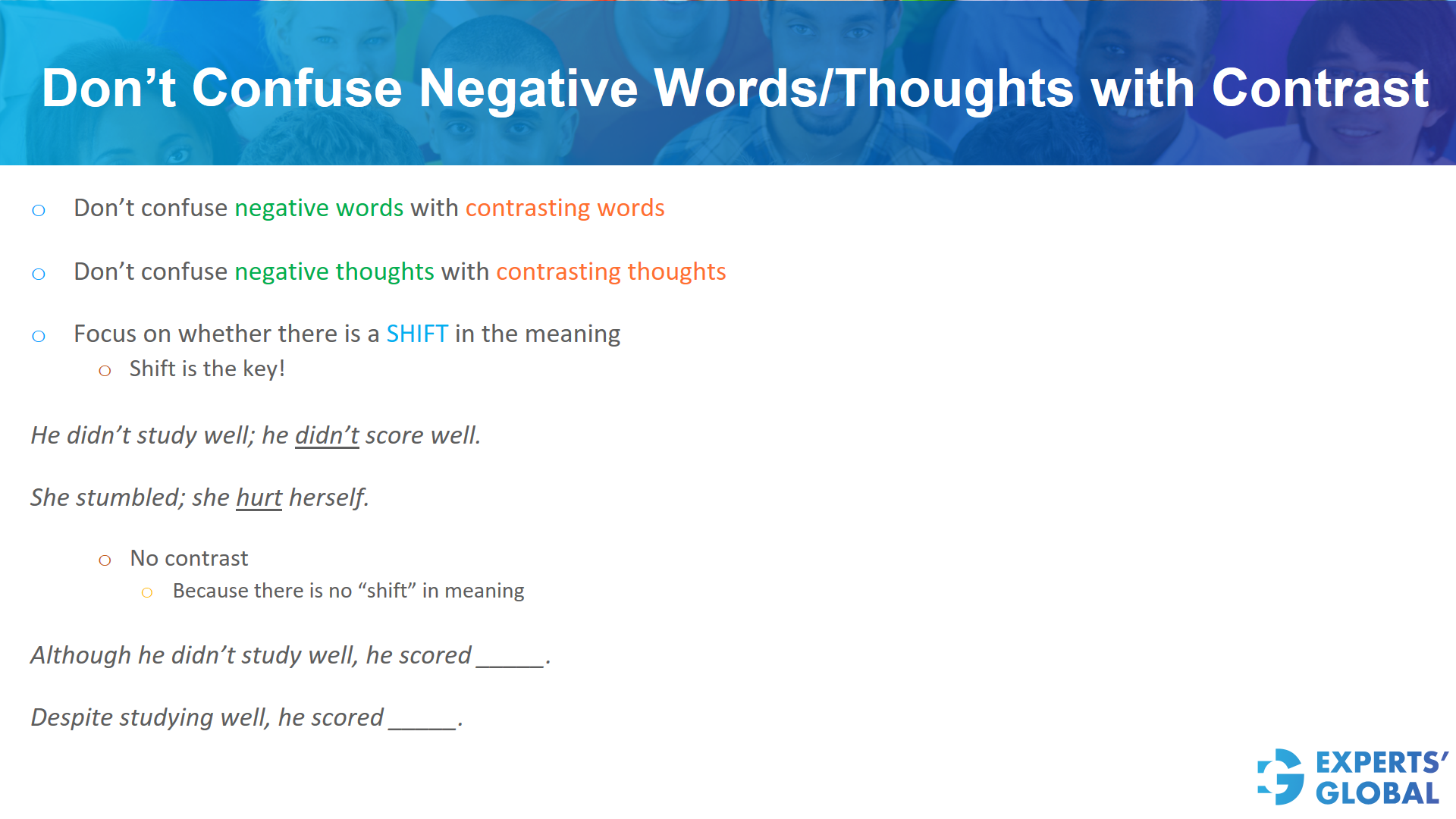
For a detailed explanation for examples on the slide, please refer to the video featured earlier on this page.
| Situation | Implication |
|---|---|
| A negative action or circumstance leading to a negative outcome | No contrast |
| A negative action or circumstance leading to a positive outcome | Contrast |
| A positive action or circumstance leading to a negative outcome | Contrast |
| A positive action or circumstance leading to a positive outcome | No contrast |
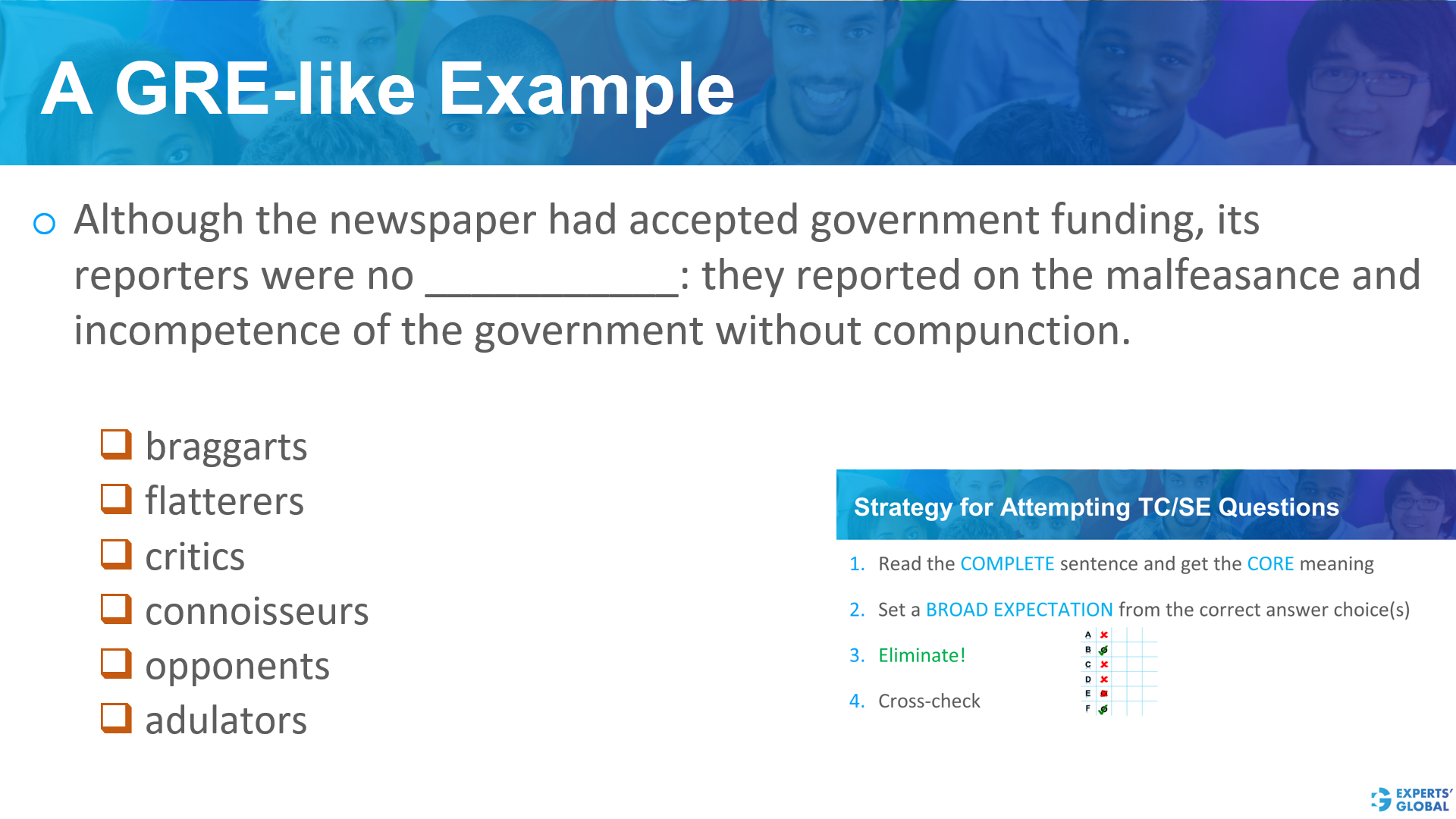
Correct answers: flatterers, adulators
For a detailed explanation of this question, please refer the last ~2 minutes of the video featured earlier on this page. Following is a step-by-step written solution:
Although the newspaper had accepted government funding, its reporters were no __________: they reported on the malfeasance and incompetence of the government without compunction.
1. Core Meaning
The contrast trigger “Although” indicates that while the paper took money, its reporters refused to be biased. The colon introduces the proof: they exposed government “malfeasance” without hesitation.
2. Broad Expectation
The reporters were “no [blank],” meaning they were NOT people who give excessive praise or unearned support. We expect a word meaning praisers.
3. Eliminate
4. Cross-check
Flatterers and adulators are synonyms that complete the logic: despite funding, the reporters were not government lapdogs.
Correct answers: flatterers, adulators
End-to-end GRE prep course online (includes 7-day free trial)
15 full-length GRE practice tests
