
Invest 30 seconds...
...for what may lead to a life altering association!
Help Line
- +91.8800.2828.00 (IND)
- 1030-1830 Hrs IST, Mon-Sat
- support@expertsglobal.com
33% off ends soon:GMAT/GRE prep + applications bundle. Profile building, longer mentoring, better results. Inquire

Learning to track meaning shifts in GRE Sentence Equivalence questions plays a central role in sincere GRE prep, and double negatives is an interesting variation, one of the clearest places to build that skill. In these sentences, the writer stacks negative ideas, and each negative can flip the meaning again, so you reach the correct interpretation only after you process each negative in sequence. You move step by step, translate each negative cleanly, and stay attentive to any pivot word that shapes where the sentence finally lands.
The video below shows a straightforward workflow for double negatives that keeps your reading clear and your choices precise. It walks you through how to unpack each negative in order, watch the direction change as the sentence develops, and then select the answer pair that matches the final meaning, using GRE-style Sentence Equivalence questions with realistic answer choices built around this pattern. The theory that follows strengthens the same workflow. Take this method into your GRE drills and full-length GRE mocks so your accuracy stays steady when multiple negatives show up on SE questions.
The Core Concept: How Negatives Work. Think of negative words like a “switch” that flips the meaning of a sentence.
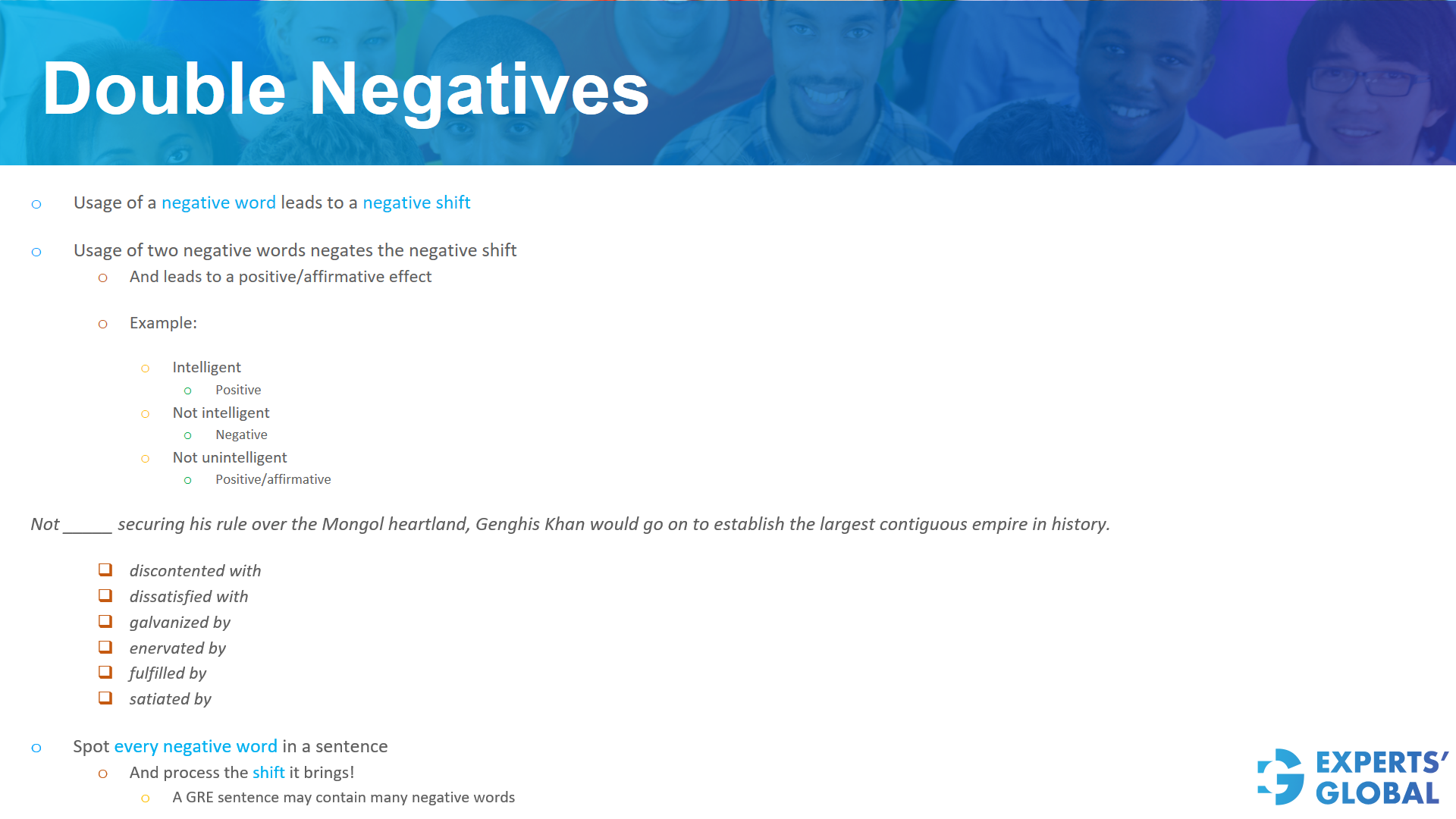
The word “No” or “Not” reverses the expected meaning of the word that follows it.
You need not memorize the list; just grasp a broad understanding.
For a detailed explanation for example on the slide, please refer to the video featured earlier on this page. Following is step-by-step written explanation.
Not _________ securing his rule over the Mongol heartland, Genghis Khan would go on to establish the largest contiguous empire in history.
The sentence structure “Not [blank]… would go on to…” suggests that Genghis Khan’s initial achievement (securing the heartland) did not stop him. Instead, it served as a starting point for even greater expansion.
2. Broad Expectation
The blank requires a word meaning satisfied or contented. Because of the “Not” at the beginning, the meaning becomes: He was not satisfied with just the heartland, so he conquered more.
3. Eliminate
4. Cross-check
Fulfilled and satiated are synonyms in this context. They complete the logic that Genghis Khan’s ambition was not fully met by his first conquest, driving him to establish a larger empire.
Correct Answers: fulfilled by, satiated by
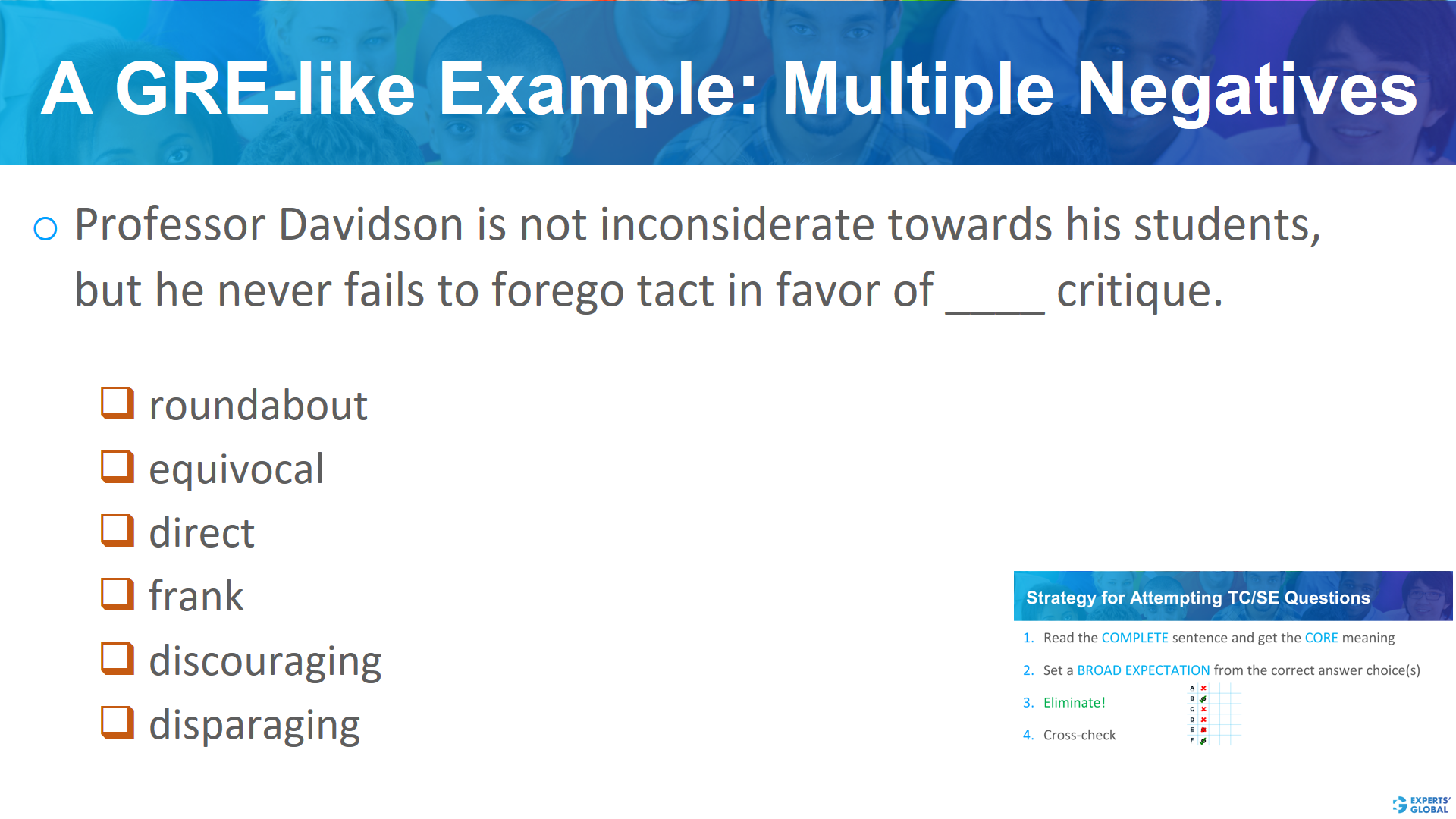
Correct answers: direct, frank
For a detailed explanation of this question, please refer the last ~2 minutes of the video featured earlier on this page. Following is a step-by-step written solution:
Professor Davidson is not inconsiderate towards his students, but he never fails to forego tact in favor of ____ critique.
1. Core Meaning
The sentence uses several negatives to clarify Professor Davidson’s character: he is “not inconsiderable” (meaning he is considerate), but he “never fails to forego tact” (meaning he always abandons politeness) in favor of a specific type of critique.
2. Broad Expectation
Because he chooses to skip “tact” (politeness), the blank must describe a critique that is the opposite of tactful—something blunt, straightforward, or honest.
3. Eliminate
4. Cross-check
Direct and frank are synonyms that complete the logic: while the professor is considerate, his feedback style is always blunt and unvarnished.
Correct answers: direct, frank
GRE online preparation course with free trial
Free full length GRE diagnostic test
