You now move beyond introductory contrast patterns and into sentences where shifts in meaning interact more closely with structure and wording. This medium complexity contrast drill builds directly on the skills you applied earlier and asks you to track contrast with sharper attention to how ideas evolve across the sentence. The goal here is tighter control over meaning as contrast becomes less obvious and more layered.
Each question invites you to pause, process the sentence deliberately, and apply what you already practiced. Use the explanations to refine how you follow shifts and confirm intended meaning before committing to an answer pair. Stay focused on precision and reasoning depth. This stage strengthens your GRE prep by reinforcing disciplined contrast handling and carries smoothly into stronger performance on GRE drills, GRE test series, and eventually on the actual GRE .
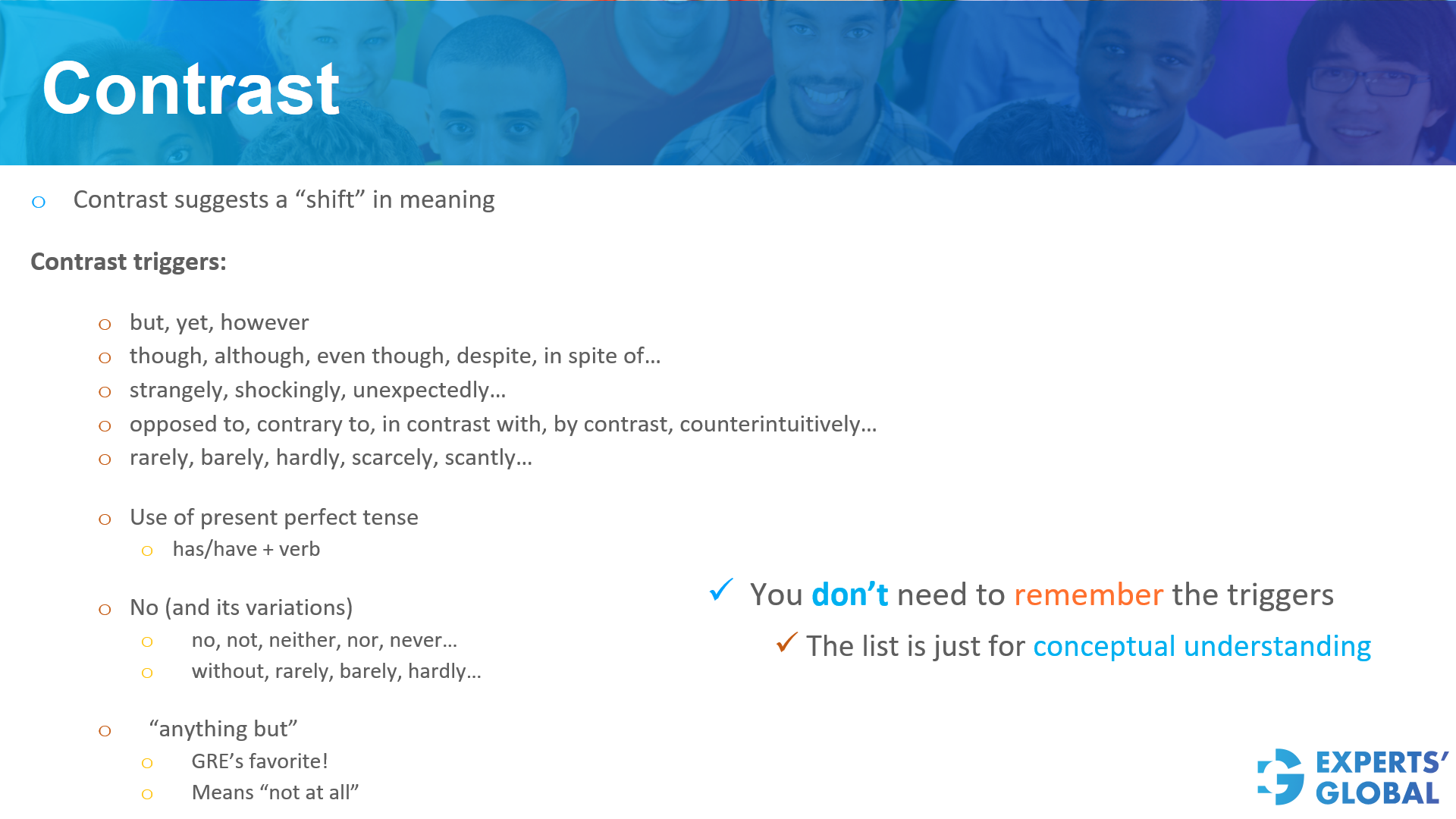
Quick Recap: Contrast or Shift in Meaning on GRE SE
Contrast signals a shift in meaning within a sentence and shows how ideas connect.
Connectors like but, yet, and however indicate a change in direction.
Words such as though, although, even though, despite, and in spite of also signal contrast.
Adverbs like strangely, shockingly, and unexpectedly highlight a change in meaning.
Phrases such as opposed to, contrary to, in contrast with, by contrast, and counterintuitively guide attention to a new line of thought.
Words expressing rarity or limitation, including rarely, barely, hardly, scarcely, and scantily, often mark a shift.
Present perfect forms using has or have plus a verb can signal contrast.
Negative words including no, not, neither, nor, never, without, rarely, barely, and hardly influence meaning.
The phrase anything but conveys a strong not at all contrast.
Recognizing these signals helps you understand meaning clearly without memorizing a list.
Contrast Drill: Medium Complexity | GRE SE
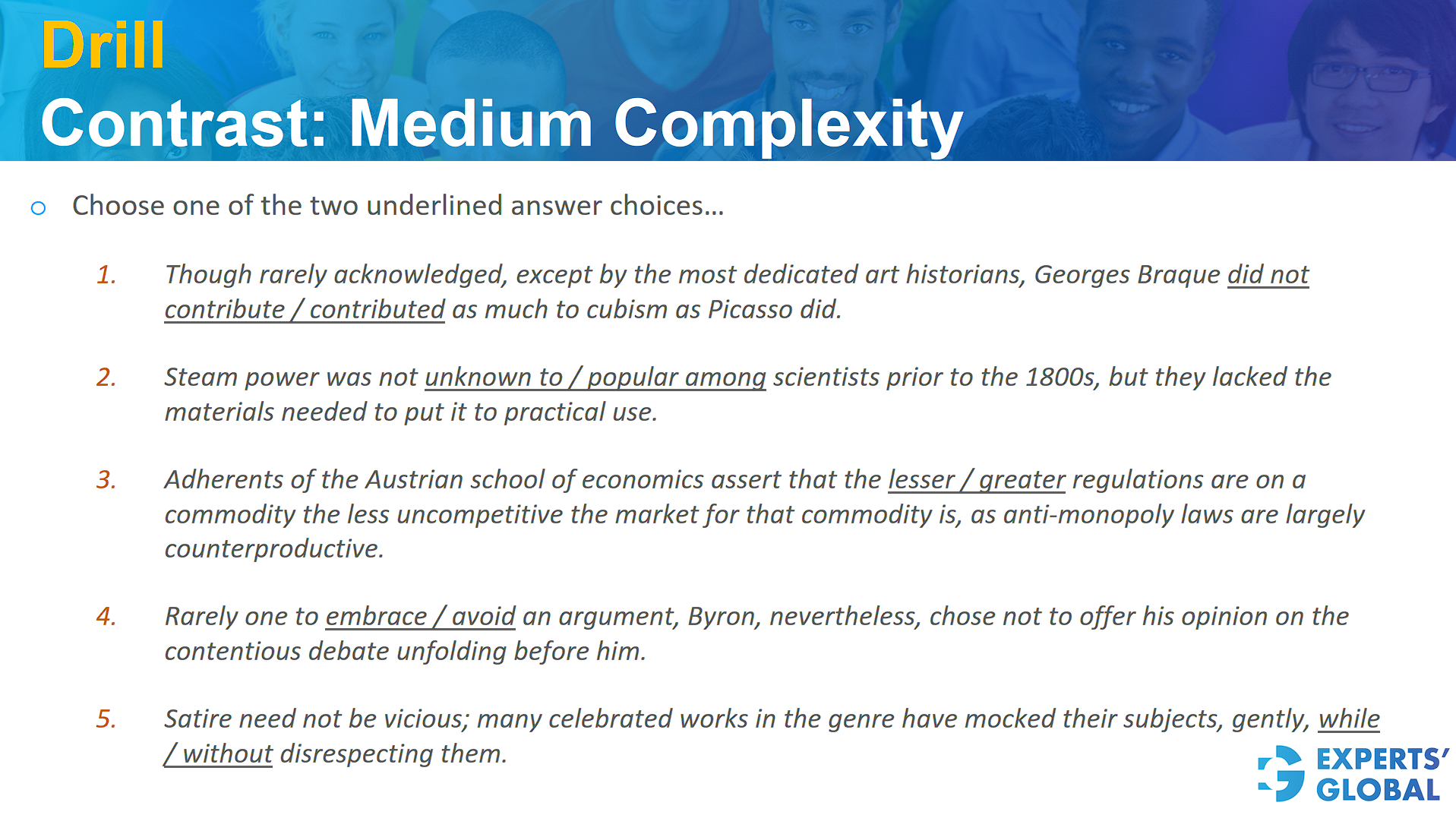
This drill asks you to choose one correct option from two underlined words in each sentence. Each sentence tests how well you track a shift in meaning within a complete idea. Contrast signals such as though, but, rarely, nevertheless, while, and without guide these shifts. You select the word that aligns with the overall direction and logic of the sentence. Topics vary across art history, science, economics, literature, and literary style, and each pair of choices creates a meaningful difference in how the sentence reads. Careful reading and aligning with sentence meaning builds accuracy.
For a detailed explanation for examples on the slide, please refer to the video featured earlier on this page. Following is step-by-step written explanation.
Example 1
Though rarely acknowledged, except by the most dedicated art historians, Georges Braque did not contribute / contributed as much to cubism as Picasso did.
Step 1 (Identify the Trigger): The sentence begins with the word “Though,” which is a contrast trigger signaling a shift in meaning.
Step 2 (Analyze the Logic): The first part says he is “rarely acknowledged,” suggesting he might not be seen as important. Because of the contrast trigger “Though,” the second part must shift to show that he actually was
Step 3 (Select the Answer): To show he was important, we choose contributed. Even though he isn’t widely acknowledged, he actually contributed as much as Picasso.
Example 2
Steam power was not unknown to / popular among scientists prior to the 1800s, but they lacked the materials needed to put it to practical use.
Step 1 (Identify the Trigger): The word “but” acts as the contrast trigger here.
Step 2 (Analyze the Logic): The second part says they “lacked the materials” to use it, which is a negative or limiting factor. The first part (with the “not”) must shift from this.
Step 3 (Select the Answer): If they couldn’t use it, it doesn’t mean they didn’t know about it. Saying it was “notunknown to” them means they did know about it, even though they couldn’t use it yet.
Example 3
Adherents of the Austrian school of economics assert that the lesser / greater regulations are on a commodity the less uncompetitive the market for that commodity is, as anti-monopoly laws are largely counterproductive.
Step 1 (Identify the Trigger): This sentence uses a “the [x]… the [y]” structure, which shows a relationship between two things.
Step 2 (Analyze the Logic): The sentence mentions that laws are “counterproductive” (harmful) and aims for a “less uncompetitive” (which means more competitive) market.
Step 3 (Select the Answer): To make a market more competitive by avoiding “counterproductive” laws, you would want fewer regulations. Therefore, the answer is lesser.
Example 4
Rarely one to embrace / avoid an argument, Byron, nevertheless, chose not to offer his opinion on the contentious debate unfolding before him.
Step 1 (Identify the Trigger): The word “nevertheless” is the contrast trigger.
Step 2 (Analyze the Logic): The second part says Byron “chose not to offer his opinion,” meaning he stayed out of the argument. “Nevertheless” tells us this behavior is the opposite of his usual self.
Step 3 (Select the Answer): If he usually jumps into arguments, he is “rarely one to avoid” them. Because he rarely avoids them, it is surprising (nevertheless) that he stayed quiet this time.
Example 5
Satire need not be vicious; many celebrated works in the genre have mocked their subjects, gently, while / without disrespecting them.
Step 1 (Identify the Trigger): The semicolon (;) and the phrase “need not be” set up a contrast between being “vicious” and being “gentle”.
Step 2 (Analyze the Logic): The sentence explains that satire can mock someone “gently” rather than viciously.
Step 3 (Select the Answer): To be gentle and not vicious, you would mock someone withoutdisrespecting them. This maintains the contrast to being “vicious”.