
Invest 30 seconds...
...for what may lead to a life altering association!
Help Line
- +91.8800.2828.00 (IND)
- 1030-1830 Hrs IST, Mon-Sat
- support@expertsglobal.com
33% off ends soon:GMAT/GRE prep + applications bundle. Profile building, longer mentoring, better results. Inquire

The following video and the theory that follows help you understand how reading comprehension influences your GRE score and how efficiency in reading comprehension shapes overall performance. Take the key learnings from this strategic review, understand the importance of reading comprehension, and carry this seriousness forward into your GRE prep as you move into deeper learning and practice of reading comprehension concepts and question types.
On the GRE, you get four reading comprehension sets contributing to around ten questions, along with passages that carry just one question. You generally see three such single-question passages. Overall, reading comprehension contributes around thirteen of the twenty-seven questions in the GRE Verbal section. If you are not strong at reading comprehension, you tend to take longer to solve questions and end up with lower accuracy. Slower speed and lower accuracy on a question type that forms nearly half of the Verbal section naturally reduces your total correct attempts, and the extra time spent on reading comprehension eats into the time needed for text completion and sentence equivalence.
Strong reading comprehension skills support performance across the entire GRE because almost every question on the exam requires you to read, comprehend, and process information accurately and promptly. When reading comprehension skills are weak, this gap shows up not only in reading comprehension questions but also in other question types. As reading comprehension improves, performance rises not just on reading comprehension itself but across the Verbal section, and this directly lifts the overall GRE score. Practically, performing well on the GRE requires solid reading comprehension skills. Thus, a thorough understanding of reading comprehension, its variations, and question types, along with rigorous practice through GRE drills, GRE sectional tests, and GRE full length tests, should be a core part of your GRE preparation.
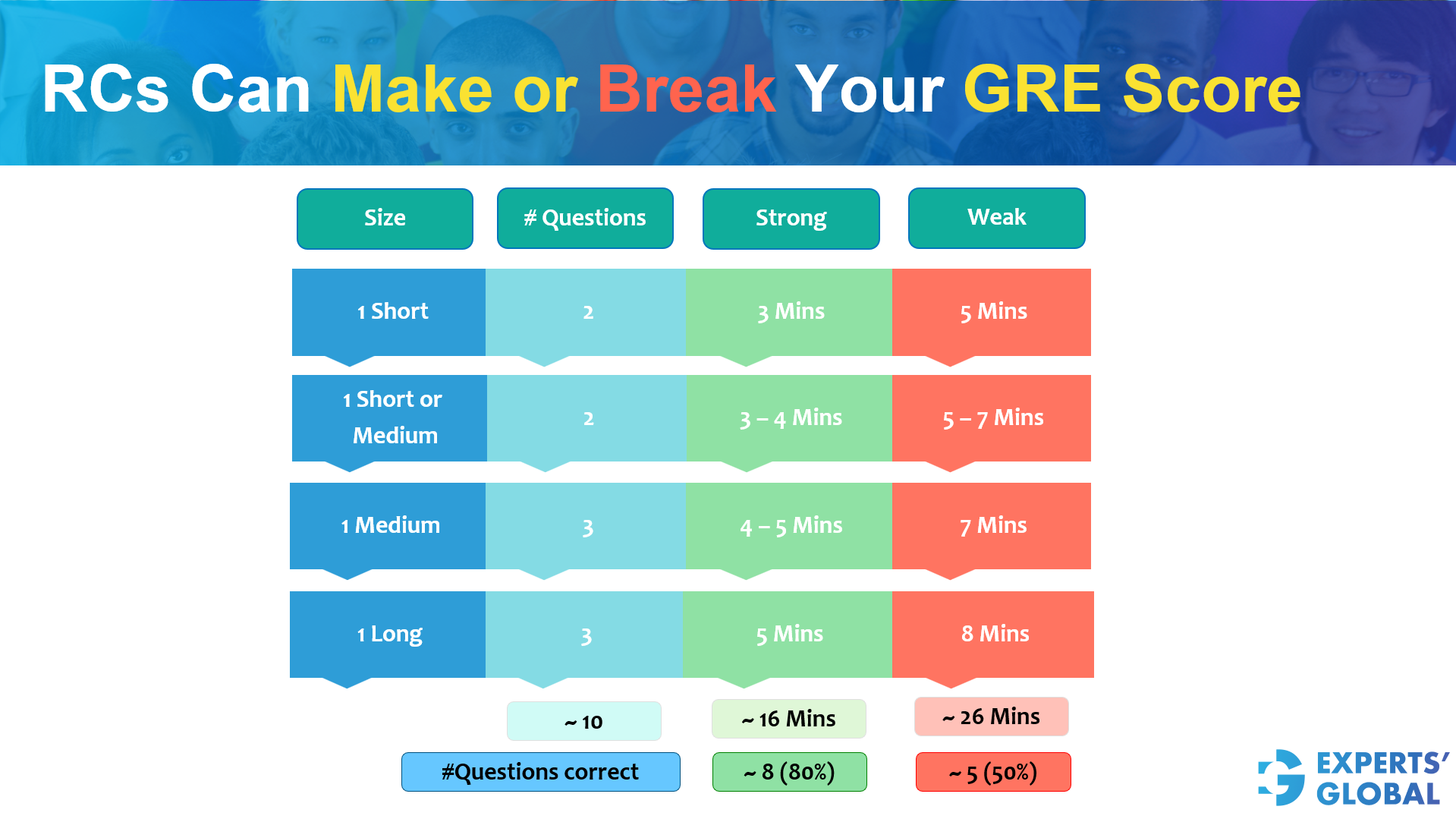
As the infographic shows, reading comprehension plays a decisive role in shaping your score. You see about four reading comprehension passages with roughly 10 questions in total. When you build strength here, these 10 questions take about 16 minutes at close to 80 percent accuracy. When this skill is weak, the same questions can take over 25 minutes with lower accuracy.
Reading comprehension accounts for nearly 40 percent of the verbal section. Strong performance here saves time and lifts accuracy, while weak performance drains time and pulls scores down. More importantly, reading comprehension builds the ability to process information quickly and clearly, a skill that supports every other question type on the test.
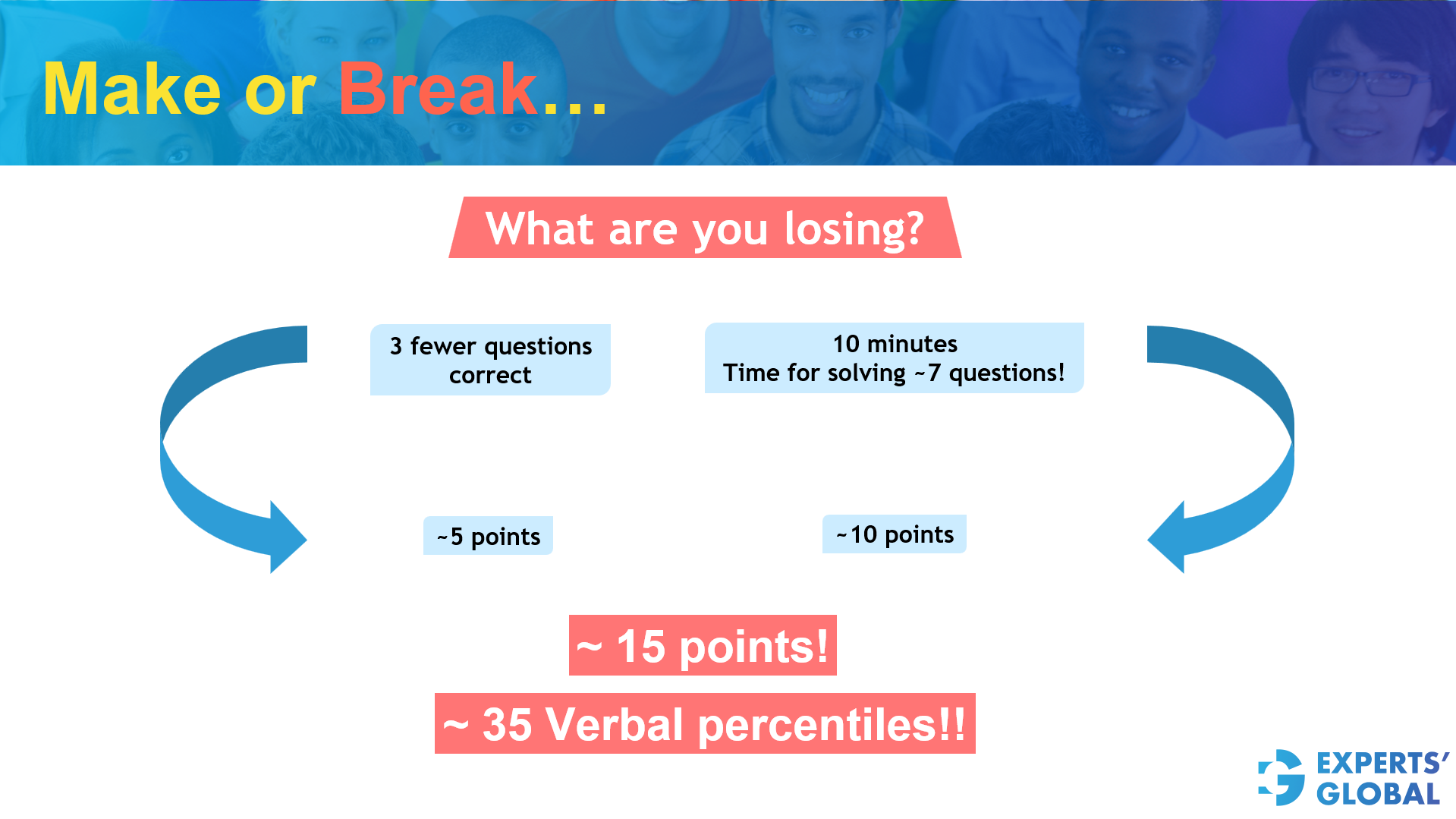
The following infographic shows how weakness in reading comprehension directly lowers GRE verbal performance. Lower accuracy by about three questions and an extra ten minutes across four passages can leave roughly seven questions unsolved, together costing nearly 15 verbal points or about 35 percentiles, which highlights why reading comprehension deserves focused preparation.
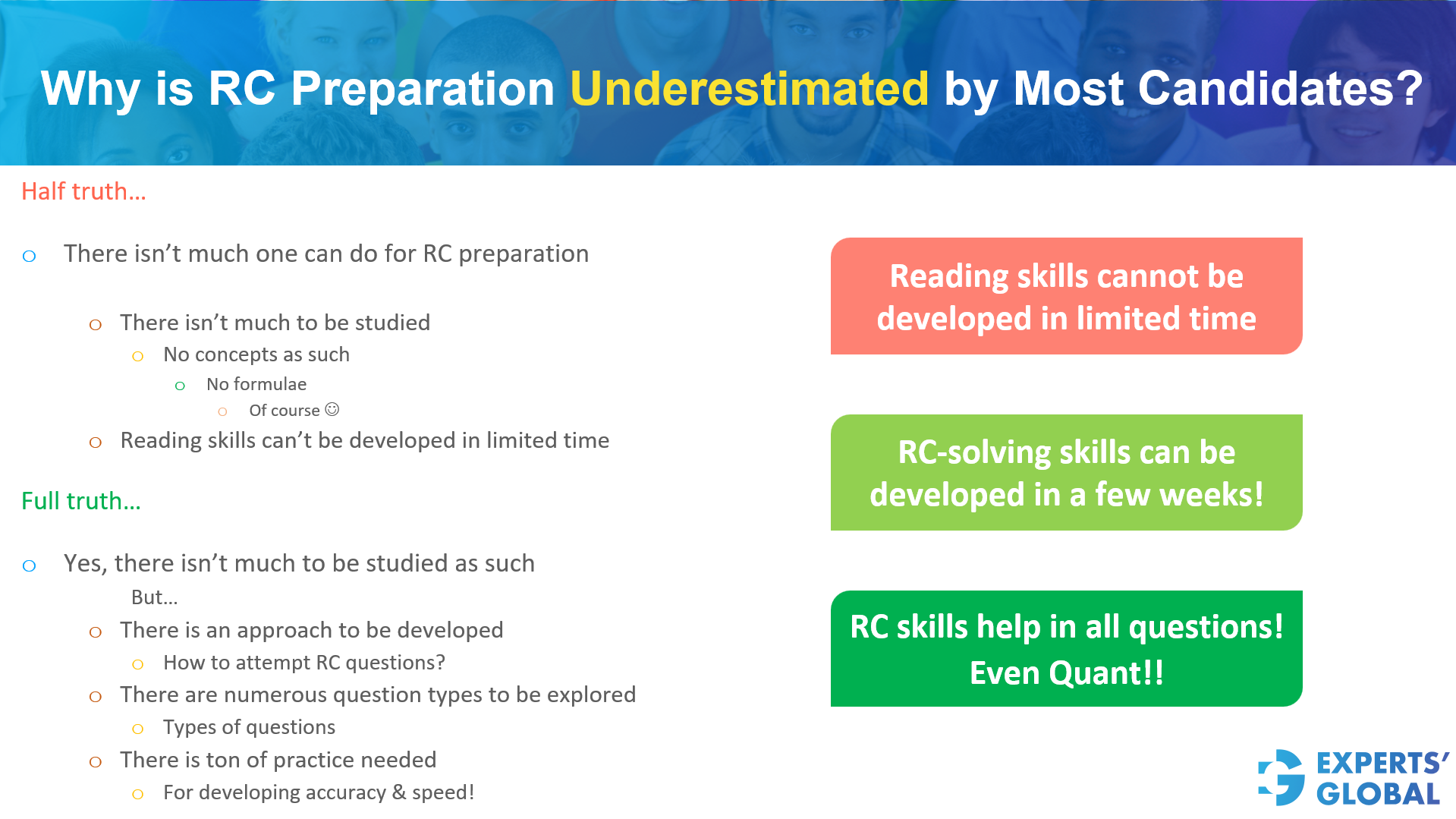
Many candidates assume Reading Comprehension offers little room for preparation because it lacks formulas, fixed concepts, or large volumes of content to memorize. This view overlooks the value of a focused and structured approach. You build strong Reading Comprehension ability by learning how to attempt questions methodically and by understanding the different question types that appear. With consistent practice, your accuracy and speed improve steadily, and you develop reliable Reading Comprehension skills within a few weeks. These skills also transfer beyond Reading Comprehension and support performance across other question types, including Quantitative questions, which makes this preparation both efficient and worthwhile.
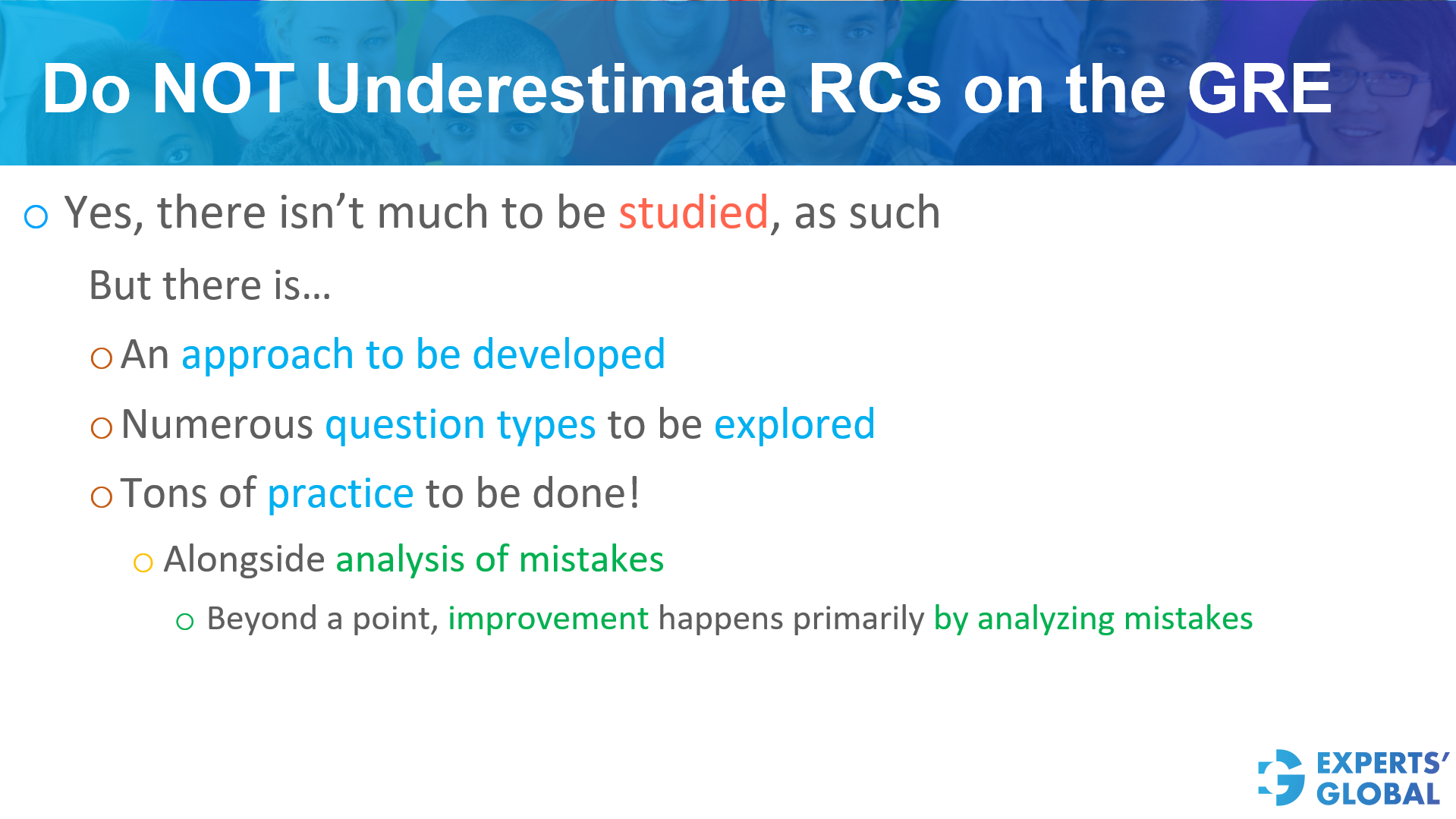
Although GRE reading comprehension involves limited theory, it demands focused preparation. You need a patient and methodical approach, applied consistently across the recurring GRE question types through repeated practice. Once accuracy comes under control, you should introduce timing to build the right balance between accuracy and speed. Alongside this process, always analyze your mistakes and flow attempts, because beyond a point in preparation, most improvement comes from learning deeply from them!
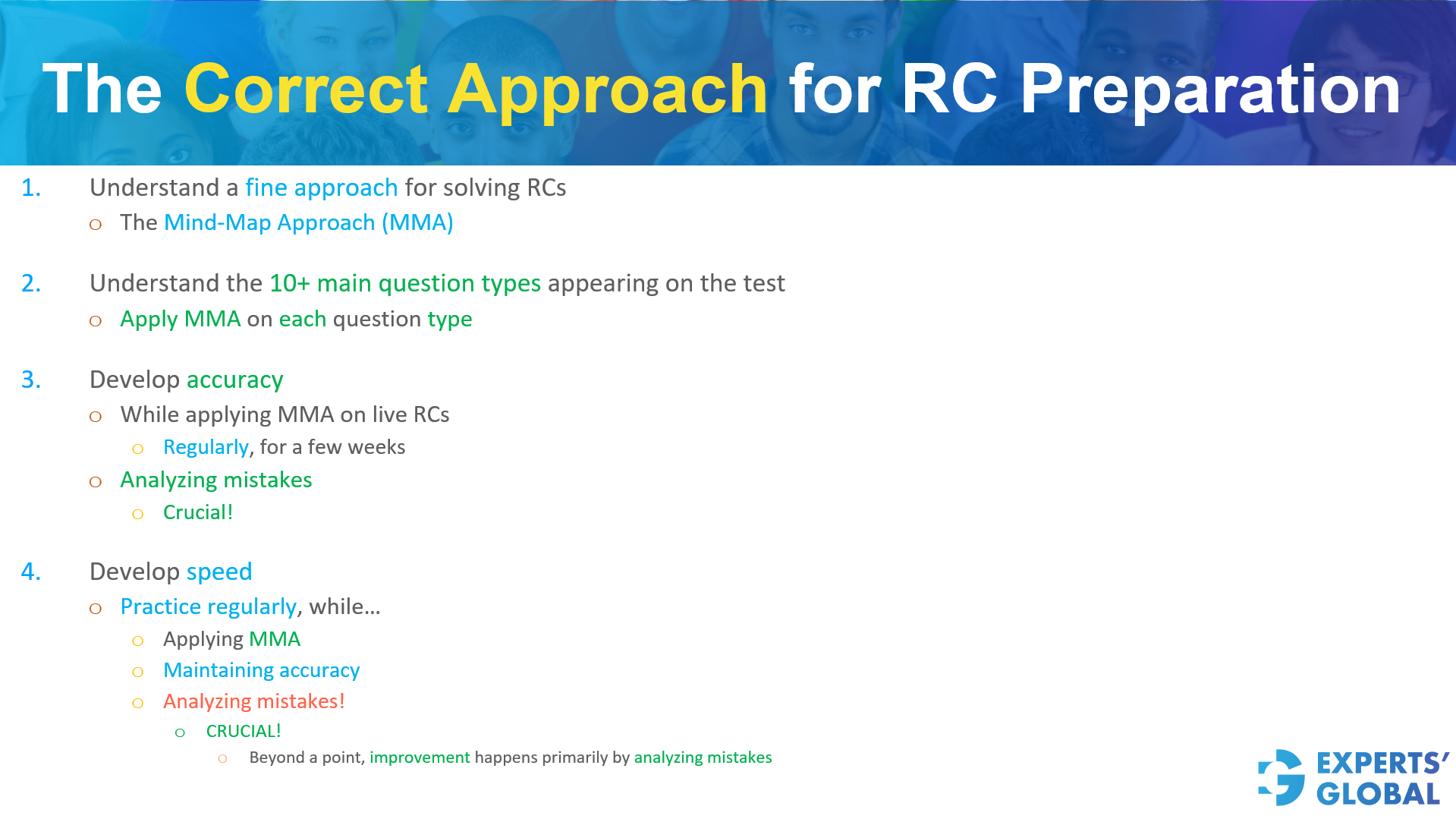
A clear and refined approach forms the foundation for solving Reading Comprehension questions effectively, and the Mind Map Approach by Experts’ Global gives you a structured way to handle Reading Comprehension passages. More than ten major Reading Comprehension question types frequently appear on the test, and you need focused understanding of each one. You build strong alignment with test demands by applying the Mind Map Approach across all question types. Accuracy develops through consistent use of the Mind Map Approach on real Reading Comprehension passages, and regular practice over a few weeks leads to steady improvement. You strengthen performance and clarity by analyzing mistakes carefully, and speed improves through continued practice that preserves accuracy. Maintaining accuracy remains essential as speed increases, and ongoing error analysis continues to support progress throughout preparation.
GRE prep course with 7-day free trial
15 full length GRE practice tests
60 sectional GRE practice tests
