
Invest 30 seconds...
...for what may lead to a life altering association!
Help Line
- +91.8800.2828.00 (IND)
- 1030-1830 Hrs IST, Mon-Sat
- support@expertsglobal.com
33% off ends soon:GMAT/GRE prep + applications bundle. Profile building, longer mentoring, better results. Inquire

Critical reasoning questions on the GRE verbal section appear as a short paragraph followed by a single question based on it. Across the two verbal sections, which together contain 27 questions, you can expect three such critical reasoning questions. Please note that ETS (the GRE maker) does not distinguish between reading comprehension and critical reasoning and groups both under the reading comprehension label. However, these one question passages are meaningfully different in structure and intent and require a distinct approach to preparation as well as solving. These questions are more critical reasoning oriented, and treating them as critical reasoning questions is the right approach while practicing exercises, taking mock tests, and attempting the actual GRE.
Therefore, in the Experts’ Global GRE prep course, short passages with a single question have been treated as critical reasoning questions. They receive complete and focused coverage, including clear explanation of question types, understanding of underlying concepts, and structured practice through dedicated CR exercises and due inclusion in our GRE test series, our GRE sectional tests, and analytics for each.
The following video and the theory that follows provide a complete overview of critical reasoning questions on the GRE. They explain how these questions appear on the exam and clearly outline the task expected of you. A clear comparison between conventional reading comprehension questions and critical reasoning questions is included, along with a detailed explanation of the weightage of CR questions in the GRE verbal section and the target time per question. Besides this, the skills tested by critical reasoning questions are reviewed in a structured way. Use this introductory resource to fully familiarize yourself with this engaging question type, where a correct approach and focused preparation make 100% accuracy achievable!
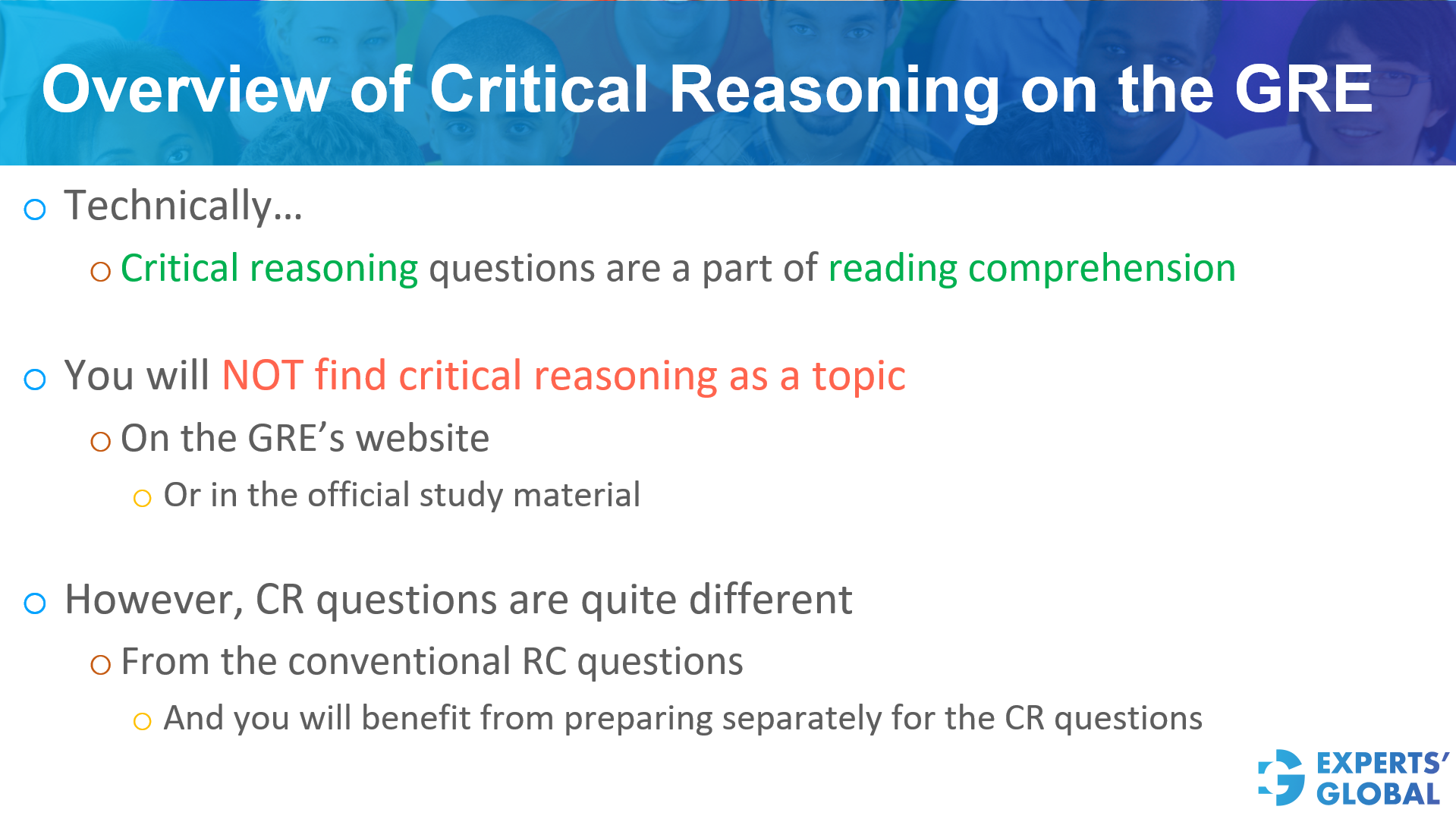
Across the two verbal sections on the GRE, you face only three critical reasoning questions, yet these questions span a wide range of concepts and formats that deserve focused preparation. These include eleven key types: Assumption, Strengthening, Weakening, Paragraph Completion, Inference, Main Point or Conclusion, Resolve the Paradox, Dialogue, Highlighted Text, Select in Passage, and Contradiction. The following video clearly explains each concept, the standard question stems through which they appear, and the exact task you are expected to perform on every critical reasoning question on the GRE.

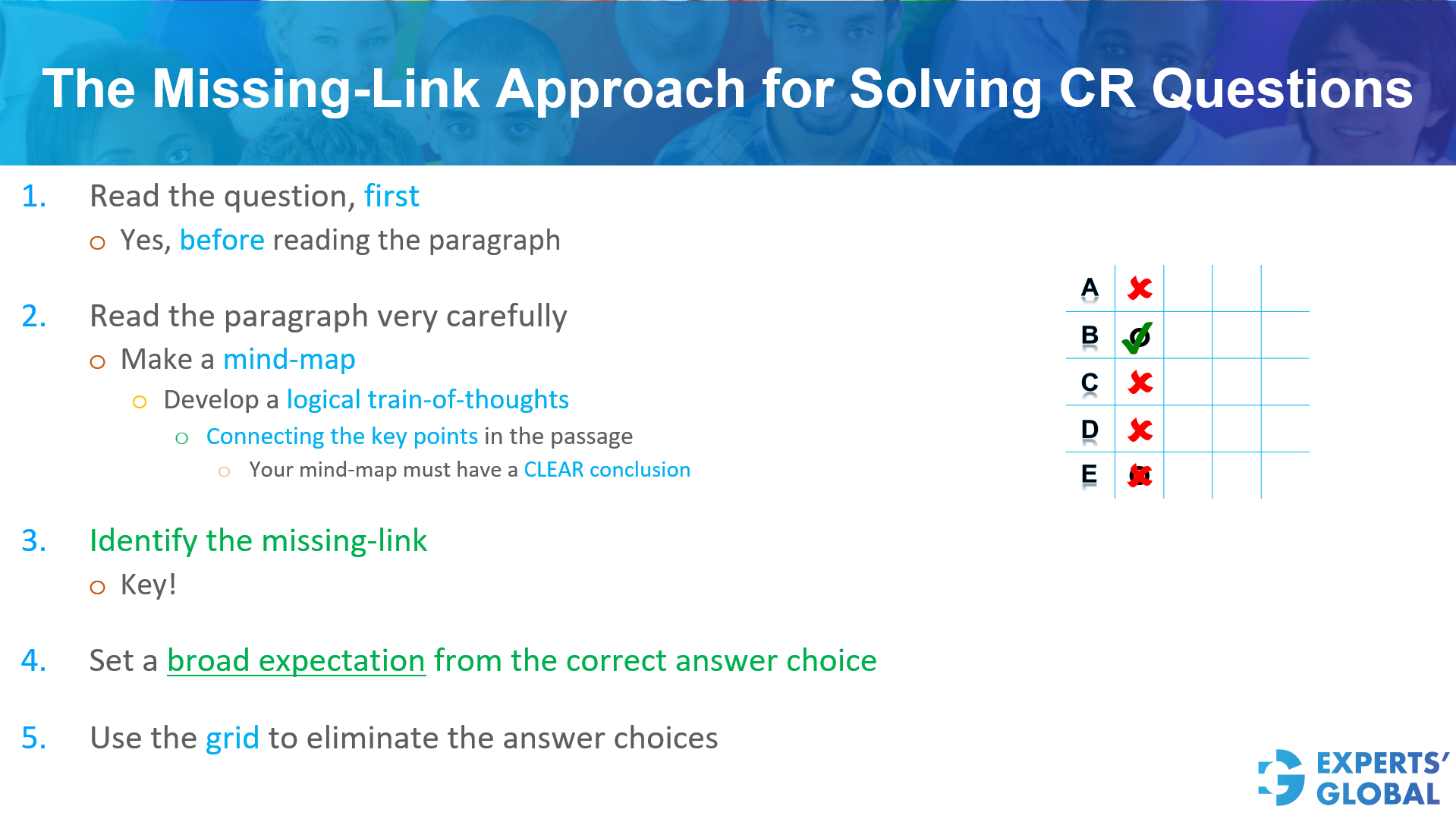
Since 2008, tens of thousands of Experts’ Global students worldwide have adopted and benefited from the Missing Link Approach for solving critical reasoning questions. This organized method helps you solve most CR questions in a methodical way by building a clear mind map that connects the key information in the argument and leads to the conclusion. Critical reasoning paragraphs almost always include an explicit or implicit conclusion, and there is almost always a gap between the information presented and the conclusion drawn. Experts’ Global calls this gap the missing link, and identifying it sits at the core of solving most critical reasoning questions. Strengthening, assumption, and resolve the paradox questions fill the missing link, weakening questions attack the missing link, and evaluation questions can help or hurt by either filling or attacking the missing link. With sincere practice across many questions and careful analysis of mistakes, this approach becomes your natural method and helps you solve GRE CR questions with high efficiency and speed. The following video explains the Missing Link Approach step by step and applies it to conceptual examples so you gain first-hand experience using it. Take your time to thoroughly understand this approach and apply it in your GRE drills, GRE sectional mock tests, and GRE full mock tests.
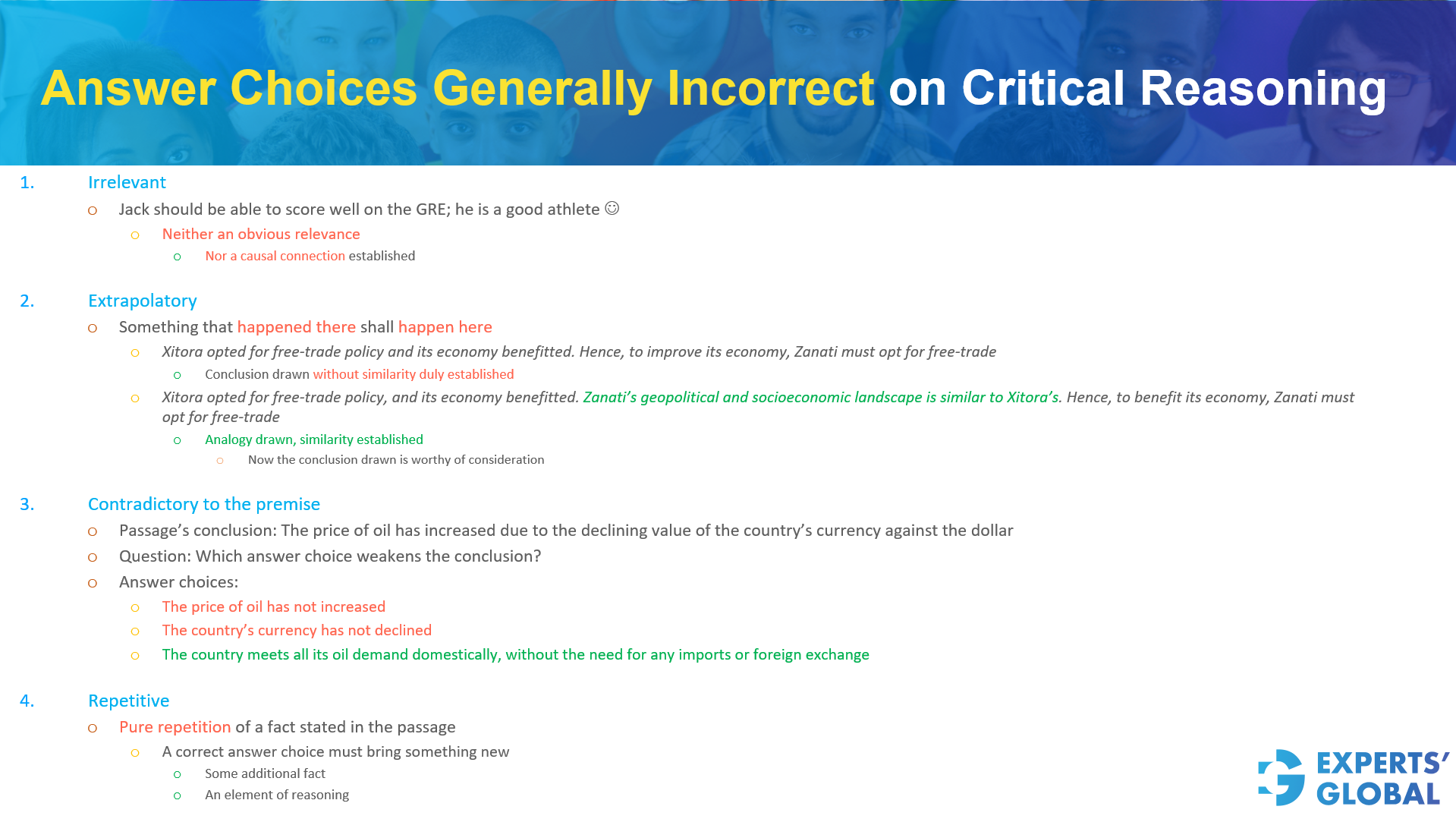
On GRE Critical Reasoning questions, wrong answer choices usually follow a few clear patterns. Some introduce ideas that are not related to the argument, some jump to conclusions without support, some contradict what the passage states, and some only repeat information already given. Learning to spot these patterns helps you remove incorrect options quickly and stay focused while solving the question. The video below explains these common wrong answer types in a very clear way and shows how they typically appear in GRE Critical Reasoning questions.
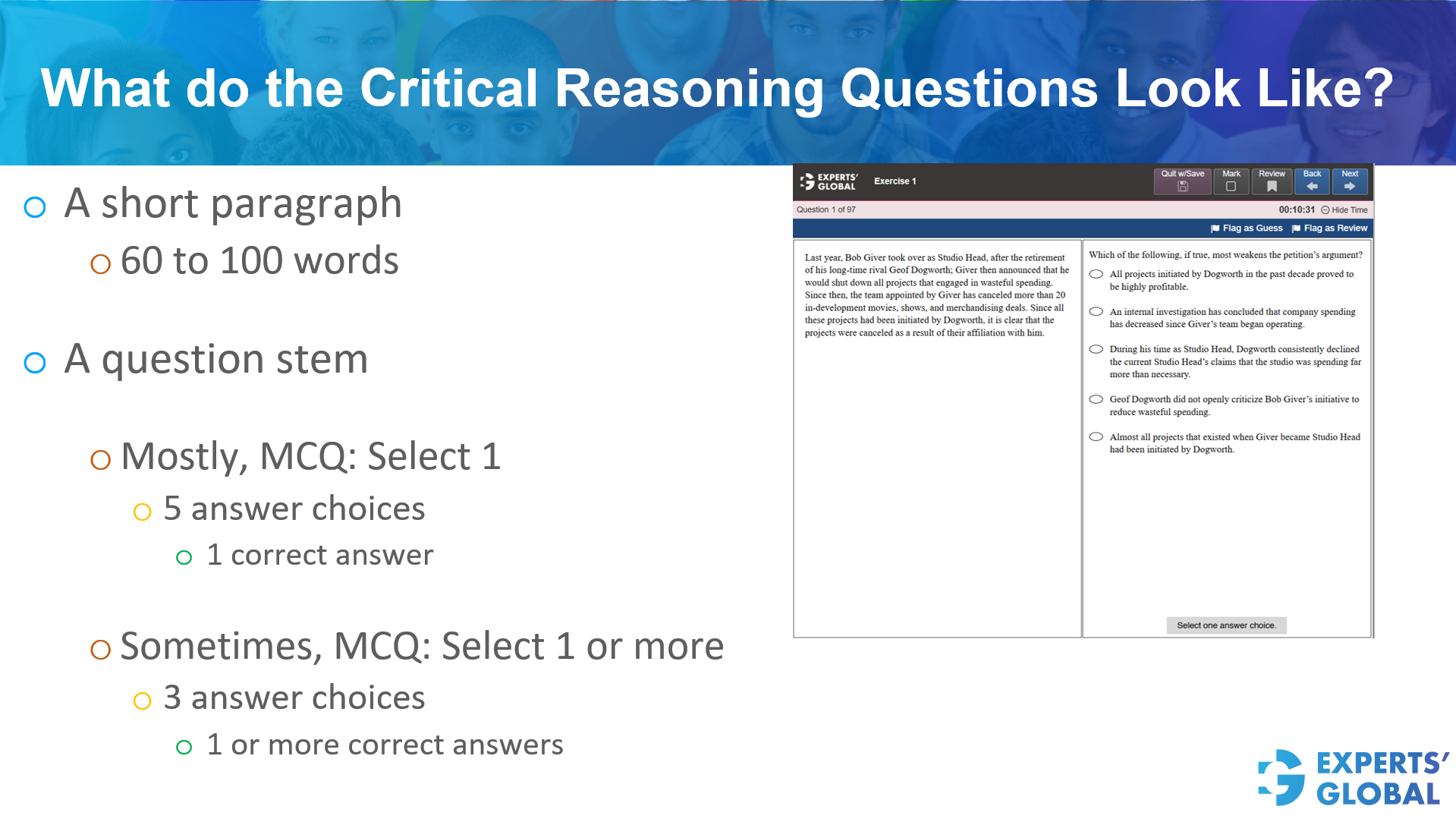
Critical reasoning questions start with a short paragraph that clearly presents the core idea. This paragraph typically ranges from sixty to one hundred words. Each question includes a clear question stem that defines the task and sets the direction. Most questions are in a multiple-choice format with “Select One,” where five answer choices are given and only one answer is correct. Some questions use a “Select One or More” format, where three answer choices are given, and one or more may be correct based on the question.
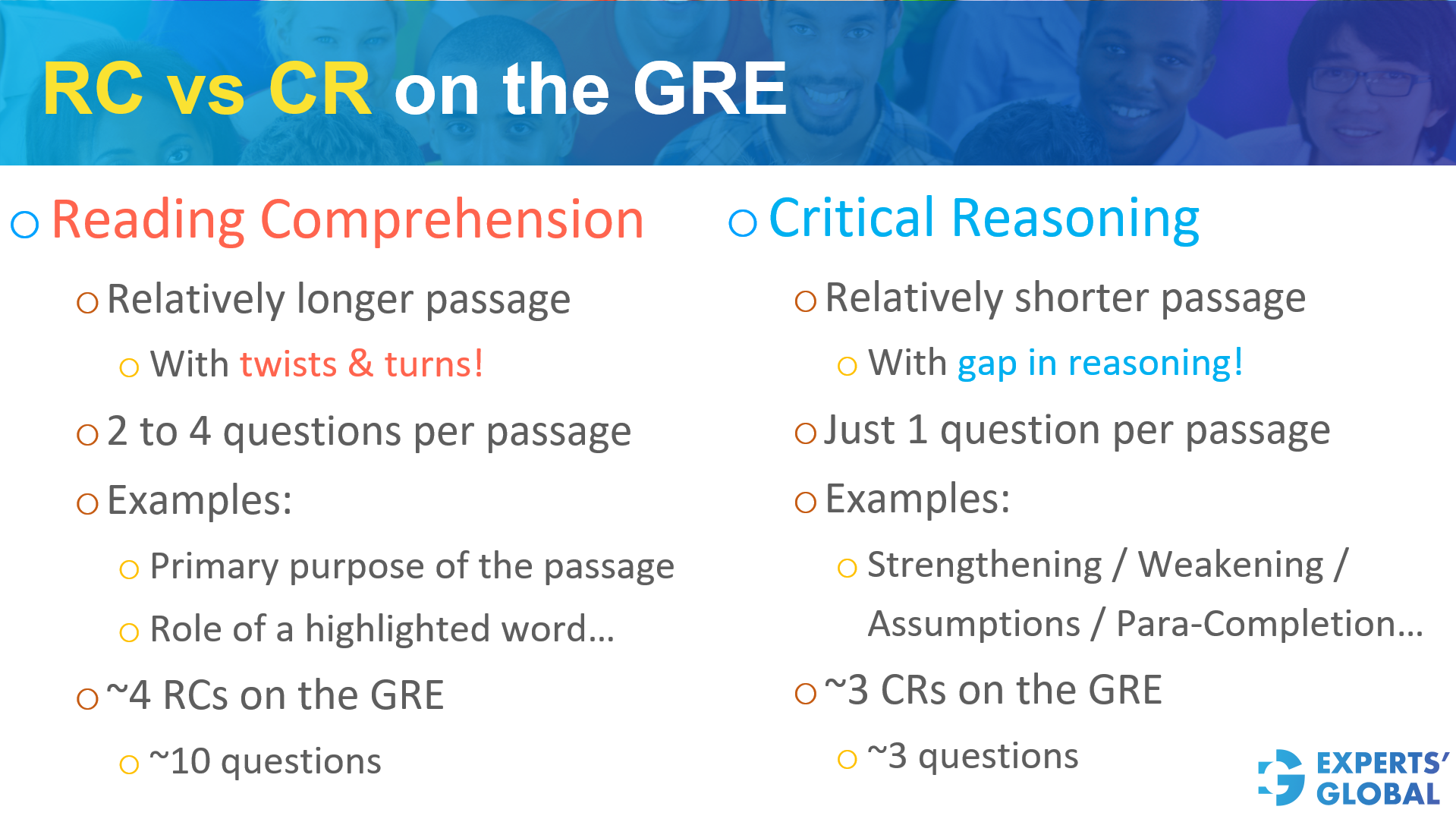
A Reading Comprehension passage includes two to four questions. Common question types involve identifying the primary purpose of the passage and understanding the role of a highlighted word. The GRE typically includes about four Reading Comprehension passages, contributing roughly ten questions in total.
Critical Reasoning questions feature one passage, ranging from 60 to 100 words, with just one question per passage. Common Critical Reasoning question types include strengthening, weakening, assumptions, and para completion. The GRE typically includes about three Critical Reasoning passages, contributing roughly three questions in total.
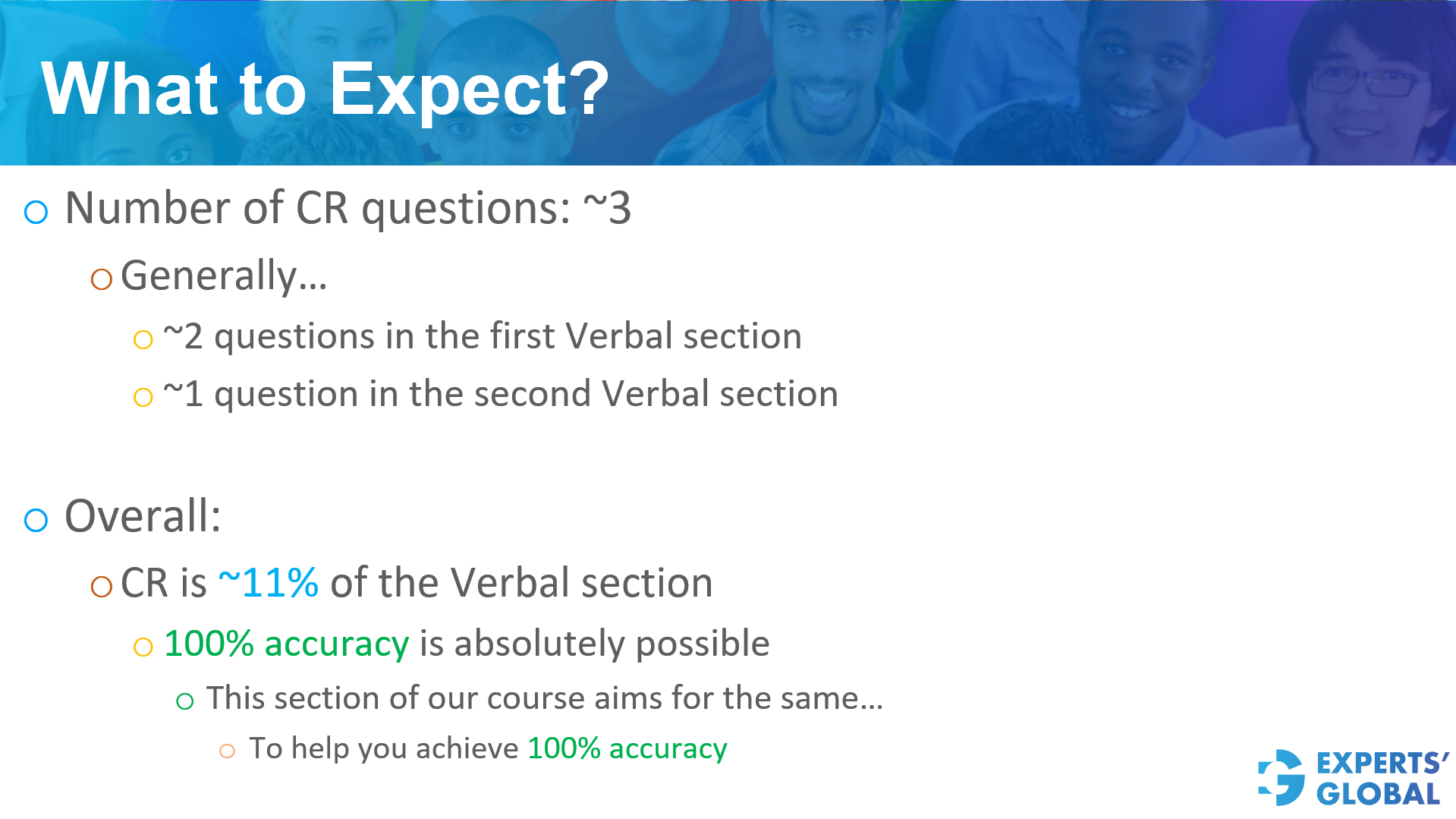
The GRE typically includes about three Critical Reasoning questions. Two Critical Reasoning questions usually appear in the first Verbal section, and one typically appears in the second Verbal section. Critical Reasoning questions make up about eleven percent of the Verbal section. Achieving one hundred percent accuracy in Critical Reasoning is possible, and this part of the course focuses on helping you reach that level of accuracy with clarity, structure, and purpose.
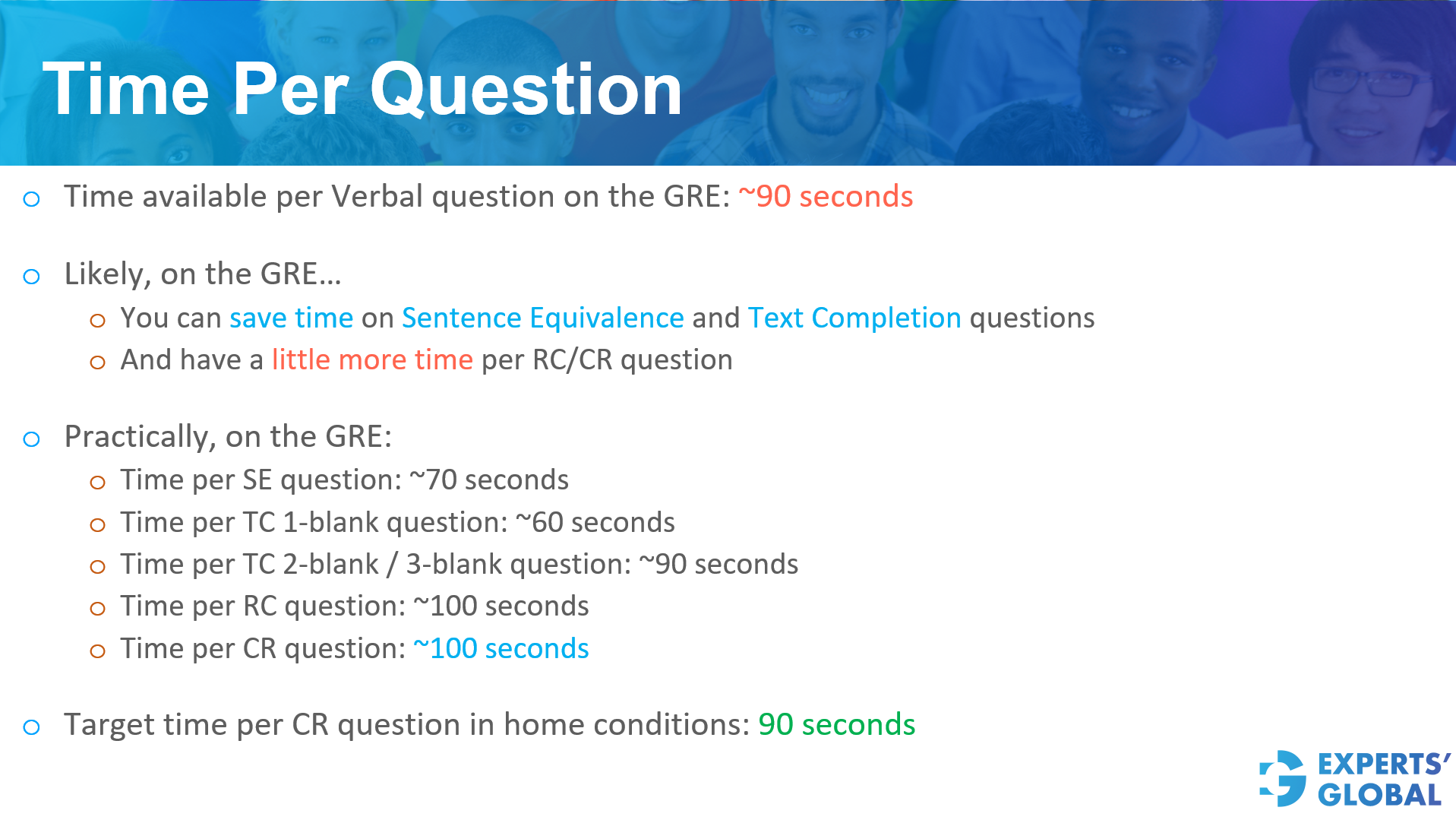
Each Verbal question on the GRE gives you about ninety seconds on average. You can save time on Sentence Equivalence and Text Completion questions, which allows more time for Reading Comprehension and Critical Reasoning questions. In practical GRE conditions, Sentence Equivalence questions take about seventy seconds, Text Completion questions with one blank take about sixty seconds, and Text Completion questions with two or three blanks take about ninety seconds. Reading Comprehension and Critical Reasoning questions each take about one hundred seconds. When practicing at home, aim for ninety seconds per Critical Reasoning question.
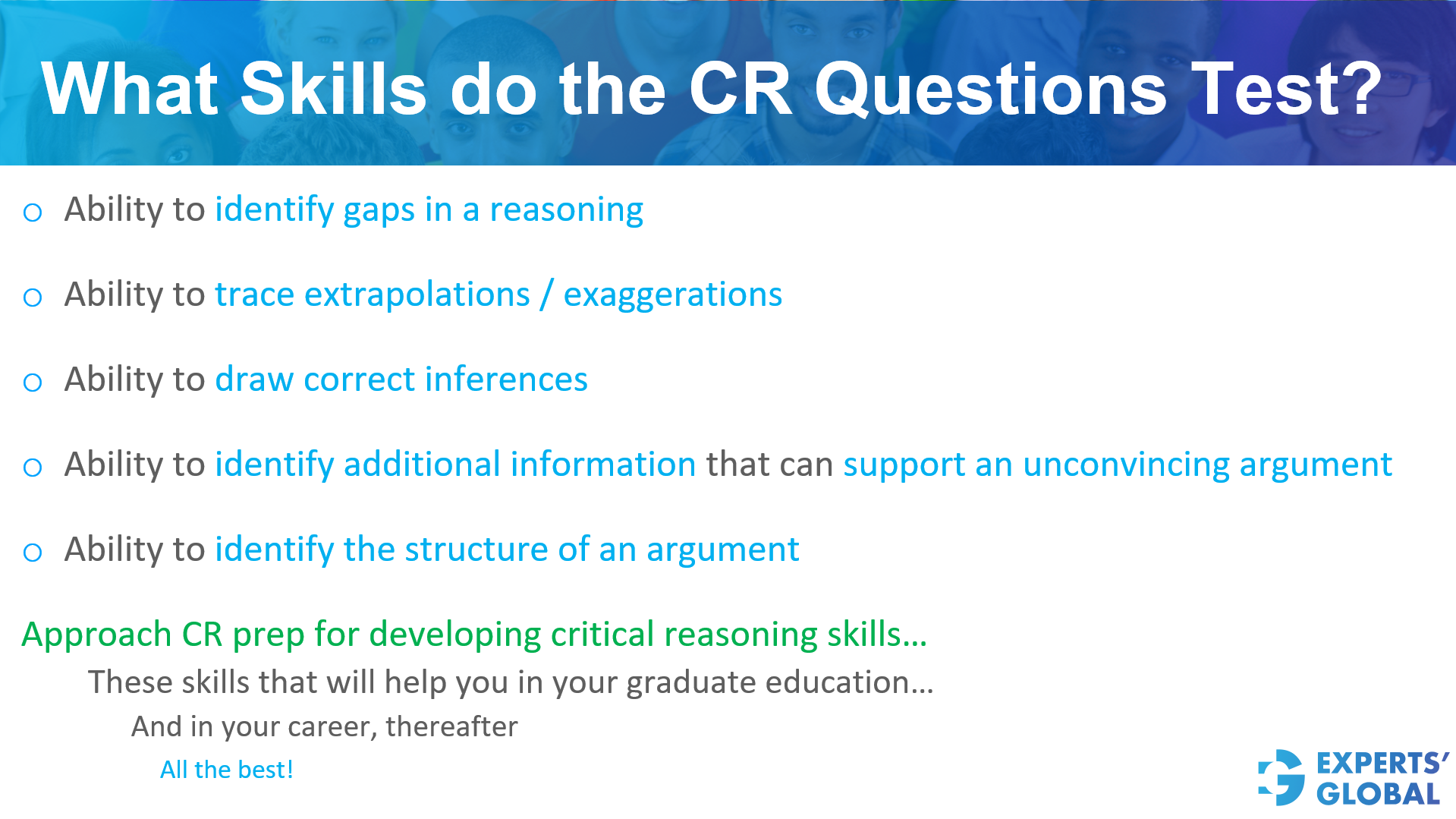
Critical Reasoning questions help you identify gaps in reasoning and strengthen your ability to spot extrapolations and exaggerations in an argument. They improve your ability to draw correct and well-supported inferences and sharpen your skill in identifying additional information that can strengthen an argument. Preparing for Critical Reasoning also helps you understand the structure of an argument. Developing strong critical reasoning skills through focused preparation benefits both your graduate education and long-term professional growth.
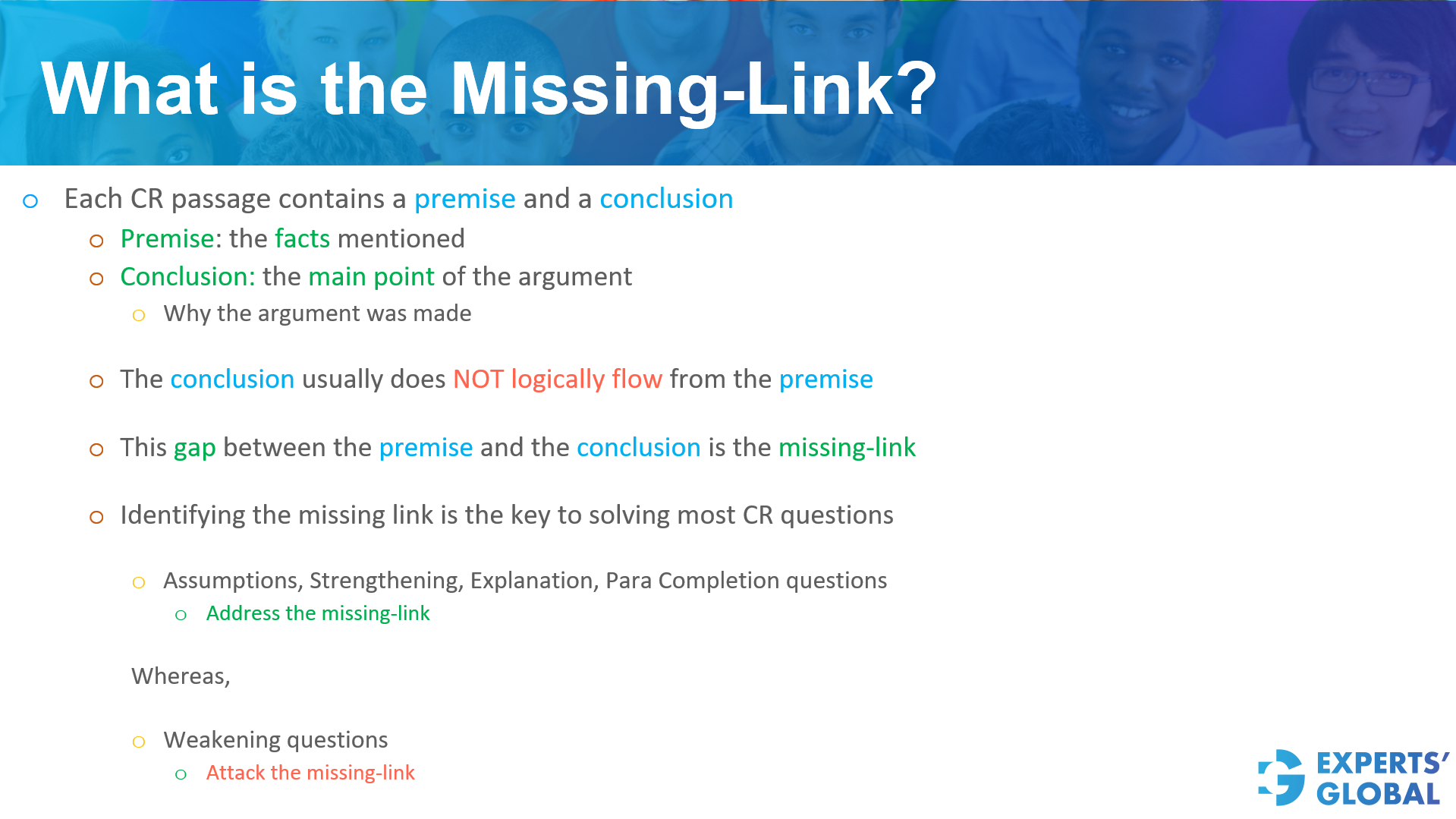
Each Critical Reasoning passage includes a premise and a conclusion. The premise presents the facts mentioned in the passage, and the conclusion represents the main point of the argument. The conclusion explains why the argument is made, but it usually does not logically follow from the premise on its own. The gap between the premise and the conclusion is called the missing link. Identifying the missing link is crucial for solving most Critical Reasoning questions. Assumption, strengthening, explanation, and para completion questions focus on addressing the missing link, while weakening questions focus on attacking the missing link directly.
For complete coverage of the Missing-Link Approach for solving GRE critical reasoning questions, please watch Strategy for Solving Critical Reasoning.
For end-to-end GRE critical reasoning prep, please watch GRE critical reasoning masterclass.
GRE prep course with 7-day free trial
60 sectional GRE practice tests
15 full length GRE practice tests
