GRE RC: How to Solve Agreement-with-Passage Questions
A part of our GRE online preparation course, the video below and the theory that follows give you a focused recap of our Mind Map Approach for RC, explain how to apply it to GRE agreement or disagreement with passage questions, and then demonstrate its use on GRE-style questions with representative answer choices so you gain direct experience with the method. Take your time, move carefully between the answer choices and the passage, eliminate options that do not align, and remember that some choices can be removed without returning to the passage when they clearly do not fit. Before confirming your answer, always verify that the selected choice matches the question stem and stays fully supported by the passage. By the end, develop a steady habit of using the Mind Map Approach for agreement or disagreement questions across your GRE drills, GRE sectional mocks, and GRE full mocks.
Understanding Agreement with Passage GRE RC Questions
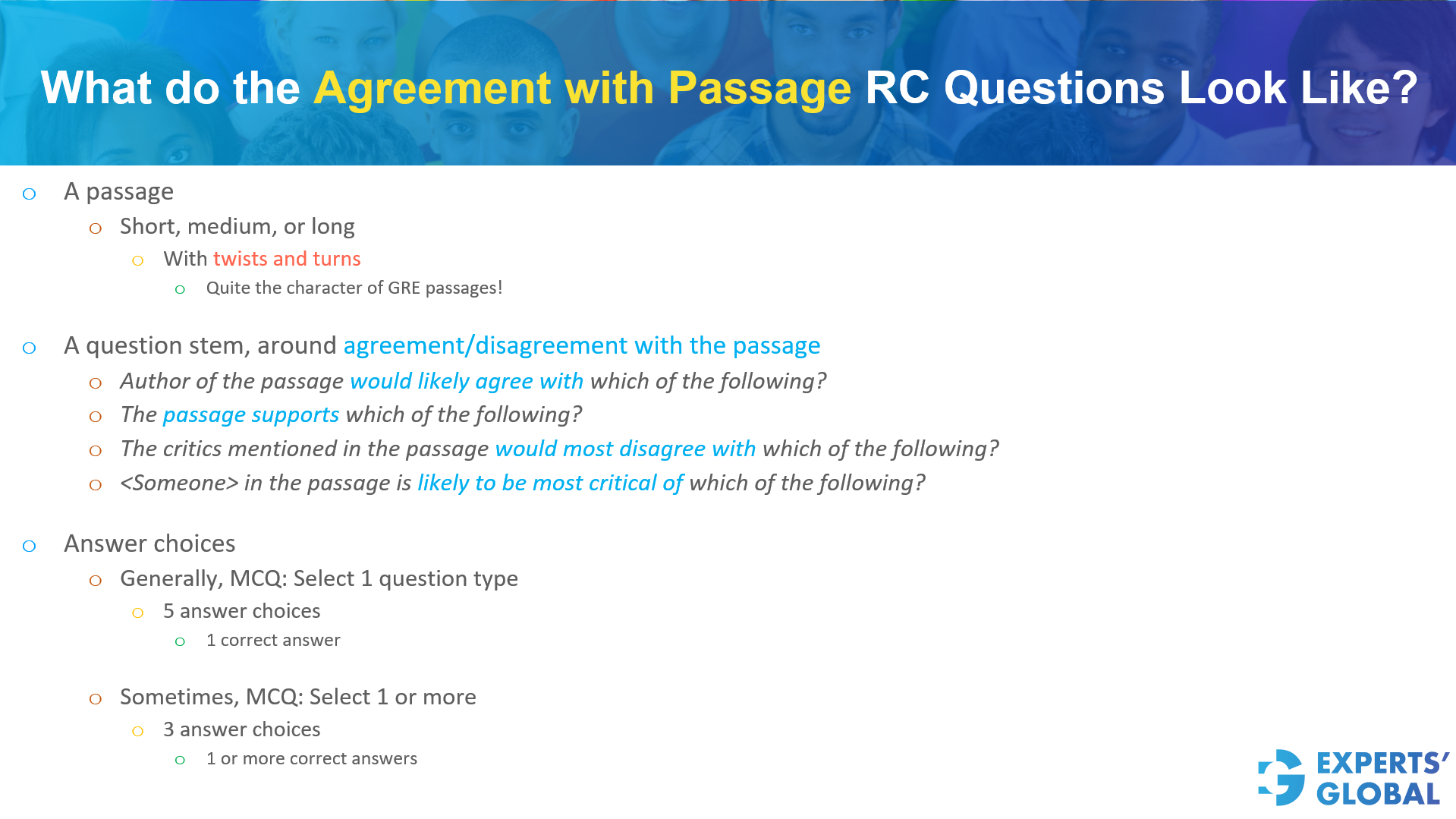
In this lesson, our focus is on “agreement or disagreement with passage” questions. In such questions, the question stem asks whether the author of the passage, or a person or group discussed in the passage, would agree or disagree with a given idea. For example, a question may ask, which of the following statements is the author of the passage most likely to agree with.
Strategy for Solving Agreement with Passage GRE RC Questions
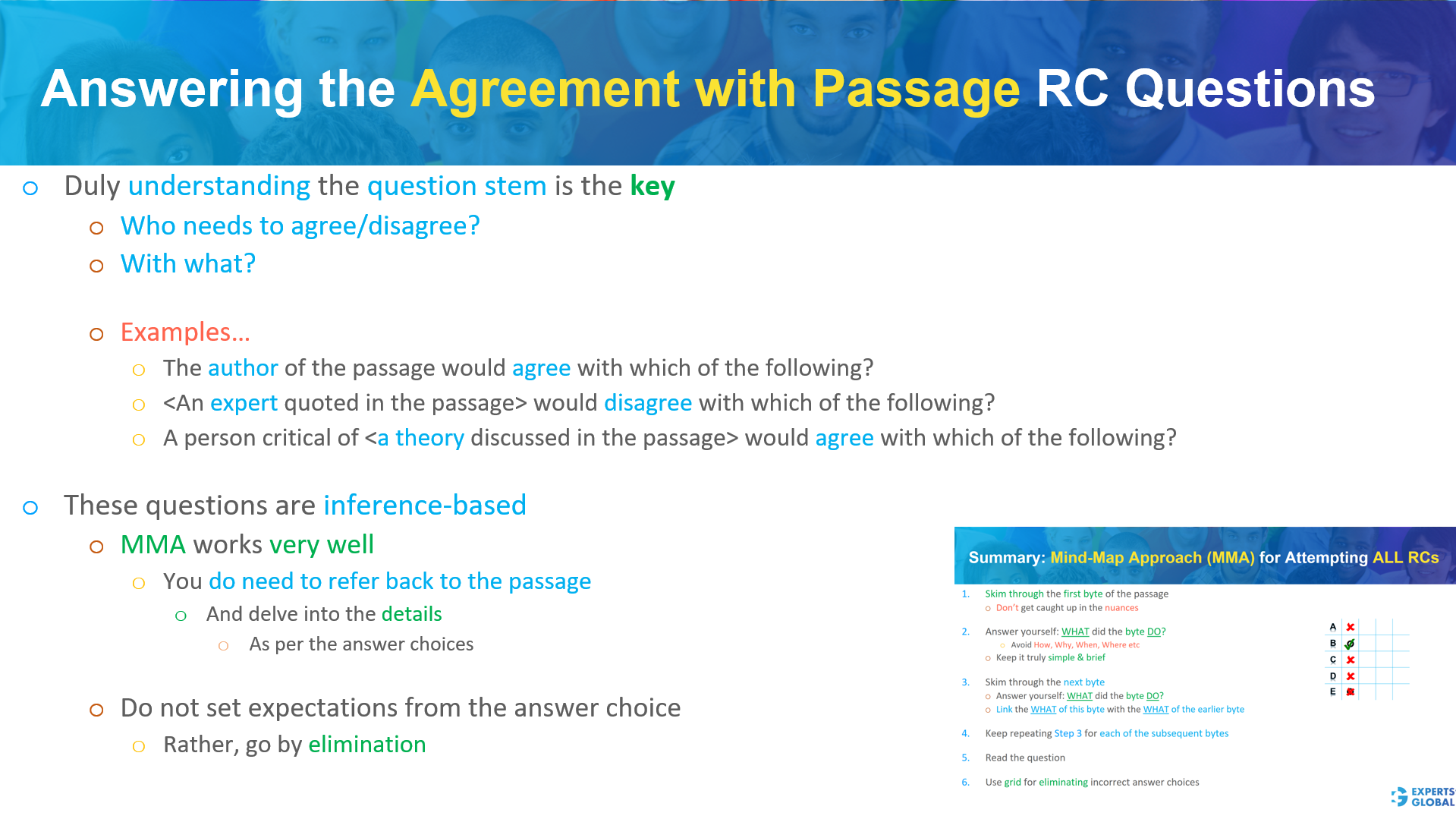
Solving these questions begins with understanding the question stem with precision, so you know exactly what the correct answer must represent. Once the expectation is clear, you examine each answer choice carefully and move back to the passage to check whether that idea aligns with what the author or the relevant speaker actually supports. Some answer choices can be eliminated immediately, while others require a careful return to the passage. The Mind Map guides you to the correct location for each check, and once four answer choices are eliminated, the remaining one is the correct answer. Before confirming your answer, cross-check that the selected answer choice and the question stem stay fully aligned in the context of the passage.
GRE-Style Agreement with Passage RC Practice Question
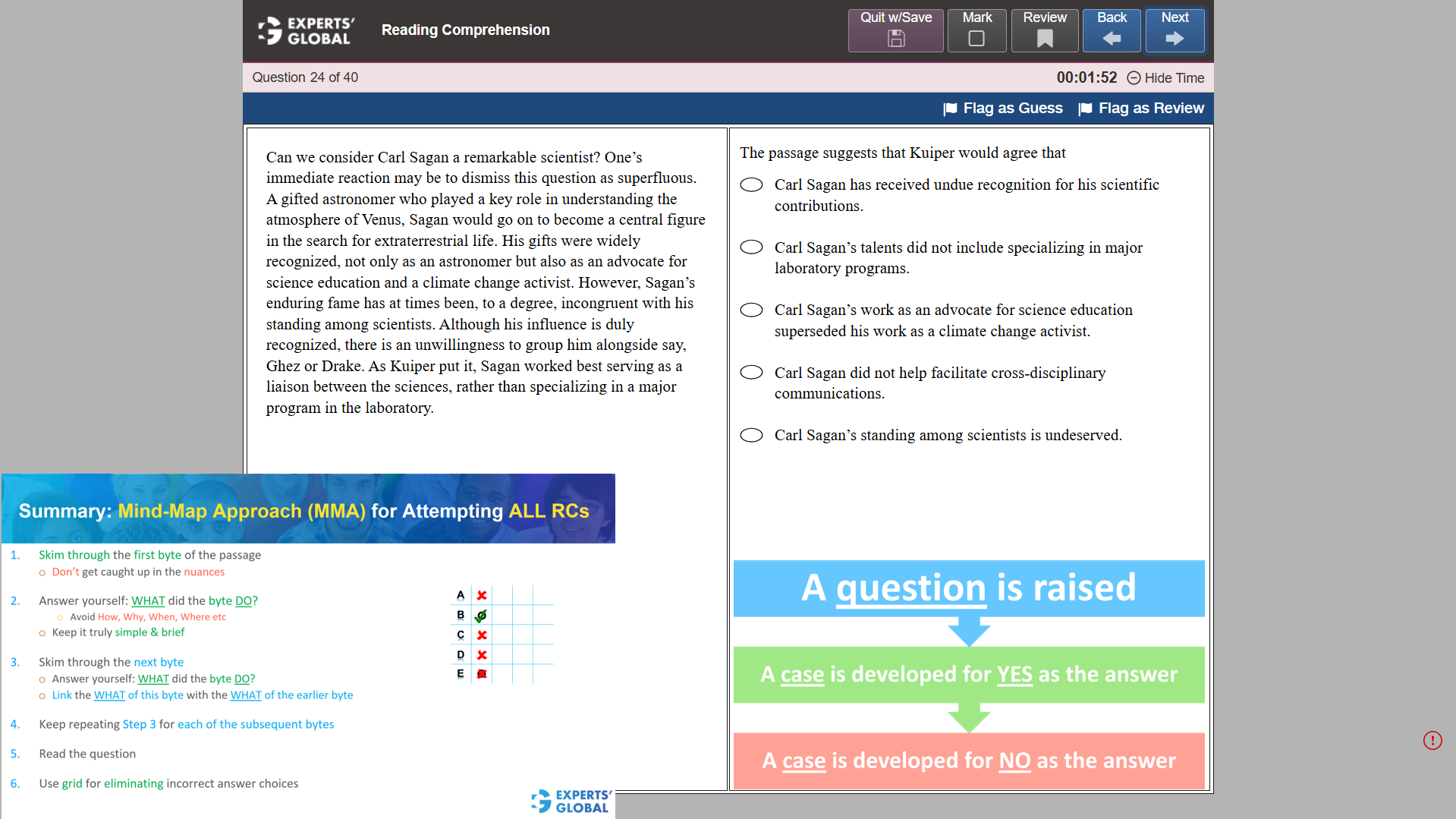
Below is a snapshot of the GRE style Agreement with Passage Reading Comprehension question discussed in the video, along with the Mind Map approach used to solve it and the Mind Map created for the passage.
Correct Answer: B
For a detailed explanation of this question, please refer to the video presented earlier on this page.
Following is a step-wise written explanation, using our Mind Map Approach…
Step 1 and 2: First Byte
Byte: “Can we consider Carl Sagan a remarkable scientist? One’s immediate reaction may be to dismiss this question as superfluous.”
What it did: It raised a question regarding Carl Sagan’s status as a scientist.
Step 3 and 4: Subsequent Bytes
Second Byte: “A gifted astronomer… key role… central figure… gifts were widely recognized… advocate for science education and a climate change activist.”
What it did: It developed a case for YES by highlighting his accomplishments and advocacy.
Third Byte: “However… incongruent with his standing among scientists… unwilling to group him alongside… Sagan worked best serving as a liaison… rather than specializing in a major program.”
What it did: It developed a case for NO by citing Kuiper’s view that Sagan was a communicator rather than a lab specialist.
Step 5: Read the Question
Question: The passage suggests that Kuiper would agree that…
Step 6: Eliminate
Carl Sagan has received undue recognition for his scientific contributions.
(Eliminate: Kuiper discusses Sagan’s specific role and specialization, not whether his total recognition was “undue” or unearned).
Carl Sagan’s talents did not include specializing in major laboratory programs.
(Keep: This directly matches the final sentence where Kuiper says Sagan worked best as a liaison “rather than specializing in a major program in the laboratory”).
Carl Sagan’s work as an advocate for science education superseded his work as a climate change activist.
(Eliminate: The passage mentions both roles but does not compare which one “superseded” the other).
Carl Sagan did not help facilitate cross-disciplinary communications.
(Eliminate: This contradicts the text; Kuiper states he “worked best serving as a liaison between the sciences”).
Carl Sagan’s standing among scientists is undeserved.
(Eliminate: This is too harsh; Kuiper points out a lack of specialization, but does not claim Sagan’s entire standing is “undeserved”).
Correct Answer: B
GRE-Style Disagreement with Passage RC Practice Question
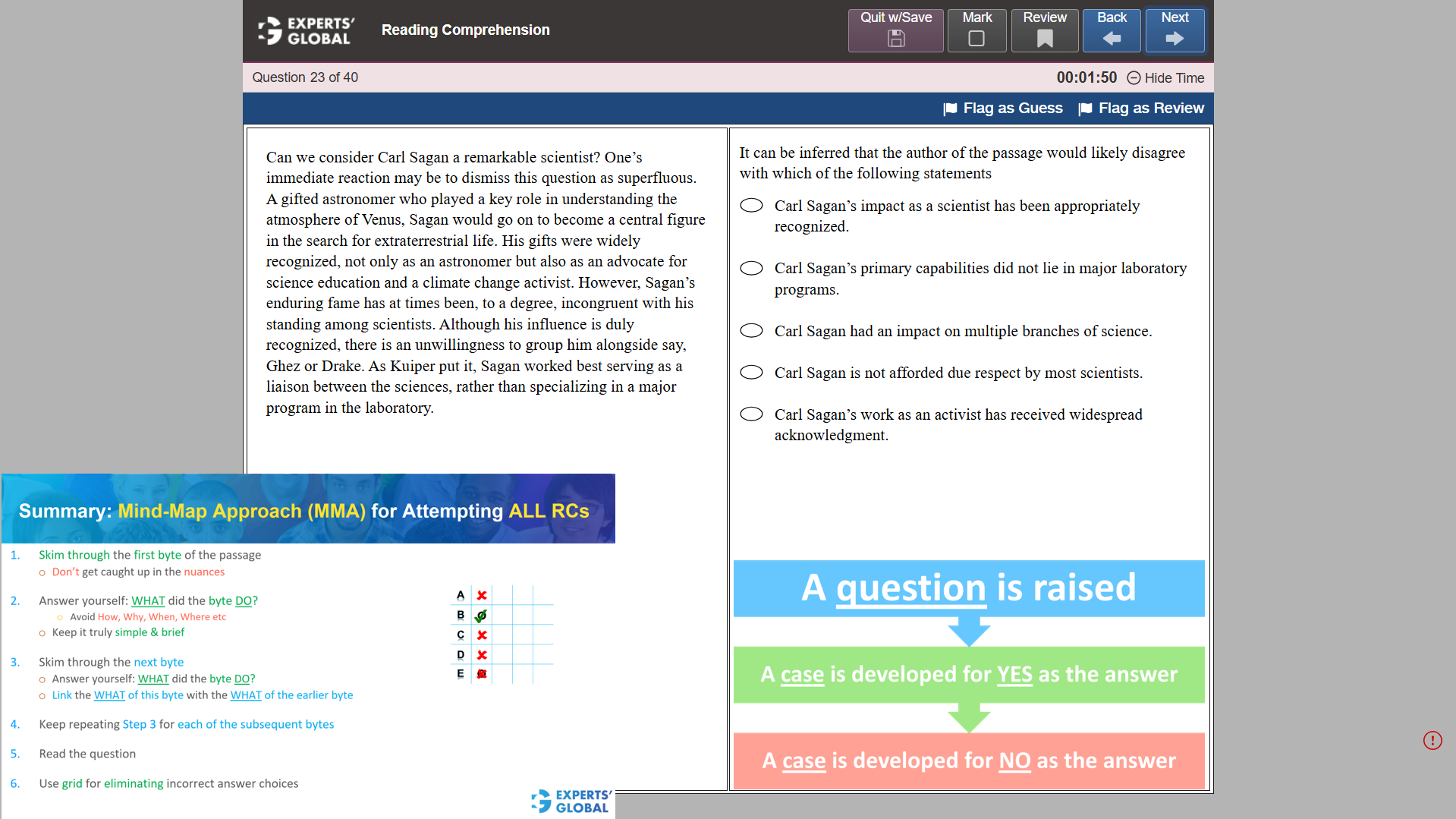
Below is a snapshot of the GRE style Disagreement with Passage Reading Comprehension question discussed in the video, along with the Mind Map approach used to solve it and the Mind Map created for the passage.
Correct Answer: A
For a detailed explanation of this question, please refer to the video presented earlier on this page.
Following is a step-wise written explanation, using our Mind Map Approach…
Step 1 and 2: First Byte
Byte: “Can we consider Carl Sagan a remarkable scientist? One’s immediate reaction may be to dismiss this question as superfluous.”
What it did: It raised a question about whether Sagan should be ranked among the top scientists.
Step 3 and 4: Subsequent Bytes
Second Byte: “A gifted astronomer… key role in understanding the atmosphere of Venus… search for extraterrestrial life… widely recognized.”
What it did: It developed a case for YES by highlighting his specific scientific achievements and influence.
Third Byte: “However… standing among scientists… unwillingness to group him alongside say, Ghez or Drake… liaison between the sciences, rather than specializing.”
What it did: It developed a case for NO by explaining that peers often saw him as a communicator rather than a core laboratory specialist.
Step 5: Read the Question
Question: It can be inferred that the author of the passage would likely disagree with which of the following statements?
Step 6: Eliminate
Carl Sagan’s impact as a scientist has been appropriately recognized.
(Keep: The passage notes an “unwillingness to group him alongside” other great scientists, suggesting his impact might not be fully or appropriately recognized by peers).
Carl Sagan’s primary capabilities did not lie in major laboratory programs.
(Eliminate: The author would agree with this, as Kuiper is quoted saying Sagan worked best as a liaison rather than a laboratory specialist).
Carl Sagan had an impact on multiple branches of science.
(Eliminate: The author would agree, citing his work in astronomy, Venusian atmospheres, and the search for extraterrestrial life).
Carl Sagan is not afforded due respect by most scientists.
(Eliminate: The passage explicitly mentions this perspective, so the author would not disagree that this view exists).
Carl Sagan’s work as an activist has received widespread acknowledgment.
(Eliminate: The author would agree, stating his gifts were “widely recognized” as an advocate and activist).