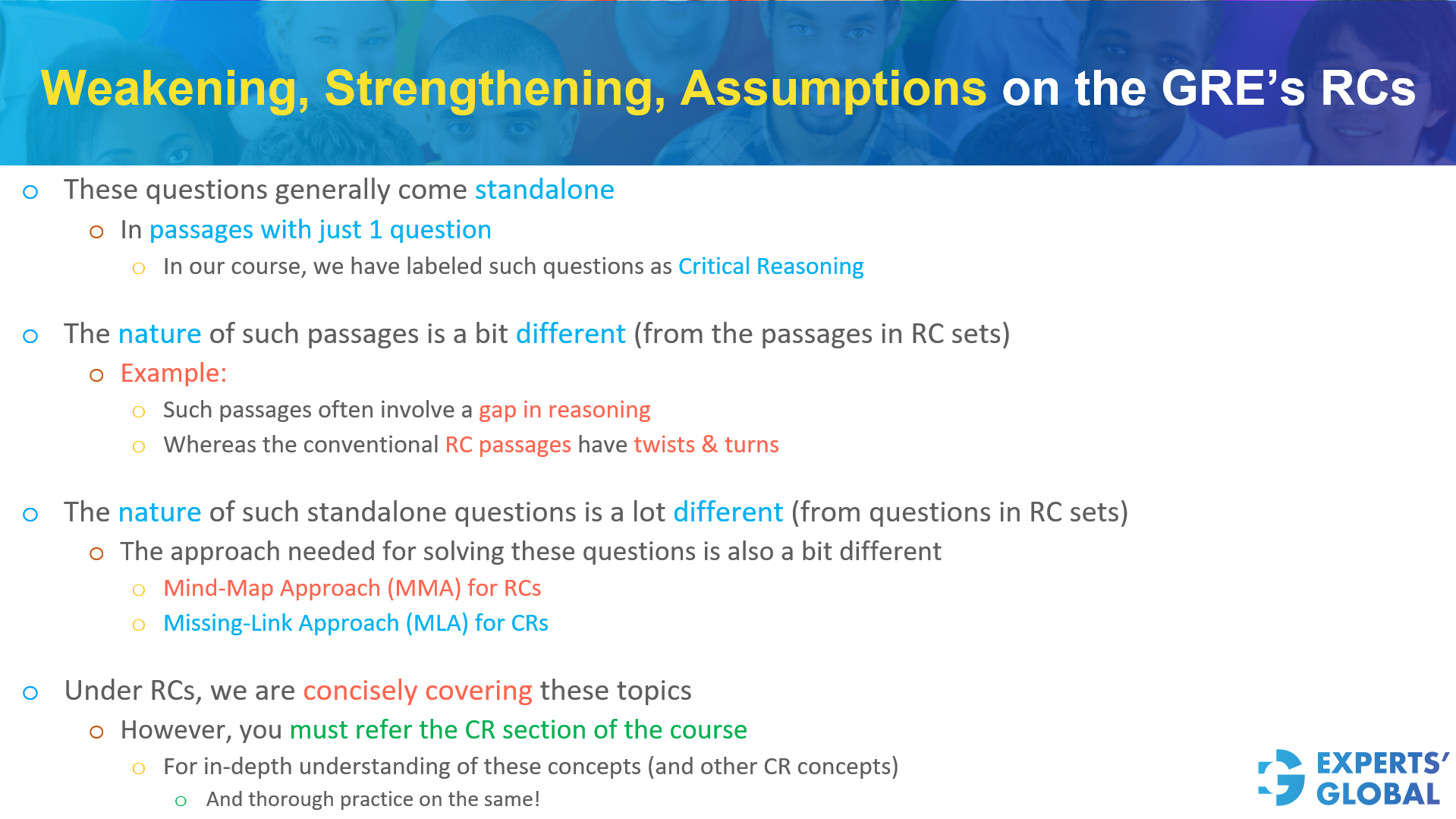
Weakening, strengthening, and assumption question types on the GRE appear as a short passage followed by a single question. Although GRE places these under Reading Comprehension, in practice they are critical reasoning questions. In the Experts’ Global GRE prep course, passages with just one question have been labeled as critical reasoning and are covered in detail under the critical reasoning segment of the course and website.
That said, since weakening, strengthening, and assumption questions are the most common formats in single-question passages, they are also introduced briefly within the Reading Comprehension section of our website an course, in interest of complete coverage. For deeper and more detailed treatment, you are encouraged to refer to the GRE critical reasoning portion of our website and prep course. These questions typically present a short argument with a conclusion and a clear gap between the information provided and the conclusion drawn.
Solving these questions depends on identifying this gap, which Experts’ Global refers to as the “missing link”. Weakening questions attack this missing link, strengthening questions fill it, and assumption questions also fill it but with an added requirement. A valid assumption must be necessarily true for the argument to hold, and if that assumption is negated, the argument must collapse. The video lesson and the theory that follows provide a concise overview of weakening, strengthening, and assumption questions on the GRE and apply these ideas to GRE-style problems to give first-hand exposure to the question types so that you can apply the learning on your GRE drills, GRE section mocks, and GRE full-length mocks.
Understanding Weakening, Strengthening, Assumption Questions | GRE RC
Weakening, strengthening, and assumption questions often appear as standalone questions on the GRE, typically in passages with only one question. These questions fall under the Critical Reasoning category, and the passages linked to them have a distinct nature compared to typical Reading Comprehension sets. Unlike conventional Reading Comprehension passages, which usually include multiple twists and turns in meaning, these standalone questions have a different structure — they generally include a clear gap in reasoning, which directs the focus of the question.
Strategy for Solving Weakening, Strengthening, Assumption Questions | GRE RC
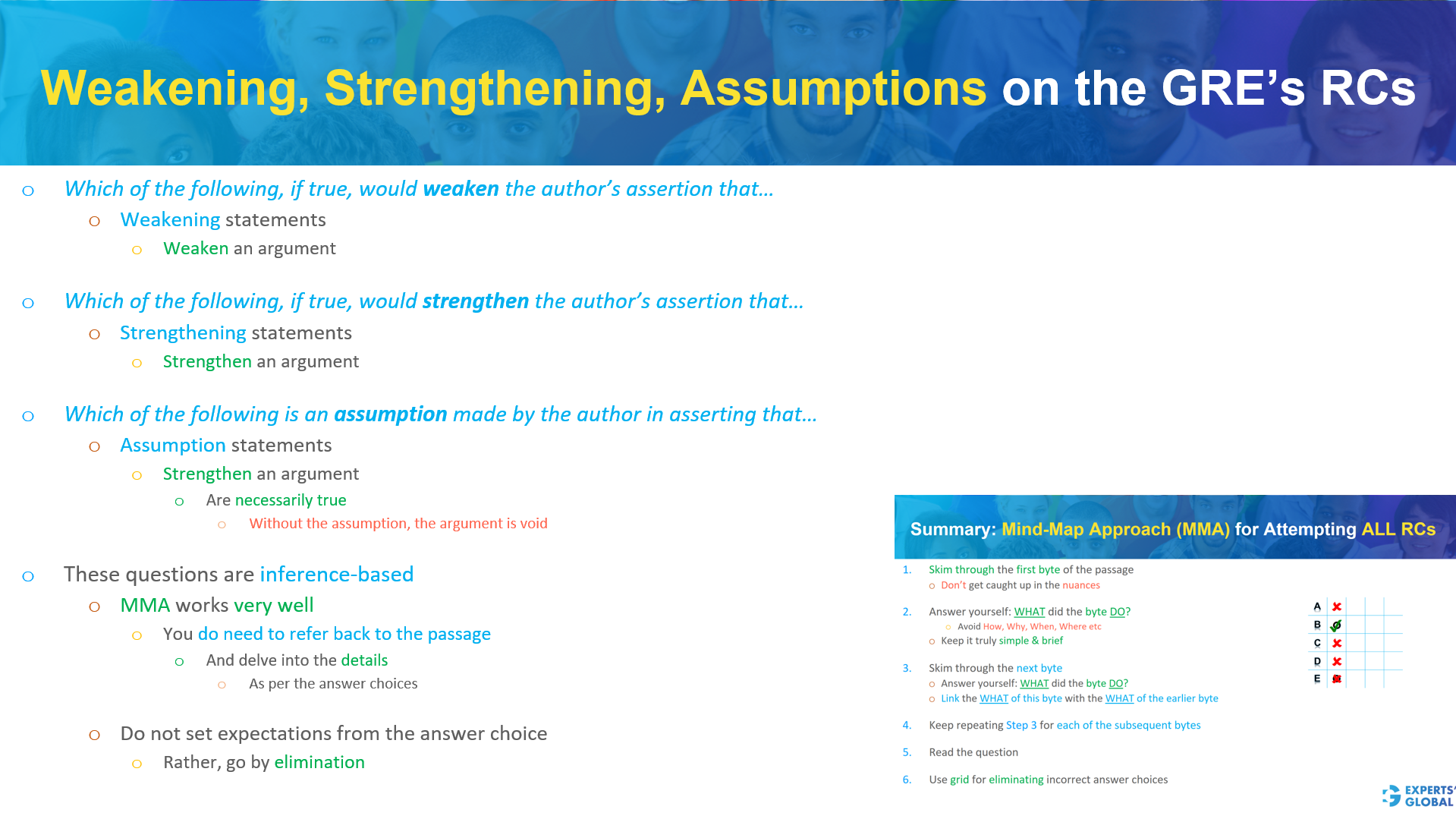
Weakening questions ask you to identify which option, if true, would weaken the author’s assertion. These questions focus on statements that weaken an argument. Strengthening questions ask you to identify which option, if true, would strengthen the author’s assertion. These questions focus on statements that strengthen an argument. Assumption questions ask you to identify the assumption made by the author. Assumption statements support an argument by identifying what must be true, as assumptions are necessary for the argument to hold. These questions are inference-based. Use the Mind Map Approach to handle them effectively. Solve these questions by referring back to the passage, paying attention to details in the answer choices, and using elimination to narrow down the options.
GRE-Style Weakening RC Practice Question
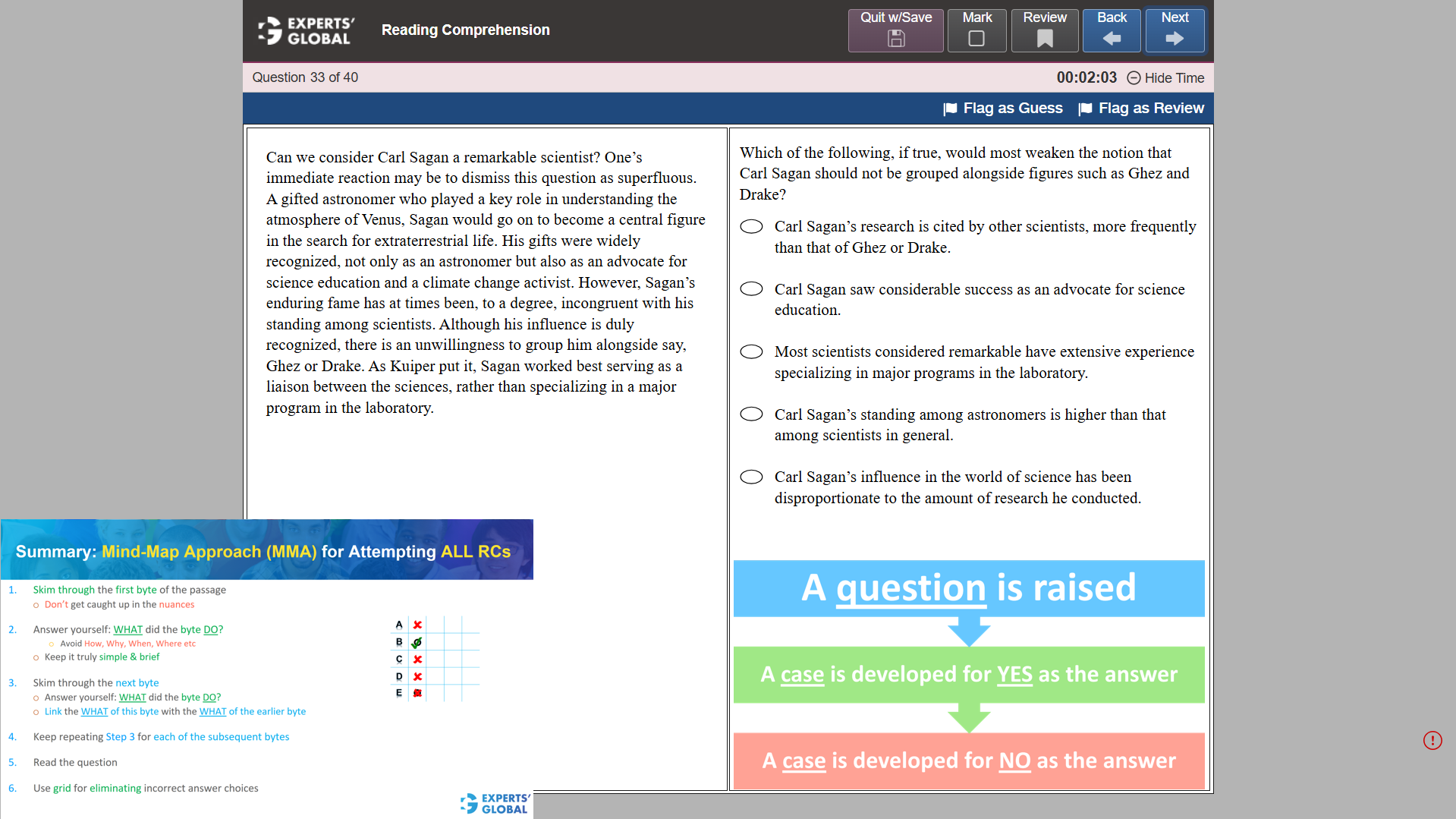
Below is a snapshot of the GRE style Weakening Reading Comprehension question discussed in the video, along with the Mind Map approach used to solve it and the Mind Map created for the passage.
Correct Answer: A
For a detailed explanation of this question, please refer to the video presented earlier on this page.
Following is a step-wise written explanation, using our Mind Map Approach…
Step 1 and 2: First Byte
Byte: “Can we consider Carl Sagan a remarkable scientist? One’s immediate reaction may be to dismiss this question as superfluous.”
What it did: It raised a question about whether Sagan should be viewed as a truly remarkable scientist.
Step 3 and 4: Subsequent Bytes
Second Byte: “A gifted astronomer… key role in understanding… Venus… extraterrestrial life… widely recognized… advocate for science education.”
What it did: It developed a case for YES by highlighting his contributions and public influence.
Third Byte: “However… incongruent with his standing among scientists… unwilling to group him alongside… Ghez or Drake… liaison… rather than specializing.”
What it did: It developed a case for NO by explaining why some peers do not rank him with top specialists like Ghez or Drake.
Step 5: Read the Question
Question: Which of the following, if true, would most weaken the notion that Carl Sagan should not be grouped alongside figures such as Ghez and Drake?
Core Task: Find the option that suggests Sagan should be grouped with them (attacks the “NO” case).
Step 6: Eliminate
Carl Sagan’s research is cited by other scientists more frequently than that of Ghez or Drake.
(Keep: If his research is cited more, it proves his scientific impact is equal to or greater than theirs. This directly weakens the “liaison only” argument).
Carl Sagan saw considerable success as an advocate for science education.
(Eliminate: This supports the “liaison” view rather than his standing as a specialist scientist).
Most scientists considered remarkable have extensive experience specializing in major programs in the laboratory.
(Eliminate: This strengthens the idea that he should not be grouped with them, as the passage says he did not specialize).
Carl Sagan’s standing among astronomers is higher than that among scientists in general.
(Eliminate: This does not compare him to Ghez or Drake specifically or prove he belongs in their group).
Carl Sagan’s influence in the world of science has been disproportionate to the amount of research he conducted.
(Eliminate: This suggests his fame outweighs his actual research, which strengthens the “NO” case).
Correct Answer: A
GRE-Style Strengthening RC Practice Question
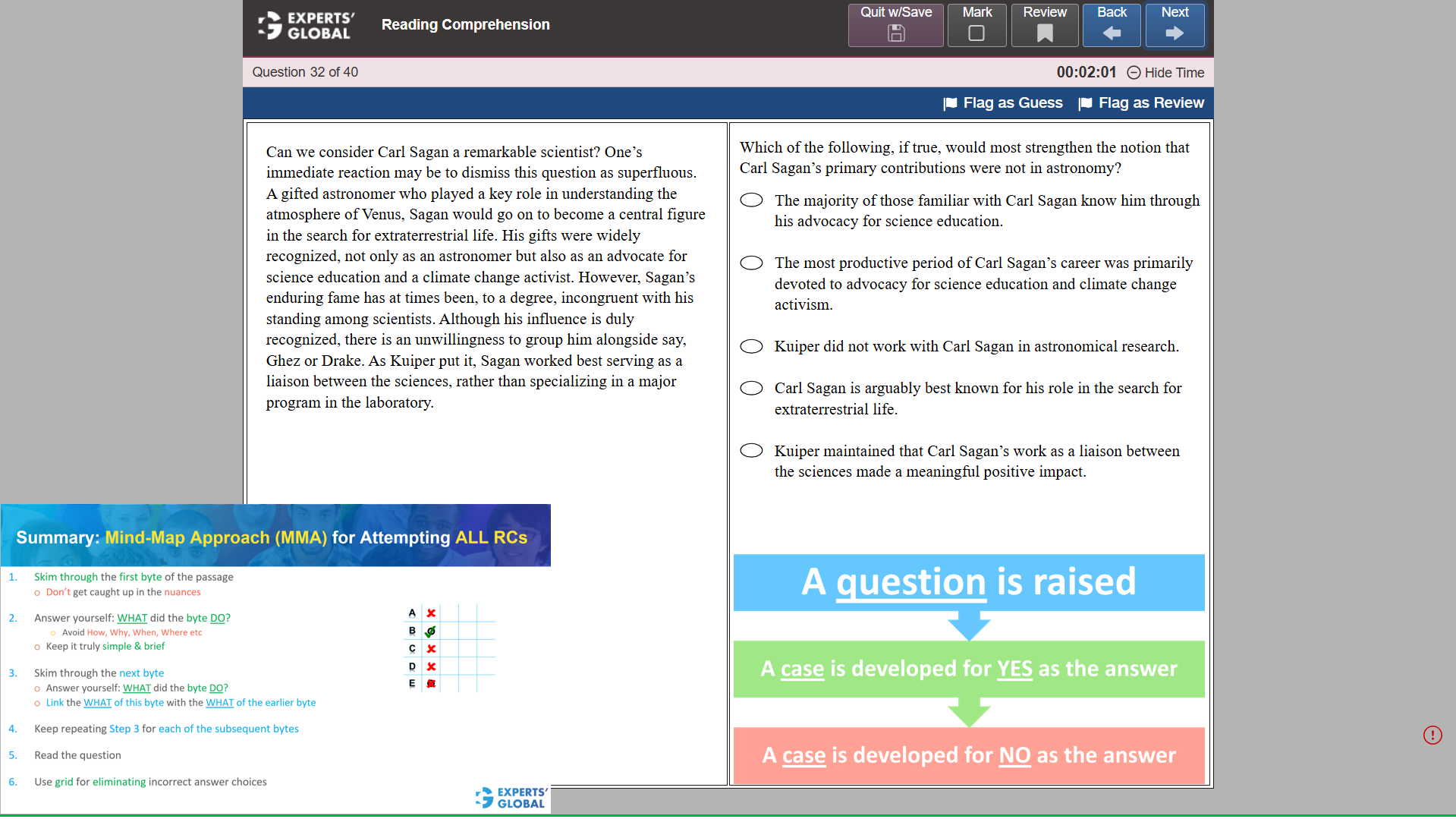
Below is a snapshot of the GRE style Strengthening Reading Comprehension question discussed in the video, along with the Mind Map approach used to solve it and the Mind Map created for the passage.
Correct Answer: B
For a detailed explanation of this question, please refer to the video presented earlier on this page.
Following is a step-wise written explanation, using our Mind Map Approach…
Step 1 and 2: First Byte
Byte: “Can we consider Carl Sagan a remarkable scientist? One’s immediate reaction may be to dismiss this question as superfluous.”
What it did: It raised a question regarding Carl Sagan’s status as a scientist.
Step 3 and 4: Subsequent Bytes
Second Byte: “A gifted astronomer… key role… understanding the atmosphere of Venus… widely recognized… advocate for science education.”
What it did: It developed a case for YES by highlighting his specific astronomical achievements and public influence.
Third Byte: “However… standing among scientists… unwilling to group him alongside… Ghez or Drake… liaison between the sciences, rather than specializing.”
What it did: It developed a case for NO by suggesting his main impact was as a communicator rather than a core researcher.
Step 5: Read the Question
Question: Which of the following, if true, would most strengthen the notion that Carl Sagan’s primary contributions were not in astronomy?
Step 6: Eliminate
The majority of those familiar with Carl Sagan know him through his advocacy for science education.
(Eliminate: Popularity does not prove where his actual primary contributions lie; it only proves what people know him for).
The most productive period of Carl Sagan’s career was primarily devoted to advocacy for science education and climate change activism.
(Keep: This directly strengthens the idea that his main work was in advocacy rather than astronomical research).
Kuiper did not work with Carl Sagan in astronomical research.
(Eliminate: A lack of collaboration with one specific person does not mean he did not contribute to the field).
Carl Sagan is arguably best known for his role in the search for extraterrestrial life.
(Eliminate: This is still a scientific and astronomical pursuit, which would weaken the argument rather than strengthen it).
Kuiper maintained that Carl Sagan’s work as a liaison between the sciences made a meaningful positive impact.
(Eliminate: This supports the value of his work but does not prove that astronomy was not his primary contribution).
Correct Answer: B
GRE-Style Assumption RC Practice Question
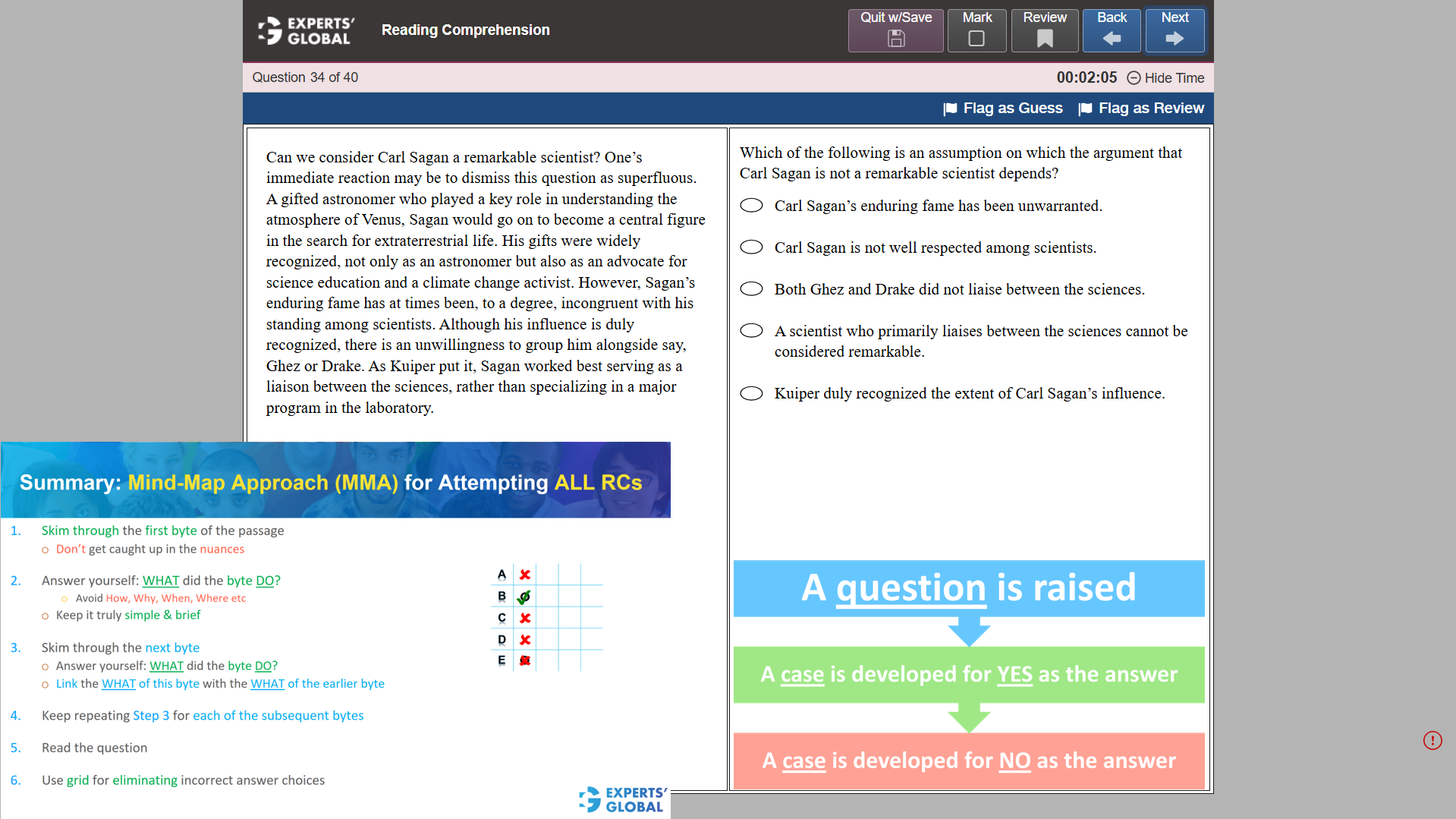
Below is a snapshot of the GRE style Assumption Reading Comprehension question discussed in the video, along with the Mind Map approach used to solve it and the Mind Map created for the passage.
Correct Answer: D
For a detailed explanation of this question, please refer to the video presented earlier on this page.
Following is a step-wise written explanation, using our Mind Map Approach…
Step 1 and 2: First Byte
Byte: “Can we consider Carl Sagan a remarkable scientist? One’s immediate reaction may be to dismiss this question as superfluous.”
What it did: It raised a question about whether Carl Sagan deserves the “remarkable scientist” label.
Step 3 and 4: Subsequent Bytes
Second Byte: “A gifted astronomer… key role… central figure… search for extraterrestrial life… widely recognized… advocate for science education.”
What it did: It developed a case for YES by highlighting his major scientific achievements and public influence.
Third Byte: “However… incongruent with his standing among scientists… unwilling to group him alongside… Ghez or Drake… liaison between the sciences, rather than specializing.”
What it did: It developed a case for NO by explaining that peers view him as a communicator (liaison) rather than a specialized researcher.
Step 5: Read the Question
Question: Which of the following is an assumption on which the argument that Carl Sagan is not a remarkable scientist depends?
Step 6: Eliminate
Carl Sagan’s enduring fame has been unwarranted.
(Eliminate: The passage says his fame is “incongruent” with his standing, but the “not remarkable” argument is specifically about his role as a “liaison”).
Carl Sagan is not well respected among scientists.
(Eliminate: The passage says he has “standing among scientists,” just not the same type of standing as specialists like Drake).
Both Ghez and Drake did not liaise between the sciences.
(Eliminate: This is not necessary for the argument. The argument focuses on Sagan’s lack of specialization).
A scientist who primarily liaises between the sciences cannot be considered remarkable.
(Keep: This is the missing link. The “NO” case relies on the idea that being a “liaison” instead of a “specialist” prevents one from being “remarkable”).
Kuiper duly recognized the extent of Carl Sagan’s influence.
(Eliminate: Recognition of influence does not explain why he would not be considered a remarkable scientist).