
Invest 30 seconds...
...for what may lead to a life altering association!
Help Line
- +91.8800.2828.00 (IND)
- 1030-1830 Hrs IST, Mon-Sat
- support@expertsglobal.com
33% off ends soon:GMAT/GRE prep + applications bundle. Profile building, longer mentoring, better results. Inquire

Two-blank Text Completion questions reward careful reading and logical consistency, yet many errors arise not only from gaps in vocabulary, but also from subtle missteps in how the sentence is processed. These mistakes often occur when the two blanks are treated separately, when the sentence is not read closely from start to finish, when every shift in meaning is not duly processed, when early assumptions go unchecked, when the relationship between the two blanks is not fully respected, and more. Because both words must work together to express a single idea, even a small lapse in tracking meaning can lead to answer pairs that feel appealing but fail to hold together. Becoming aware of where test takers commonly go wrong creates a strong foundation for improving accuracy and decision-making, which is an important focus within any well-designed GRE prep course.
The following video and the theory that follows introduce the most common mistake patterns associated with two-blank Text Completion questions on the GRE. They help you recognize where errors typically enter the solving process, how they influence your answer choices, and why avoiding them leads to more consistent outcomes. This awareness supports smoother learning from the explanations and examples ahead and helps you apply those ideas more effectively during practicing GRE drills and GRE mock tests. Use this overview to sharpen attention, stay alert to common pitfalls, and move ahead with clarity and purpose.
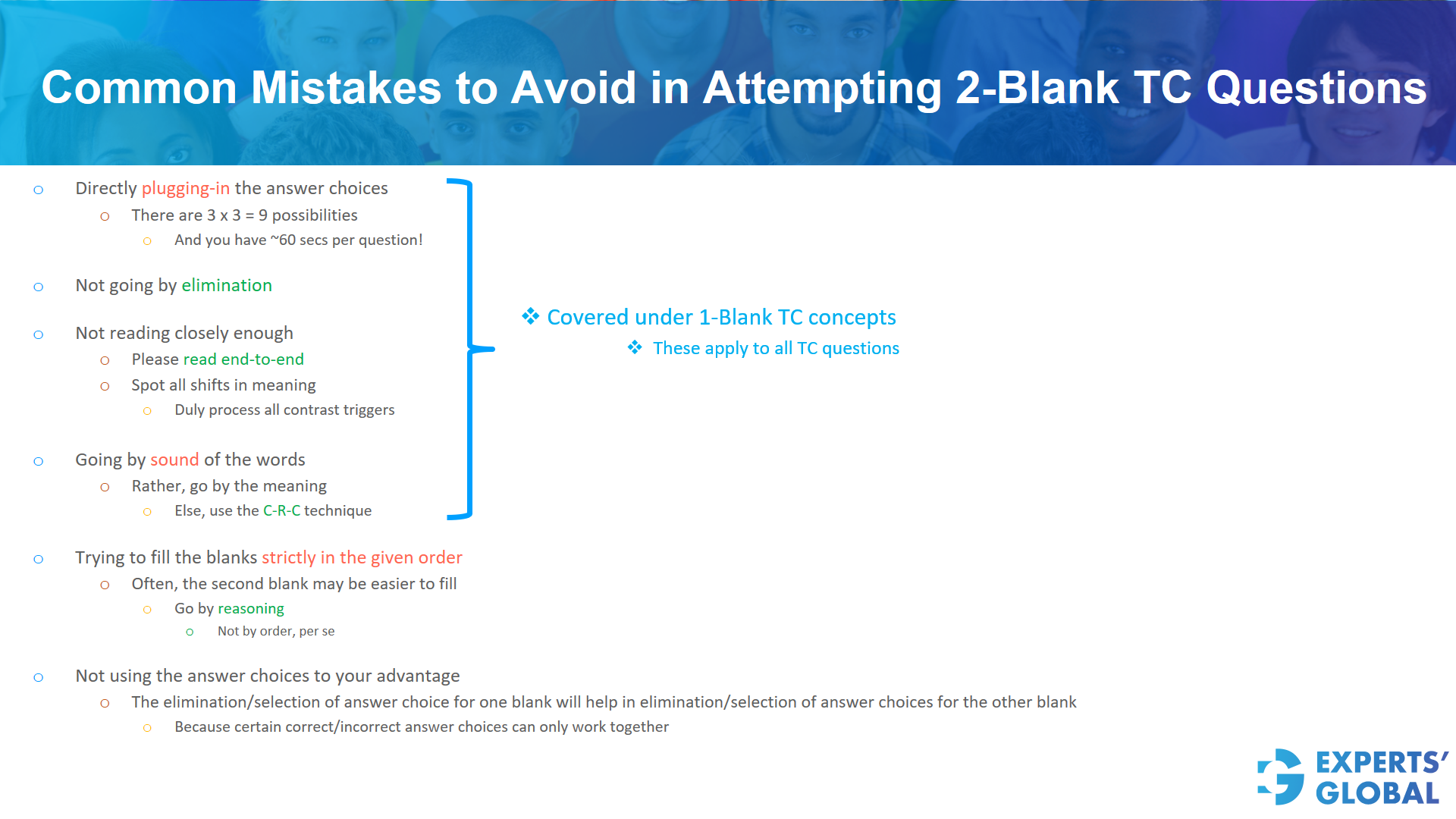
In 2-blank questions, each blank has three choices, which creates nine possible combinations. With about 60 seconds per question, this approach quickly drains your time and energy. A smarter path always begins with understanding, not trial and error.
Elimination is not optional here. Removing weak or mismatched choices early simplifies the task and brings structure to your thinking. This habit alone changes how efficient these questions feel.
Always read end to end before thinking about blanks. Train yourself to spot shifts in meaning and deliberately process contrast triggers. These signals quietly guide you toward the correct idea of the sentence.
Words may sound appealing, but meaning matters more than tone. Focus on what the sentence is trying to say. When needed, rely on the C-R-C technique to stay grounded in logic rather than surface appeal.
Many times, the second blank feels clearer than the first. Let reasoning decide the order, not position. Flexibility here often leads to faster and more accurate decisions.
Choices across both blanks interact with each other. Selecting or eliminating an option for one blank often unlocks the other. Some choices only work together, and recognizing these pairings gives you strong control over the question.
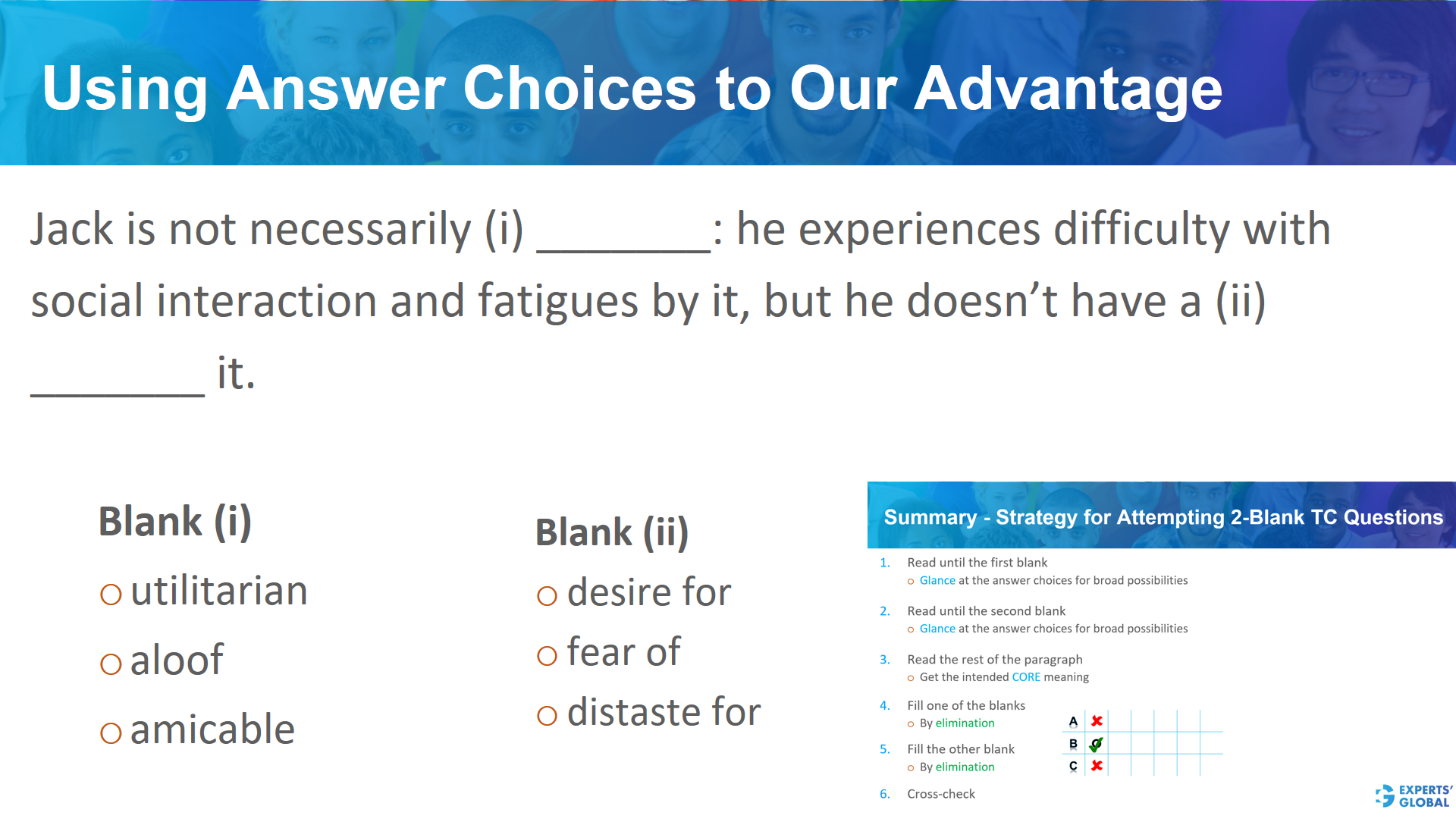
Correct answers: Blank (i): aloof Blank (ii): distaste for
For a detailed explanation of this question, please refer the last ~2 minutes of the video featured earlier on this page. Following is a step-by-step written solution:
Jack is not necessarily (i) ________: he experiences difficulty with social interaction and fatigues by it, but he doesn’t have a (ii) ________ it.
Blank (i)
Blank (ii)
1. Core Meaning
The sentence contrasts Jack’s outward behavior with his internal feelings. Even though he struggles with social interaction and finds it tiring, it does not mean he is unfriendly or that he actually hates being around people.
2. Broad Expectation
3. Eliminate
Blank (i)
Blank (ii)
4. Cross-check
The word aloof for the first blank explains how he might appear to others, while distaste for in the second blank clarifies that his struggle is due to exhaustion, not a lack of liking for people.
Correct answers: Blank (i): aloof Blank (ii): distaste for
GRE preparation course with 7-day trial
Set of 15 Full length GRE practice tests
Set of 15 sectional GRE practice tests
Free full length diagnostic test for GRE
