
Invest 30 seconds...
...for what may lead to a life altering association!
Help Line
- +91.8800.2828.00 (IND)
- 1030-1830 Hrs IST, Mon-Sat
- support@expertsglobal.com
33% off ends soon:GMAT/GRE prep + applications bundle. Profile building, longer mentoring, better results. Inquire

Dialogue-based questions in GRE Critical Reasoning present an argument through a conversation between two individuals. Each speaker contributes specific points that together form one logical argument. The question itself is not new. The task remains one of the standard Critical Reasoning objectives such as assumption, strengthen, weaken, inference, main point, resolve the paradox etc. The only difference lies in how the information is delivered – rather than in the form of a single paragraph, the argument is presented in the form of an interaction between two persons.
In these questions, the dialogue must be treated as a unified argument. To solve, you first read the question stem carefully to identify your task. You then read the dialogue and build a clear mind map that duly connects the key points across the dialogue between the speakers. Based on the task stated in the question stem, you set a broad expectation for what the correct answer must achieve in the context of the dialogue and proceed by elimination. Before you confirm your answer, cross-check that your selection duly meets the requirement of the question stem in the context of the presented dialogue.
The following comprehensive video lesson, a part of our GRE preparation course, explains dialogue-based Critical Reasoning questions in a clear and structured way. It demonstrates how to convert conversational arguments into clean logical maps and apply elimination on GRE-style examples. Use this method consistently to improve accuracy and clarity when handling dialogue-based GRE CR questions. Duly understand the concept and apply it in your GRE exercises, GRE sectional tests, and GRE full-length practice tests.
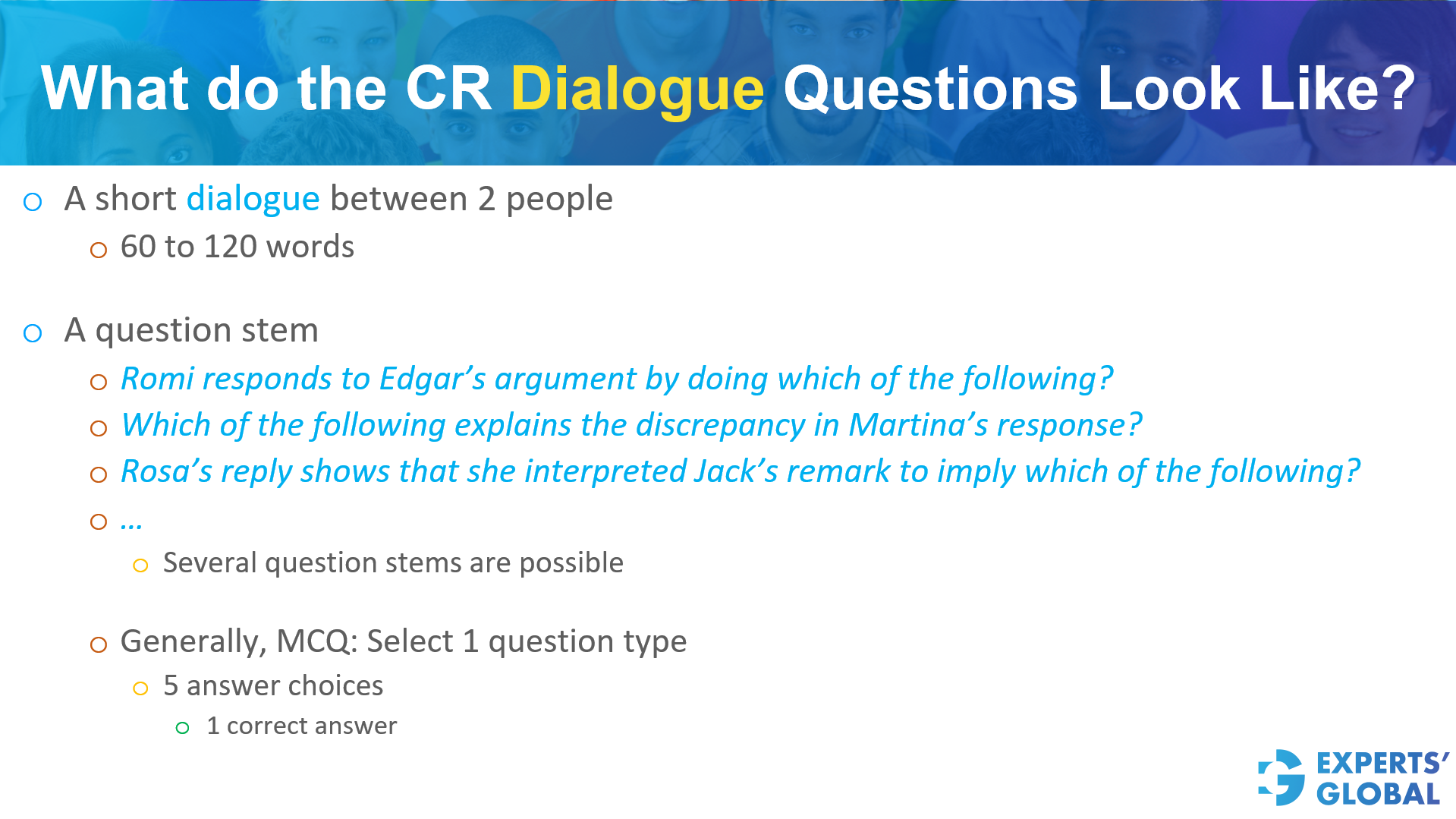
Critical Reasoning Dialogue questions present a short conversation between two people. These exchanges typically range from 60 to 120 words to ensure the dialogue remains focused and clear. A direct question stem follows the conversation and focuses on how one speaker responds to, explains, or interprets the statement of the other person.
Common question stems ask you to identify how one person responds to an argument or what explains a discrepancy in a specific response. Some stems require you to determine how a speaker interprets a particular remark. Although the question stem formats vary, the structure remains consistent. These questions use a multiple choice format with five answer choices. Exactly one answer choice is correct.
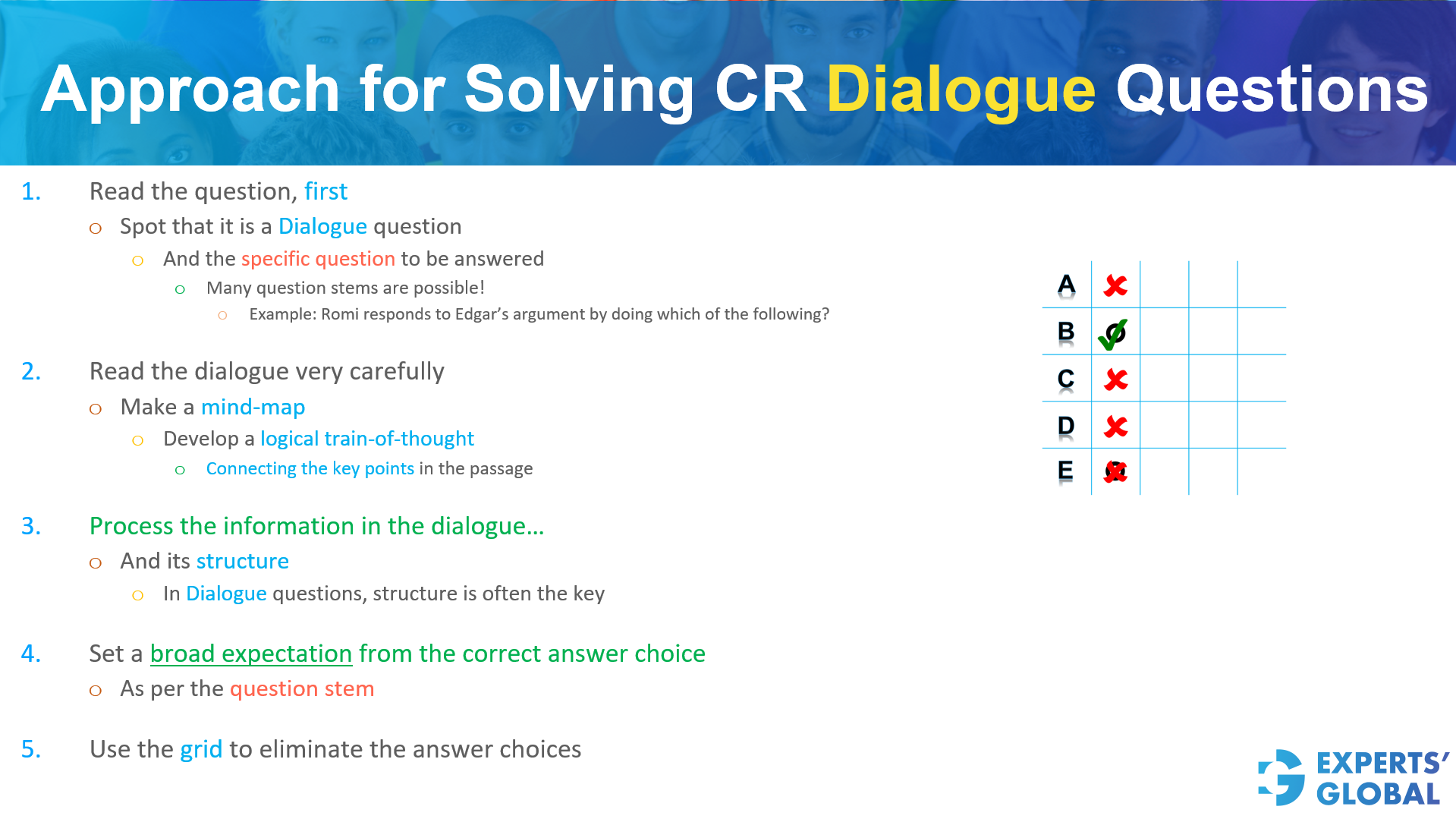
Read the question first and identify it as a Dialogue question. Determine the specific objective of the question stem because this question type uses many different formats. Read the dialogue carefully and create a mind map to establish a logical train of thought. Connect the key points in the exchange to see how the speakers interact.
Pay close attention to the structure of the dialogue as you process the information. Structure often provides the central clue for this question type. Form a broad expectation of the correct answer based on the requirements of the question stem. Use a grid to systematically eliminate incorrect choices and identify the best option.
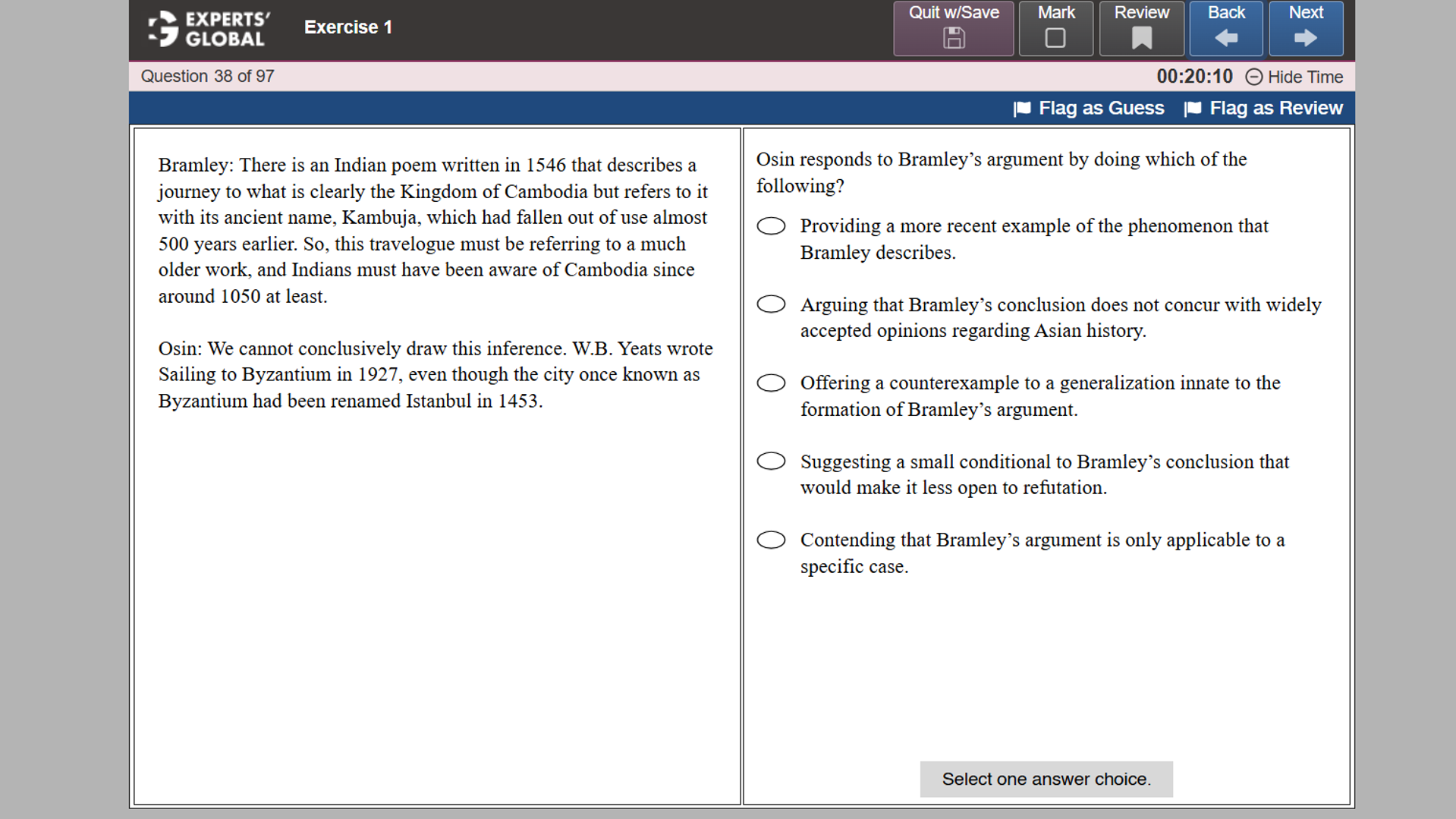
Correct Answer: C
For a detailed explanation of this question, please refer to the video presented earlier on this page.
Following is a concise, step-wise written explanation, using our Missing-Link Approach (MLA)…
Bramley assumes a generalization: if an author uses an ancient name, they must be referencing a contemporary source from that ancient time.
Osin uses an analogous counterexample (Yeats and Byzantium) to show that an author can use an archaic name simply for literary or poetic reasons, without needing a 500 year old source. This weakens the necessity of Bramley’s conclusion.
Correct Answer: C
15 full length GRE practice exams
60 sectional GRE practice exams
Free full length diagnostic GRE exam
