
Invest 30 seconds...
...for what may lead to a life altering association!
Help Line
- +91.8800.2828.00 (IND)
- 1030-1830 Hrs IST, Mon-Sat
- support@expertsglobal.com
33% off ends soon:GMAT/GRE prep + applications bundle. Profile building, longer mentoring, better results. Inquire

Data Interpretation questions appear within the quantitative section on the GRE and usually come as one set with three questions based on the same data set. Data interpretation is not a separate question type. It is a format that presents raw information through charts and tables, which form the core of what you analyze. The question formats remain the same, including multiple choice select one, multiple choice select one or more, and numeric entry, and quantitative comparison questions generally do not appear in these sets. These questions help you read data, identify useful information, and process it to answer specific questions. These skills support strong performance across the quantitative section and connect naturally to higher order careers. For this reason, thorough coverage of data interpretation is an essential part of a sincere GRE prep course.
The following video gives a clear and thorough overview of data interpretation question types. It helps you visualize how these questions appear, what they look like, and how they show up on the GRE. Use this overview to build a strong foundation before moving deeper into data interpretation questions in the upcoming lessons. All the best!
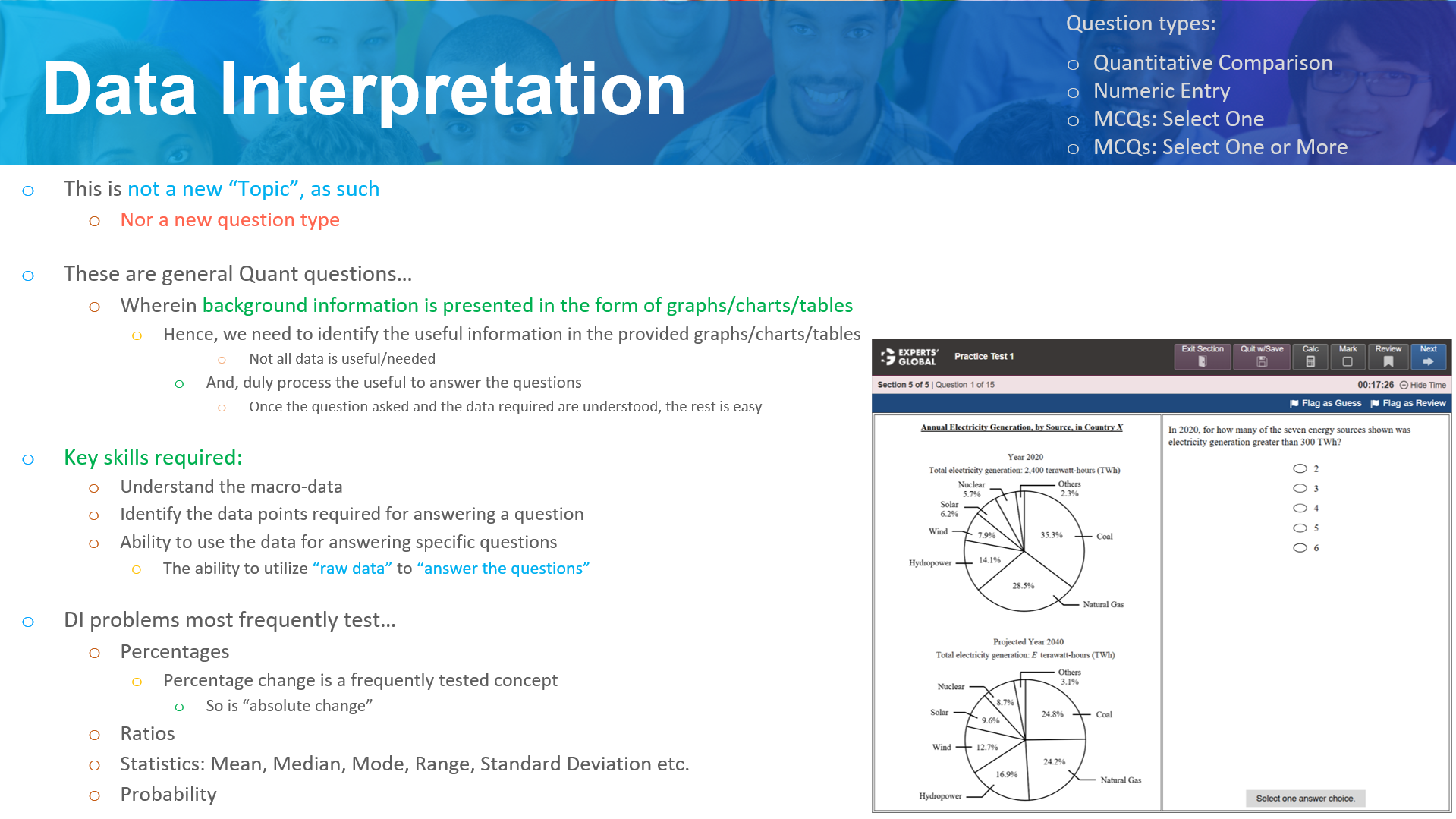
Data Interpretation (DI) is not a separate topic or unique question type, but rather a variation of general quantitative questions where background information is provided through graphs, charts, or tables. The core task involves identifying relevant information from these visual aids, filtering out unnecessary data, and processing the useful points to answer specific questions.
DI problems frequently evaluate proficiency in the following mathematical areas:
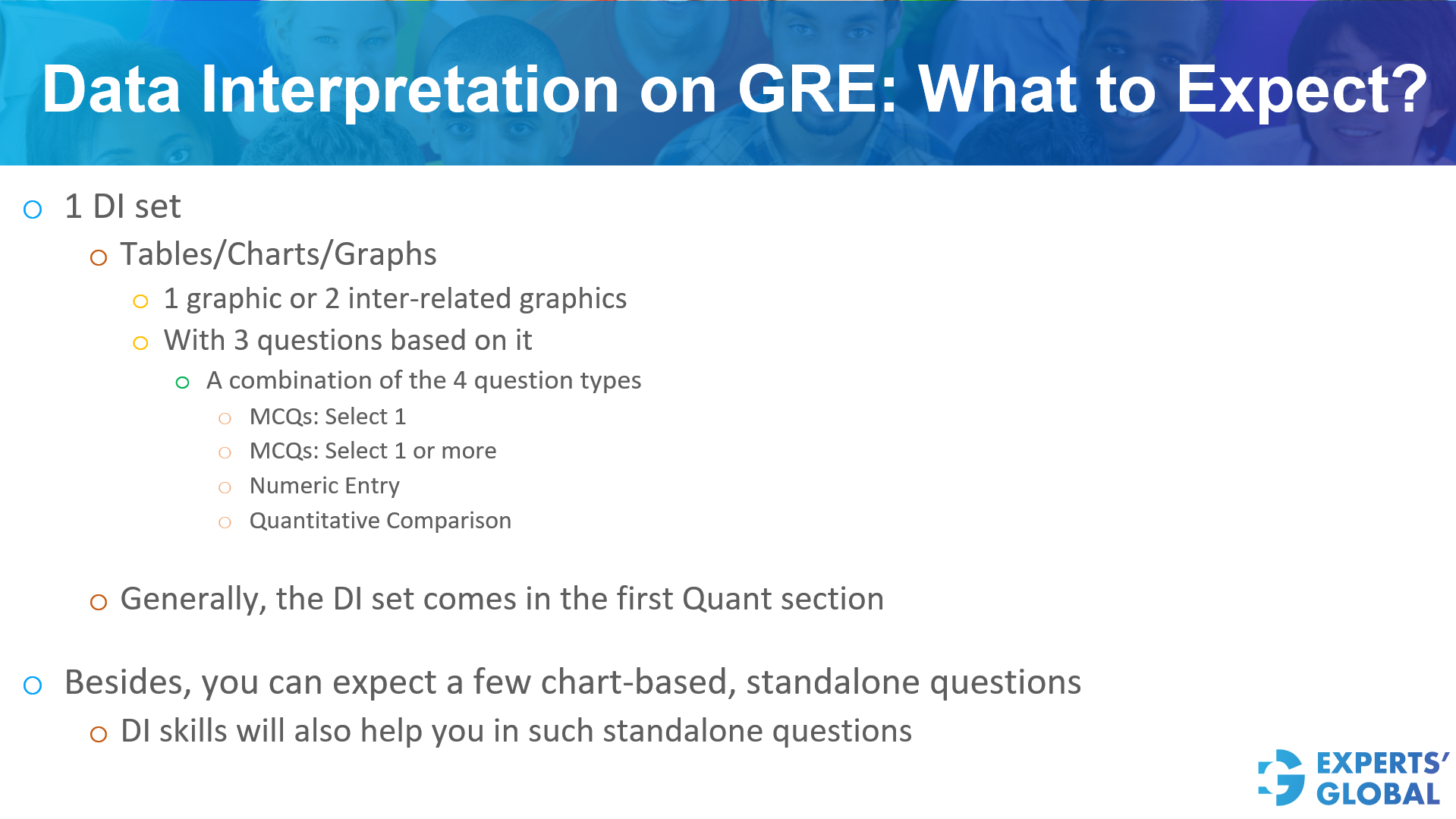
The GRE Data Interpretation (DI) component primarily consists of one comprehensive set of questions based on a specific visual prompt. This prompt typically features either a single graphic or two interrelated graphics, such as tables, charts, or graphs.
Beyond the main set, you may encounter standalone questions that are chart-based. The analytical skills required for the primary DI set are directly applicable to these individual questions.
End-to-end GRE prep course online (includes 7-day free trial)
15 full-length GRE practice tests
60 sectional GRE practice tests
