GRE Quant: Types of Numbers – Properties & Exceptions
Number properties form the base of the GRE Quant section, and the first step in preparing for number properties is understanding the classification of numbers. This idea is simple and intuitive, yet it supports interesting and layered questions and traps on the GRE. Being fully comfortable with number types helps you see through the layers in problems and navigate several GRE Quant questions with clarity and ease.
The following video, part of the GRE prep course by Experts’ Global, explains the classification of numbers in a simple and structured way. It explains that all numbers tested on the GRE are real numbers, that complex numbers do not appear, that real numbers divide into rational and irrational numbers, and that rational numbers divide into fractions and integers. Integers then divide further into types such as prime and non-prime, even and odd, and more.
The video also highlights important observations and patterns, including 2 as the only even prime number, 0 as an even integer, 1 as not a prime number, and pi as an example of an irrational number. These observations often act as exception cases in GRE Quant questions and can change the correct answer choice. Take your time to absorb this important topic and apply the learnings across your GRE practice exercises, GRE sectional practice tests, and GRE full-length practice tests.
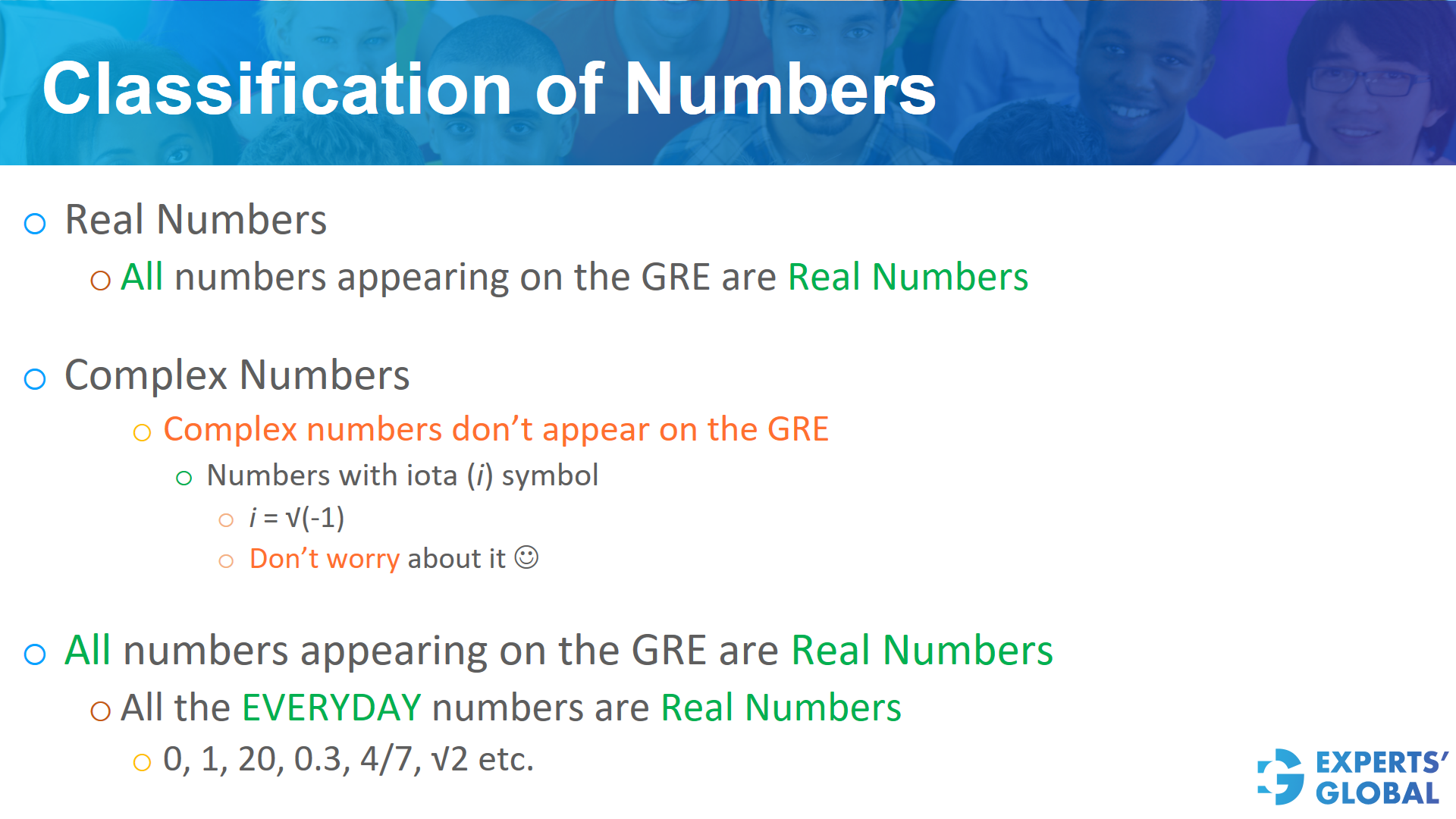
Numbers are broadly classified into two main categories: Real Numbers and Complex Numbers.
Real Numbers
Real numbers include all the everyday numbers used in standard mathematics and are the only type of numbers that appear on the GRE. These encompass:
Whole numbers: such as 0, 1, and 20
Decimals: such as 0.3
Fractions: such as 4/7
Roots: such as the square root of 2
Complex Numbers
Complex numbers do not appear on the GRE. They are characterized by the inclusion of the iota symbol (i), where i = sqrt(-1).
Because they are not part of the exam curriculum, they do not require study in the context of GRE prep.
Classification of Real Numbers
Classification of Real Numbers
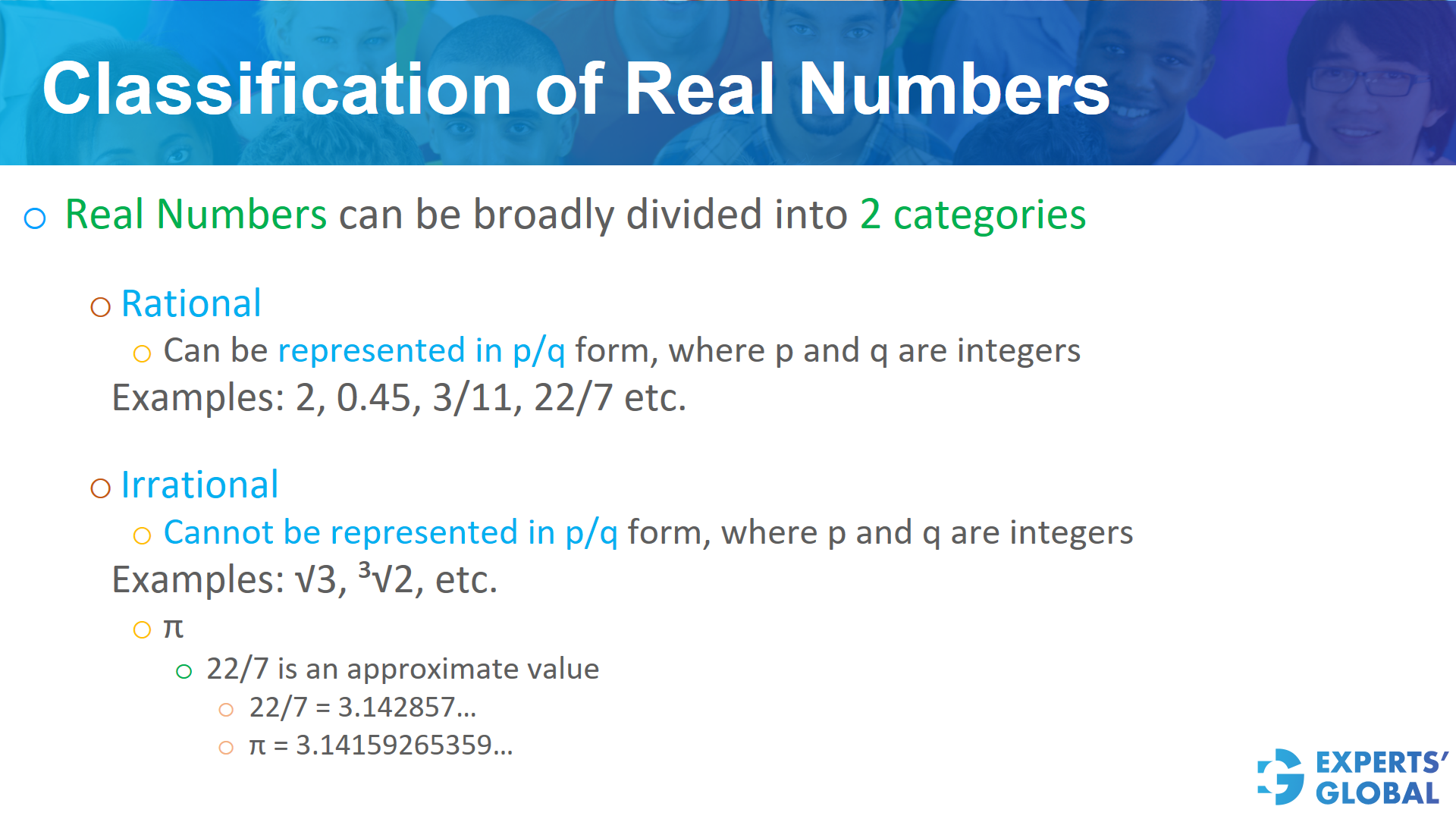
Real Numbers are broadly divided into two main categories:
1. Rational Numbers
Definition: These are numbers that can be represented in p/q form, where both p and q are integers.
Examples: 2, 0.45, 3/11, and 22/7.
2. Irrational Numbers
Definition: These are numbers that cannot be represented in p/q form where p and q are integers.
Examples: square root of 3, cube root of 2, and pi.
The Case of π vs. 22/7
It is important to distinguish between the actual value of pi and its common fraction approximation:
π: An irrational number with a value of approximately 3.14159265359…
22/7: A rational approximation of pi. Its decimal value is 3.142857…
Classification of Rational Numbers
Classification of Rational Numbers
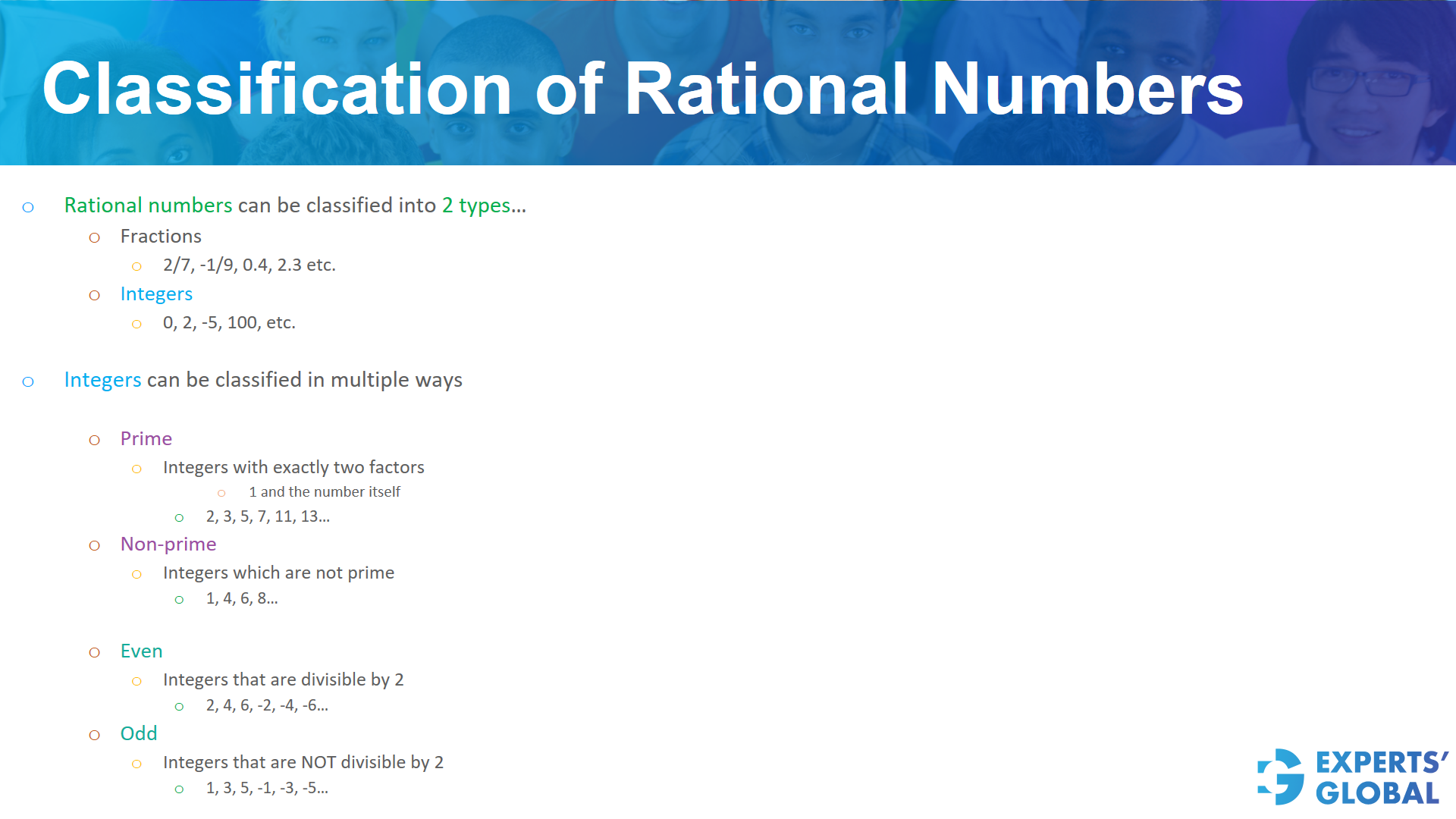
Rational numbers are classified into two primary categories:
Fractions: This includes values such as 2/7, -1/9, 0.4, and 2.3.
Integers: This includes whole numbers and their negatives, such as 0, 2, -5, and 100.
Classification of Integers
Integers can be categorized in several different ways based on their properties:
Prime vs. Non-prime
Prime: These are integers with exactly two factors: 1 and the number itself. Examples include 2, 3, 5, 7, 11, and 13.
Non-prime: These are integers that do not meet the criteria for being prime. Examples include 1, 4, 6, and 8.
Even vs. Odd
Even: Integers that are divisible by 2. Examples include 2, 4, 6, 0, -2, -4, and -6.
Odd: Integers that are NOT divisible by 2. Examples include 1, 3, 5, -1, -3, and -5.
Some Interesting Observations | Types of Numbers
Prime Numbers and Factors
The Number 2: This is uniquely identified as the only even number that is prime. All other prime numbers are odd because any other even number would have at least three factors: 1, 2, and the number itself. For instance, the number 4 is not prime because it has three factors: 1, 2, and 4.
The Number 1: This is not a prime number. By definition, a prime number must have exactly two distinct factors. Since the number 1 has only one factor (itself), it does not meet the criteria for primality.
Parity and Divisibility of Zero
Classification of 0: Zero is classified as an even integer.
Mathematical Proof: An even integer is defined as any integer that leaves a remainder of 0 when divided by 2. Because 0 leaves a remainder of 0 when divided by any divisor, it is a multiple of all integers, thereby satisfying the requirement to be an even integer.
Rational vs. Irrational Numbers
Nature of Pi: The constant pi is an irrational number, meaning its decimal representation is non-terminating and non-repeating.
Rational Approximations: The fraction 22/7 is a rational number and is often used as a convenient approximation for π. However, they are not equal.