
Invest 30 seconds...
...for what may lead to a life altering association!
Help Line
- +91.8800.2828.00 (IND)
- 1030-1830 Hrs IST, Mon-Sat
- support@expertsglobal.com
33% off ends soon:GMAT/GRE prep + applications bundle. Profile building, longer mentoring, better results. Inquire

Units digit questions involving large exponents focus on how the final digit of a number follows a repeating cycle as the power increases. A clear grasp of this cyclic behavior helps you determine the units digit efficiently without expanding the full expression. Simple observations lead to precise outcomes, and steady familiarity with exponent cycles helps you track results accurately in GRE Quant questions that involve large powers.
The following video, part of the GRE course by Experts’ Global, explains units digit cyclicity in a clear, structured, and intuitive manner. It walks you through how units digits repeat across exponents and shows how to locate the correct position within a cycle. The lesson then applies the approach on GRE-style questions so you experience the application first-hand. Take your time to absorb this topic and apply the learnings steadily across your GRE practice drills, GRE sectional mock tests, and GRE mock tests.
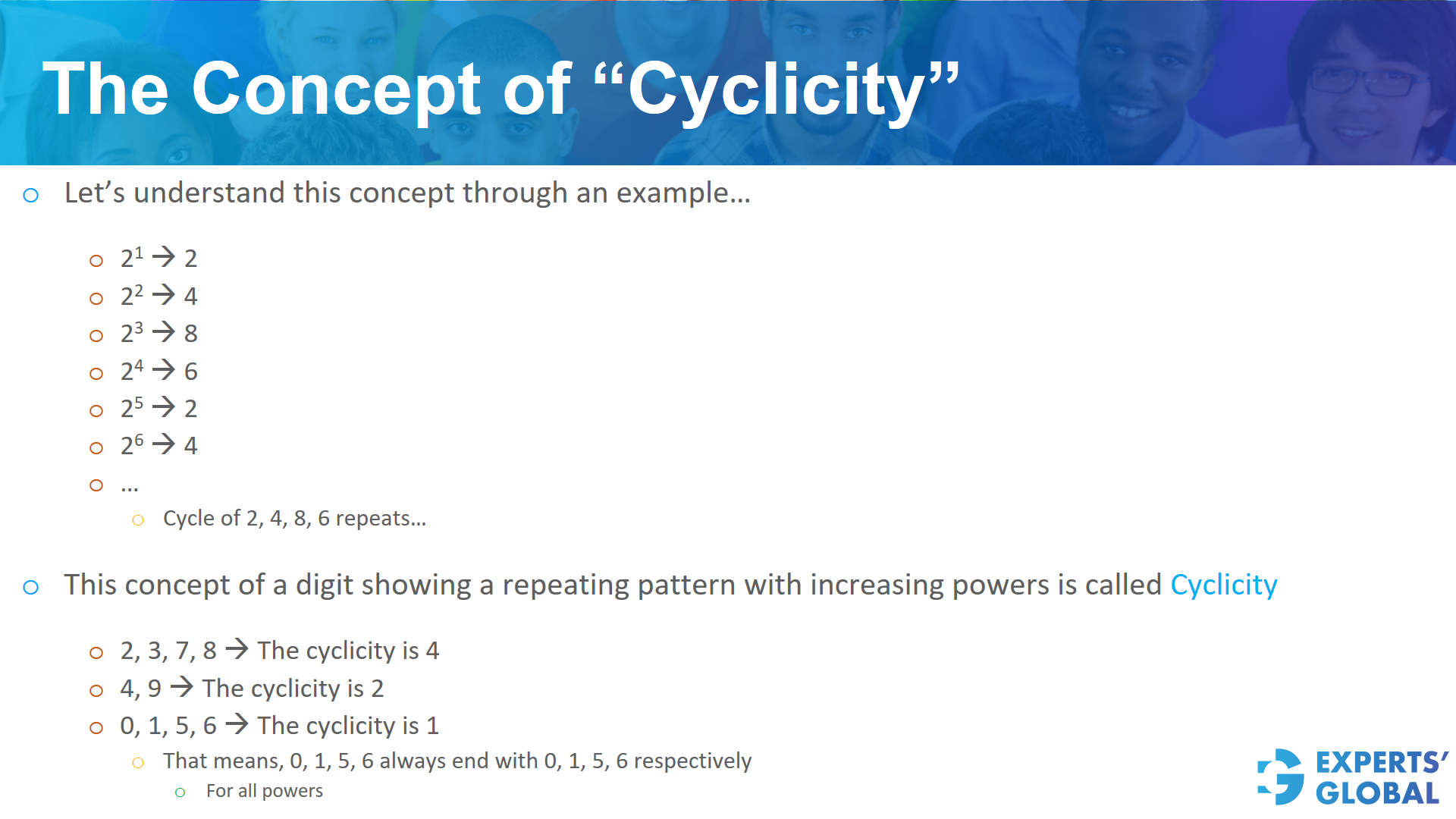
Cyclicity is a mathematical concept where the last digit of a number follows a repeating pattern when raised to increasing powers.
When 2 is raised to successive powers, the last digits form a specific sequence:
Different digits have different cycle lengths (the number of steps before the pattern repeats):
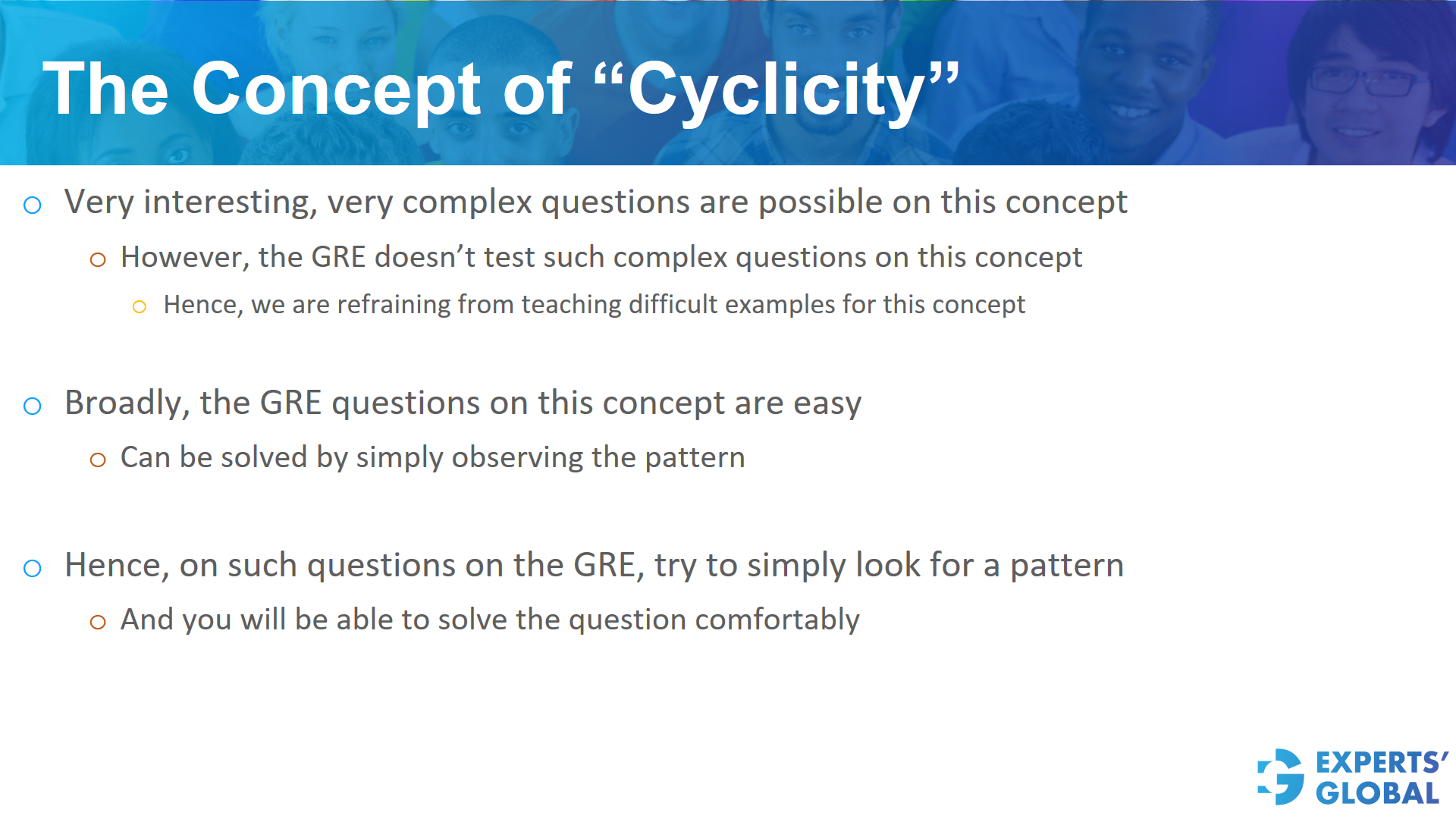
The concept of cyclicity involves mathematical patterns that repeat at regular intervals. While this topic can support highly complex problems, for the purpose of the GRE, the questions are generally straightforward and easy to manage.
The primary academic takeaway for this topic includes:
Most problems can be solved by simply observing and identifying a recurring pattern rather than using advanced formulas.
When encountering these questions, focus on looking for the specific cycle of numbers or values that repeat.
High-level complexity is typically avoided, meaning a comfortable understanding of basic patterns is sufficient for mastery.
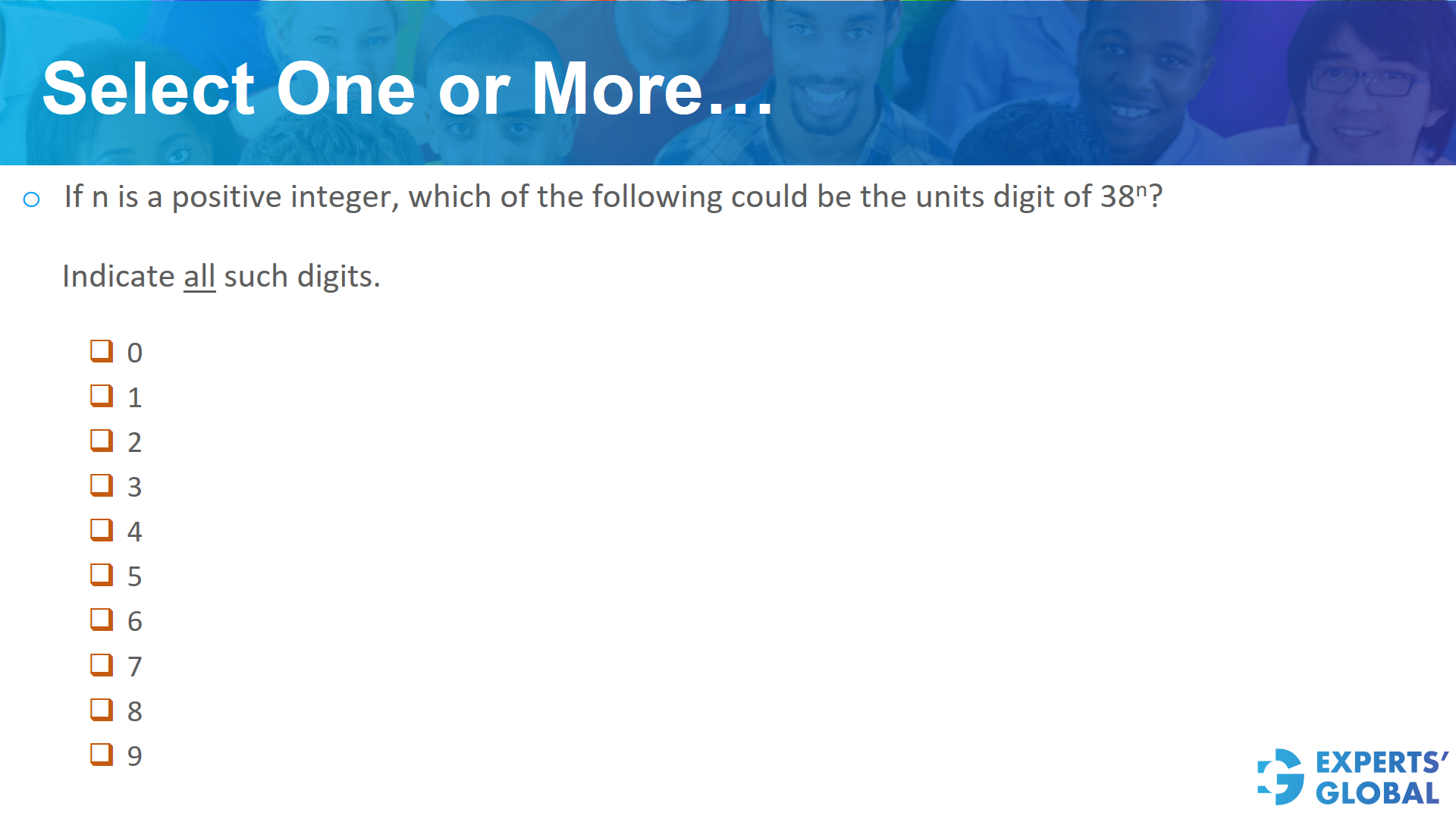
Answer: The possible units digits for (38)n are 2, 4, 6, and 8.
For a detailed explanation, please refer to the video presented earlier on this page.
Following is a concise, step-wise written explanation…
If n is a positive integer, which of the following could be the units digit of (38)n?
Indicate all such digits.
The units digit of any number raised to a power depends only on the units digit of the base. In this case, the base is 38. Therefore, we only need to look at the behavior of the digit 8.
We calculate the units digit for the first few powers of 8 to find a repeating cycle:
The units digits repeat every four powers in the sequence: 8, 4, 2, 6.
The possible units digits for (38)n are 2, 4, 6, and 8.
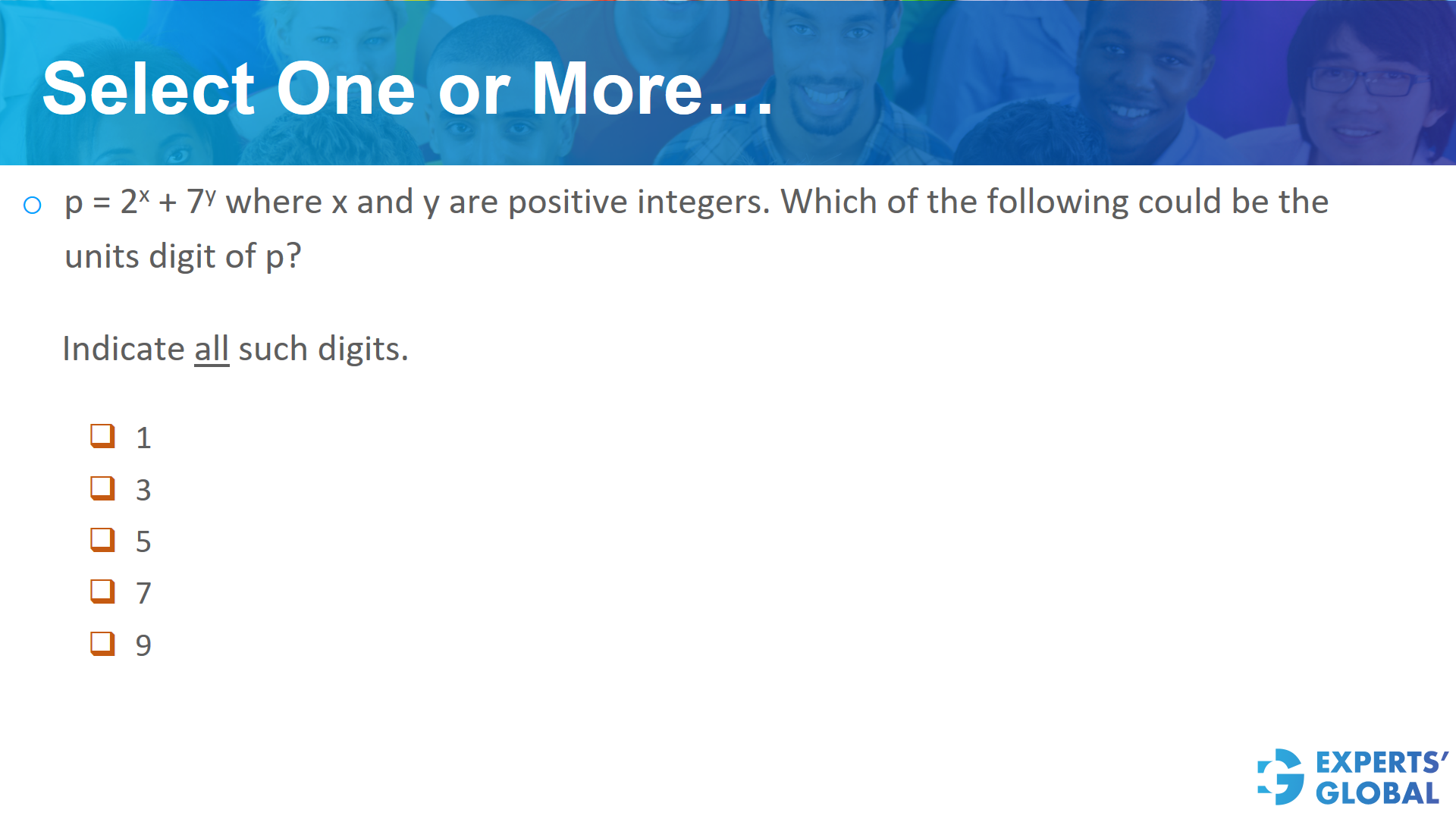
Correct Answers: 1, 3, 5, 7, 9
For a detailed explanation, please refer to the video presented earlier on this page.
Following is a concise, step-wise written explanation…
p = (2)x + (7)y, where x and y are positive integers. Which of the following could be the units digit of p?
Indicate all such digits.
To find the possible units digits of p = (2)x + (7)y, we must look at the patterns of the units digits for powers of 2 and 7.
The units digit of (2)x repeats every 4 powers:
The possible units digits are {2, 4, 8, 6}.
The units digit of (7)y also repeats every 4 powers:
The possible units digits are {7, 9, 3, 1}.
We add one number from the first set to one number from the second set. If the sum is 10 or more, we only take the last digit.
The resulting units digits are 1, 3, 5, 7, and 9.
Correct Answers: 1, 3, 5, 7, 9
Correct Answer: B
Quantity B is greater.
For a detailed explanation, please refer to the video presented earlier on this page.
Following is a concise, step-wise written explanation…
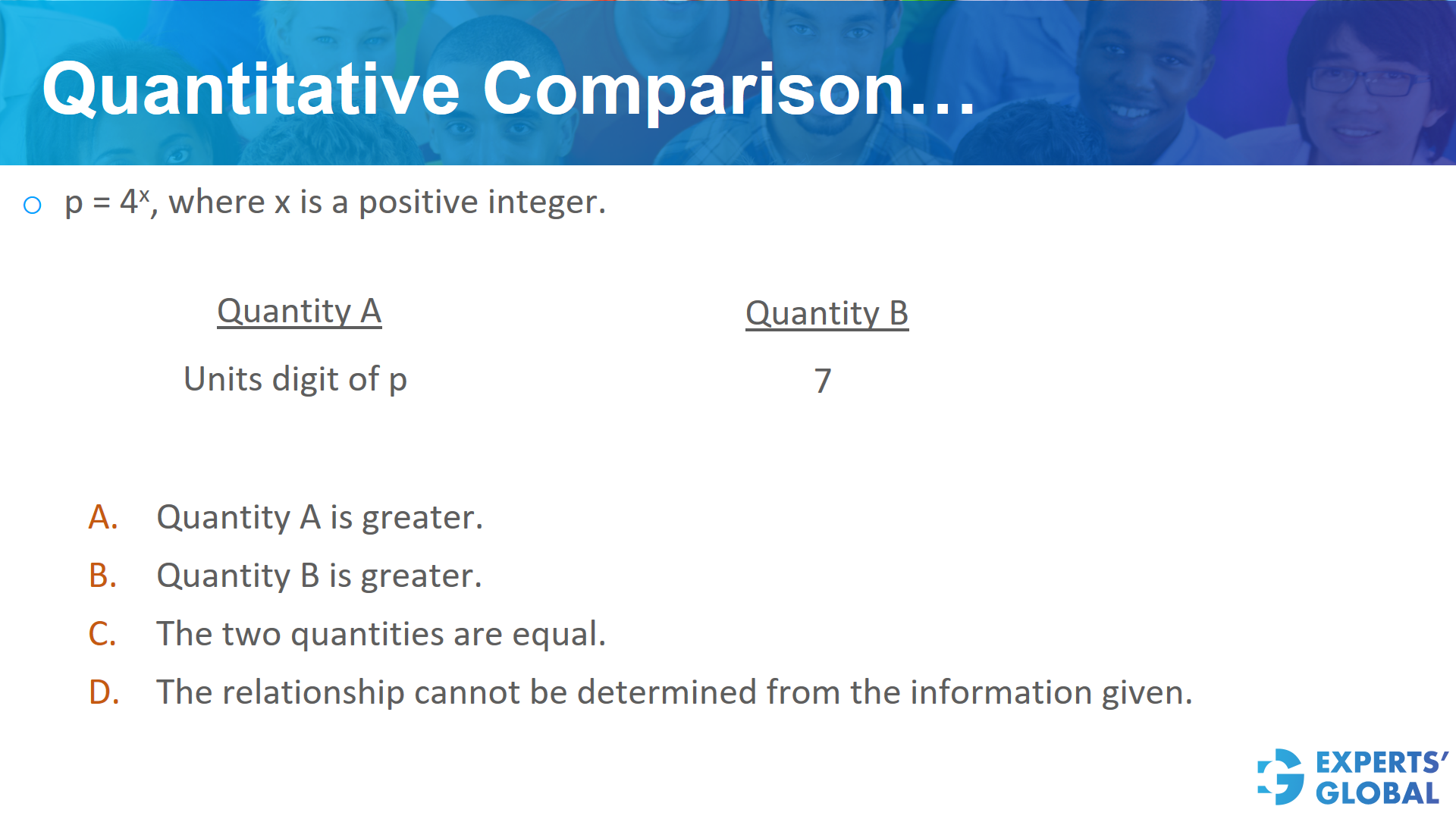
p = (4)x , where x is a positive integer.
Quantity A
Units digit of p
Quantity B
7
To solve this quantitative comparison, we look at the pattern of units digits for powers of 4.
Quantity A is the units digit of p, where p = (4)x and x is a positive integer. Let us list the first few powers of 4 to find the pattern:
The units digit of (4)x is always either 4 or 6.
Quantity B is the number 7.
Now we compare the possible values of Quantity A to Quantity B:
In both possible cases for Quantity A, the value is smaller than Quantity B.
Correct Answer: B
Quantity B is greater.
Correct Answer: B
Quantity B is greater.
For a detailed explanation, please refer to the video presented earlier on this page.
Following is a concise, step-wise written explanation…
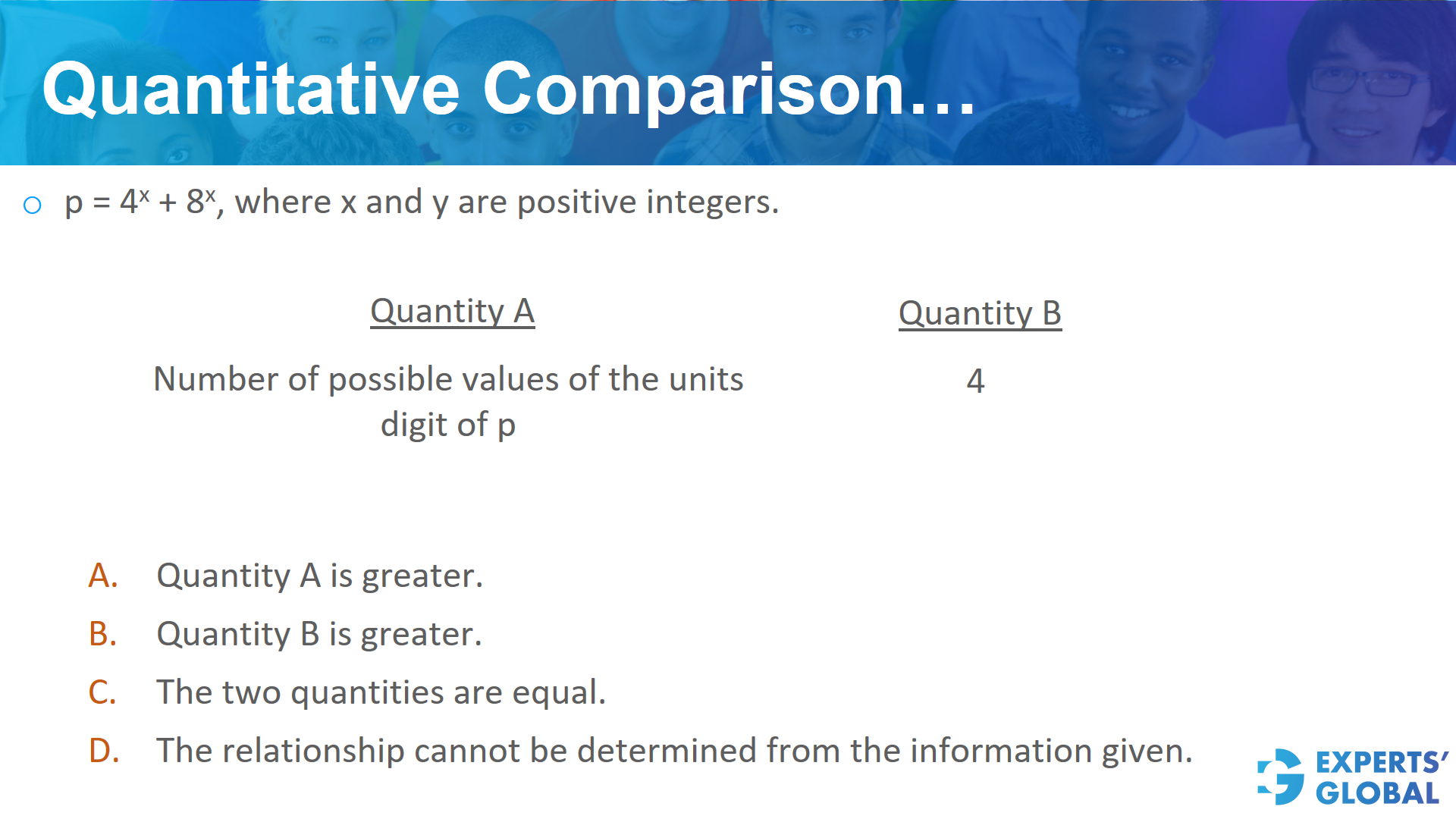
p = (4)x + (8)x, where x and y are positive integers.
Quantity A
Number of possible values of the units digit of p
Quantity B
4
To solve this quantitative comparison, we find the number of unique units digits possible for the sum.
The units digit of 4 raised to a positive integer x follows a pattern:
The possible units digits are {4, 6}.
The units digit of 8 raised to a positive integer x follows a pattern:
The possible units digits are {8, 4, 2, 6}.
Quantity A is the number of possible units digits for p = (4)x + (8)x. Since both terms use the same exponent x, we add the units digits from the same position in their respective patterns:
The unique units digits for p are {2, 0, 6}.
Quantity A = 3.
Since 3 is less than 4, Quantity B is greater.
Correct Answer: B
Quantity B is greater.
Comprehensive online GRE prep course
15 GRE practice tests full length
60 GRE practice tests sectional
Free GRE diagnostic test full length
