
Invest 30 seconds...
...for what may lead to a life altering association!
Help Line
- +91.8800.2828.00 (IND)
- 1030-1830 Hrs IST, Mon-Sat
- support@expertsglobal.com
33% off ends soon:GMAT/GRE prep + applications bundle. Profile building, longer mentoring, better results. Inquire

Remainder questions with exponents focus on finding the remainder of a power expression when divided by a given number. You work with the base and the exponent together, track how the value behaves under division, and use that structure to determine the required remainder with precision. Very interesting and layered questions get developed and tested around the concept of finding remainders with exponents,
The following conceptual video, part of our comprehensive online GRE course, covers how to find remainders with exponents for GRE Quant. It explains the core idea, outlines how this concept commonly appears on the GRE Quantitative section, and then applies it to multiple GRE-style problems so you gain first-hand experience using it. Take your time to absorb the concepts and apply them in your further GRE practice on GRE quizzes, GRE sectional mocks, and GRE full mocks.
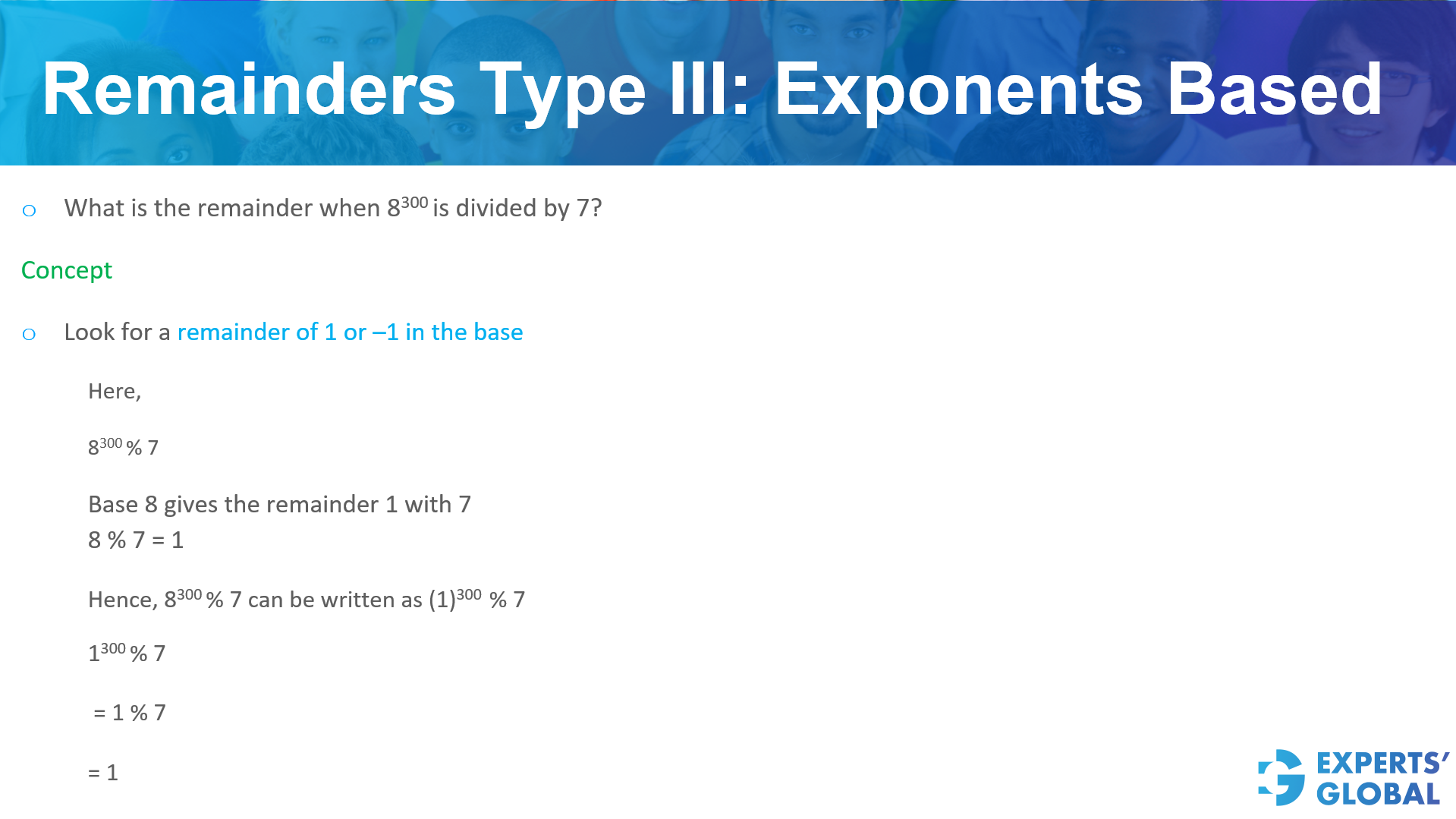
To calculate remainders for large exponents, the most effective strategy is to look for a remainder of 1 or -1 in the base.
What is the remainder when (8)300 is divided by 7?
The goal is to simplify the base relative to the divisor before dealing with the exponent.
The remainder is 1.
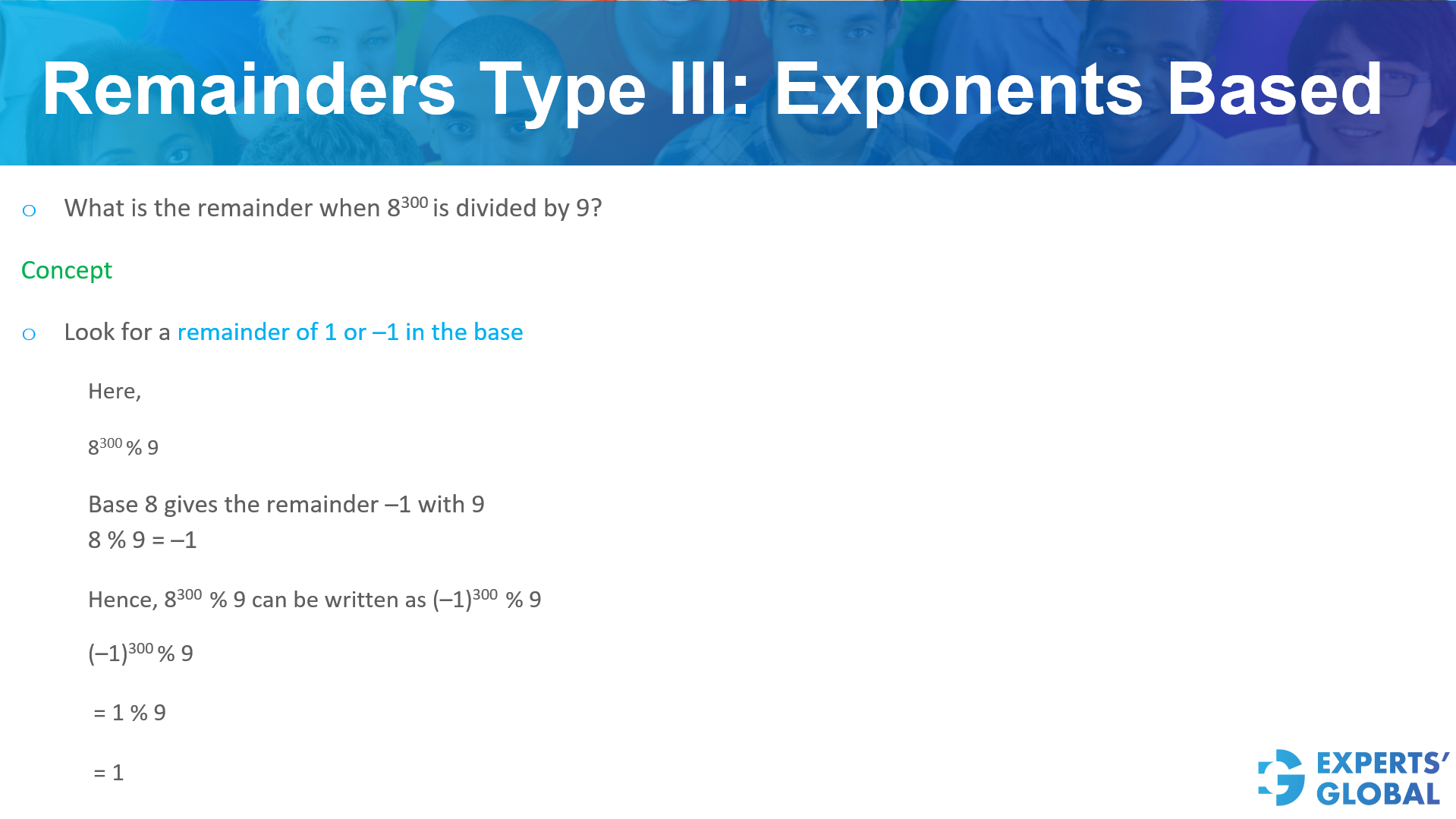
When calculating the remainder of a large exponential expression, the goal is to find a base that results in a remainder of 1 or -1 when divided by the divisor. This simplifies the calculation because any power of 1 is 1, and any power of -1 is either 1 (for even exponents) or -1 (for odd exponents).
Find the remainder when (8)300 is divided by 9.
Divide the base (8) by the divisor (9).
Replace the base with its remainder in the original expression.
Since 300 is an even number, (-1)300 equals 1.
The remainder is 1.
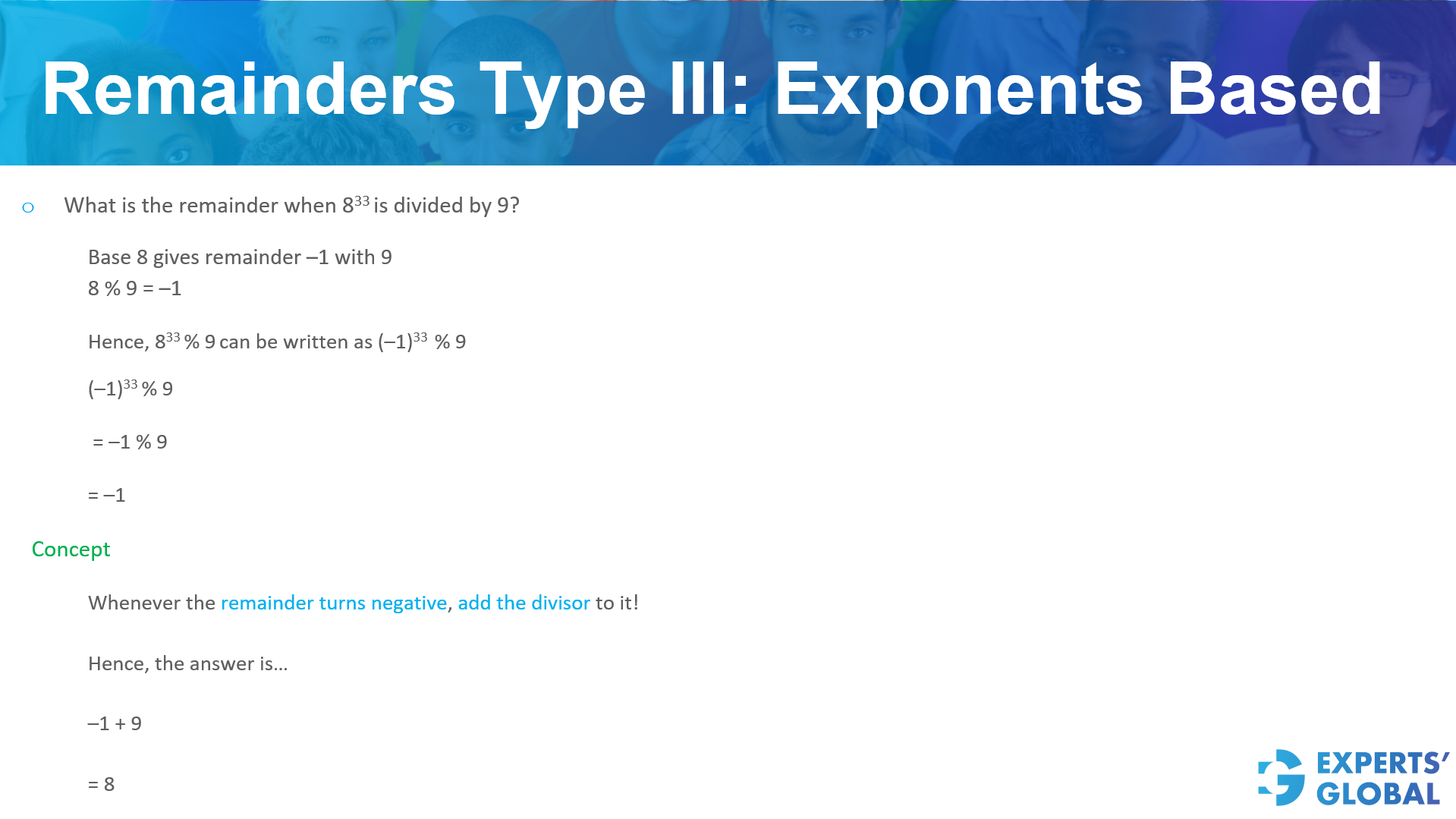
To find the remainder when a number with an exponent is divided by another, you can use the concept of negative remainders to simplify the calculation.
When dividing, if the base is one less than the divisor, it can be expressed as having a remainder of -1. If a calculation results in a negative remainder, you must add the divisor to that negative value to find the final, positive remainder.
Find the remainder when (8)33 is divided by 9.
Divide the base (8) by the divisor (9). Since 8 is 1 less than 9, the remainder is -1. Expression: 8 % 9 = -1
Replace the base with its remainder and raise it to the original power. Expression: (-1)33 % 9
Since 33 is an odd number, (-1) raised to the power of 33 remains -1. Expression: -1 % 9 = -1
Because a remainder cannot be negative in the final answer, add the divisor (9) to the negative result. Calculation: -1 + 9 = 8
The remainder is 8.
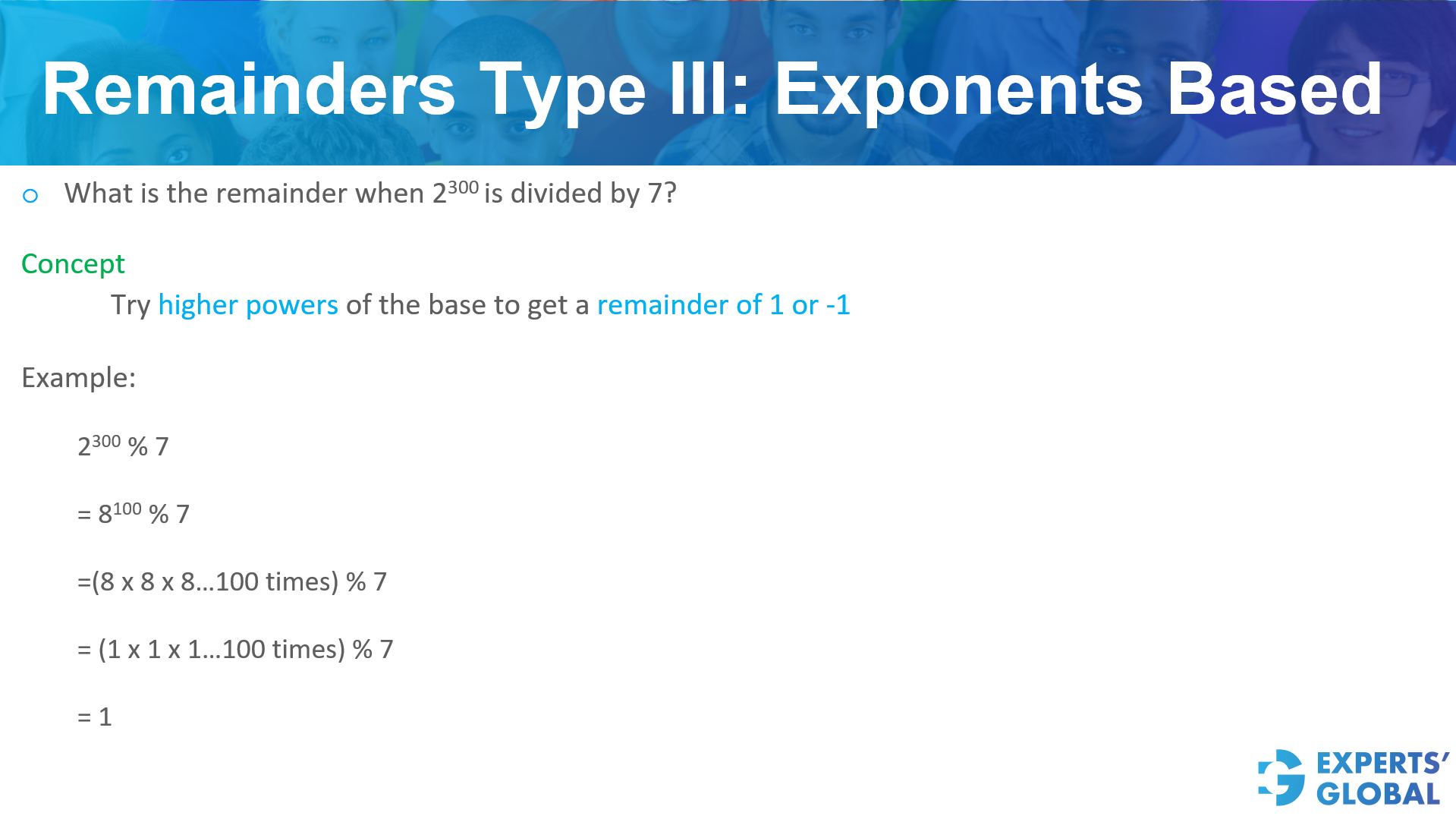
To find the remainder of a large exponential expression, the primary goal is to find a power of the base that results in a remainder of 1 or -1 when divided by the divisor. This simplifies the calculation significantly because any power of 1 is 1.
Find the remainder when (2)300 is divided by 7.
The base is 2. We know that (2)3 = 8.
When 8 is divided by 7, the remainder is 1.
We can rewrite (2)300 using the power of a power rule: (2)300 = (23)100 = (8)100
8^100 % 7 is equivalent to: (8 * 8 * 8 … 100 times) % 7
Since 8 % 7 = 1, we replace each 8 with 1: (1 * 1 * 1 … 100 times) % 7
The remainder is (1)100 = 1

To calculate the remainder of 2 raised to the power of 303 when divided by 9, the following mathematical steps are used:
The term (2)303 is converted into (23)101, which equals (8)101.
This is expressed as 8 multiplied by itself 101 times, all divided by 9.
Since 8 is equivalent to -1 when considering division by 9 (because 8 – 9 = -1), the expression becomes -1 multiplied by itself 101 times.
Because the exponent 101 is an odd number, -1 raised to that power remains -1.
Since a remainder is typically expressed as a positive value, the result -1 is added to the divisor 9 to get the final answer of 8.
The remainder is 8.

Correct Answers:
For a detailed explanation, please refer to the video presented earlier on this page.
Following is a concise, stepwise written explanation…
To solve these problems, we use the property of remainders where we find a power of the base that is close to a multiple of the divisor (usually 1 more or 1 less).
Correct Answer: 1
Correct Answer: 16
Correct Answer: 1
Correct Answer: 1
End to end online GRE preparation course with free trial
Free GRE full length diagnostic mock
