Even and odd numbers play an important role within number properties on the GRE Quant section, and building clarity on how these values behave forms a strong base for solving many Quant questions. Simple definitions lead to layered outcomes, and solid familiarity with even and odd properties helps you recognize patterns, track relationships, and understand how parity behaves across a wide range of GRE Quant problems.
The following video, part of our GRE preparation course, explains even and odd numbers in a clear, structured, and intuitive manner. It walks through core properties, shows how these numbers behave under common operations, and highlights patterns related to parity that frequently influence answer choices on GRE Quant questions. Then, the video applies the concepts on GRE-style problems so you experience the application first-hand. Take your time to absorb this topic and apply the learnings steadily across your GRE prep, practice exercises, GRE sectional mocks, and GRE full mocks.
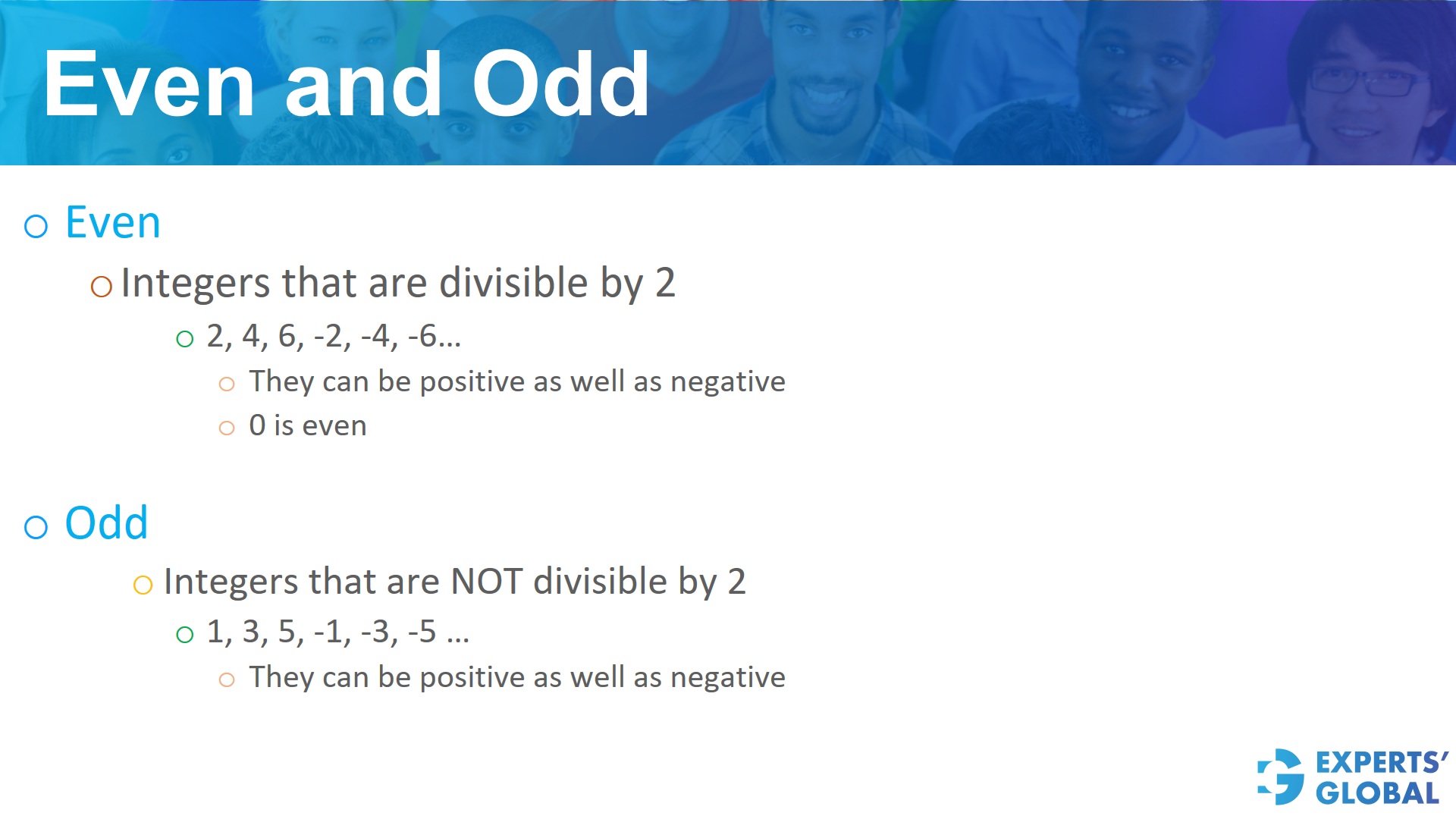
Even integers are integers that are divisible by 2. This group includes both positive and negative values, such as 2, 4, 6, -2, -4, and -6. Additionally, 0 is classified as an even integer.
Odd Integers
Odd integers are integers that are not divisible by 2. Like even integers, these can be positive or negative, including values such as 1, 3, 5, -1, -3, and -5.
Basic Properties of Even and Odd Numbers
Here are some of the basic properties of even and odd numbers:
Addition Rules
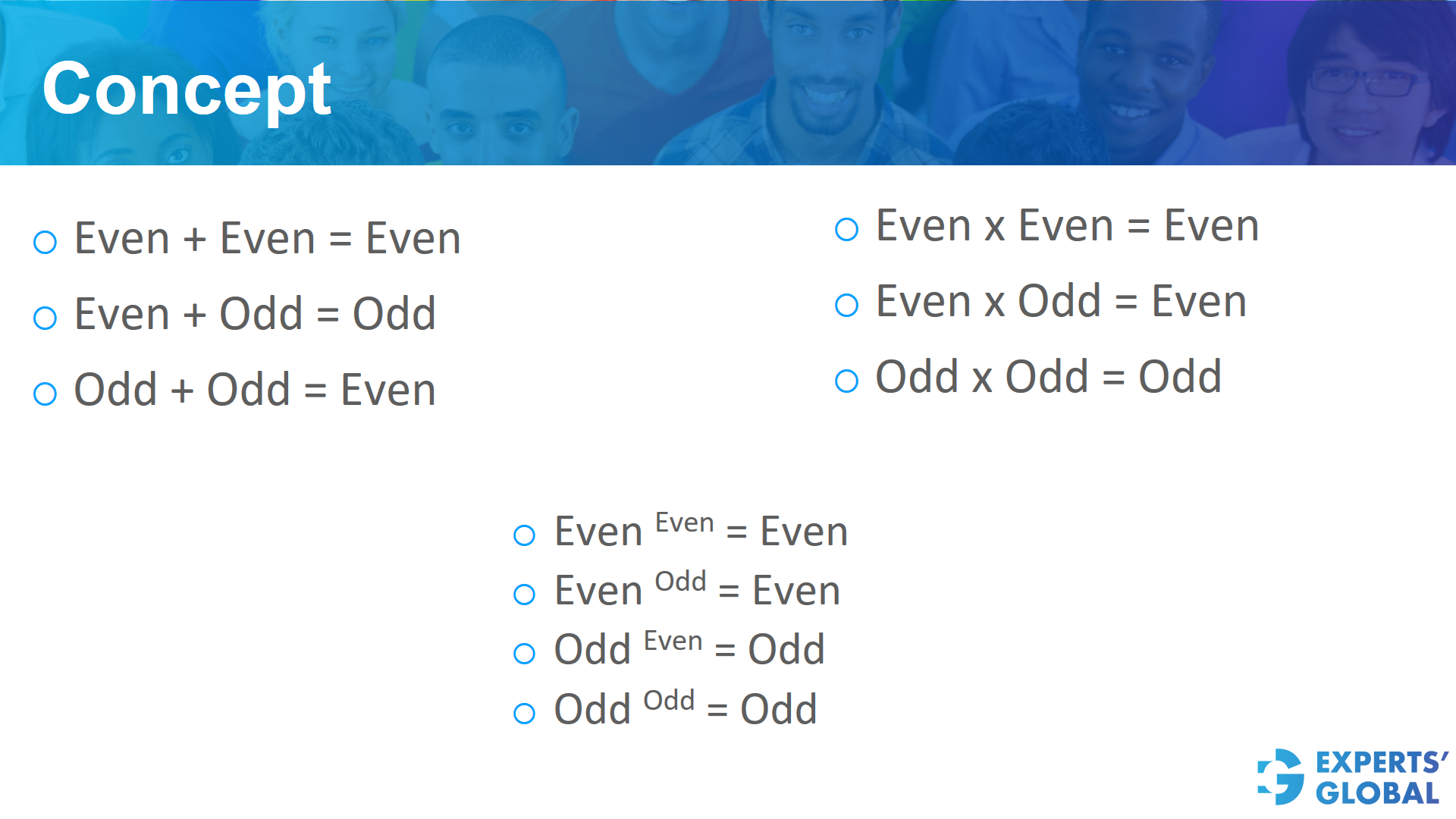
Even + Even = Even
Even + Odd = Odd
Odd + Odd = Even
Multiplication Rules
Even x Even = Even
Even x Odd = Even
Odd x Odd = Odd
Exponentiation Rules
Even Even = Even
Even Odd = Even
Odd Even = Odd
Odd Odd = Odd
Though these concepts are extremely basic, a wide range of interesting and challenging questions can be built on them, and they appear frequently on the GRE.
Worked Examples: Select One or More…
For a detailed explanation of these questions, please refer to the video presented earlier on this page.
Following is a concise, step-wise written explanation…
Parity Rules Reference
Even + Even = Even
Even + Odd = Odd
Odd + Odd = Even
Even x Any Integer = Even
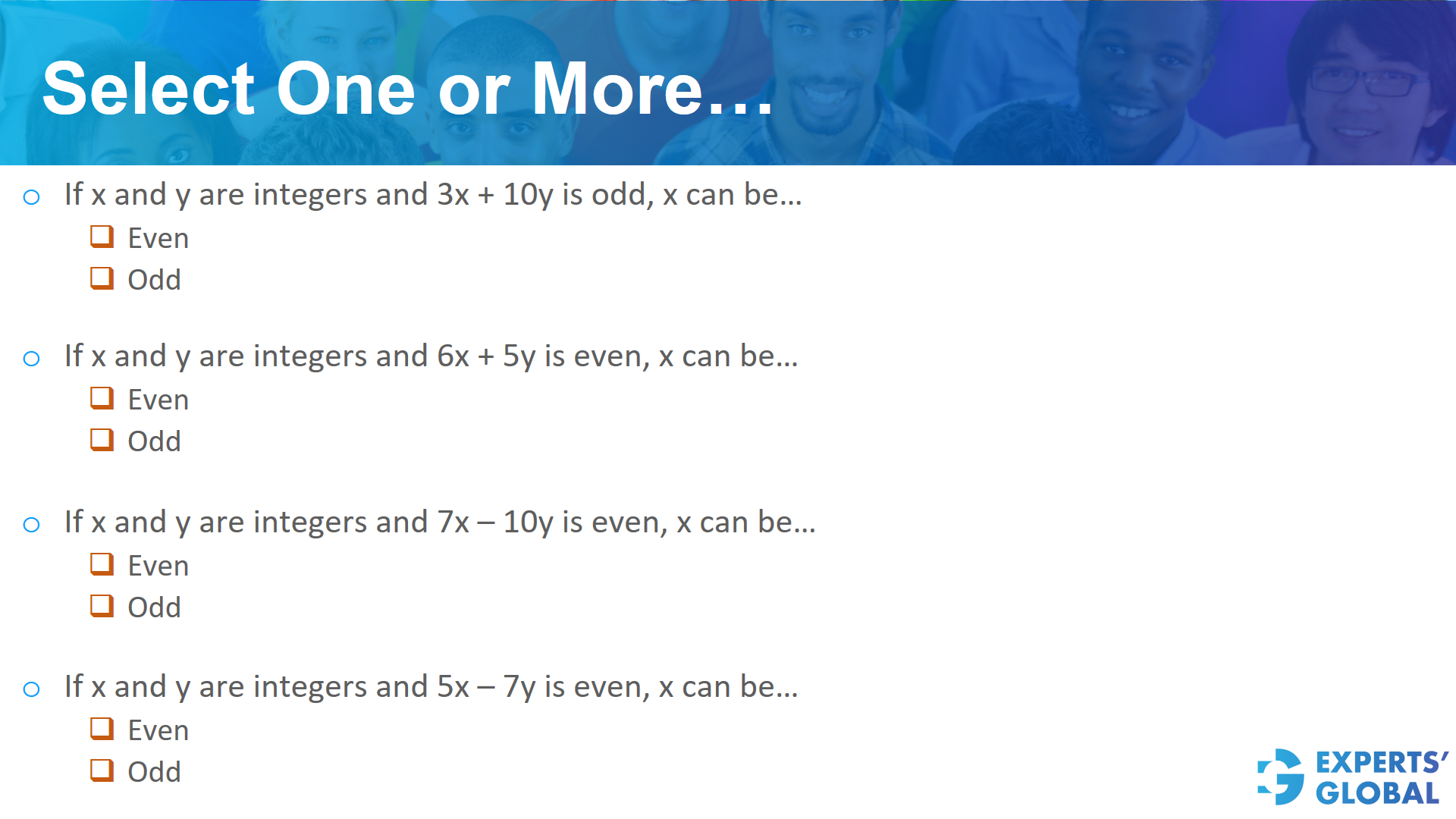
Question 1: If 3x + 10y is odd, x can be…
Analysis of 10y: Since 10 is even, 10y is always Even.
Analysis of the Sum: We have (3x) + (Even) = Odd.
Finding 3x: For a sum to be odd, an even number must be added to an Odd number. Thus, 3x is odd.
Finding x: Since 3 is odd, x must be Odd to result in an odd product.
Answer: x can be Odd.
Question 2: If 6x + 5y is even, x can be…
Analysis of 6x: Since 6 is even, 6x is always Even, regardless of whether x is even or odd.
Analysis of the Sum: We have (Even) + (5y) = Even.
Finding 5y: For the sum to be even, 5y must also be Even.
Finding x: Because 6x is even no matter what x is, there are no restrictions on x.
Answer: x can be Even or Odd.
Question 3: If 7x – 10y is even, x can be…
Analysis of 10y: Since 10 is even, 10y is always Even.
Analysis of the Difference: We have (7x) – (Even) = Even.
Finding 7x: To get an even result, you must subtract an even number from an Even number. Thus, 7x is even.
Finding x: Since 7 is odd, x must be Even to make the product even.
Answer: x can be Even.
Question 4: If 5x – 7y is even, x can be…
Analysis of the Difference: For (5x) – (7y) to be even, both terms must have the same parity (both even or both odd).
Case 1: If y is even, then 7y is even, so 5x must be even. This makes x Even.
Case 2: If y is odd, then 7y is odd, so 5x must be odd. This makes x Odd.
Answer: x can be Even or Odd.
A Difficult Set on the Concept of Even-Odd…
Answer: None of these
For a detailed explanation, please refer to the video presented earlier on this page.
Following is a concise, step-wise written explanation…
Question
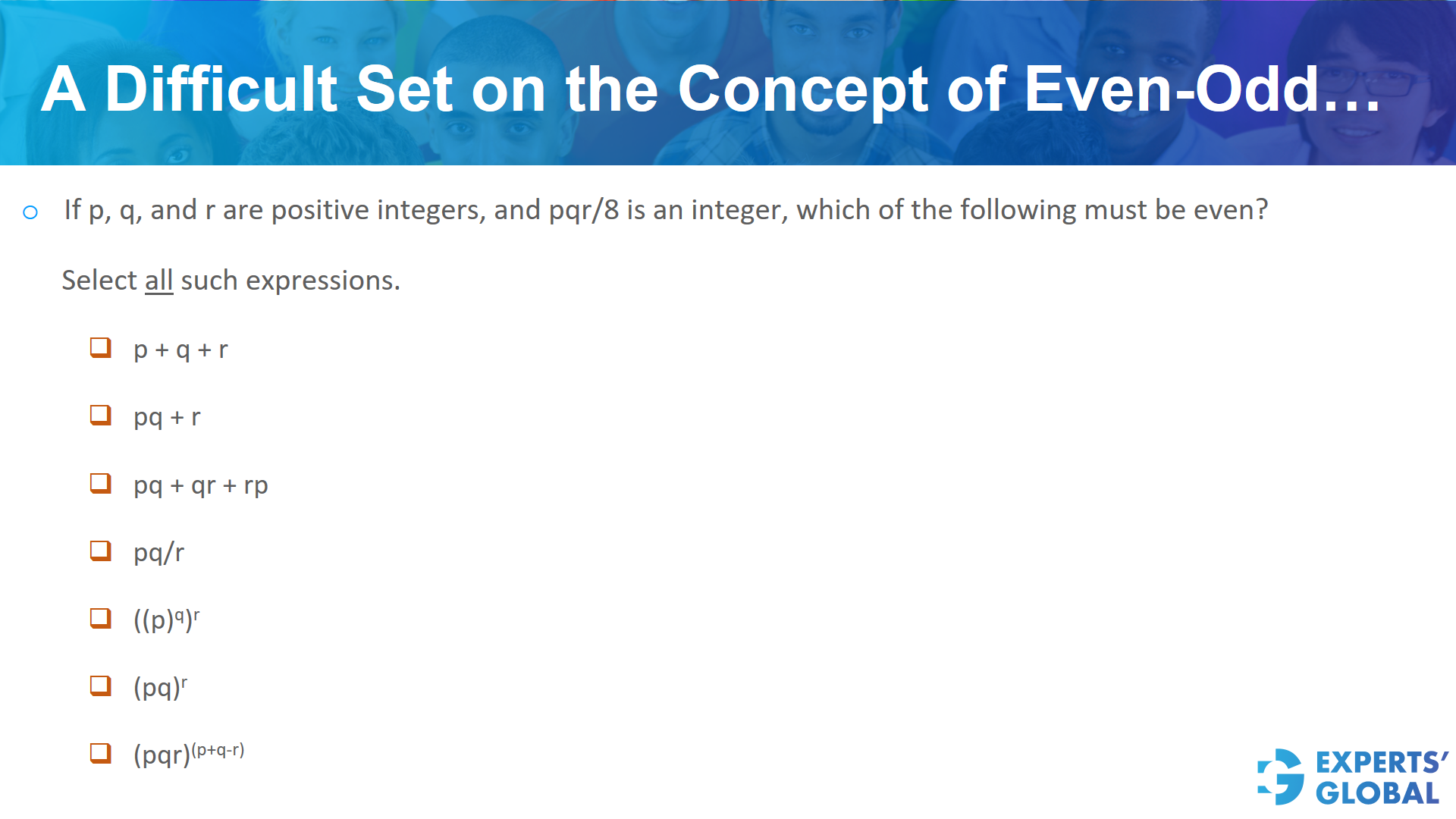
If p, q, and r are positive integers, and pqr/8 is an integer, which of the following must be even?
Select all such expressions.
p + q + r
pq + r
pq + qr + rp
pq / r
((p)q)r
(pq)r
(pqr)( p + q − r )
Explanation
p + q + r : This does not have to be even. For example, if p = 8, q = 1, and r = 2, the sum is 11, which is odd.
pq + r : This does not have to be even. If p = 8, q = 1, and r = 1, the result is (8 * 1) + 1 = 9, which is odd.
pq + qr + rp : This does not have to be even. If p = 8, q = 1, and r = 1, the result is 8 + 1 + 8 = 17, which is odd.
pq / r : This does not have to be even. If p = 2, q = 2, and r = 4, then pqr/8 = 16/8 = 2 (an integer), but pq/r is 4/4 = 1, which is odd.
((p)q)r : This is p raised to the power of qr. It is only even if the base “p” is even. If p = 1, q = 8, and r = 1, the result is 1 raised to the power of 8 , which is 1 (odd).
(pq)r : This is only even if the base “pq” is even. If p = 1, q = 1, and r = 8, the result is 1 raised to the power of 8, which is 1 (odd).
(pqr)( p + q − r ) : For cases where r is much bigger than p, q, this expression seizes to be an integer; example, for p = 2, q = 4, r = 8, pqr/8 is even but (pqr)(p + q − r) is a fraction.