
Invest 30 seconds...
...for what may lead to a life altering association!
Help Line
- +91.8800.2828.00 (IND)
- 1030-1830 Hrs IST, Mon-Sat
- support@expertsglobal.com
33% off ends soon:GMAT/GRE prep + applications bundle. Profile building, longer mentoring, better results. Inquire

Remainder questions where the divisor changes focus on tracking how a division situation shifts when you divide by a new number. You start with what you already know about the original division, then connect it to the updated divisor to determine the new remainder. This concept is tested on a variety of GRE questions built around remainders and divisibility.
The following conceptual video, part of our online GRE course, covers how to find the remainder when the divisor changes. It explains the core setup, shows how to carry information forward from the original division, outlines how this concept is commonly tested on the GRE Quantitative section, and then applies it to multiple GRE-style problems so you gain first-hand experience using it. Take your time to absorb the concepts and apply them in your further GRE preparation, GRE drills, GRE sectional mock tests, and GRE mock tests.
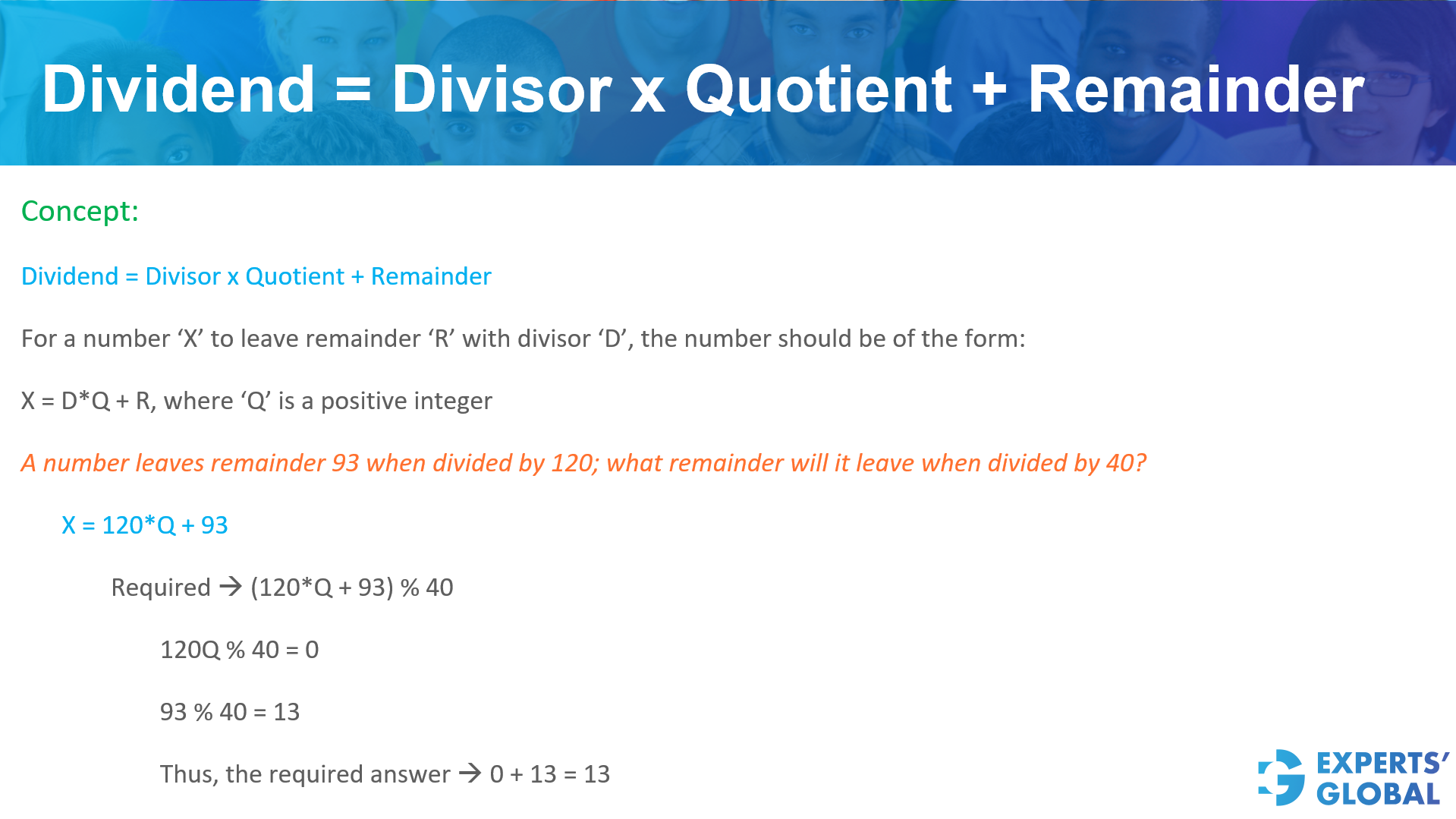
The fundamental relationship between numbers in division is expressed as: Dividend = Divisor * Quotient + Remainder
For any number X to leave a remainder R when divided by a divisor D, the number can be represented by the formula: X = D * Q + R (where Q is a positive integer)
To find the remainder when a number X is divided by 40, given that X leaves a remainder of 93 when divided by 120:
The remainder is 13.
For a detailed explanation, please refer to the video presented earlier on this page.
Following is a concise, step-wise written explanation…
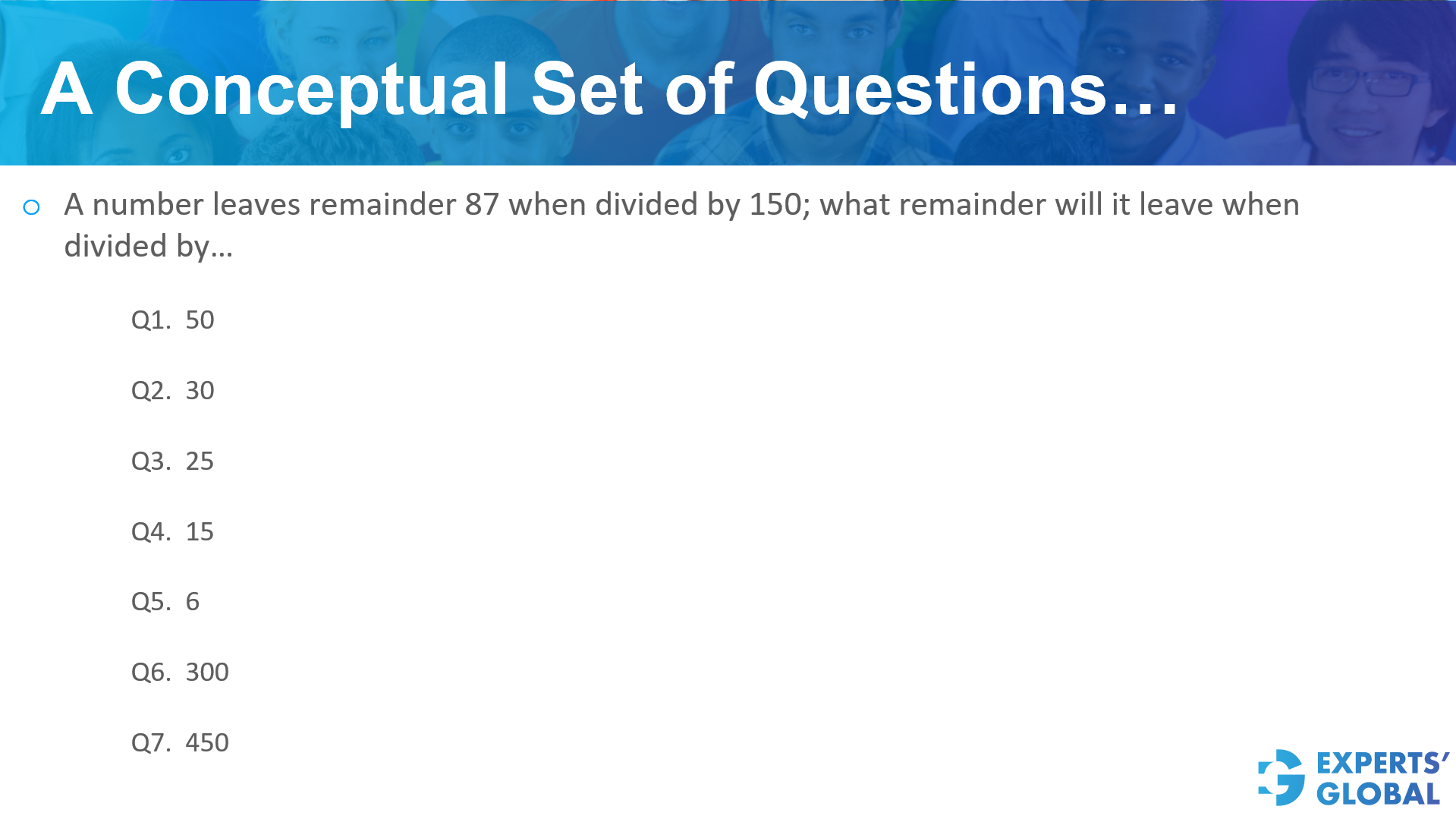
A number leaves remainder 87 when divided by 150; what remainder will it leave when divided by…
Q1. 50
Q2. 30
Q3. 25
Q4. 15
Q5. 6
Q6. 300
Q7. 450
If a number is divided by 150, it can be written as: Number = (150 * k) + 87
When you divide this number by a new divisor, you check if the new divisor is a factor of 150. If it is, the (150 * k) part will leave a remainder of 0. You only need to divide the original remainder (87) by the new divisor to find the final answer.
If the new divisor is a multiple of 150 (like 300 or 450), the remainder cannot be determined because we do not know the value of k.
We divide 150k + 87 with each of the given divisors.
50 is a factor of 150.
Divide 87 by 50.
87 = (50 * 1) + 37.
Correct Answer: 37
30 is a factor of 150.
Divide 87 by 30.
87 = (30 * 2) + 27.
Correct Answer: 27
25 is a factor of 150.
Divide 87 by 25.
87 = (25 * 3) + 12.
Correct Answer: 12
15 is a factor of 150.
Divide 87 by 15.
87 = (15 * 5) + 12.
Correct Answer: 12
6 is a factor of 150.
Divide 87 by 6.
87 = (6 * 14) + 3.
Correct Answer: 3
300 is not a factor of 150.
It is a multiple.
Two answers are possible, for odd and even values of k: 87 and 237 respectively.
Correct Answer: 87 or 237
450 is not a factor of 150. It is a multiple.
The result depends on the value of k.
Three different remainders are possible: 87, 237, 387
Correct Answer: 87, 237, or 387
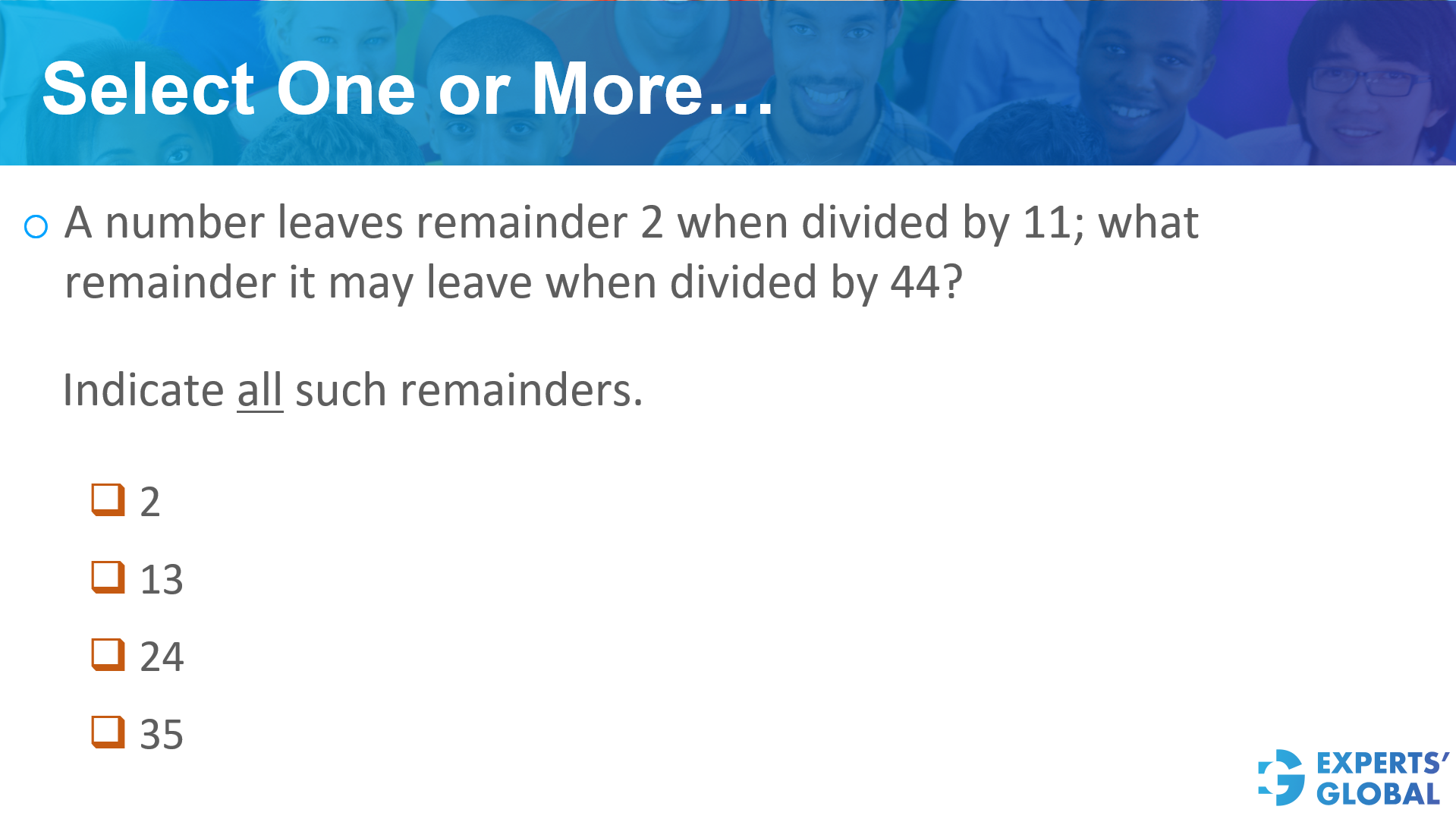
Correct Answers: 2, 13, 24, 35
For a detailed explanation, please refer to the video presented earlier on this page.
Following is a concise, step-wise written explanation…
A number leaves remainder 2 when divided by 11; what remainder it may leave when divided by 44?
Indicate all such remainders.
A number that leaves a remainder of 2 when divided by 11 can be written as: Number = 11 * k + 2 (where k is any integer 0, 1, 2, 3, …)
To find the remainders when divided by 44, we test different values for k:
If k = 0: Number = 11 * 0 + 2 = 2. 2 divided by 44 leaves a remainder of 2.
If k = 1: Number = 11 * 1 + 2 = 13. 13 divided by 44 leaves a remainder of 13.
If k = 2: Number = 11 * 2 + 2 = 24. 24 divided by 44 leaves a remainder of 24.
If k = 3: Number = 11 * 3 + 2 = 35. 35 divided by 44 leaves a remainder of 35.
If we continue with k = 4, the number becomes 46, and 46 divided by 44 returns to a remainder of 2. Therefore, all four listed values are possible remainders.
Correct Answers: A, B, C, D
Correct Answer: 1
For a detailed explanation, please refer to the video presented earlier on this page.
Following is a concise, stepwise written explanation…
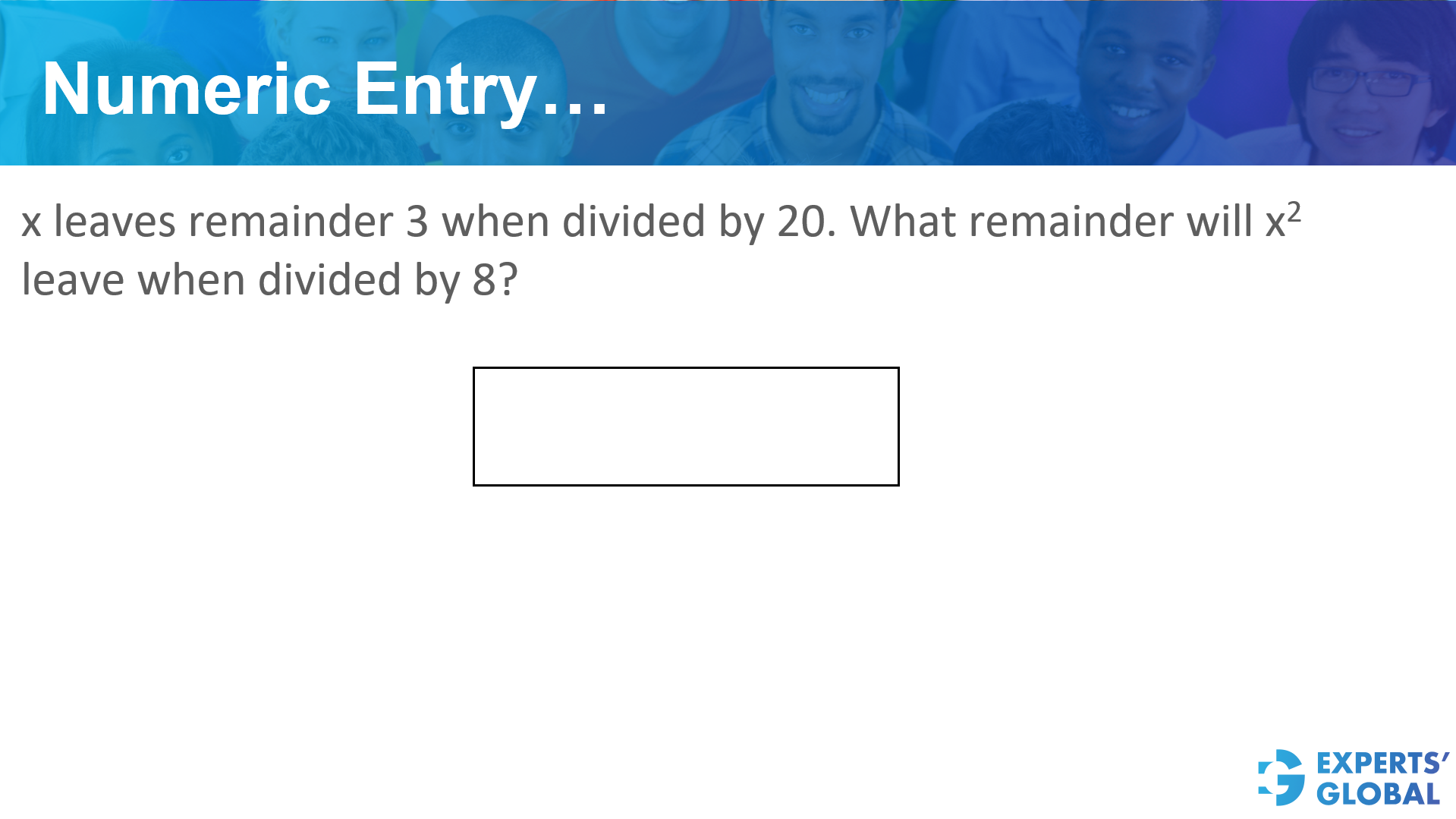
x leaves remainder 3 when divided by 20. What remainder will x² leave when divided by 8?
We are told that x divided by 20 leaves a remainder of 3.
The simplest way to find a value for x is to add the remainder to the divisor: x = 20 + 3 = 23
Now, we calculate x² using our chosen value: x² = 23 * 23 = 529
Divide 529 by 8 to see what remains:
529 / 8 leaves a remainder of 1
Correct Answer: 1
Correct Answer: C
The two quantities are equal.
For a detailed explanation, please refer to the video presented earlier on this page.
Following is a concise, step-wise written explanation…
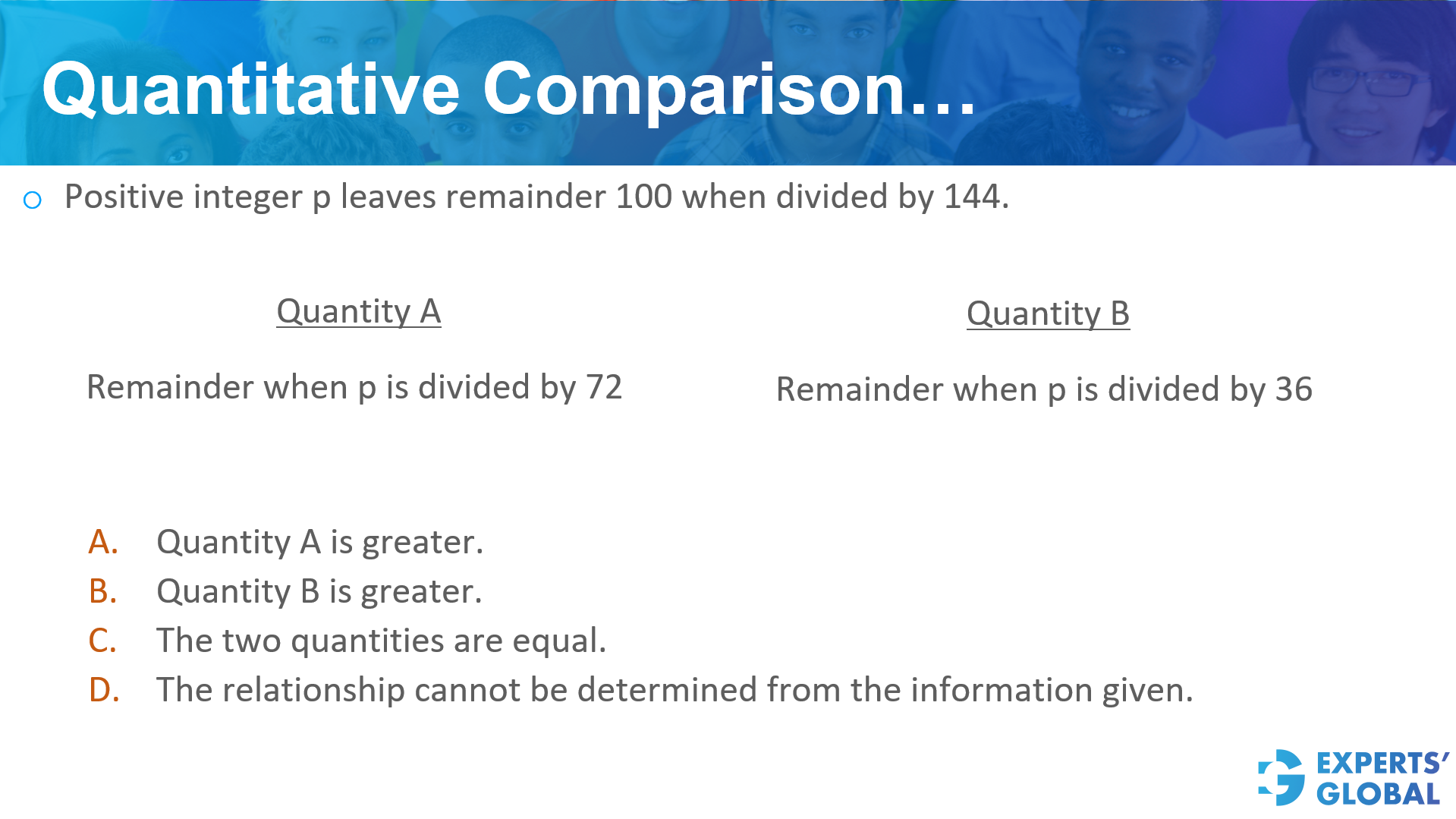
Positive integer p leaves remainder 100 when divided by 144.
Quantity A
Remainder when p is divided by 72
Quantity B
Remainder when p is divided by 36
We can write p using the formula: dividend = (divisor * quotient) + remainder.
Let the quotient be n. p = 144 * n + 100
Divide p by 72: (144 * n + 100) / 72
Since 144 is divisible by 72, we only need to find the remainder of 100 / 72.
The remainder is 28.
Divide p by 36: (144 * n + 100) / 36
Since 144 is divisible by 36, we only need to find the remainder of 100 / 36.
The remainder is 28.
Quantity A = 28
Quantity B = 28
Correct Answer: C
The two quantities are equal.
Complete GRE prep course online with free trial
