
Invest 30 seconds...
...for what may lead to a life altering association!
Help Line
- +91.8800.2828.00 (IND)
- 1030-1830 Hrs IST, Mon-Sat
- support@expertsglobal.com
33% off ends soon:GMAT/GRE prep + applications bundle. Profile building, longer mentoring, better results. Inquire

Mixtures focus on combining different components to form a whole with a specific composition. You work with parts, percentages, ratios, or quantities to understand how individual elements contribute to the final mixture. This idea helps you track contribution, concentration, and balance in a clear way. From this foundation, the GRE builds a range of layered and engaging questions and word problems that test how well you manage combined quantities across different mixture situations.
The following video, part of our GRE preparation online course, explains mixtures in a simple and structured manner. It shows how to set up mixture relationships correctly, track individual components, and connect them to the final outcome. The video then applies the method on GRE-style problems so you experience the application first-hand. Use this learning steadily across your GRE prep, practice drills, GRE sectional mocks, and GRE mocks.
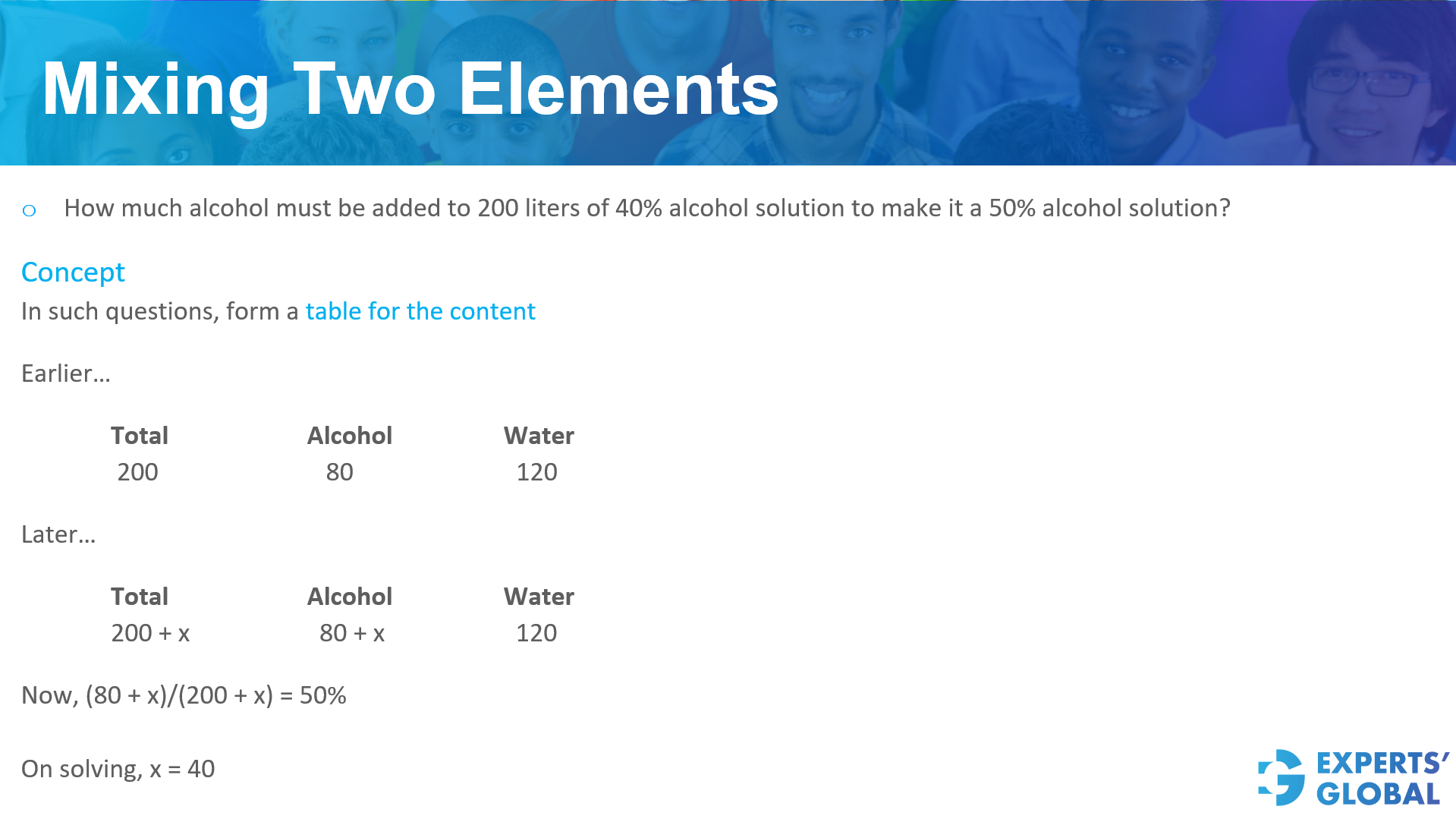
To determine how much pure alcohol must be added to a mixture to reach a specific concentration, you can use a structured table to track the quantities of each component.
The goal is to find how much alcohol should be added to 200 liters of a 40% alcohol solution to increase the concentration to 50%.
In the starting mixture, the total volume and the individual parts are calculated as follows:
When an unknown amount of pure alcohol (represented as x) is added, the values change:
To find the value of x, set up an equation where the new alcohol volume divided by the new total volume equals the target percentage:
(80 + x) / (200 + x) = 50%
By converting 50% to its decimal form (0.5) or fraction (1/2) and solving the equation: 80 + x = 0.5 * (200 + x) 80 + x = 100 + 0.5x 0.5x = 20 x = 40
The amount of alcohol to be added is 40 liters.
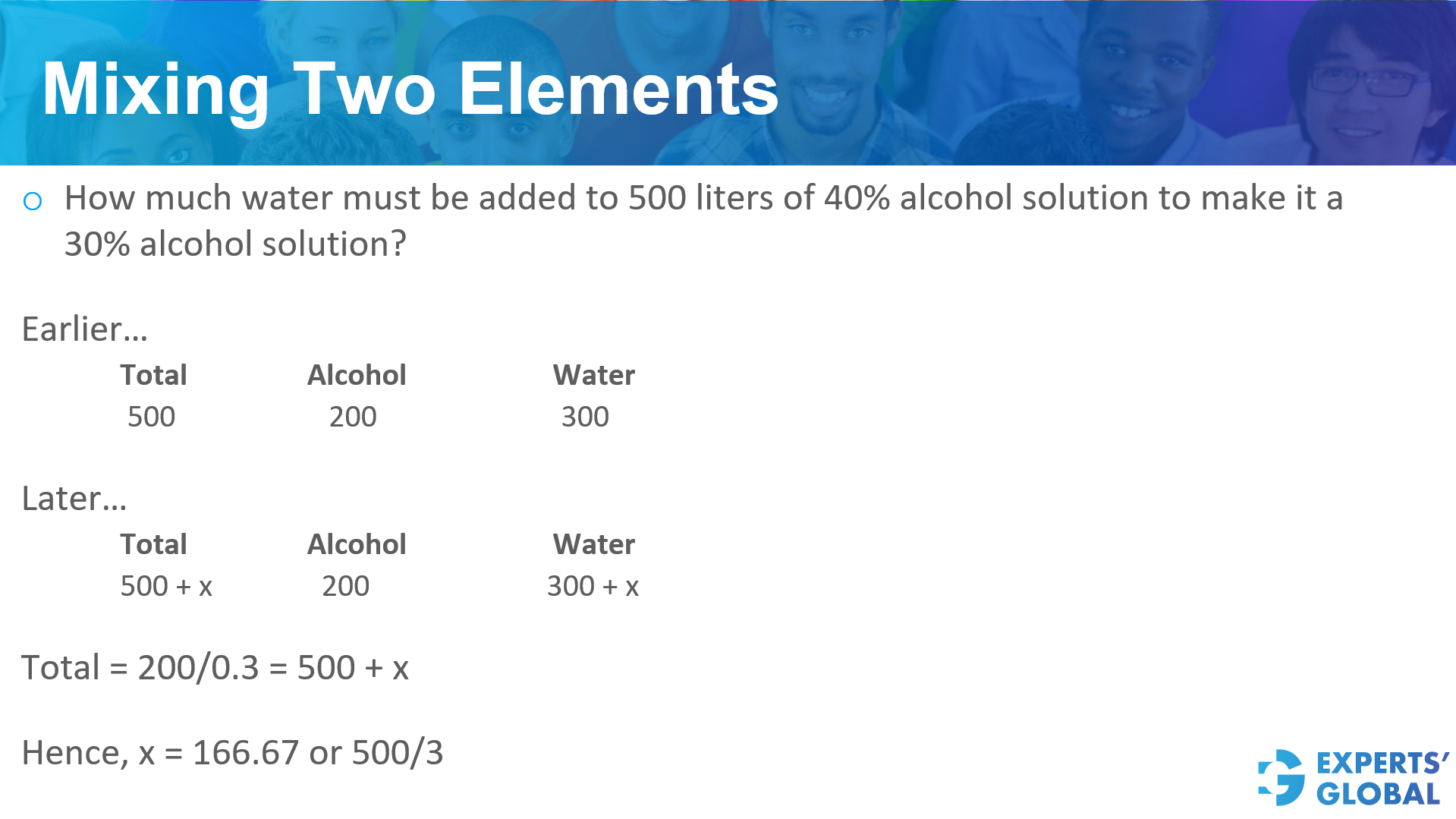
To solve the problem of diluting a solution, we determine the amount of water needed to change the concentration of an alcohol mixture.
Determine how many liters of water must be added to 500 liters of a 40% alcohol solution to decrease the alcohol concentration to 30%.
When water (x) is added, the volume of alcohol remains the same, but the total volume increases.
Since the 200 liters of alcohol must represent 30% (or 0.3) of the new total volume, we set up the following equation:
Total Volume = 200 / 0.3 = 500 + x
Solving for x:
166.67 liters of water must be added.
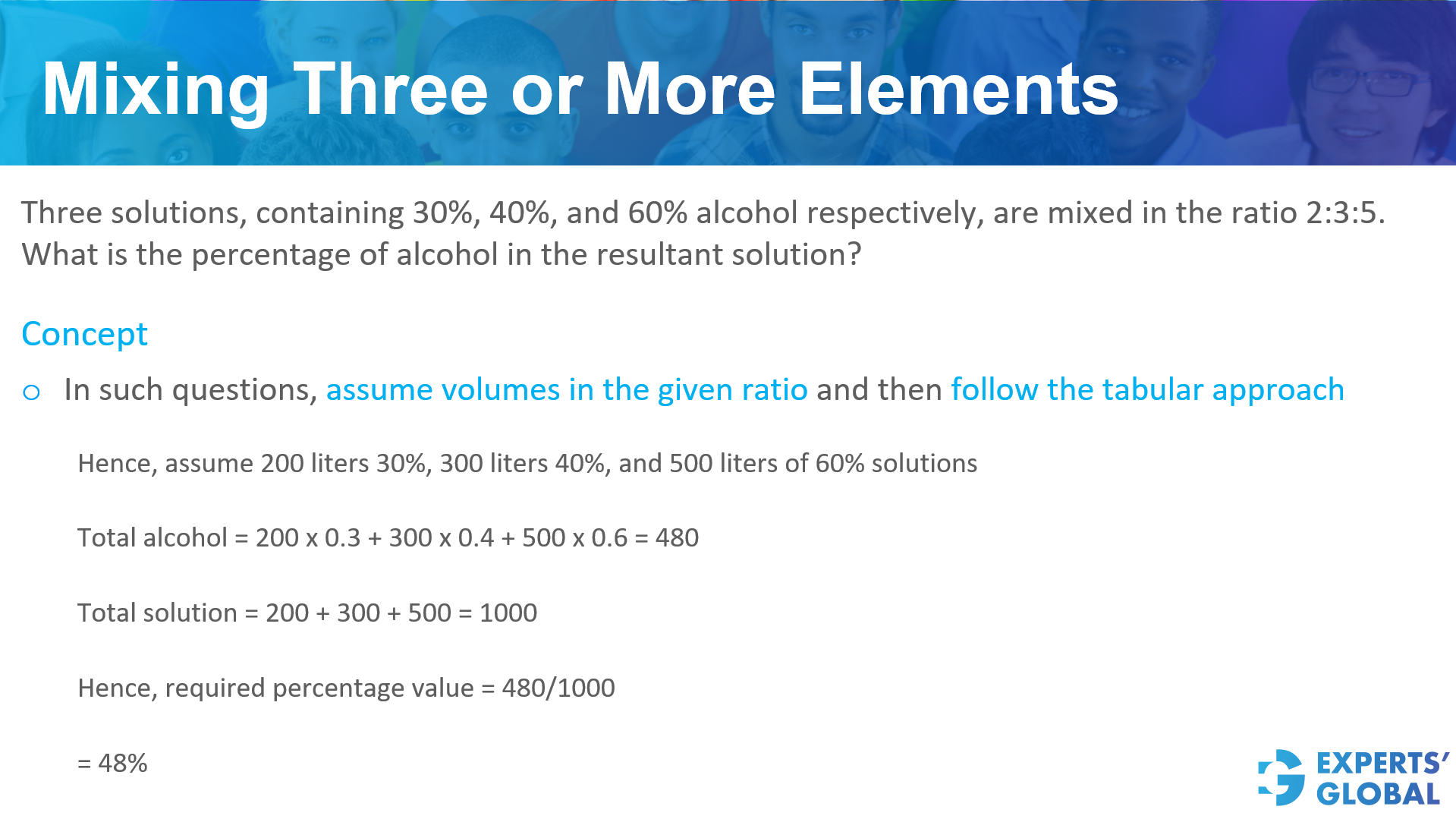
When mixing three or more solutions to find the final concentration, the most effective method is to assume specific volumes based on the provided ratio and then calculate the total amount of the pure substance.
To determine the alcohol percentage in a mixture of three solutions with concentrations of 30%, 40%, and 60% mixed in a ratio of 2:3:5, follow these steps:
The result shows that the final concentration of the mixture is 48%.
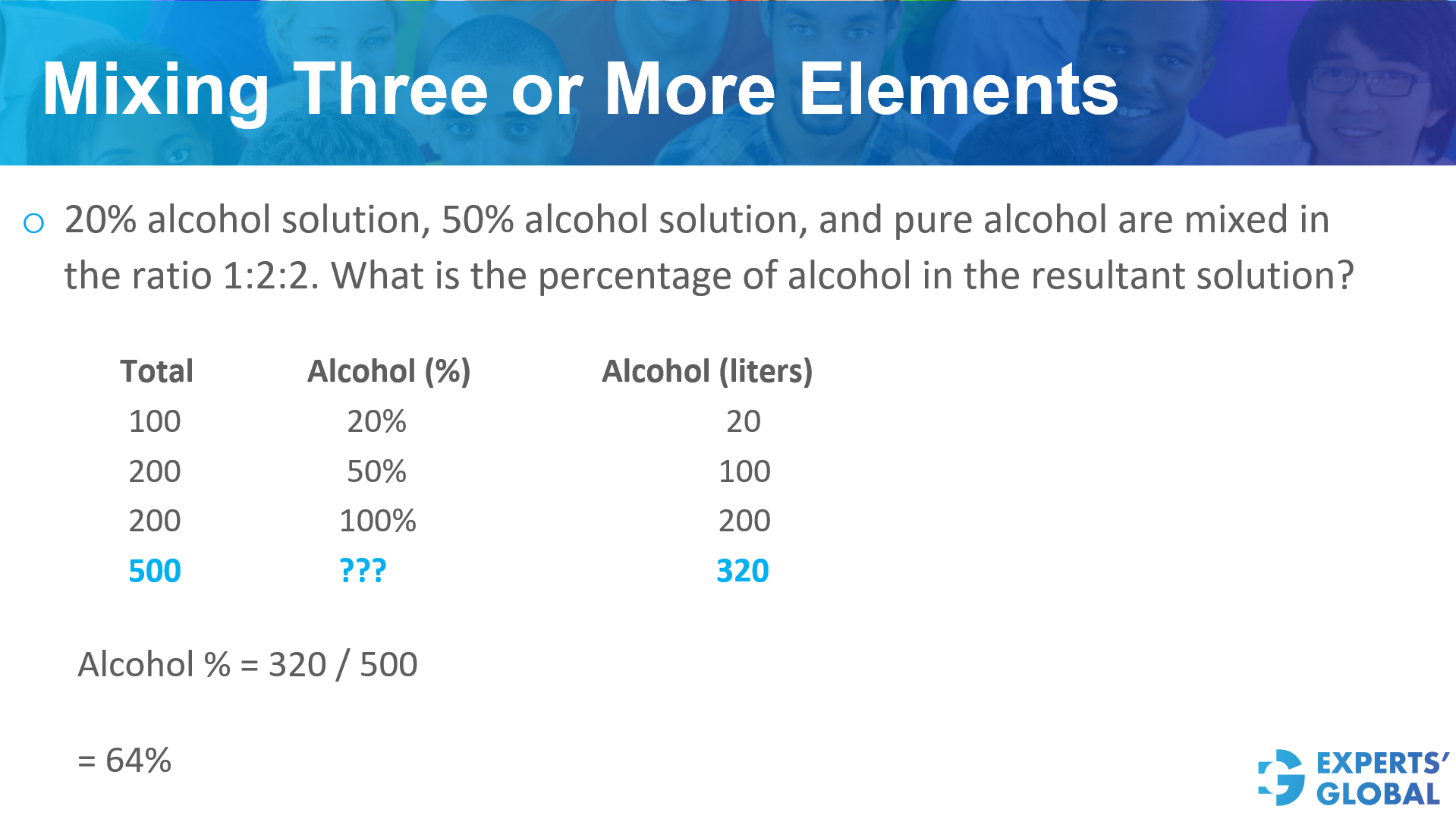
When mixing multiple solutions of different concentrations, the final concentration is determined by the ratio of the components and their individual purity levels.
A mixture is created using three different alcohol components in a ratio of 1:2:2:
To find the final alcohol percentage, you calculate the total volume of pure alcohol and divide it by the total volume of the entire mixture. Using the given ratio (1:2:2), you can assign sample volumes to each part:
The final solution has an alcohol concentration of 64%.
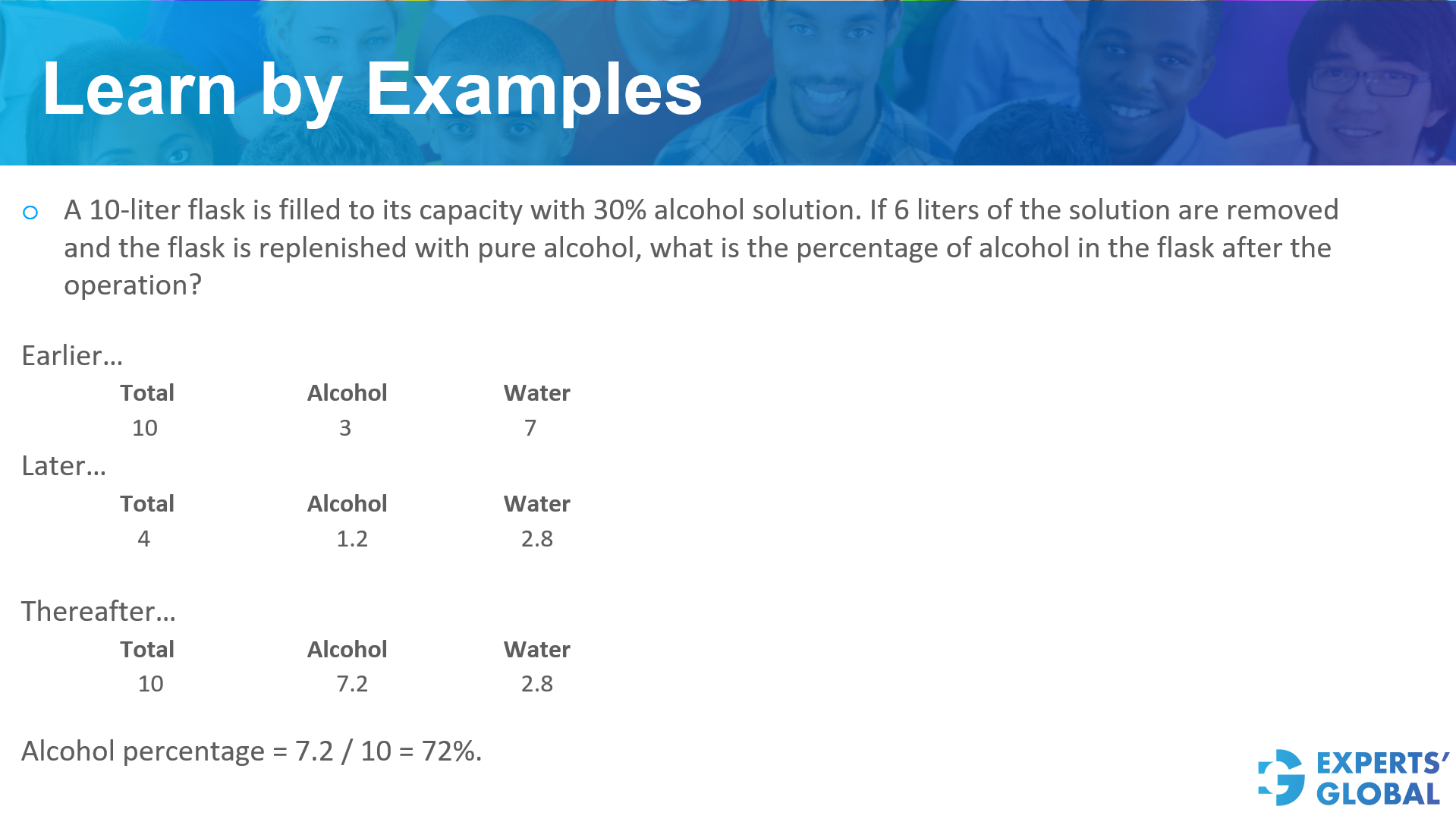
Correct Answer: 72%.
For a detailed explanation, please refer to the video presented earlier on this page.
Following is a concise, step-wise written explanation…
A 10-liter flask is filled to its capacity with 30% alcohol solution. If 6 liters of the solution are removed and the flask is replenished with pure alcohol, what is the percentage of alcohol in the flask after the operation?
The flask has 10 liters of total solution.
Since it is a 30% alcohol solution, the amount of alcohol is 30% of 10, which equals 3 liters.
When you remove 6 liters of the mixture, you have 4 liters left in the flask.
This remaining mixture still has the same 30% concentration.
Alcohol left = 30% of 4 = 1.2 liters.
You add 6 liters of pure (100%) alcohol back into the flask to fill it to 10 liters.
New total alcohol = 1.2 liters (leftover) + 6 liters (added) = 7.2 liters.
The final concentration is the total alcohol divided by the total volume.
Alcohol percentage = (7.2 / 10) * 100 = 72%.
Correct Answer: 72%
Complete GRE preparation course with 7-day free trial
