
Invest 30 seconds...
...for what may lead to a life altering association!
Help Line
- +91.8800.2828.00 (IND)
- 1030-1830 Hrs IST, Mon-Sat
- support@expertsglobal.com
33% off ends soon:GMAT/GRE prep + applications bundle. Profile building, longer mentoring, better results. Inquire

Variation and proportionality explain how one quantity changes with another in a defined relationship. In direct variation, values move together, and in inverse variation, one value increases as the other decreases. Proportionality also extends to higher powers, such as one quantity being proportional to the square of another. These relationships help you connect quantities, understand scaling, and follow how changes pass through a setup. On the GRE, variation and proportionality appear in a wide mix of questions and word problems that test how accurately you read and apply these relationships.
The following video, part of our GRE prep course online, explains variation and proportionality in a clear and easy to follow way. It shows how to work with direct and inverse relationships, set up proportional expressions correctly, and handle cases involving higher powers. The lesson then works through GRE-style problems so you see the ideas applied clearly and can carry the method into your GRE prep, quizzes, GRE sectional mocks, and GRE mocks.
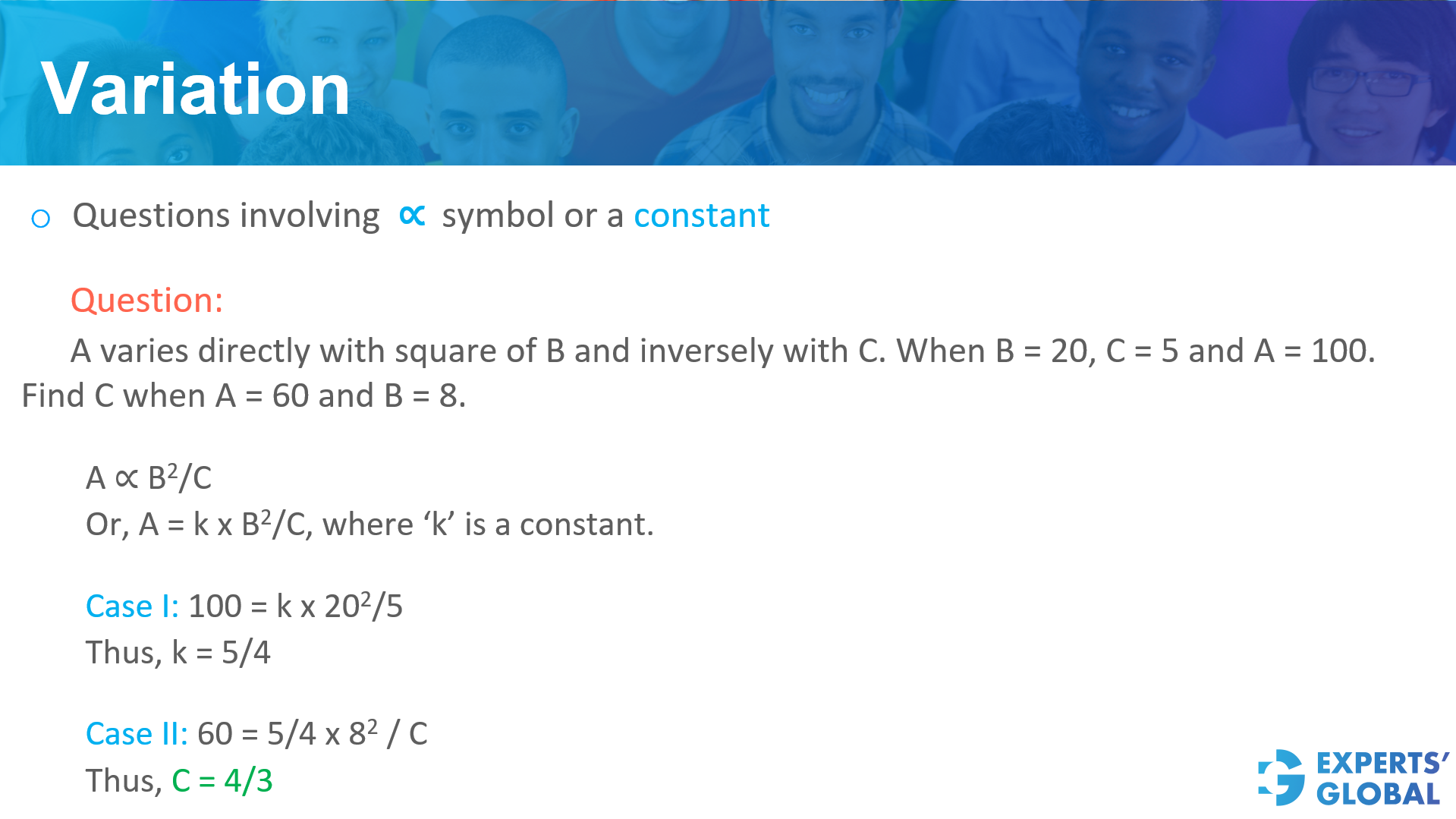
Variation involves relationships between variables using a constant.
When a variable A varies directly with the square of B and inversely with C, the relationship is expressed as: A is proportional to B² / C
To turn this into an equation, a constant k is introduced: A = k * (B² / C)
Given the initial values A = 100, B = 20, and C = 5:
To find C when A = 60 and B = 8, use the constant k = 5/4:

Correct Answer: D
Increase by 1500%
For a detailed explanation, please refer to the video presented earlier on this page.
Following is a concise, step-wise written explanation…
The quantities P and Q are related by the equation P = k / Q², where k is a constant. A decrease of 75% in the value of Q leads to what effect in the value of P?
Let the initial value of Q be 100. Initial P = k / 100² = k / 10000.
A 75% decrease means the new Q is 25% of the original. New Q = 25.
New P = k / 25² = k / 625.
To find the relationship, divide the new P by the initial P: (k / 625) / (k / 10000) = 10000 / 625 = 16. The new P is 16 times the original P.
An increase to 16 times the original value is a 1500% increase. Calculation: (16 – 1) * 100 = 1500%.
Correct Answer: D
Increase by 1500%

Correct Answer: $3,000
For a detailed explanation, please refer to the video presented earlier on this page.
Following is a concise, step-wise written explanation…
Jack’s salary includes a fixed component and a variable component. The variable component involves t for every additional car that he sells after the first 20 cars. In May, Jack sold 30 cars and drew a salary of $4,000. In June, he sold 45 cars and drew a salary of $5,500. What is the fixed component of Jack’s salary?
Correct Answer: $3,000
Correct Answer: C
The two quantities are equal.
For a detailed explanation, please refer to the video presented earlier on this page.
Following is a concise, step-wise written explanation…
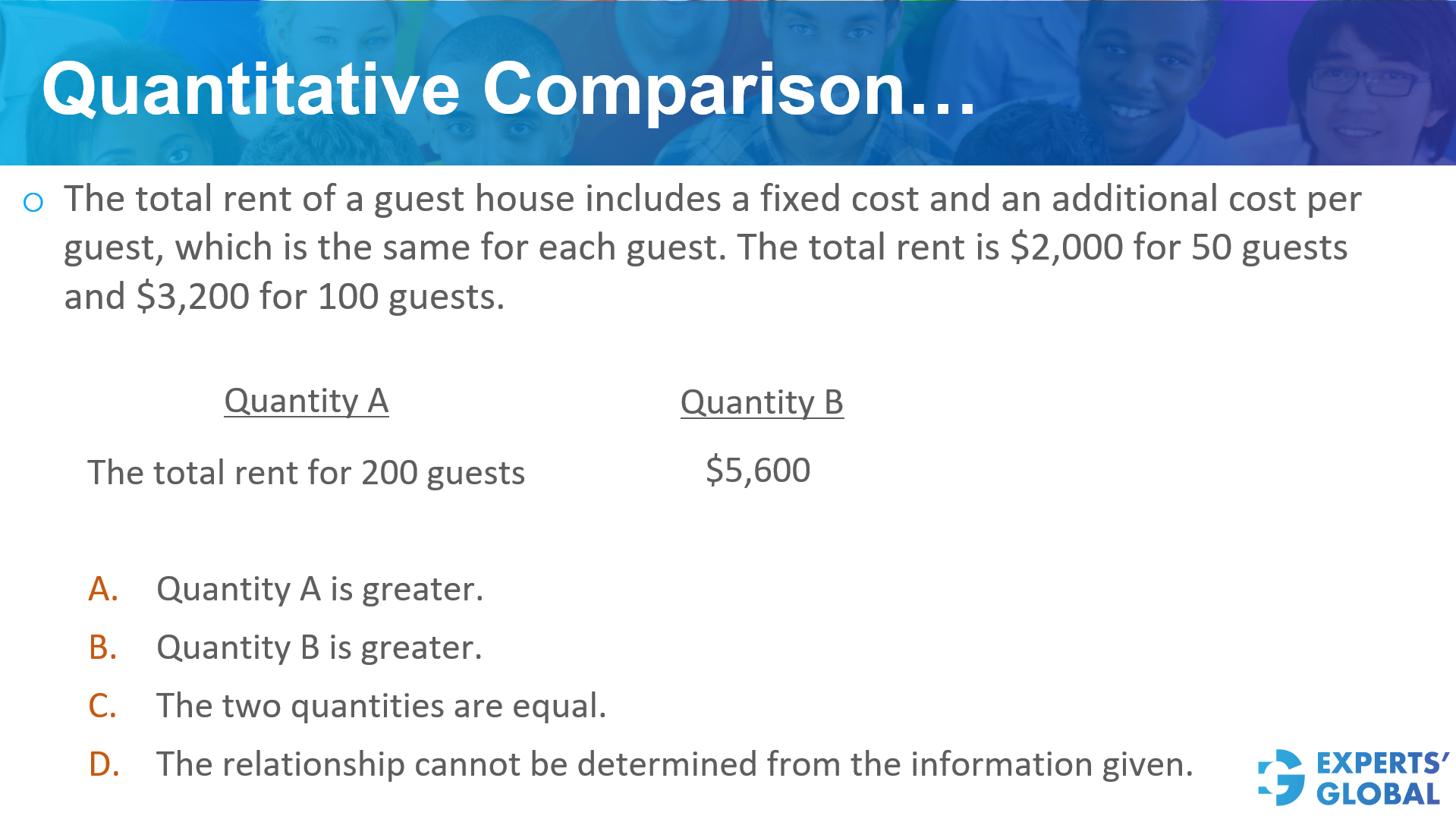
The total rent of a guest house includes a fixed cost and an additional cost per guest, which is the same for each guest. The total rent is $2,000 for 50 guests and $3,200 for 100 guests.
Quantity A
The total rent for 200 guests
Quantity B
$5,600
The number of guests increased by 50 (from 50 to 100). The total rent increased by $1,200 (from $2,000 to $3,200). Since the fixed cost does not change, the $1,200 increase is due to the 50 extra guests. Cost per guest = $1,200 / 50 = $24.
Total rent for 50 guests is $2,000. The cost for these 50 guests is 50 * $24 = $1,200. Fixed cost = Total rent – Variable cost. Fixed cost = $2,000 – $1,200 = $800.
Total rent for 200 guests = Fixed cost + (200 * Cost per guest). Total rent = $800 + (200 * $24). Total rent = $800 + $4,800 = $5,600.
Quantity A is $5,600. Quantity B is $5,600.
Correct Answer: C
The two quantities are equal.

Correct Answer: 100 million
For a detailed explanation, please refer to the video presented earlier on this page.
Following is a concise, step-wise written explanation…
A bacterial population grows by the same factor on passage of each hour. The bacterial population 8 hours ago was 1 thousand and the population two hours ago was 1 million. What will be the population of bacteria two hours from now?
The time between 8 hours ago and 2 hours ago is 6 hours. During these 6 hours, the population grew from 1 thousand to 1 million.
To get from 1 thousand to 1 million, the population increased by a factor of 1000. Since this happened over 6 hours, we let r be the hourly growth factor. r6 = 1000
The time between 2 hours ago and 2 hours from now is 4 hours. We need to find the population after these 4 hours of growth.
The growth over 4 hours is r4. We know r6 = 10³. This means r² = 10. Therefore, r4 = (r²)² = 10² = 100.
Multiply the population from 2 hours ago by the 4 hour growth factor. 1 million * 100 = 100 million.
Correct Answer: 100 million
GRE prep course with 7-day free trial
15 full length GRE practice tests
