
Invest 30 seconds...
...for what may lead to a life altering association!
Help Line
- +91.8800.2828.00 (IND)
- 1030-1830 Hrs IST, Mon-Sat
- support@expertsglobal.com
33% off ends soon:GMAT/GRE prep + applications bundle. Profile building, longer mentoring, better results. Inquire

Profit and loss focus on understanding whether a transaction results in a gain or a loss and by how much. These ideas form an important part of arithmetic and help you interpret real situations involving buying and selling. From this basic understanding, the GRE builds a wide range of interesting and nuanced questions and word problems that test how well you follow value as it moves through a transaction.
The following video, part of GRE preparation course by Experts’ Global, explains profit and loss by walking through the complete value chain in a clear and easy to follow way. It covers cost price, markup, marked price, discount, selling price, profit, loss, profit percentage, and profit margin, and shows how these pieces connect to produce the final result. The lesson then works through GRE style problems so you see the full application clearly and can carry the method into your GRE prep, practice drills, GRE sectional mock tests, and GRE mock tests.
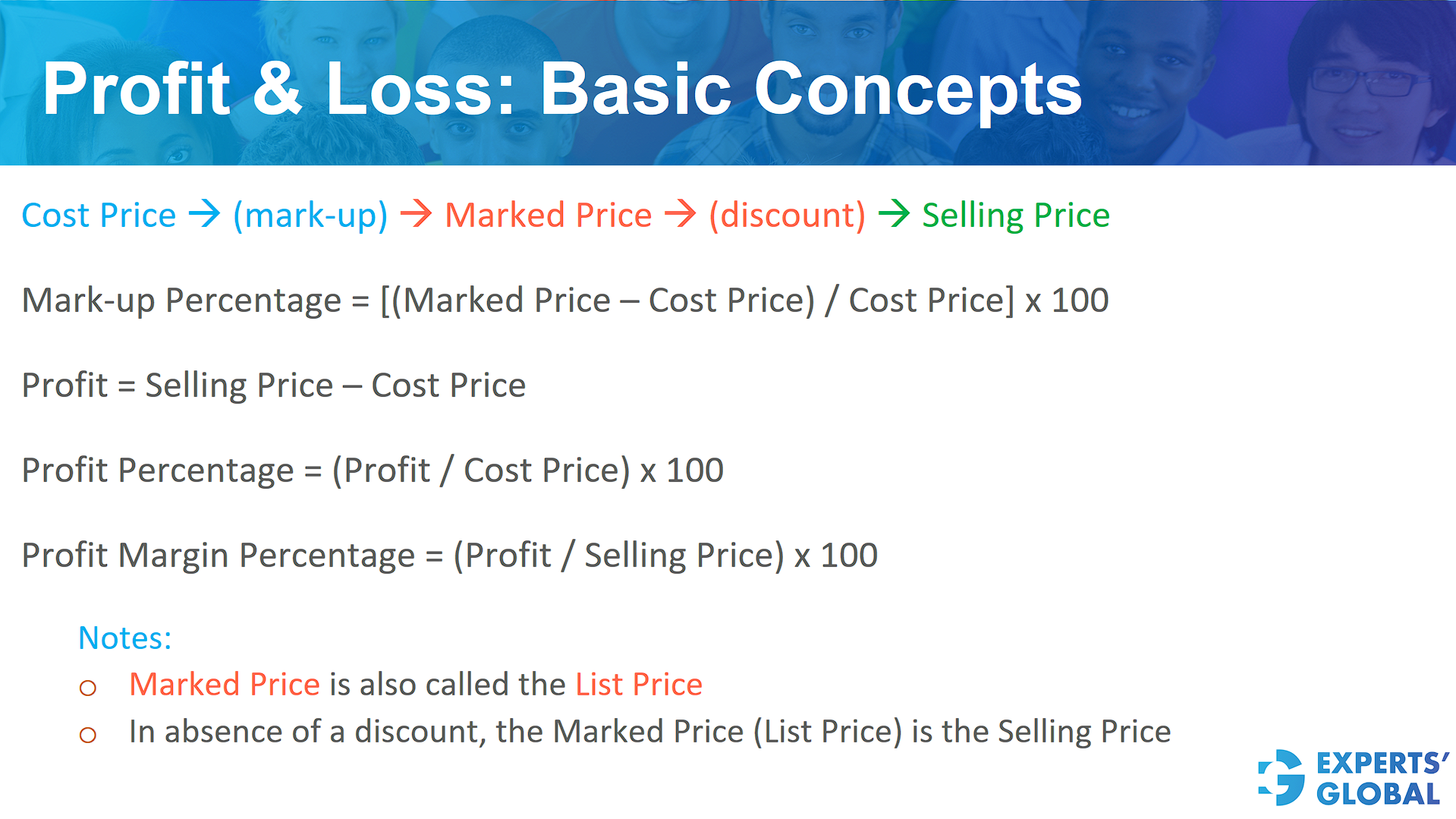
Here is a plain text summary of the academic concepts regarding profit and loss:
The progression of a product’s price follows this path: Cost Price -> (mark-up) -> Marked Price -> (discount) -> Selling Price
Correct Answer: 28%.
For a detailed explanation, please refer to the video presented earlier on this page.
Following is a concise, step-wise written explanation…
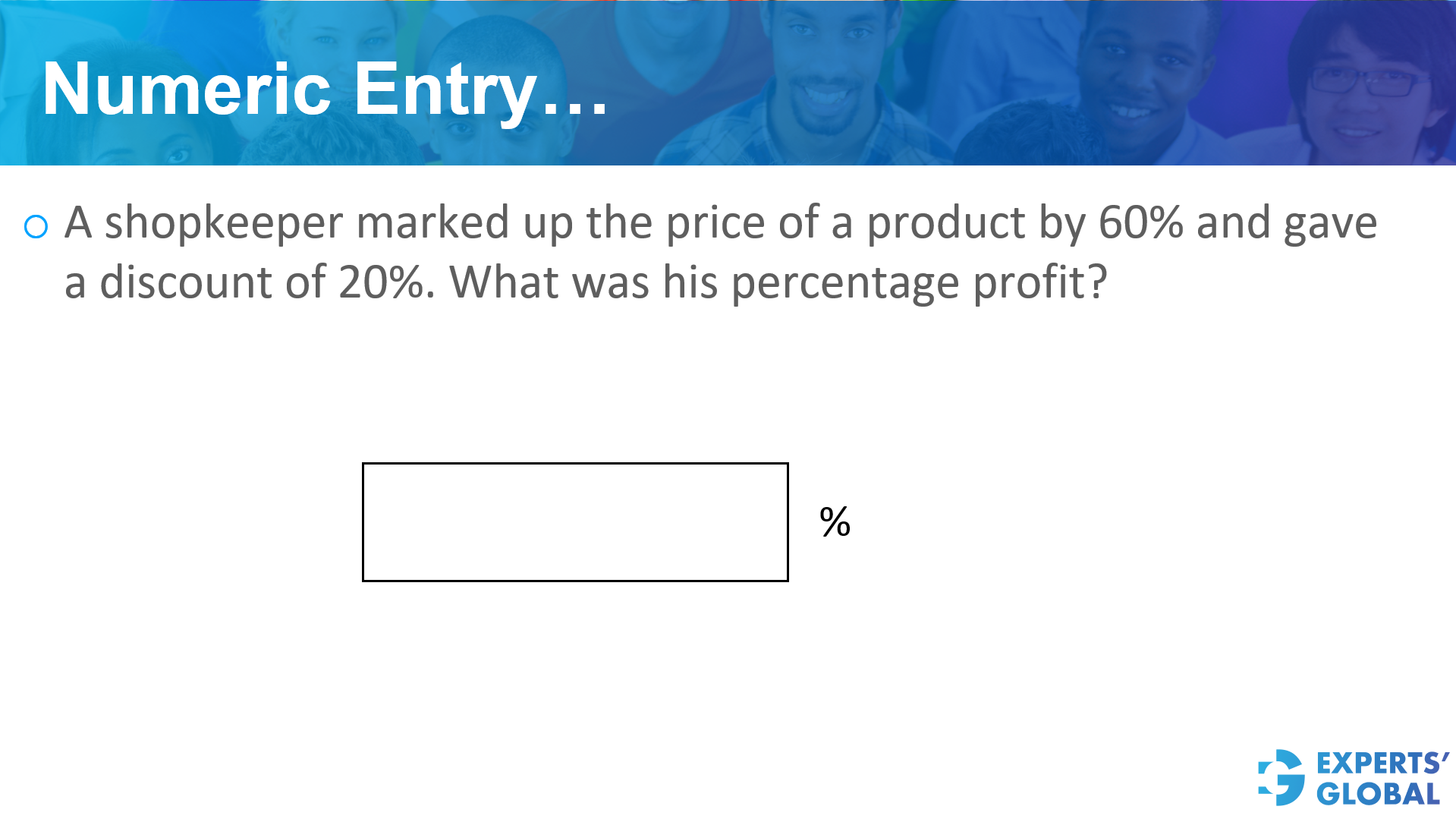
A shopkeeper marked up the price of a product by 60% and gave a discount of 20%. What was his percentage profit?
Let the Cost Price (CP) of the product be 100.
The shopkeeper marks it up by 60%. Marked Price (MP) = 100 + 60% of 100 = 100 + 60 = 160.
A discount of 20% is given on the Marked Price. Discount = 20% of 160 = (20 / 100) * 160 = 32. Selling Price (SP) = 160 – 32 = 128.
Profit = Selling Price – Cost Price = 128 – 100 = 28. Since the base is 100, the profit percentage is 28%.
Correct Answer: 28%
Correct Answers:
25 percent
20 percent
For a detailed explanation, please refer to the video presented earlier on this page.
Following is a concise, step-wise written explanation…
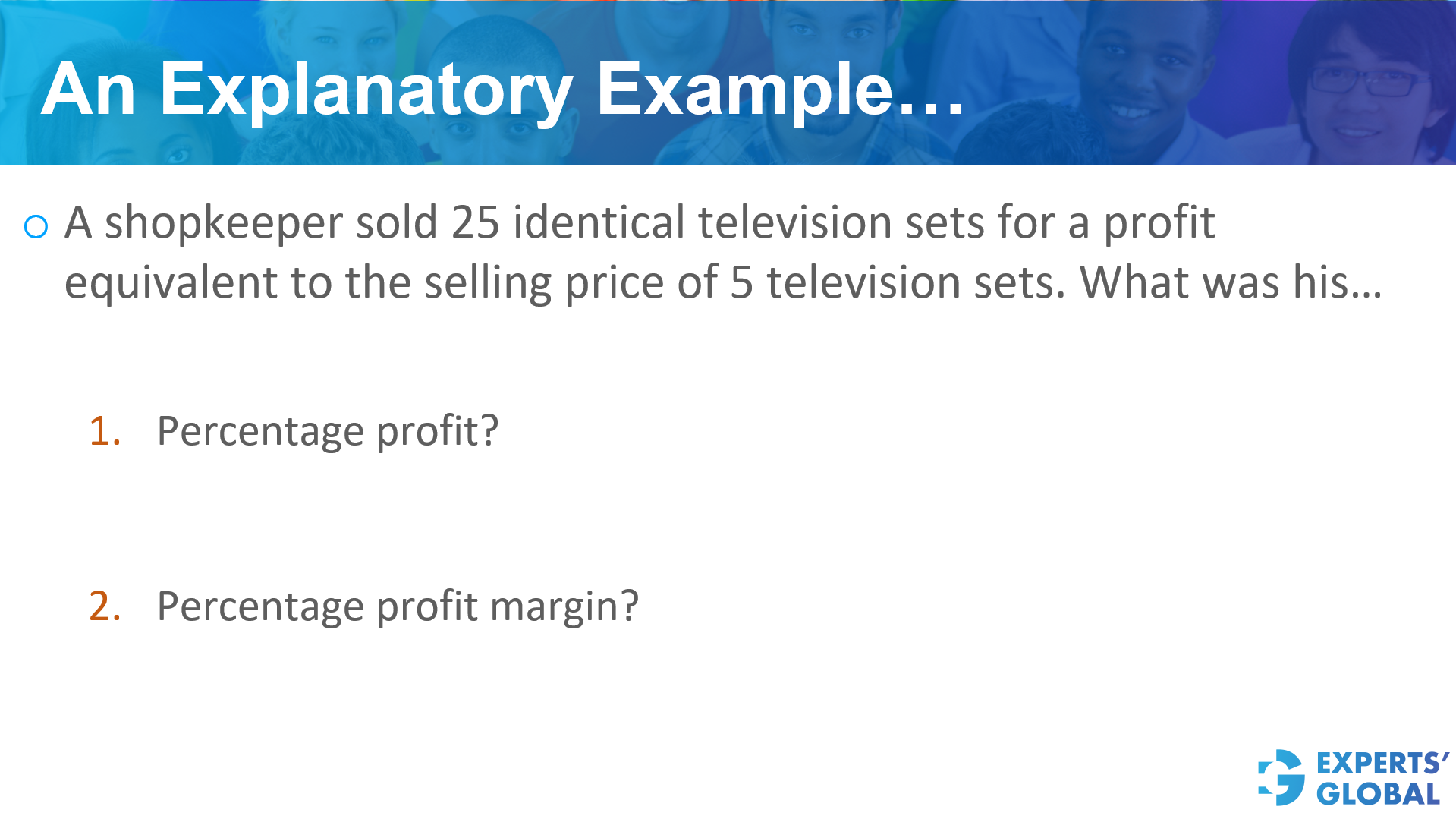
A shopkeeper sold 25 identical television sets for a profit equivalent to the selling price of 5 television sets. What was his…
Let the selling price of 1 television set be 1. Therefore, the total selling price for 25 sets is 25. The profit is equal to the selling price of 5 sets, so the profit is 5.
Cost Price = Selling Price – Profit Cost Price = 25 – 5 = 20.
Percentage profit is calculated on the cost price. Formula: (Profit / Cost Price) * 100 Calculation: (5 / 20) * 100 = 25 percent.
Percentage profit margin is calculated on the selling price. Formula: (Profit / Selling Price) * 100 Calculation: (5 / 25) * 100 = 20 percent.
Correct Answers:
25 percent
20 percent
Correct Answer: 44
For a detailed explanation, please refer to the video presented earlier on this page.
Following is a concise, step-wise written explanation…
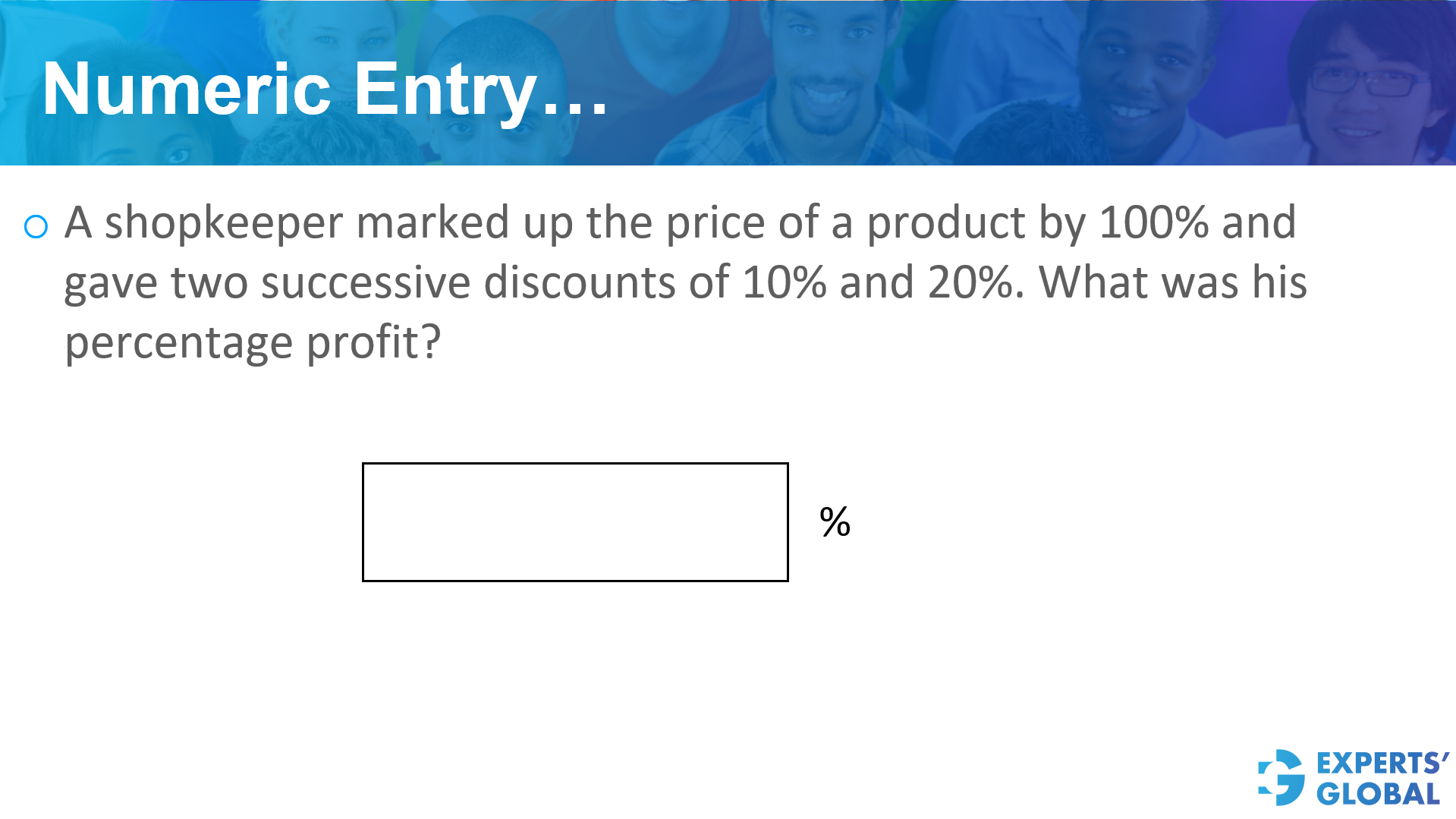
A shopkeeper marked up the price of a product by 100% and gave two successive discounts of 10% and 20%. What was his percentage profit?
To solve this easily, let us assume the original Cost Price (CP) is 100.
The shopkeeper marks up the price by 100%. 100% of 100 is 100. Marked Price = 100 + 100 = 200.
The first discount is 10% on the Marked Price. 10% of 200 = (10 / 100) * 200 = 20. Price after first discount = 200 – 20 = 180.
The second discount is 20% on the new price. 20% of 180 = (20 / 100) * 180 = 36. Final Selling Price (SP) = 180 – 36 = 144.
Profit = Selling Price – Cost Price Profit = 144 – 100 = 44. Since the original cost was 100, the profit is 44%.
Correct Answer: 44
Correct Answer: 24.44%.
For a detailed explanation, please refer to the video presented earlier on this page.
Following is a concise, step-wise written explanation…
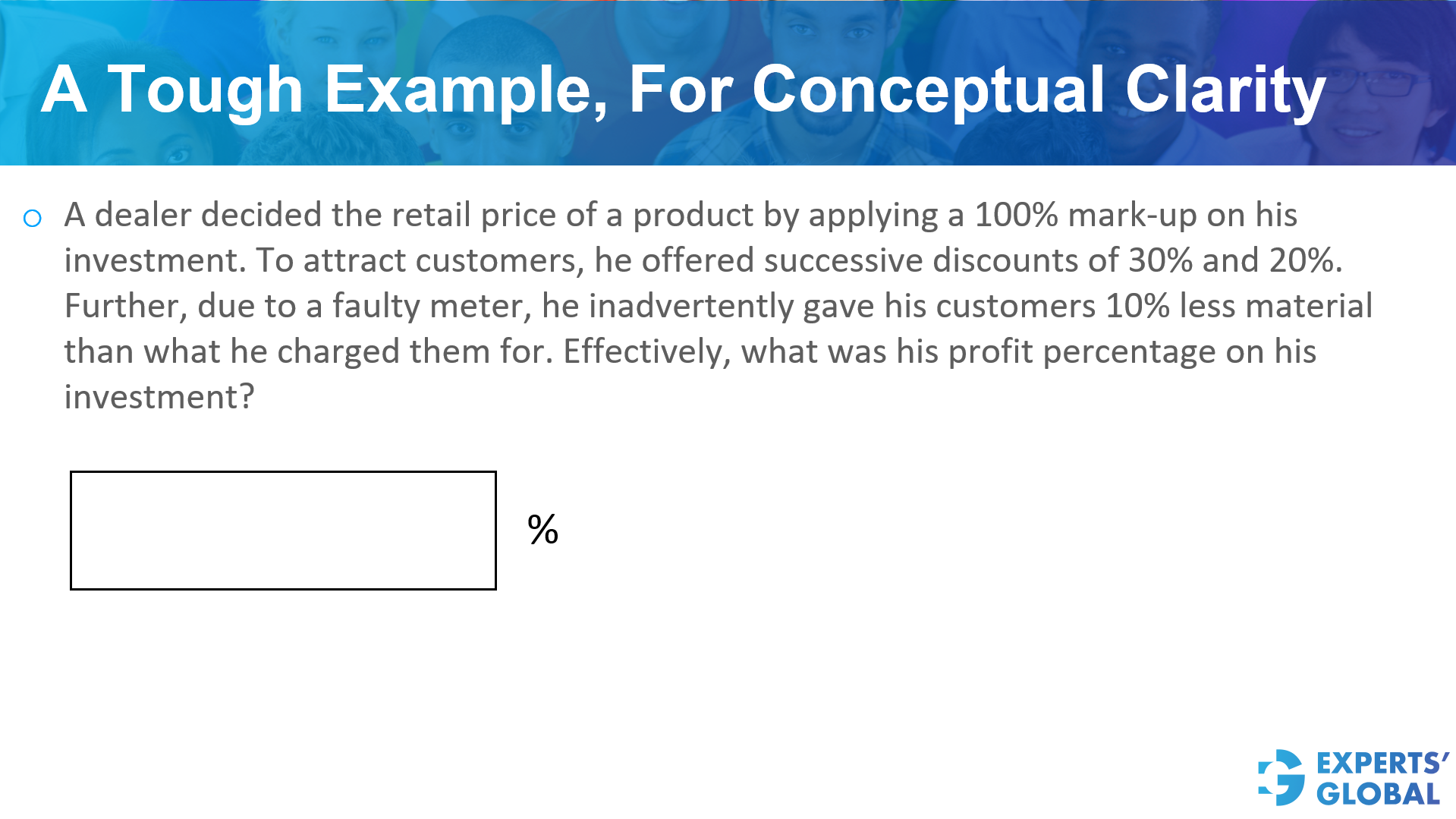
A dealer decided the retail price of a product by applying a 100% mark-up on his investment. To attract customers, he offered successive discounts of 30% and 20%. Further, due to a faulty meter, he inadvertently gave his customers 10% less material than what he charged them for. Effectively, what was his profit percentage on his investment?
Assume the dealer’s investment is 100 dollars for 100 units of material.
A 100% mark-up means the retail price is 100 + 100 = 200 dollars.
First discount of 30% on 200: 200 * 0.70 = 140 dollars.
Second discount of 20% on 140: 140 * 0.80 = 112 dollars.
The customer pays 112 dollars.
The dealer gives 10% less material. Instead of 100 units, he gives 90 units.
Since 100 units cost him 100 dollars, 90 units cost him 90 dollars.
The dealer received 112 dollars for material that cost him 90 dollars.
Profit = 112 – 90 = 22 dollars. Profit percentage = (22 / 90) * 100.
Profit percentage = 24.44%.
Correct Answer: 24.44%
Complete GRE prep course online with free trial
Free GRE diagnostic test (full length)
