
Invest 30 seconds...
...for what may lead to a life altering association!
Help Line
- +91.8800.2828.00 (IND)
- 1030-1830 Hrs IST, Mon-Sat
- support@expertsglobal.com
33% off ends soon:GMAT/GRE prep + applications bundle. Profile building, longer mentoring, better results. Inquire

Alligation is a method used to combine quantities with different values to reach a required average or final composition. This concept offers a simplified and direct way to handle situations involving weighted averages, proportions, and mixtures. By organizing values logically, it helps you decide how much of each component goes into the final result. On the GRE, alligation supports a variety of nuanced questions and word problems that test how accurately you connect individual values to an overall outcome.
The following video, part of our GRE online course, walks you through alligation with a focused and practical approach. It demonstrates how to set up the framework correctly, align given values with the target average, and determine quantities efficiently. The lesson then works through GRE-style problems so you see the method in action and understand how to apply it during practice. Use these learnings steadily across your GRE prep, practice exercises, full length GRE sectional mock tests, and full length GRE mock tests.
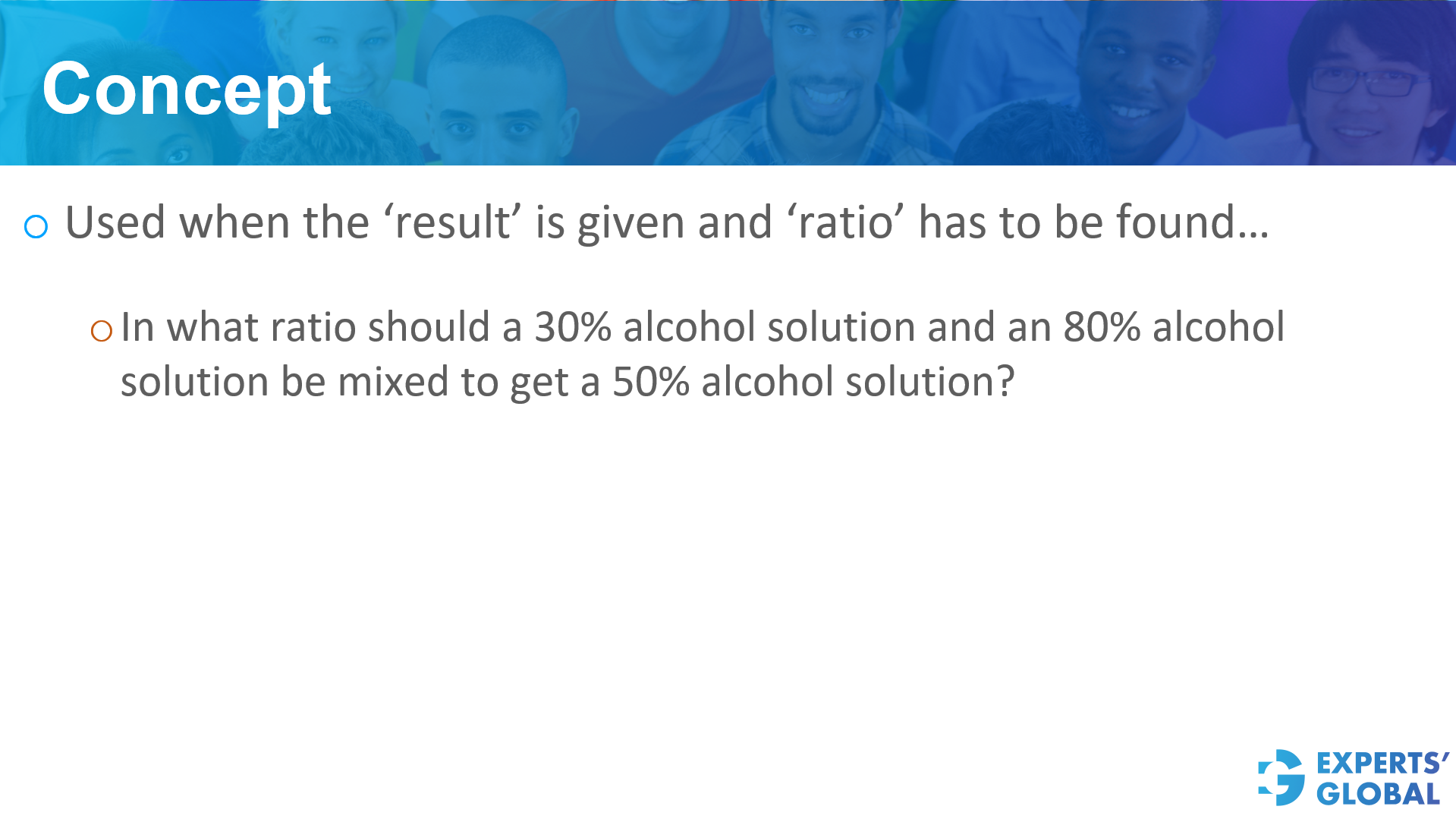
The core concept involves determining the ratio in which two different concentrations of a substance must be combined to achieve a specific target concentration. This is a common application of the rule of alligation or weighted averages.
The specific problem presented asks for the ratio needed to mix a 30 percent alcohol solution with an 80 percent alcohol solution to result in a final mixture that is 50 percent alcohol.
To solve this, you calculate the difference between each starting concentration and the desired result:
The ratio of the quantities is inversely proportional to these differences.
Therefore, the solutions should be mixed in a ratio of 30 to 20, which simplifies to 3 to 2.

The concept of alligation is a mathematical method used to determine the relationship between the qualities of two individual components and the resulting mixture.
The process involves the following components:
These represent the individual characteristics (such as price, concentration, or percentage) of two different ingredients.
This represents the desired mean or average quality achieved once the two components are mixed together.
These represent the specific amounts or ratios of each ingredient needed to achieve the target result.
The method works by calculating the cross-differences between the individual qualities and the average result. Specifically:
This visual framework allows for a quick calculation of the ratio in which two items must be mixed to produce a mixture of a specific value.
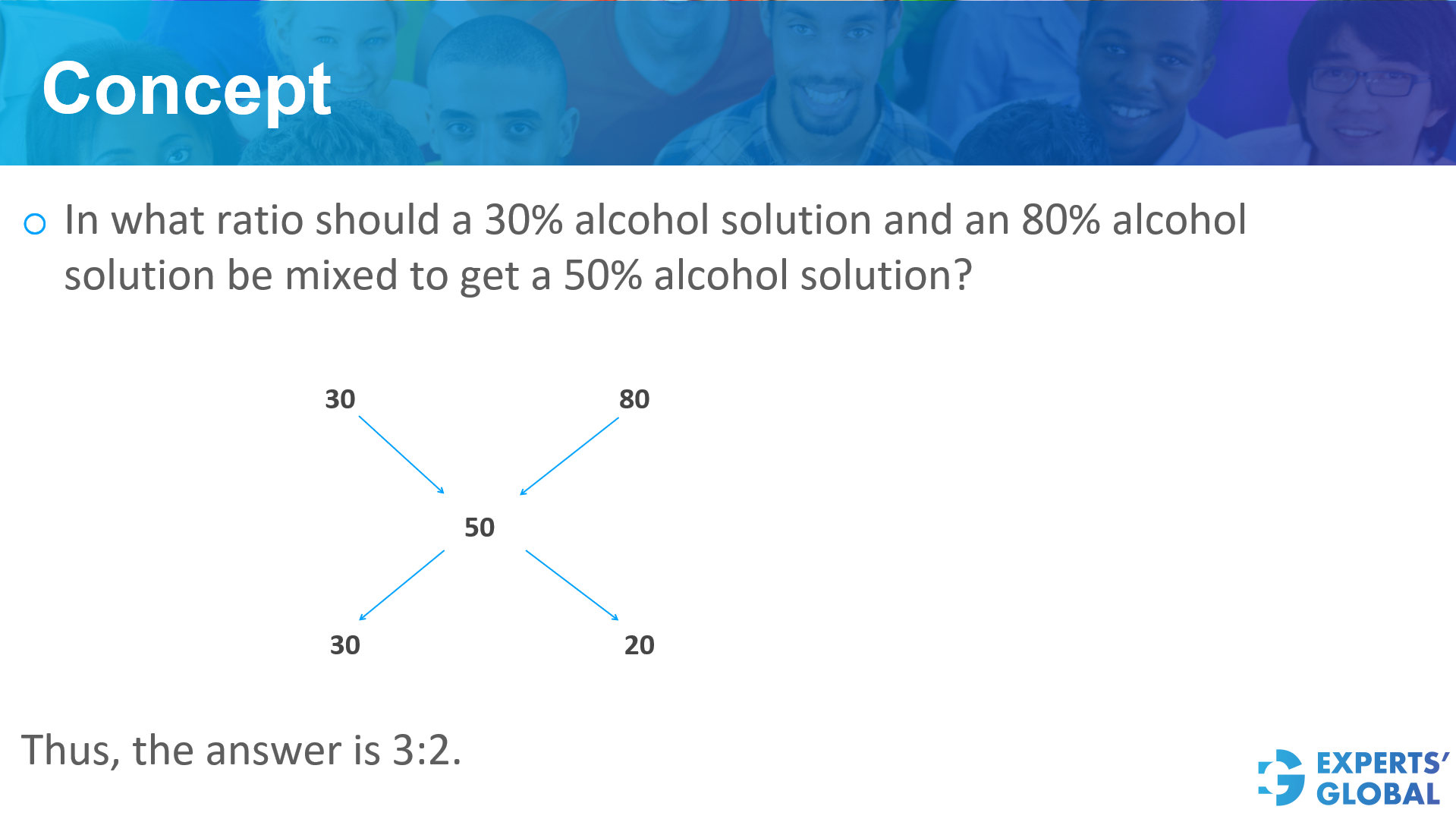
To mix a 30% alcohol solution and an 80% alcohol solution to achieve a final 50% alcohol concentration, the alligation method is used.
By placing the target concentration (50) in the center and the two initial concentrations (30 and 80) at the top, the differences are calculated diagonally:
These differences represent the relative parts of each solution needed.
The resulting ratio of the 30% solution to the 80% solution is 30:20, which simplifies to a 3:2 ratio.
Correct Answer: 7:1.
For a detailed explanation, please refer to the video presented earlier on this page.
For visual illustration, here is a snapshot from the video…
Following is a concise, step-wise written explanation…
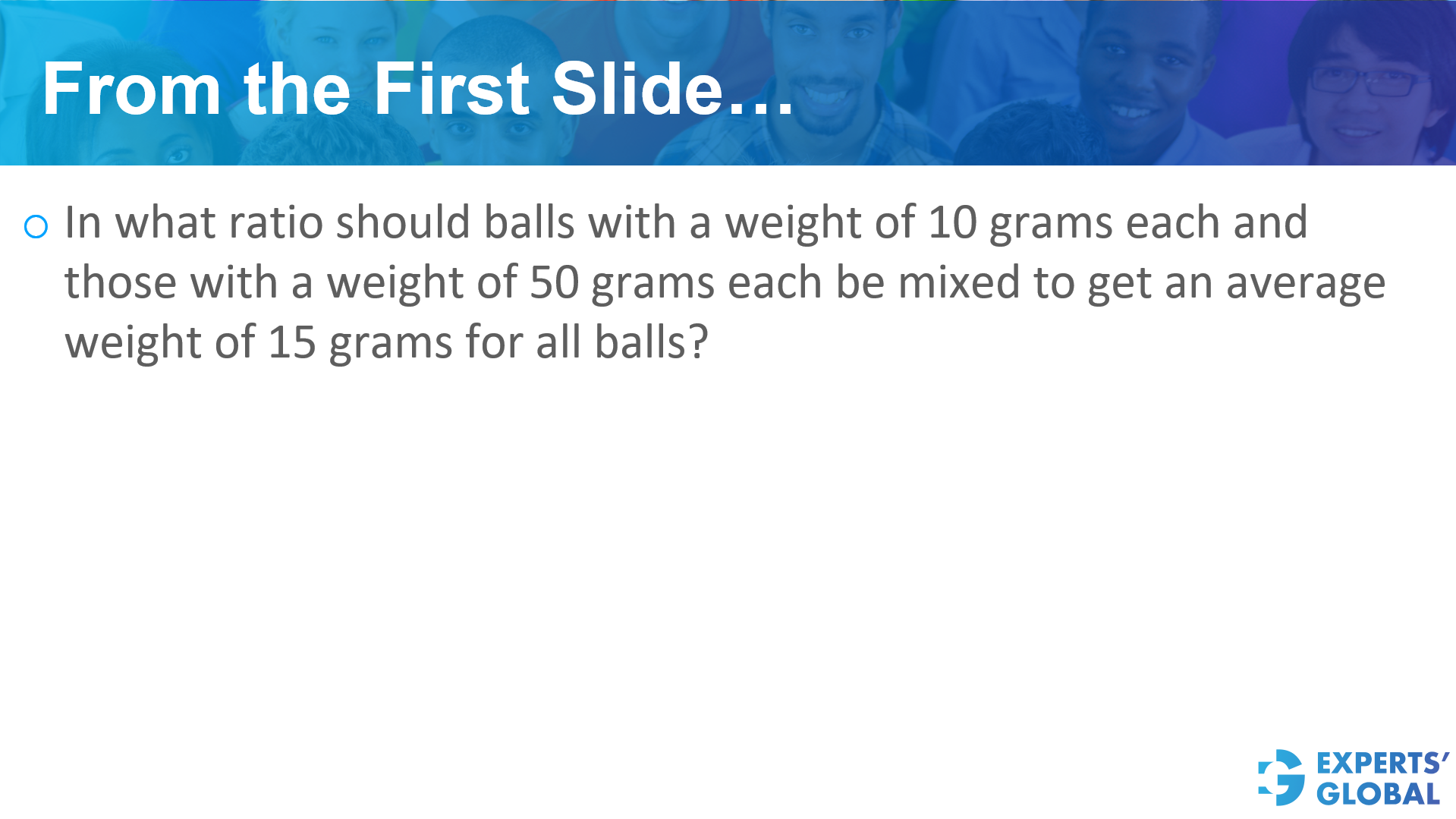
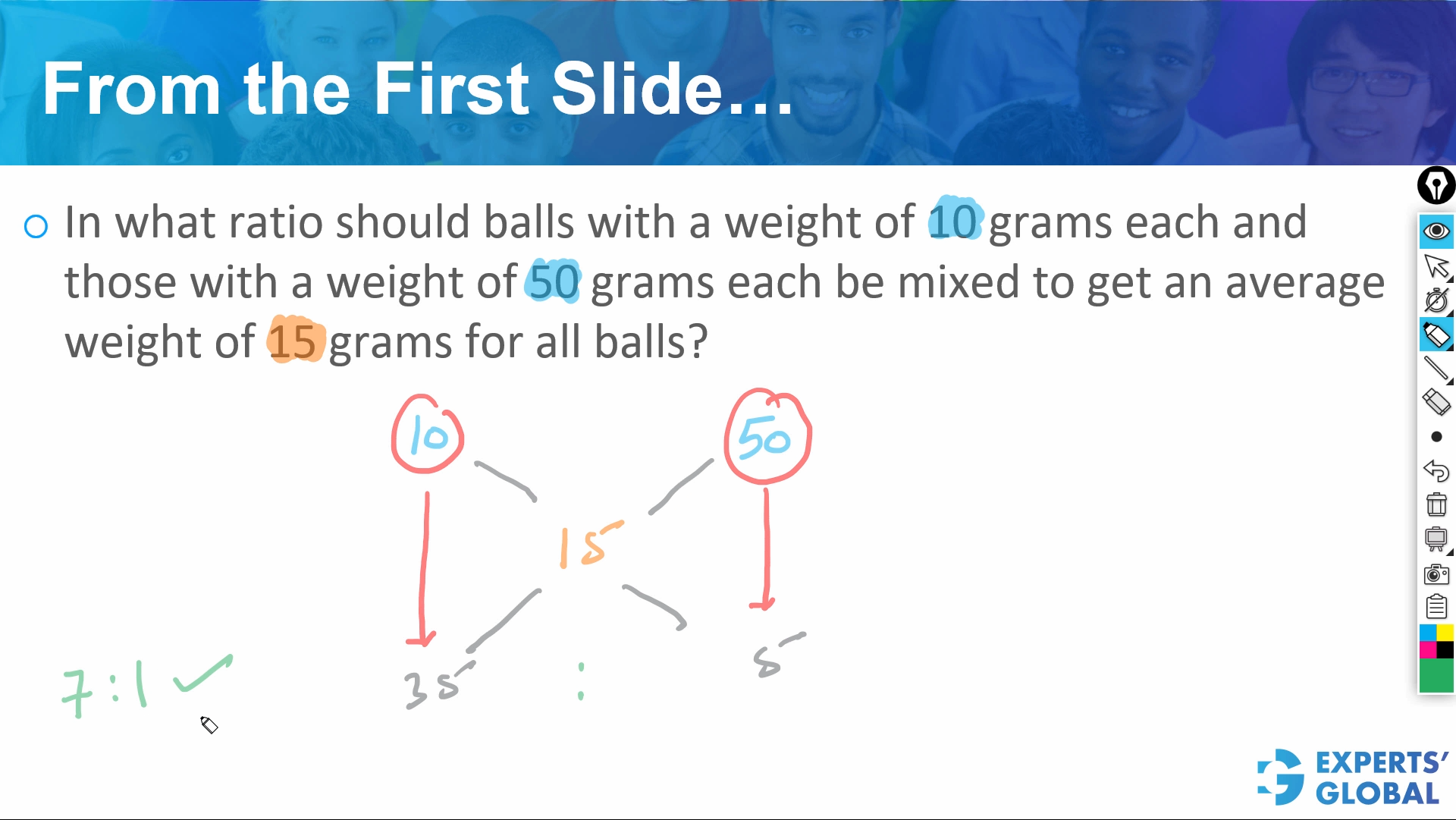
In what ratio should balls with a weight of 10 grams each and those with a weight of 50 grams each be mixed to get an average weight of 15 grams for all balls?
We can solve this using the rule of allegation, which is a quick way to find ratios when mixing two items.
Correct Answer: 7 : 1
Correct Answer: 3 : 5.
For a detailed explanation, please refer to the video presented earlier on this page.
For visual illustration, here is a snapshot from the video…
Following is a concise, step-wise written explanation…
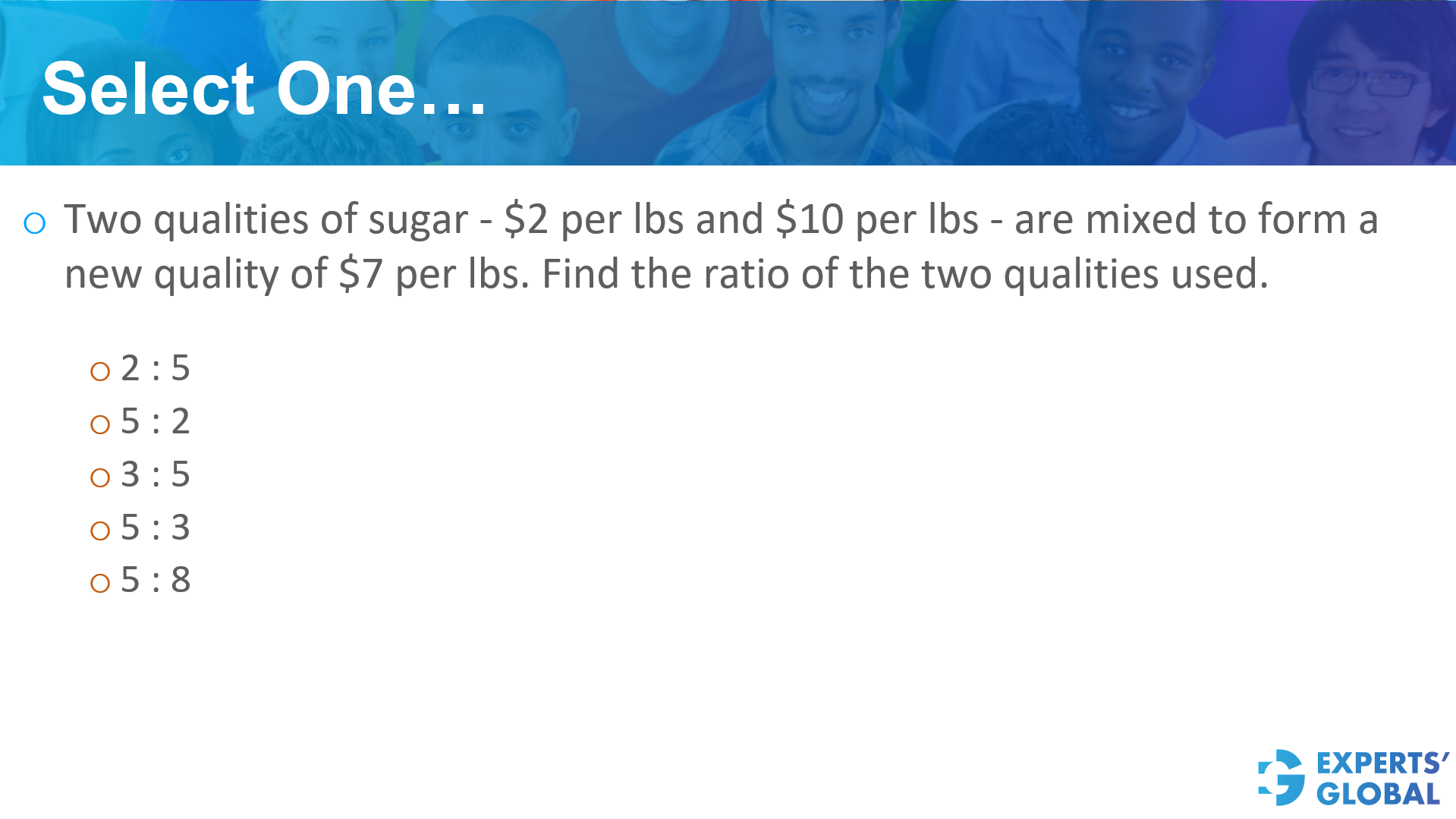
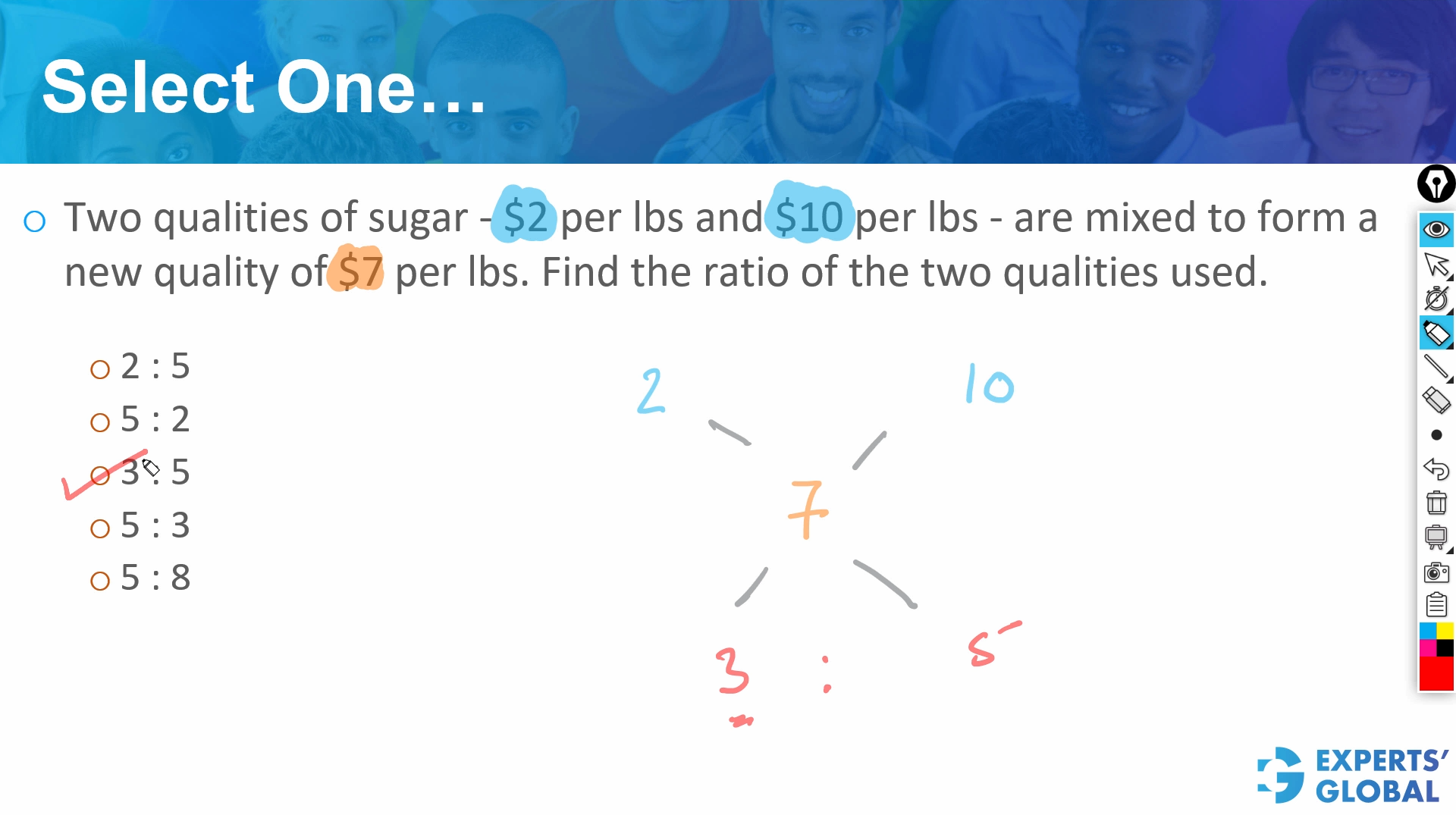
Two qualities of sugar – $2 per lbs and $10 per lbs – are mixed to form a new quality of $7 per lbs. Find the ratio of the two qualities used.
To solve this, we use the rule of alligation. It is a simple shortcut to find the ratio of ingredients in a mixture.
Correct Answer: 3 : 5
Correct Answer: 3:2.
For a detailed explanation, please refer to the video presented earlier on this page.
For visual illustration, here is a snapshot from the video…
Following is a concise, step-wise written explanation…
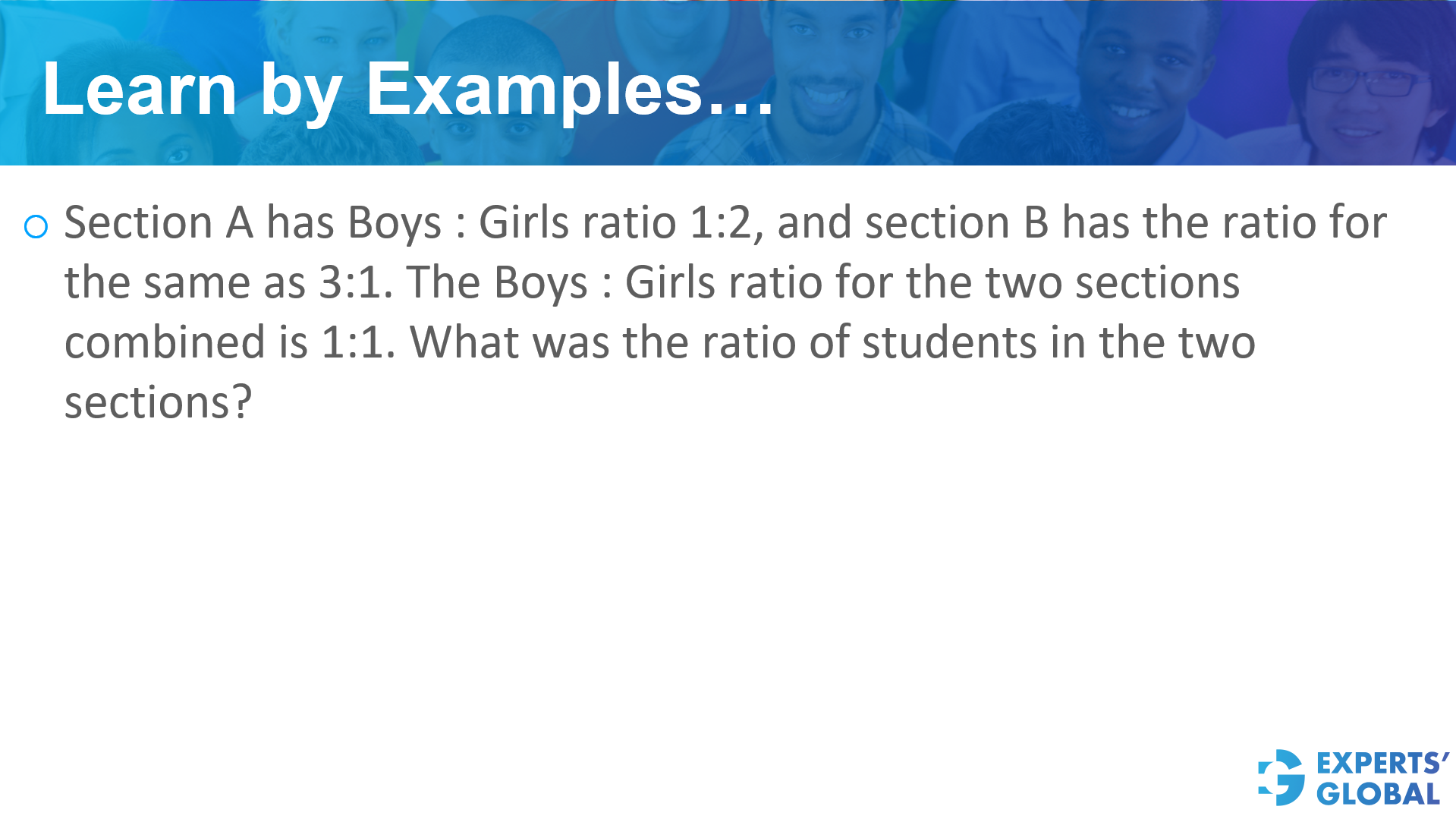
Section A has Boys : Girls ratio 1:2, and section B has the ratio for the same as 3:1. The Boys : Girls ratio for the two sections combined is 1:1. What was the ratio of students in the two sections?
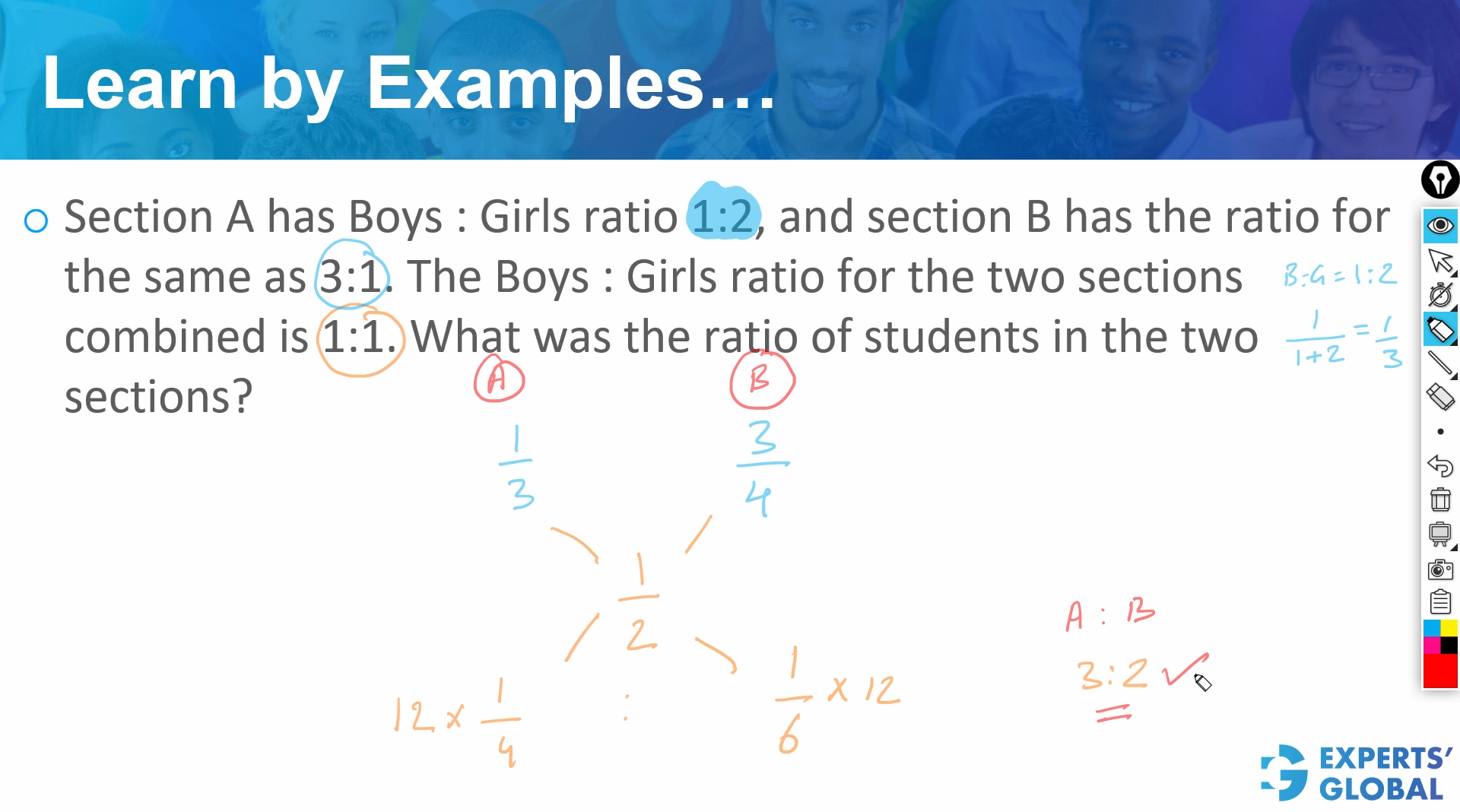
In section A, the ratio is 1:2, so boys are 1 / (1 + 2) = 1/3 of the total.
In section B, the ratio is 3:1, so boys are 3 / (3 + 1) = 3/4 of the total.
In the combined group, the ratio is 1:1, so boys are 1 / (1 + 1) = 1/2 of the total.
Subtract the smaller value from the larger value to find the differences:
Difference 1 (Section B and Combined): 3/4 – 1/2 = 3/4 – 2/4 = 1/4.
Difference 2 (Combined and Section A): 1/2 – 1/3 = 3/6 – 2/6 = 1/6.
The ratio of total students in Section A to Section B is the ratio of these differences: Ratio = 1/4 : 1/6.
Multiply both sides by 12 to clear the fractions: 3 : 2.
Correct Answer: 3:2

Alligation is not a fundamentally new mathematical concept. It is a specific shortcut used to calculate weighted averages more efficiently and save time during problem-solving.
If the alligation method does not feel intuitive or easy to apply, it is perfectly acceptable to ignore it. You should feel comfortable continuing to use the standard weighted average method if that approach works better for you and yields more consistent results.
End-to-end GRE prep course online (includes 7-day free trial)
15 full-length GRE practice tests
60 sectional GRE practice tests
